|
interviews
text translation service for many worldwide languages
On December 7 2001 , Michael Posner of the Canadian Globe & Mail reported that in January 2002, the ADC expedition team would be returning to the site of the megalithic complex they discovered in July 2000, though this time with the first deep-water mobile excavator equipped with functions needed for on-site archæological evaluation, including the ability to blow sand off stone. In an interview with Dr Paul Weinzweig of ADC, Posner quoted Dr Weinzweig as saying:
“Some structures within the complex may be as long as 400 metres wide and as high as 40 metres … Some are sitting on top of each other. They show very distinct shapes and symmetrical designs of a non-natural kind. We’ve shown them to scientists in Cuba, the U.S. and elsewhere and nobody has suggested they are natural.”
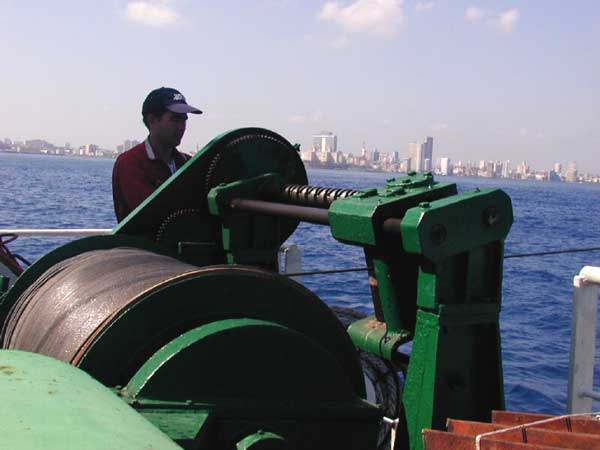
Below, an ADC crew member supervises the winch attached to the ROV on the deck of the ‘Ulises’
ADC – Havana, Cuba –
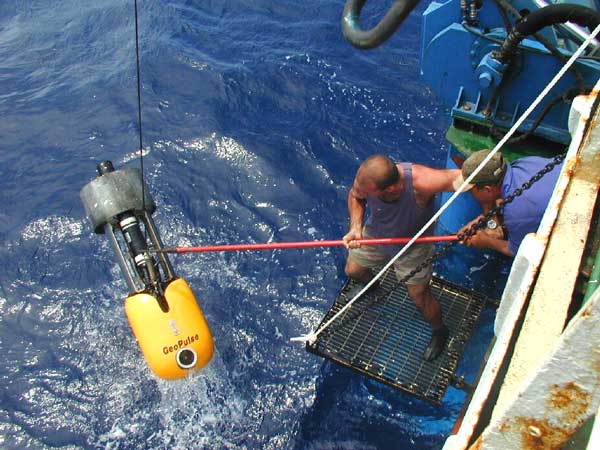
an ADC crew member helps to retrieve the GeoPulse Sidescan Sonar from the sea after an expedition in July 2001, when they returned with a 1.3 tonne, unmanned Remotely Operated Vehicle (ROV) controlled by fibre-optic cable from computers in the research ship ‘Ulises’
ADC – Havana, Cuba –
The cameras on board the ROV confirmed the earlier findings, showing large granite-like blocks between 6 and 15 feet in length, that were cut in circular and perpendicular designs. But because of some technical problems encountered, Dr Weinzweig told the
” … we were only able to survey the perimeter of the site. Based on initial explorations, we think it’s much larger than even our sonar projections show. It may extend for several kilometres.”
back to the interview with Dr Paul Weinzweig
please take a look at our Ancient Mysteries Bookshoppe for a wide selection of books that challenge orthodox views of prehistory on every continent
|