|
“Mysterious Egyptian Glass Formed by Meteorite Strike”
December 21, 2006, National Geographic News, USA:
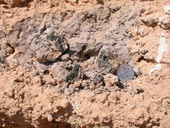
“Strange specimens of natural glass found in the Egyptian desert are products of a meteorite slamming into Earth between 100,000 and 200,000 years ago, scientists have concluded.
The glass – known locally as Dakhla glass – represents the first clear evidence of a meteorite striking an area populated by humans.
|
National Geographic News
|
|
At the time of the impact, the Dakhla Oasis, located in the western part of modern-day Egypt, resembled the African savanna and was inhabited by early humans, according to archaeological evidence.
(see Egypt map)
|
‘This meteorite event would have been catastrophic for all living things’, said Maxine Kleindienst, an anthropologist at the University of Toronto in Canada. ‘Even a relatively small impact would have exterminated all life for several miles.’.
The origin of the glass had puzzled scientists since Kleindienst discovered it in 1987. Some researchers had suggested the Stone Age glass may have been produced by burning vegetation or lightning strikes.
But a chemical analysis showed that the glass was created in temperatures so high that they could only have been the result of a meteorite impact.
Gordon Osinski, a geologist at the Canadian Space Agency in Saint-Hubert who conducted the analysis, found that the glass samples contain strands of molten quartz, a signature of meteorite impacts.
‘We can now say for definite that they were caused by a meteorite impact’, he said.”
[Full Story]
“An ancient computer: It’s Greek to me”
December 19, 2006, Belleville News-Democrat, USA:
“We take you now to Greece, around 100 B.C. An alien civilization visits Earth … it leaves mementos behind – technology humankind could not have had back then … flash-forward to 2006 … the mementos are found. Whoa!
Here’s something just as amazing: What if the ancients – the Greeks, let’s say – were better at technology than we thought? What if they created gadgets more advanced than anything for an additional 1,000 years?
It really happened. There’s this thing called the Antikythera Mechanism, named after the island near where it was found. A Rube Goldbergesque assemblage of dials and gears, it was discovered in 1902 by Greek divers amid the ruins of a Roman ship sunk around 80 B.C. For 104 years, scientists have puzzled over what it really was and did.
Fact beggars fiction. High-resolution 3D X-ray computed tomography, enhanced computer imaging software (custom-built by Hewlett-Packard), and recent recovery of more fragments make it clear: This thing was a crank-driven computer (analog) made out of bronze. (It even had an operator’s manual inscribed on it, much of which has been translated.) It showed the positions of the sun, moon, planets and stars, and it would have allowed users to predict solar and lunar eclipses and other events.
Mysteries abound. Who made it? (Not Archimedes: The device reflects his theories, but he died at least a century before.) And if they built this, what else did they have?”
[Full Story]
“Scientists look for answers in 2,100-year-old computer”
December 12, 2006, Houston Chronicle, USA:
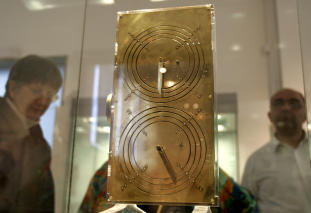
“Visitors look at a tentative reconstruction of the 2,100-year-old Antikythera Mechanism, believed to be the earliest surviving mechanical computing device. The bronze system of cogs and wheels was found in a Roman wreck off southern Greece in 1900.
The island of Antikythera lies 18 miles north of Crete, where the Aegean Sea meets the Mediterranean. Currents there can make shipping treacherous — and one ship bound for ancient Rome never made it.
|
Houston Chronicle
|
|
The ship that sank there was a giant cargo vessel measuring nearly 500 feet long. It came to rest about 200 feet below the surface, where it stayed for more than 2,000 years until divers looking for sponges discovered the wreck a little more than a century ago.
Inside the hull were a number of bronze and marble statues. The statues were retrieved, along with a lot of other unimportant stuff, and stored.
|
Nine months later, an enterprising archaeologist cleared off a layer of organic material from one of the pieces of junk and found that it looked like a gearwheel. It had inscriptions in Greek characters and seemed to have something to do with astronomy.
That piece of ‘junk’ went on to become the most celebrated find from the shipwreck; it is displayed at the National Archaeological Museum of Athens. Research has shown that the wheel was part of a device so sophisticated that its complexity would not be matched for a thousand years — it was also the world’s first known analog computer.
‘We have gear trains from the 9th century in Baghdad used for simpler displays of the solar and lunar motions relative to one another — they use eight gears’, said Frangois Charette, a historian of science in Germany who wrote an editorial accompanying a new study of the mechanism two weeks ago in the journal Nature. ‘In this case, we have more than 30 gears. To see it on a computer animation makes it mind-boggling.’.
The device was probably built between 100 and 140 B.C., and the understanding of astronomy it displays seems to have been based on knowledge developed by the Babylonians around 300-700 B.C., said Mike Edmunds, a professor of astrophysics at Cardiff University in Britain.
The mechanism explores the relationship between lunar months — the time it takes for the moon to cycle through its phases, say, full moon to full moon — and calendar years. The gears had to be cut precisely to reflect this complex relationship; 19 calendar years equal 235 lunar months.”
[Full Story]
The
Antikythera Mechanism Research Project is based at the Department of Astophysics at Cardiff University, Wales/Cymru.[Ed.]
“Look back in time at Signal Hill”
December 10, 2006, Arizona Daily Star, USA:
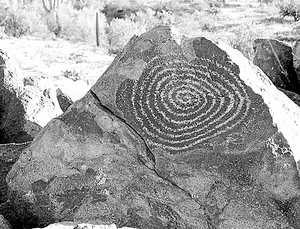
“One day — maybe 600 years ago, maybe 1,000 or more — someone carved a design on a rock atop a hill west of Tucson. It’s still there today — a stone etching known as a petroglyph.
That spiral-shaped design and many other petroglyphs were pecked into boulders on Signal Hill by ancient people known as the Hohokam.
|
Arizona Daily Star
|
|
Officials of Saguaro National Park West, where the hill juts modestly from the surrounding desert, say the petroglyphs date roughly from A.D. 200 to 1450. They depict lizards, snakes, game animals, humanlike figures and geometric shapes.
A quarter-mile trail leads to the site from the park’s Signal Hill Picnic Area.
|
‘It’s pretty cool. You can actually distinguish what some of the animals are’, said Tucsonan Stan Gordon, who hiked to Signal Hill recently with his wife, Linda Abrams. ‘These things have endured. It’s a real tribute to the ancient cultures that were here before us.’.
Information panels along the trail trace the history of the area, and they note that the meaning of the petroglyphs is far from certain.
‘They could have religious or ceremonial significance’, reads one panel. ‘They may be solstice markers, clan symbols, decorative motifs, or simply ancient graffiti.’“
[Full Story]
“Ohio’s Stonehenge”
December 10, 2006, Akron Beacon Journal, USA:
“Fort Ancient is largest, best preserved earthwork of its kind in America. Its purpose is not known. Fort Ancient remains a mystery.
The extensive earthen mounds and walls in southwest Ohio are unlikely a fortress, although they might have been used for social gatherings and religious ceremonies and astronomical viewings.
The site, atop a wooded bluff 235 feet above the Little Miami River in Warren County, was built 2,000 years ago by ancient Indians that archaeologists call Hopewells. The intricate mounds stretch nearly 3 ½ miles and enclose about 100 acres atop a promontory on the east bank of the river in Washington Township.
The earthen walls are as high as 23 feet and as wide as 68 feet. The walls are divided by 67 crescent-shaped gateways. There are stone pavements in some places. Some call Fort Ancient Ohio’s Stonehenge and it is one of Ohio’s top prehistoric sites.
In general, the walls are irregular. They follow the plateau and ravines in some areas and in some spots are laid out in specific geometric patterns. There are a number of dome-shaped mounds inside and outside the enclosure.
Research suggests that the people who built the earthworks might have used them to mark the movement of the sun and the moon.
Standing near four stone-covered mounds in the North Fort’s northeast corner, researchers have seen how sunrises on the summer and winter solstices and the minimum and maximum northern moon rises align with certain gaps in the mounds.
The four inner mounds create a perfect square, 512 feet apart on each side. The moonrises marked by the openings occur 9.3 years apart.”
[Full Story]
“Scientists decode ancient astral computer”
December 01, 2006, The Sydney Morning Herald, Australia:
“A mysterious device salvaged from an ancient Roman shipwreck has astounded scientists who have finally unlocked its secrets.
After a century of study, the 2100-year-old device, known as the Antikythera Mechanism, has been shown to be a complex and uncannily accurate astronomical computer. Recovered in 82 highly corroded fragments, it could predict the positions of the sun and planets, show the location of the moon and even forecast eclipses.
‘This device is extraordinary, the only thing of its kind’, said Mike Edmunds, a physicist at Cardiff University, in Wales. ‘The astronomy is exactly right … In terms of historic and scarcity value, I have to regard this mechanism as being more valuable than the Mona Lisa.’.
It was lost among cargo in 65BC, when the ship carrying it sank in 42 metres of water off the Greek island of Antikythera. In 1900 a sponge diver discovered the wreck.
Bronze was often recycled in the period the device was made, so many artefacts from that time were melted down and erased from the archaeological record. The fateful sinking of the ship carrying the Antikythera Mechanism may have inadvertently preserved it.”
[Full Story]
“In search of lost time”
November 30, 2006, Nature, UK:
“The ancient Antikythera Mechanism doesn’t just challenge our assumptions about technology transfer over the ages — it gives us fresh insights into history itself.
Hear the sound of the Antikythera Mechanism recreated
on the 30 November for the Nature Podcast.
It looks like something from another world — nothing like the classical statues and vases that fill the rest of the echoing hall. Three flat pieces of what looks like green, flaky pastry are supported in perspex cradles. Within each fragment, layers of something that was once metal have been squashed together, and are now covered in calcareous accretions and various corrosions, from the whitish tin oxide to the dark bluish green of copper chloride.
This thing spent 2,000 years at the bottom of the sea before making it to the National Archaeological Museum in Athens, and it shows.
This is the Antikythera Mechanism. These fragments contain at least 30 interlocking gear-wheels, along with copious astronomical inscriptions. Before its sojourn on the sea bed, it computed and displayed the movement of the Sun, the Moon and possibly the planets around Earth, and predicted the dates of future eclipses. It’s one of the most stunning artefacts we have from classical antiquity.
No earlier geared mechanism of any sort has ever been found. Nothing close to its technological sophistication appears again for well over a millennium, when astronomical clocks appear in medieval Europe. It stands as a strange exception, stripped of context, of ancestry, of descendants.
The mechanism is contained in a squarish wooden case a little smaller than a shoebox. On the front are two metal dials (brass, although the original was bronze), one inside the other, showing the zodiac and the days of the year. Metal pointers show the positions of the Sun, the Moon and five planets visible to the naked eye.
I turn the wooden knob on the side of the box and time passes before my eyes: the Moon makes a full revolution as the Sun inches just a twelfth of the way around the dial. Through a window near the centre of the dial peeks a ball painted half black and half white, spinning to show the Moon’s changing phase.
The researchers realized that the ratios of the gear-wheels involved produce a motion that closely mimics the varying motion of the Moon around Earth, as described by Hipparchus. When the Moon is close to us it seems to move faster. And the closest part of the Moon’s orbit itself makes a full rotation around the Earth about every nine years.
Hipparchus was the first to describe this motion mathematically, working on the idea that the Moon’s orbit, although circular, was centred on a point offset from the centre of Earth that described a nine-year circle. In the Antikythera Mechanism, this theory is beautifully translated into mechanical form.”
[Full Story & many images]
“Enigma of ancient world’s computer cracked at last”
November 30, 2006, The Middle East Times, Egypt:
“A 2,100-year-old clockwork machine whose remains were retrieved from a shipwreck more than a century ago has turned out to be the celestial super-computer of the ancient world.
Using twenty-first-century technology to peer beneath the surface of the encrusted gearwheels, stunned scientists say that the so-called Antikythera Mechanism could predict the ballet of the Sun and Moon over decades and calculate a lunar anomaly that would bedevil Isaac Newton himself.
‘This device is extraordinary, the only thing of its kind’, said Mike Edmunds, a physicist at Cardiff University, in Wales. ‘The astronomy is exactly right … In terms of historic and scarcity value, I have to regard this mechanism as being more valuable than the Mona Lisa.’.
Built in Greece around 150 to 100 BC and possibly linked to the astronomer and mathematician Hipparchos, its complexity was probably unrivalled for at least 1,000 years, they say.
‘It’s beautifully designed. Your jaw drops when you work out what they did and what they put into this’, said astronomer Mike Edmunds of Cardiff University, Wales, in an interview. ‘It implies the Greeks had great technical sophistication.’.
The Antikythera Mechanism is named after its place of discovery, where Greek divers, exploring a Roman shipwreck at a depth of 42 meters (136 feet) in 1901, came across 82 curious bronze fragments.
At first, these pieces, thickly encrusted and jammed together after lying more than 2 millennia on the sea floor, lay forgotten. But a closer look showed them to be exquisitely made, hand-cut, toothed gearwheels.
It was clear that, within this find, 29 gearwheels fitted together, possibly making some sort of astronomical calendar. But of what, exactly? For a quarter of a century, the textbook on the strange find was a work written by a historian of science and technology, Derek de Solla Price.
He hypothesized that the Mechanism in fact had 31 gearwheels, and did something pretty astonishing – it linked the solar year with a 19-year cycle in the phases of the Moon. This is the so-called Metonic cycle, which takes the Moon 235 lunar months to the same phase on the same date in the year.
It could also predict lunar and solar eclipses under the Saros cycle, a 223-month repetitive interplay of the Sun, Earth, and Moon. This function, presumably, would have been useful for religious purposes, given that eclipses are traditionally taken as omens.
It was not until the end of the first millennium AD and the golden age of Islamic science that anything so technologically wondrous surfaced again, if the archaeological evidence is a guide. This was an eight-geared astrolabe, depicting the movements of the Sun and Earth, by the Islamic astronomer Al Biruni in AD 996.
Had the Greeks’ knowledge somehow survived and been transmitted across the centuries, to inspire Al Biruni? Or had it withered away and disappeared, leaving Islamic scholars with the task of rediscovering what had been known 1,000 years before?
The computer is so advanced in its mathematics and technology that the history of ancient Greece may have to be rewritten, contends Edmunds.
‘We now must ask: What else could they do? That’s a difficult thing, because this is really the only surviving metallic artifact of its kind. Who knows what else may be lost?’“
[Full Story]
“The gears of the ancient mariner”
November 29, 2006, ARS Technica, USA:
“The discovery of a nearly intact Roman shipwreck at the beginning of the last century provided a wealth of information about the trade among the Mediterranean cities of the time. But the most startling item to come out of the wreck wasn’t a work of art or a luxury item in the traditional sense.
|
ARS Technica
|
|
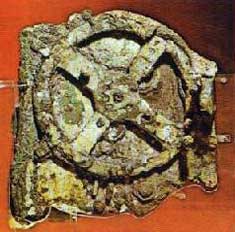
While drying out after recovery, an otherwise inauspicious looking lump cracked open to reveal the completely unexpected: interlocking metal gears of the type that any of us would recognize as machinery. I’d imagine it would have been like opening a time capsule dating from the 1850s and discovering a laser pointer.
What the gears did, however, has been the subject of contentious debate.
|
In the centuries since it wound up on the sea floor, many of the metal parts had become compressed and encrusted to the point where it was difficult to tell where one part ended and the next began. The most complete reconstruction suggested that it might be an astronomical device, but there was little consensus on this proposal.
Now, a combination of X-ray tomography and analysis of the text and symbols has revealed many features of the device in stunning detail.
The new reconstruction proposes a mechanism involving 37 individual gears, with all but five of them having been recovered from the wreck. When functioning, a hand crank could send the device forward or backwards in time, with the faces revealing the relationship between dates, eclipses, lunar position, and other astronomical events relative to the ancient Greek calendar.
The device is sophisticated enough to include a mechanism that accurately recapitulates changes in the moon’s apparent motion due to its orbit being centered on the center of mass of the earth/moon system.
That last bit is especially intriguing, since these changes were first described by Hipparchus of Rhodes at roughly the time of the device’s origin, and the wreck itself contained other material from Rhodes. This raises the possibility that the device was potentially created with his direct input.
The new description raises an obvious question: why did devices of this sophistication take about 1,000 years to reappear? There are reasons to think that they may have been somewhat common in ancient Greece, but most were destroyed so that their valuable metals could be reused.”
[Full Story & Readers Comments]
“New study: single, huge meteor killed dinosaurs”
November 29, 2006, XinhuaNet, China:
“A recent analysis of an ancient sediment sample from the bottom of the Atlantic Ocean lends credence to the theory the extinction of dinosaurs was because of a single huge meteor striking Earth, not multiple impacts.
‘The sample we found strongly supports the single impact hypothesis’, said lead researcher Ken MacLeod of the University of Missouri-Columbia.
Geological evidence reveals that about 65 million years ago a giant meteorite about six miles wide smashed into the Yucatan Peninsula close to the current Mexican town of Chicxulub. That impact sent dust high into the atmosphere where it locked the sun’s light for decades or centuries.
A small team of scientists, however, have argued that a single meteorite was not enough to end the dinosaurs’ reign, and that the Yucatan impact occurred 300,000 years too early. The biggest proponent of this alternative scenario is Gerta Keller of Princeton University.
Keller thinks that the Chicxulub impact, combined with volcanoes in India and global warming, only upset the ecological balance, causing many species to shrink in size. But these things weren’t enough to trigger a mass extinction, she believes. Instead, Keller speculates that a second, currently unidentified meteor crashed sometime after Chicxulub.
But a new examination of sediments taken from the Demerara Rise in the Atlantic Ocean casts fresh doubt on Keller’s minority view.”
[Full Story]
“Out of this world solution to a Scottish standing stone”
November 29, 2006, Edinburgh Evening News, Scotland:
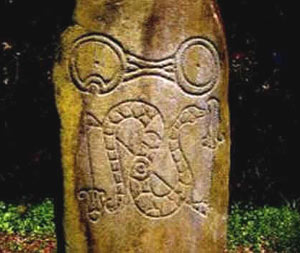
“The Newton Stone is a small, rather unassuming pillar in Aberdeenshire, Scotland. On one side is faded, ancient writing, on the other a curling snake and cylindrical patterning. Many would say that it is a typical example of a Scottish standing stone.
|
Edinburgh Evening News
|
|
Yet one man claims that this is no ordinary stone, that instead it holds the secret of our missing pre-history. That it shows the birth of Jupiter from Saturn and more explosively, that it proves that someone was around to witness this planetary catastrophe and that this someone may not be human.
‘The keys to our lost history lie in things like the Newton Stone’, says Stan Hall before trying to explain the meaning of the carvings itself in relation to catastrophism theory.
|
The major proponent of catastrophism was Immanuel Velikovsky, who, in the 1950s, posited the idea that the earth has suffered global catastrophes, mostly caused by planetary action, that have been set down in myths, legends and histories of all ancient cultures. Hall thinks that the Newton Stone demonstrates one such cataclysmic event.
‘I recognised that on the Newton Stone it shows two planets breaking away from each other…The double disc and z-rod pictographs…record for posterity the actual birth of Jupiter from Saturn.’
‘The Greeks talk of the night of the falling stars – all major civilisations have records of major interplanetary catastrophes.’“
[Full Story]
“High tech helps solve mystery of ancient calculator”
November 22, 2006, Network World, USA:
“Results of a high-tech research project to be released next week promise to finally unravel much of the remaining mystery of a 2,000-year-old astronomical calculator.
Since its discovery in 1902, the Antikythera Mechanism — with its intricate and baffling system of about 30 geared wheels — has been an enigma. Our knowledge of its functions has increased as computer-based imaging, analysis and X-ray technologies have evolved.
During the last 50 years, researchers have identified various astronomical and calendar functions, including gears that mimic the movement of the sun and moon.
The moon year is, however, 11 days shorter than the sun year. This was taken into account in ancient times by adding an extra month, leading experts to believe that people in the Bronze Age were already making sophisticated astronomical observations similar to those written about by the Babylonians around 1,000 years later..
The disc is thought to be a depiction of the Bronze Age view of the world – the Earth as a disc with the sky arching over it in a dome. But it has taken some of the most advanced technology of the 21st century to decipher during the past year the most advanced technology of the 1st century B.C.
See a slide show of the mechanism
‘We believe we’ve found the functions with regard to the sun and moon movements, and to its calendrical function’, says Michael Edmunds, a professor in the School of Physics and Astronomy at Cardiff University in Wales, and a specialist in the chemical composition of galaxies.
Cardiff’s Edmunds says the current research has not, in fact, found evidence of planetary displays, based on what’s now known about the gear trains, but there is evidence of ‘planetary functions’. He prefers the term calculator to computer: ‘It multiplies, divides and subtracts, but you can’t program it’, he says. “
[Full Story]
“Sky disc of Nebra shines in Basel”
November 22, 2006, NZZ Online, Switzerland:
“The oldest representation of the cosmos ‘the sky disc of Nebra’ has gone on show in Basel’s history museum.
Basel has a special place in the disc’s history. It was here that police seized the disc after it was stolen from its place of origin in Germany. The disc, which forms the centrepiece of an exhibition devoted to Bronze Age objects, has been hailed as one of the most important archaeological discoveries of recent times.
Made out of bronze with gold embossing, the 3,600-year-old object is an astronomical clock. It connects the sun and the moon calendars together, with the sun giving the day and year and the moon, the month.
The moon year is, however, 11 days shorter than the sun year. This was taken into account in ancient times by adding an extra month, leading experts to believe that people in the Bronze Age were already making sophisticated astronomical observations similar to those written about by the Babylonians around 1,000 years later..
The disc is thought to be a depiction of the Bronze Age view of the world – the Earth as a disc with the sky arching over it in a dome.
‘Basically the disc was used by people in the Bronze Age, or at least the elite, to work out the beginning of spring or autumn, or the seasons in general’, Eliane Tschudin, a museum spokeswoman, told swissinfo. ‘They were not aware of the calendars of today with their named days and months’, she added.”
[Full Story]
“Tikal, Guatemala — Exploring ancient history”
November 19, 2006, Deseret News, USA:
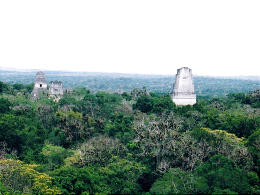
“The jungle rises 100 feet into the air, a rainforest of ceibas and mahogany and cedar trees. But the ancient stone pyramids rise even higher.
|
Deseret News
|
|
The Temple of the Jaguar Priest. The Temple of the Two-Headed Serpent. Their flat tops poke through the canopy, into the vast and misty sky. This is Tikal, in the tropics of Guatemala.
Tikal was a premier trading and ceremonial center during the Classic period of Mayan culture, inhabited as a city from 200 B.C. to A.D. 900.
|
At its peak, it was home to about100,000 people. Out of thousands of structures, about 500 buildings have been excavated and studied, and about 300 have been restored.
Your Guatemalan guides will tell you that the altars of Tikal were never overgrown or in disrepair, because they have been used continuously for nearly 3,000 years.
But if the culture seems raw and rugged in some ways, in other ways it was quite sophisticated. Proudly, the guides describe the precision of the astronomy. They find the Mayan calendar superior to the Roman calendar in that it doesn’t need a leap year.
And there’s more. In the Tikal national park guidebook, Thor Janson notes, ‘The foundations of the great Mayan temples were correctly engineered to be tangent to Earth, indicating that the architects were conscious of the planet’s spherical surface curvature at a time when European authorities insisted the Earth must be flat.’“
[Full Story]
“Abu Simbel to witness perpendicular sun fall
on Ramses II’s face”
October 21, 2006, State Information Service, Egypt:
“Egypt will witness the annual celebration of the perpendicular sun fall on the face of Pharaoh Ramses II statue in Abu Simbel Temple in Luxor on Sunday October 22.
‘The celebrations will kick off with parades moving from Luxor’s entrance to the Abu Simbel Temple’, said Saber Sanad, the head of the Abu Simbel municipality.
‘Presents will also be offered to tourists whose dates of birth or marriage coincide with the occasion’, he added.
Mohamed Hamid, director of the Abu Simbel antiquities department, said the perpendicular sun fall on the face of Ramases II will begin early Sunday.”
[Full Story]
“Mexican archaeologists unearth monolith
showing early calendar”
October 06, 2006, Pravda, Russia:
“Researchers said they have unearthed what may be one of the earliest calendar entries in Meso-America, a monolithic sculpture that suggests women held important status roles in pre-Hispanic culture.
|
Pravda
|
|
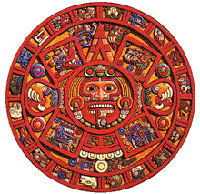
The massive stone sculpture depicts two decapitated women with streams of blood or water flowing from their necks. Markings on top of the figures appear to depict an entry from, or part of, a 13-month lunar calendar, said archaeologist Guillermo Ahuja, who led the excavation of the monument.
‘This would be the first depiction of a calendar or calendar elements in such an early time period’, Ahuja said Thursday.
|
The stone’s glyph-like inscriptions were carved sometime around 700 B.C., likely by the Huasteco culture and may predate other early calendars by hundreds of years, Ahuja said.
The lunar calendar has frequently been associated with female figures. The site where the stone was found was also a sacred area and burial ground occupied by the graves of 14 females, whose pottery offerings depicted women.”
[Full Story]
“Rebel Science: Uncovering the autumnal equinox”
October 06, 2006, The Rebel Yell, USA:
“Evidence exists that humans have been studying this ancient march of the seasons for many thousands of years.
In addition to literature describing the sun’s behavior, astronomically aligned monuments, ceremonial structures and petroglyph sites have been found on nearly every continent.
Various ancient cultures once held the equinoxes and solstices significant and even sacred, scheduling important events such as crop plantings, harvests and hunting expeditions around their dates. These practices and the early calendars have become the center of a relatively new academic field of study known as archaeoastronomy.
According to the Center for Archaeoastronomy, founded by the University of Maryland, the roots of this discipline lie in the archaeological studies of Stonehenge in the 1960s; since then, the field has grown to encompass the related interests of mathematics, surveying, sociology and epigraphy (the science of decoding ancient inscriptions).
According to archaeoastronomy.com, new petroglyph sites of astronomical significance are discovered each year here in the desert southwest. Understandably, explorers are particularly active at this time of the year, searching for unusual shadows or beams of light cast upon canyon walls.
Plants and animals live by the movement of the earth and the stars, setting their clocks to its nearly constant rhythm. Because of Earth’s slight, yet critical tilt, we are able to live in a comfortable, reliable world of change.”
[Full Story]
“Golfers control ancient lunar observatory”
September 04, 2006, Indian Country Today, USA:
“‘Look, we’ve won’, quipped Mark Welsh, Yankton Dakota/Mohawk, as he stood on a wooden viewing tower and watched golfers plant a white pennant on a hole of the Moundbuilders Country Club golf course. ‘They’re surrendering’.
The golf course sits on the Newark Earthworks, the world’s largest mound complex, built 2,000 years ago by ancestral indigenous people in what was then a managed prairie landscape, kept largely free of trees by periodic burning.
The site includes grass-covered, precisely sculpted earthen walls defining a 20-acre circle and a 50-acre octagon, as well as freestanding mounds, or artificial hills. Portions of the vast installation align with important lunar events – including the northernmost and southernmost rises and sets of the moon’s 18.6-year cycle.
Walled roads as long as 60 miles appear to have connected it to other mound complexes around central Ohio.
Denison College professor emeritus of physics and astronomy Michael Mickelson called the site ‘an ancient solid-state lunar computer’, and a British archaeologist cataloging wonders of the ancient world recently placed it on the list. “
[Full Story]
“Enigmatic Brodgar structure produces another
example of Neolithic art”
August 29 2006, Orkney Archaeology News, Scotland:
“As another season’s work draws to a close, the Stenness side of the Ness of Brodgar continues to throw up archaeological surprises – including two pieces of iconic Neolithic art.
Investigating earlier geophysics scans of a field between Lochview and Brodgar Farm, a trench has revealed the remains of what may be a chambered tomb. And if it is, it could be the ‘missing link’ between the two styles of Stone Age cairn found in Orkney.
|
Orkneyjar
|
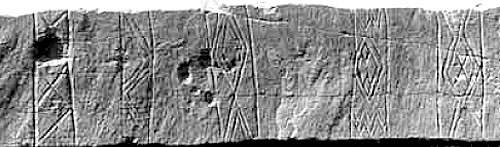
Is the design a mere artistic expression, or was there another, more symbolic reason? The repeated lozenge, for example. Is it just a pretty pattern? Or, as some would have it, a geometrical representation of the positions of the solstice sunrise and sunsets?
When it comes to tombs, the early Neolithic period is characterised by stalled cairns – structures, such as Unstan in Stenness, which are divided into cells, or stalls, by large upright stones. Towards the end of the period, these were superseded by Maeshowe-type structures – circular with side chambers.
The Brodgar building appears to show characteristics of both. It was a large oval structure but was subdivided into radial chambers – similar to those found inside the Crantit cairn in 1998.”
[Full Story]
“Lost secrets revealed at Stonehenge”
August 22, 2006, 24Dash News, UK:
“Visitors to Stonehenge over the August Bank Holiday weekend will have the chance to catch a glimpse of life in Britain more than 4,000 years ago.
A team of archaeologists from around Britain are carrying out excavations at Woodhenge, Durrington Walls and Stonehenge Cursus to find out more about these sites and their links with Stonehenge.
The work is part of the Stonehenge Riverside Project, designed to explore the archaeological evidence from the landscape around Stonehenge, Woodhenge and Durrington Walls, and to examine this wide complex of monuments and human activities.
In 2005, archaeologists at Durrington Walls discovered remains of at least three Neolithic houses, as well as the first known metalled road surface from the European Neolithic period.
This formed a ceremonial avenue aligned on the Midsummer Solstice sunset.”
[Full Story]
“Peru link to Indian archaeological find?”
August 03, 2006, BBC News Online, UK:
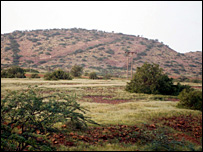
“Geologists have discovered a striking archaeological feature on a hillock in the Kutch district of the western Indian state of Gujarat.
|
BBC News
|
|
This feature is shaped like the Roman numeral VI. Each arm of this feature is a trench that is about 2 metres wide, 2 metres deep and more than 100 metres long.
The feature has evoked the curiosity of archaeologists because such signs have mostly been observed so far in Peru.
|
The team, led by Dr RV Karanth, a former professor of geology at the Maharaja Sayajirao University in Vadodara, Gujarat, has been involved in a palaeoseismological study of the Kutch region for the past 11 years.
The Kutch region is host to several archaeological findings belonging to the Harappan civilisation (3000-1500 BC). This has led to the speculation that this feature could be related to the Harappan civilisation.
Dr Karanth says such trenches have not been noticed elsewhere in the region. Archaeologists, he says, can now pursue further research.
He says that one of the prominent explanations given for the Peruvian features is that they may have been constructed to make astronomical observations and calculations.
‘The Tropic of Cancer passes through Kutch. So if this structure is man-made, it is likely that the slope of the hillock was utilised for making certain astronomical calculations in the past’, explains the geologist.
Interestingly, there are numerous indications to suggest that Harappans were well-versed in astronomy. The straight streets of that time were oriented in the cardinal directions – east, west, north and south.
Linkages between ancient Harappan scripts and latter Vedic texts also suggest that Harappan priest-astronomers tracked the progress of various planets and mapped the sky.”
[Full Story]
“Mysteries of the Rocks and Stars”
August 02, 2006, KitsapSun.com, USA:
“Where did science and religion begin? Two men in blue standing on a mountain in northeast Macedonia claim it began here, at an ancient sacred temple called Kokino.
Just five years ago archaeologist Jovica Stankovski and astrophysicist Gjore Cenev were poking about the Bronze Age ruins near the top of this 1,000-meter high neovolcanic shock when they noticed certain notches in the ridge were aligned with the positions of the sun and moon at their seasonal rise.
A year later the discovery was validated by NASA, and Kokino is now fourth on the short list of oldest observatories on earth.
Just beneath the summit the cut andesite rocks and a hand-hewn throne make up what is being marketed as the Macedonian Stonehenge, one of the greatest prehistoric observatories in the world – the only one so far discovered in Eastern Europe, ranking up there with Angkor Wat in Cambodia and Abu Simbel in Egypt.
Like boys on a treasure hunt, Gjore and Jovica scramble about the site, excitingly pointing to each marker and cut, oblivious to the 100-degree heat, espousing their theories.
It was, they believe, crafted by a pagan cult in one of the first known efforts to create a calendar. Similar to the illustrious scene in the film ‘Raiders of the Lost Ark’, the sun here would climb at the solstice and pour a ray through a slit in the rock.
The rising beam would then illume the face of the high priest, they theorize, who sat on the stone throne.
The meeting of the sun and the mountain represented a marriage of two gods, and at that moment a series of sacrifices would begin – horses, bulls, rams, goats, perhaps humans.”
[Full Story]
“France’s new Stonehenge: Secrets of a neolithic time machine”
July 31, 2006, The Independent, UK:
“Some months ago builders were clearing a piece of wasteland in southern Brittany when they struck an enormous hunk of granite. The developer was no historian but he knew instantly what the obstacle must be: the remains of a buried ‘menhir’ or neolithic standing stone.
He ordered a bulldozer to shove the stone underground again before any passing busybody spotted it. He did not want the work on his six seaside bungalows to be halted for a prolonged archaeological dig.
Brittany, he probably reasoned, is crammed with old stones. At Carnac – the largest neolithic site in the world, just down the road – there is a linear forest of 3,000 menhirs in the space of four kilometres. Was that not enough ancient monuments to satisfy the historians, the tourists and the Ministry of Culture in Paris? Too late. A passing busy-body had noticed the unearthed menhir. Work on the bungalows was halted. An archaeological dig was ordered.
Too late. A passing busy-body had noticed the unearthed menhir. Work on the bungalows was halted. An archaeological dig was ordered.
Because the Kerdruelland menhirs have been preserved in mud and silt for 4,500 years, they should offer important new information on how such alignments were created and why. At the well-known sites, such as Carnac and Stonehenge, some of the stones have been moved or propped up or stolen or added over the centuries. Here the stones, up to 2m long, lie just as they did after they were felled four-and-half millennia ago.
What happened inside such enclosures has excited fevered speculation for centuries. Human sacrifice? Elaborate astronomical observations? Sexual and drunken orgies? Ceremonies at the winter and summer solstices to encourage the healthy growth of crops?
Professor Burl suggests that, far from being elaborate astronomical observatories, most stone-circles are shaped by local topography.
They do often, however, have alignments with summer and winter solstices and the movements of the Moon. Professor Burl’s best guess on their purpose is a mixture of propitiation of the crop gods and sexual and alcoholic-psychedelic orgies. There is much archaeological evidence that the late Stone Age was also a stoned aged.”
[Full Story]
“Solar Circle: A 7,000-year-old henge in eastern Germany
may be the world’s first observatory”
July 2006 Edition, Archaeology Magazine, USA:
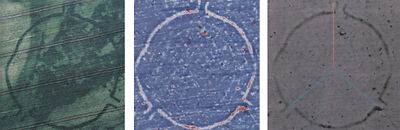
“The henge showed up as dark ridges in a wheat field in a 1991 aerial photograph of the site, left. A magnetometer survey confirmed the anomaly.
Analysis shows that the southeast entrance to the henge marked the winter solstice and that the southwest gate was aligned to the summer solstice. Though some archaeologists question the intepretation, Biehl believes the site was a kind of solar observatory.
|
Archaeology Magazine
|
When archaeologists Peter Biehl and Francois Bertemes decided to excavate a 7,000-year-old circular enclosure outside of Goseck, Germany, in 2002, they didn’t expect to make any major discoveries, certainly nothing that might rewrite the history of Neolithic Europe.
‘We had just started our archaeology program, and we wanted a place near the university for our students to practice’, says Biehl, formerly a professor at Halle-Wittenberg University and now at Cambridge. Combining Global Positioning System data with archaeological evidence from the site, they soon discovered that the two southern gates of the henge marked the start of the summer and winter solstice, making the enclosure possibly the world’s oldest solar observatory.
The farmers of Neolithic Central Europe, who most scholars believed were a generally unsophisticated group who tilled the land with basic wooden tools, were actually measuring the heavens far earlier than anyone had ever believed.”
[Full Story]
“Did ancient Amazonians build a ‘Stonehenge’?”
June 29, 2006, CNN/AP, USA:
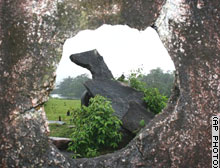
“A grouping of granite blocks along a grassy Amazon hilltop may be the vestiges of a centuries-old astronomical observatory – a find archaeologists say indicates early rain forest inhabitants were more sophisticated than previously believed.
|
CNN/AP
|
|
The 127 blocks, some as high as 9 feet, are spaced at regular intervals around the hill, like a crown 100 feet in diameter.
On the shortest day of the year – December 21 – the shadow of one of the blocks disappears when the sun is directly above it.
|
‘It is this block’s alignment with the winter solstice that leads us to believe the site was once an astronomical observatory’, said Mariana Petry Cabral, an archaeologist at the Amapa State Scientific and Technical Research Institute., he said. ‘We may be also looking at the remnants of a sophisticated culture.’.
Anthropologists have long known that local indigenous populations were acute observers of the stars and sun.
But the discovery of a physical structure that appears to incorporate this knowledge suggests pre-Columbian Indians in the Amazon rain forest may have been more sophisticated than previously suspected.”
[Full Story]
“King Tut’s necklace shaped by fireball”
June 26, 2006, The Australian, Australia:
“Scientists believe they have solved the mystery surrounding a piece of rare natural glass at the centre of an elaborate necklace found among the treasures of Tutankhamun, the boy pharaoh.
They think a fragile meteorite broke up as it entered the atmosphere, producing a fireball with temperatures over 1800C that turned the desert sand and rock into molten lava that became glass when it cooled.
Experts have puzzled over the origin of the yellow-green glass – carved into the shape of a scarab beetle – since it was excavated in 1922 from the tomb of the teenage king, who died about 1323BC.
It is generally agreed the glass came from an area called the Great Sand Sea, but there has been uncertainty over how it was formed because there is no crater to back up the idea of a meteorite.
Now it is thought the meteorite responsible was not intact but made up of loose rubble.
‘A fireball moving quicker than a hurricane force would have meant a blast of air so hot it could melt all the sand and sandstone on the ground’, said Mark Boslough, an expert on impact physics based at the Sandia National Laboratories in New Mexico.”
[Full Story]
“Dancing with the moon goddess in Callanish”
June 22, 2006, The Scotsman, Scotland:
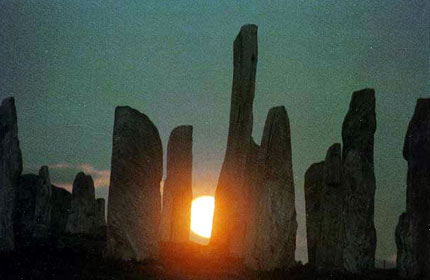
“The lunar standstill this month at the Neolithic standing stones in Callanish, in the Outer Hebrides, was a rare event. .
As the moon’s journey through the sky takes nearly 19 years, the standstill only takes place three or four times in an average lifetime.
|
The Scotsman
|
Many worshipers from alternative religions travelled to Callanish to witness the moon ‘walk across the earth’.
What makes Callanish such an intriguing spot is its placing with a ‘Sacred landscape’.
Moonrise to moonset during the standstill takes nearly four hours. The moon sets at three o’clock in the morning only to regleam – or reappear – through the standing stones.”
[Full Story]
“Stonehenge-Like Tomb Also Marks Solstice”
June 22, 2006, Discovery Channel News, USA:
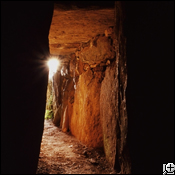
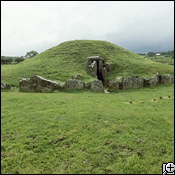
“An ancient British tomb monument contemporary with the first phase of Stonehenge’s construction suggests one prehistoric culture built the two structures to mark the summer solstice, according to archaeologists.
The tomb is called Bryn Celli Ddu, which in Welsh translates to ‘the mound in a dark grove.’
|
Discovery Channel News
|
|
It is located on the island of Anglesey off the northwest coast of Wales.
New radiocarbon dating of postholes outside of the burial monument determined the mound is over 6,000 years old.
Stonehenge dates to around 2800 B.C., but some historians think it could be much older.
|
According to research published in the current issue of British Archaeology and the National Museum Wales Book “The Tomb Builders in Wales: 4,000-3,000 B.C.,” both Bryn Celli Ddu and Stonehenge are aligned with the summer solstice.
|
Discovery Channel News
|
|
The heel stone at Stonehenge marks this event, while a passageway and quartz-rich stone located in the back of the burial monument lights up in a dramatic sun show.
The exterior postholes indicate a wooden structure may have preceded the current tomb monument, which consists of a stone circle surrounding a stone-lined passageway that leads to an internal chamber.
|
Steve Burrow, curator of Neolithic archaeology at the National Museum Wales, suspected that the tomb might mark the midsummer rising sun, so he stood in the chamber last year at dawn on the summer solstice to see what would happen.
‘It’s stunning’, said Burrow, who made the discoveries and led the research. ‘First there is a sparkle through the trees, then the sun rises out. It’s quite exhilarating.’“
[Full Story]
“Solstice sun beams into chamber”
June 21, 2006, BBC News Online, UK:
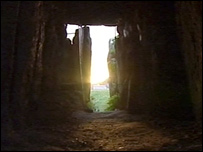
“The summer solstice sun beaming through a north Wales burial chamber has been recorded by experts. The 20-minute alignment of the sun will occur on only a few days this week at the Bryn Celli Ddu chamber on Anglesey.
|
BBC News
|
|
The video of the summer solstice at the 5,000-year-old chamber will form part of a museum exhibition in Cardiff.
Archaeologist Steve Burrow made the discovery after reading a book by Sir Norman Lockyear published almost 100 years ago.
|
Mr Burrow said: ‘The sun doesn’t move that much on the days around the solstice. “Last year I spent six days going up there, on the last day we managed to get it – the weather was a bit dodgy. It was absolutely incredible’, he said.
Sir Norman – the man who discovered helium – had travelled to the site, otherwise known as the Hill of Black Grove, and measured the alignment of the sun at Easter.
‘I came across this reference in a book dating back to 1908 but nobody had checked it, nobody had gone and verified it in person’, he said.”
[Full Story]
[A number of local people have seen the Alban Hefyn – Summer Solstice – sunrise from inside this chamber at Bryn Celli Ddu over the past few decades. This News Editor has experienced this phenomena several times in recent years, and Mr T. Llewelyn Williams of Bangor experienced it in the mid-1970s.
Both of us independently made these re-discoveries whilst conducting just such an astro-archaeological survey of the structure that archaeologist Steve Burrow has just done – but no-one listens to or credits us ‘amateurs’ even when we refer to the pioneering astro-archaeological work of Sir J. Norman Lockyer.
In fact, Bryn Celli Ddu is just one structure in a massive megalithic complex of astronomical instruments reaching several miles down to the Maesoglan area and beyond. See more of the Morien Institute images here.
This astronomical complex is without any manner of doubt the reason why the Welsh Druids were reknowned throughout the classical world for their superior knowledge of astronomy – and was probably the reason why the Romans ‘cut down their sacred groves’ and portrayed them as ‘barbarians’.
While those Druids may not have built the many structures in the astronomical complex, they most certainly would have inherited the knowledge of how to use them their for scientific observations. – JM.]
“Ancient monument aligned to sun”
June 18, 2006, BBC News Online, UK:
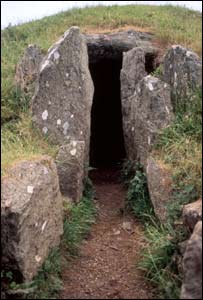
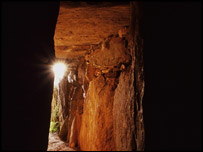
“An archaeologist has discovered that the passage into a burial mound on Anglesey was built to catch the rising sun on the summer solstice.
|
BBC News
|
|
Steve Burrow said he was “elated” when the sun filtered in through trees as he sat in the Bryn Celli Ddu chamber.
He made the discovery as he researched a book about burial tombs in Wales from 4,000-3,000 BC.
Carbon dating on the site has also revealed it may contain the oldest building in Wales.
Mr Burrow, the curator of Neolithic archaeology at the National Museum of Wales, said he had to visit the site twice before his discovery.
|
On the last day of his second visit he said he was “absolutely elated” when the sun filtered through nearby trees and entered the chamber along the five metre-long entrance passage.
|
BBC News
|
|
‘The emotion of seeing something that was put there deliberately 5,000 years ago was amazing’, he said.
What impressed researchers was the sophistication of the construction.
|
‘I was the first person to be recording the event so I was trying to record it with stills and digital cameras as well as on a video camera, but I was jumping up and down.’
Testing has discovered that post holes outside the entrance to the chamber are 3,000 years older than the tomb itself.”
[Full Story]
“Divers begin search for underwater ‘Atlantis'”
June 17, 2006, People’s Daily, China:
“Ten divers began a seven-day search for a possible underwater ‘Atlantis’ on Friday in the Fuxian Lake near Kunming, the second-deepest freshwater pool in the country.
Local diver Geng Wei first told of a large ancient city in the lake eight years ago, thought to span 2.4 square kilometres. Geng claimed to have seen lots of square boulders more than 1.4 square metres in size, either piled or scattered deep underwater.
In 2001, the local government launched the first large exploration of the lake, which was broadcast live across the nation by China Central Television (CCTV).
A submarine was sent down and detected a 60-metre-long stone wall. Divers unearthed a shard of pottery embedded in the stone wall, which was found to date back to the Han Dynasty (104 BC-220 AD).
The evidence convinced Chinese archaeologists that there might be some constructions under the lake, possibly more than 1,800 years old.
This hypothesis was substantiated on Friday in the first dive, when Geng was videotaped finding three notches, each 1.2 metres long and 45 centimetres wide, on a moss-covered square slate.
The ‘IY’-shaped notches must have been artificial, and ‘support the idea that all the stones were once processed by humans’, said Li Kunsheng, director of the Archaeology Research Centre of Yunnan University.”
[Full Story]
“Bailey: Article 19, a $600K lesson in
Town Meeting style democracy”
June 16, 2006, Sharon Advocate, USA:
“On May 8, about 100 Town Meeting voters approved taking key parts of an approved 3-lot development on an 11-acre parcel to save what some claim is tied to an ancient Native American culture.
This land abuts the 90-acre town-owned King Philip’s Cave land off Mansfield Street. To finance this taking by eminent domain ‘(or negotiation with the developer), the town will borrow $600,000.
In these lean times, the town has postponed many projects, but to save this parcel, it will likely cost $721,000 over 10 years at current interest rates and reduce next year’s capital budget by $600,000.
The average annual debt service of $72,100 would pay the salary of a full time executive assistant-planner, or a senior teacher or six times the amount needed to maintain the library’s accreditation annually.
Frederick Martin, a professional physicist and a Dedham-based amateur archaeologist, has been advocating the town “to preserve the hill where the equinox sun rises directly at its summit, where the solstice sunrises occur at either end, and where skyline stones exist” since the development proposal first came to Planning Board in 2001.
Martin believes Native Americans aligned stones at the site to measure time more than 2,000 years ago, but professionals question the legitimacy of his claim.”
[Full Story]
“Druids and moon worship in the sacred landscape of Callanish”
June 15, 2006, The Scotsman, Scotland:
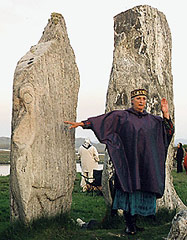
“It had been unseasonably hot all day and the great standing stones at Callanish shimmered in the setting sun. These Neolithic giants stood out among the throng of people.
The Isle of Lewis might be the end of the road, yet a crowd of nearly 200 had trekked to this ancient site in the Outer Hebrides to bear witness to a most unusual spectacle and sate their spiritual need. They stood out against the bleached greens and greys of the Lewis countryside.
|
The Scotsman
|
|
Flame-haired druids beating drums, dowsers with brass rods reflecting the sunlight, pagans, moon worshippers, hippies, shamans and witches were all there, facing west into their sacred landscape awaiting the goddess.
It is probable that Callanish (or Calanais) – which comprises two other stone circles in addition to the main site – was built some 5,000 years ago as a lunar calendar.
|
The path of the moon, unlike the reliably annual tracks of the sun, only returns to the same point once every 18.6 years. Callanish plots this slow progress, building to a crescendo in the 19th year at the lunar standstill – when the path of the moon is so low that it seems to walk along the horizon before setting within the stone circle.
Callanish’s mystery to the expectant crowd is not merely in the stones, but in their setting within a sacred landscape. To the south-west of the stones is a low, undulating hill known to the local people in Gaelic as Cailleach na Mointeach – the old woman of the moors, or Sleeping Beauty as she is more affectionately known.
The contours look irresistibly like a reclining woman. At the lunar standstill the moon rises from behind this hill, tip-toes across her supine body and sets four hours later behind the Clisham, another sacred hill.”
[Full Story]
“Ancient stone face ruled lives”
June 10, 2006, The Kansas City Star, USA:
“‘It’s the most exciting discovery of my lifetime.’ Anthropologist Robert Benfer.
Anthropologist Robert Benfer of the University of Missouri-Columbia found the unexpected when he was digging in Peru to study what coastal people ate centuries ago.
Benfer uncovered what amounts to an ancient observatory that used the sun and constellations to mark the seasons for farming. It dates to about 2200 BC, 1,000 years earlier than most archaeologists thought such methods were used.
The temple and sculpture were aligned in such a way that observers could determine the arrival of the summer and winter solstices. Those are Dec. 21 and June 21, respectively, in Peru, the opposite of North America’s.”
[Full Story]
“Was this the world’s first computer – and what did it measure?”
June 10, 2006, The Western Mail, Cymru:
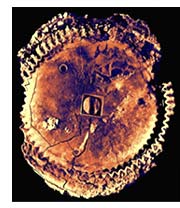
“THE mysteries of an astonishing ancient Greek device could soon be unlocked by Welsh scientists. The Antikythera Mechanism, which is about the size of a shoe box and has about 30 moving parts, has been an enigma since being discovered in a shipwreck by sponge divers a century ago.
|
The Western Mail
|
|
It has intrigued scientists and historians, and its markings suggest astronomical use.
But while experts say it is one of the most remarkable pieces of ancient technology ever discovered, they have struggled to find out exactly what the device was built for.
Now Professor Mike Edmunds of Cardiff University’s astrophysics department is leading a team hoping to find out.
|
Using the latest technology, he hopes to examine more of the inscriptions than ever before – tantalising clues which he believes will show how the device was meant to work, and what its purpose was.
He said, ‘It’s a remarkable object. Nothing else with the same level of technology is known to have been built for another millennium. What we’re trying to find out is exactly what its purpose was.’
‘We know it’s a mathematical calendrical device, which would seem to have something to do with the movements of planets and the sun, moon and stars. But we don’t know whether it was an educational or display device, or used for predicting the future of astronomical movements.’“
[Full Story]
“Ancient Astronomy Artifact Bears Hidden Text”
June 08, 2006, Discovery Channel News, USA:
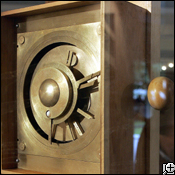
“A shoebox-sized bronze device scooped out of a Roman-era shipwreck at the dawn of the 20th century has baffled scientists for years.
|
Discovery Channel
|
|
Now a British researcher has stunningly established it as the world’s oldest surviving astronomy computer.
A team of Greek and British scientists probing the secrets of the artifact, known as the Antikythera Mechanism, has managed to decipher ancient Greek inscriptions unseen for over 2,000 years, members of the project say.
|
‘Part of the text on the machine, over 1,000 characters, had already been deciphered, but we have succeeded in doubling this total’, said physician Yiannis Bitsakis.
Bitsakis is part of a multi-disciplinary team of researchers from universities in Athens, Salonika and Cardiff, the Athens National Archaeological Museum and the Hewlett-Packard company.
‘We have now deciphered 95 percent of the text’, he told AFP”
[Full Story]
“Was Ancient Supernova Recorded by Ancient North Americans?”
June 08, 2006, Space.About, USA:
“Paul Sutherland, of the Sky Mania blog reports on a hiking astronomer who happened upon a rock in the White Tank Mountain Regional Park in Arizona, which seems to depict the Supernova of 1006.
The rock showed an 8 pointed star alongside a drawing of a scorpion. John Barentine, a professional scientist at the Apache Point Observatory in New Mexico, said he recognized the supernova right away, because of its proximity to the constellation Scorpio.
Many other ancient civilizations have also recorded the event. Barentine says, ‘If confirmed, this discovery supports the idea that ancient Native Americans were aware of changes in the night sky and moved to commemorate them in their cultural record.’“
[Full Story]
“Were Greeks 1,400 years ahead of their time?”
June 07, 2006, ZanteWeb, Greece:
“The ‘Antikythera Mechanism’ was discovered damaged and fragmented on the wreck of a cargo ship off the tiny Greek island of Antikythera in 1900.
Now, a joint British-Greek research team has found a hidden ancient Greek inscription on the device, which it thinks could unlock the mystery. The team believes the Antikythera Mechanism may be the world’s oldest computer, used by the Greeks to predict the motion of the planets.
The researchers say the device indicates a technical sophistication that would not be replicated for millennia and
may also be based on principles of a heliocentric, or sun-centred, universe – a view of the cosmos that was not accepted by astronomers until the Renaissance.
The Greek and British scientists used three-dimensional X-ray technology to make visible inscriptions that have gone unseen for 2,000 years. Mike Edmunds, an astrophysicist at Cardiff University, who is heading the British team, said: ‘The real question is, ‘What was the device actually for?’ Was it a used to predict calendars? Was it simply a teaching tool? The new text we have discovered should help answer these questions’.
The mechanism contains over 30 bronze wheels and dials and was probably operated by hand, Mr Edmunds said. The most prominent appraisal of the mechanism’s purpose was put forward in 2002 by Michael Wright, the curator of mechanical engineering at the Science Museum in London, who said it was used to track the movements of all the celestial bodies known to the Greeks: Mercury, Venus, Mars, Jupiter and Saturn.
[Full Story]
“Rock Carving Linked To 1000-Year-Old Supernova Sighting”
June 06, 2006, SpaceDaily, USA:
“Astronomers announced Monday they have discovered a possible link between a symbol on an ancient rock carving and a supernova that occurred 1,000 years ago.
Reporting at the 208th meeting of the American Astronomical Society, John Barentine, with Apache Point Observatory in New Mexico and Gilbert A. Esquerdo, with the Planetary Science Institute in Tucson, Ariz., said they think a petroglyph, found in the White Tanks Regional Park in Arizona depicts the well-known supernova of A.D. 1006.
The petroglyph is located in an area once occupied by prehistoric Native Americans called the Hohokam, which archaeologists think lived in the area – outside modern-day Phoenix – from about A.D. 500 to 1100.
Until now, the supernova was thought to only have been recorded by star watchers in the Old World, because simultaneous written records from Asia, the Middle East and Europe recognize the appearance of a ‘new star’ in the modern constellation of Lupus on May 1, 1006.”
[Full Story]
“White Tanks petroglyph may mark death of star”
June 06, 2006, AZ Central, USA:
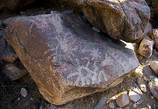
“A thousand years ago last month, the brightest star ever seen by modern humans burst into the sky. Astronomer John Barentine thinks the ancient Hohokams recorded that event in a petroglyph in the White Tank Mountains, on the west side of the Valley.
|
AZ Central
|
|
If he is right, it is the only known depiction of the supernova in the Western Hemisphere. Barentine, who works at the Apache Point Observatory in Sunspot, New Mexico, presented his theory Monday at the American Astronomical Society meeting in Calgary, Alberta.
|
The supernova of 1006 appeared in the constellation Lupus, a little below and west of the well-known constellation of Scorpius, the Scorpion.
‘What particularly got my attention about that rock and the glyphs on it was the representation of what is pretty obviously a star, and a bright star at that. And the figure of a scorpion. Scorpions appear in rock in the Southwest but are not a very common motif’, Barentine said.
The petroglyph panel in the White Tanks consists of several figures pecked into the dark desert varnish, a patina of iron and manganese oxides that often coats rock in arid environments.”
[Full Story]
“Ancient rock art may depict exploding star”
June 05, 2006, CNN, USA:
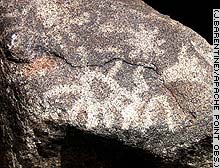
“A rock carving discovered in Arizona might depict an ancient star explosion seen by Native Americans a thousand years ago, scientists announced today.
|
CNN
|
|
If confirmed, the rock carving, or ‘petroglyph’ would be the only known record in the Americas of the well-known supernova of the year 1006.
The carving was discovered in White Tanks Regional Park just outside Phoenix, in an area believed to have been occupied by a group of Native Americans called the Hohokam from about 500 to 1100 A.D.
|
The finding is being announced today at the 208th meeting of the American Astronomical Society in Calgary, Canada.
In the spring of 1006, stargazers in Asia, the Middle East and Europe recorded the birth of a ‘new star’ above the southern horizon of the night sky, in the constellation Lupus, just south of Scorpio.
Unknown to them, what those ancient astronomers were actually witnessing was the swan song of a star as it blew itself apart in a violent explosion called a supernova.”
[Full Story]
“Amazon Stonehenge found in Brazil”
June 05, 2006, Zee News, India:
“Brazilian scientists have made a discovery, which may totally change the opinion that the Amazon area has never been populated by highly developed civilizations, the Globo newspaper said.
Amapa archaeologists have found an assembly of stones, nicknamed the Amazon Stonehenge after the famed stone circle in Britain.
One hundred and twenty-seven granite blocks are arranged at an equal distance from one another on a flat surface 390 kilometers away from the administrative center of the Amapa state, Macapa.
So far, their age is estimated at 500 to 2,000 years. A local archaeologist said that it might have been an ancient astronomic observatory, as one of the stones marked the position of the Sun on the winter solstice day.”
[Full Story]
“Ancient Calendar Unearthed in Peru”
June 03, 2006, Discovery Channel News, USA:
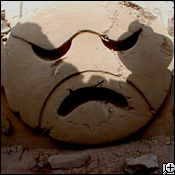
“Archaeologists have discovered an enormous prehistoric calendar, formed by sculptures arranged in a circle, at the Temple of the Fox in Buena Vista, Peru.
|
Discovery Channel News
|
|
The calendar, which dates to 2200 B.C., is the oldest known structure of its kind found in the Americas.
Similar monuments erected by the Mayans of Mexico have also been found, but those have dated to approximately 2,000 years ago. There have been European versions too.
|
‘Early solstice markers are known in Ireland with dates earlier than Buena Vista, but not, to my knowledge, with multiple instruments’, said Robert Benfer, who oversaw the project and is a professor emeritus of anthropology at the University of Missouri-Columbia.
The Peruvian calendar would have been a dramatic sight for onlookers 4,000 years ago. Its towering sculptures – made of mud plaster mixed with grass and covered with clay – were painted bright yellow and red.”
[Full Story]
“X-Tek stars in the ancient sky”
June 02, 2006, EMSNow News, UK:
“X-Tek Systems has played a vital role in an innovative link-up between high-tech industry and international universities, aimed at uncovering the secrets of a two-thousand-year-old astronomical calculation device, more advanced than any other known mechanism for at least a thousand years after its manufacture in around 100 BC..
X-Tek’s equivalent of a body scanner has been used to probe the secrets of the ancient artefact, estimated to date from around 80 BC. Discovered in 1900 AD in a shipwreck in the Greek islands, the Antikythera Mechanism contains over 30 gear wheels and dials and the remains are covered in astronomical inscriptions.
It may be a device to demonstrate the motion of the Sun, Moon and planets, or to calculate calendars or astrological events.
Although the Mechanism is no bigger than a shoe box, it’s too priceless and unique to leave the National Archaeological Museum in Athens, so a major expedition at the end of last year brought a unique 400kV microfocus Computed Tomography System, weighing over 7.5 tonnes, from X-Tek to examine the artefact in Greece.
As the results of the research are analysed, the structure and purpose of the mechanism, now in dozens of fragments, will become clearer.
X-Tek’s imaging equipment has enabled researchers to view inscriptions inside the Mechanism which haven’t been seen for over 2,000 years and work can now continue on counting the gear teeth and deciphering the inscriptions.”
[Full Story]
“Codes of world’s historical, cultural assets await discovery”
June 02, 2006, Turkish Daily News, Turkey:
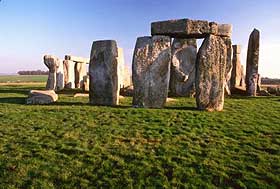
“The Nazca lines in Peru, the statues on Easter Island, Stonehenge in England and the stones in Van’s Kalecik Village still jealously guard their mysteries
|
Turkish Daily News, Turkey
|
|
While the film adaptation of Dan Brown’s best-selling book ?The Da Vinci Code? drew attention to fictional assertions regarding Jesus, the secrets of non-fictional historical and cultural assets remain to be discovered.
Many historical, archeological and cultural sites on earth still retain their mysteries, and some believe they possess important codes.
|
The Nazca lines in Peru, the statues on Easter Island, Stonehenge in England and stones in Van’s Kalecik Village, for instance, remain among those phenomena that attract attention because of their mysteries, reported the Anatolia news agency.
Nazca lines: Since their discovery various theories have been floated regarding the secrets behind the lines, with some postulating that the lines symbolized the summer and winter equinoxes while others claimed that they served as a giant calendar.
Steles in Van’s Kalecik Kalesi: Although some findings indicate that the site was used for astronomical observations, archeological work continues to attempt to uncover the function of the mathematically designed stones.”
[Full Story]
“Bosnia: land of pyramids and new wonders”
May 24, 2006, IOL, South Africa:
“New wonders related to purported pyramids in central Bosnia-Herzegovina may soon transform the tiny Balkan country into a world archaeological giant, backers of the pyramids theory are arguing.
A Sarajevo-born American Semir Osmanagic, who strikingly resembles the famous action-movie hero Indiana Jones, still claims that the alleged pyramids in Bosnia were built by a highly-developed civilisation thousands of years ago.
The new evidence discovered in the system of tunnels under the biggest alleged pyramid – the Pyramid of the Sun – in the central Bosnian town of Visoko, Osmanagic told a press conference in Sarajevo, proves the existence of a developed civilisation in that area some 12 000 years ago.
‘While working in the tunnel, we recently discovered huge sandstone monoliths with some symbols engraved on one of them’, said Osmanagic.
The sample pictures of the symbols discovered in the tunnels under the local Visocica Hill were sent for further analyses to Egypt. An expert for ancient letters and languages, he said, should join a team of Egyptian experts, expected to arrive soon in Bosnia and examine what is believed to be Bosnian Pyramid Valley, about 30km north from Sarajevo.
Besides three purported pyramids – one each for the sun, the moon and a dragon – that he discovered since April last year, when first researches started near Visoko, Osmanagic now claims another two significantly smaller pyramids exist in the valley.
The pyramids, or the alleged Bosnian Pyramid Valley, however, did not stop Osmanagic in searching for other wonders in Bosnia- Herzegovina.
His Bosnian Pyramid of the Sun Foundation has just started research into ancient stone spheres, huge stone balls discovered on several locations from central- to northern Bosnia.”
[Full Story]
“Archaeology find is unique: Peru solstice marker
among world’s oldest”
May 21, 2006, Columbia Daily Tribune, USA:
“Robert Benfer, a professor emeritus of anthropology at the University of Missouri-Columbia, was rooting around in the Peruvian dirt, looking for evidence of ancient human diet when he made a startling discovery.
|
University of Missouri
|
|
‘When we found that first sculpture – wow! I was petrified’ Benfer said. ‘I would have been in trouble. You have to have a special permit to excavate something like that.’
The discovery gradually emerged during excavations in 2004 and 2005. Benfer explained them during formal presentations last month to archaeological conferences.
|
Benfer and a team of archaeologists from the United States and Peru discovered sculptures that indicate there were floodplain farmers tracking the movement of the sun for cultivation purposes 1,000 years earlier than previously thought.
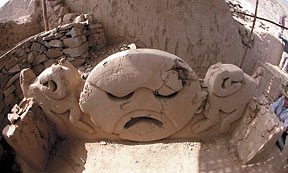
Excavations in 2004 and 2005 in Peru by University of Missouri-Columbia Professor Emeritus Robert Benfer, below, and a team of archaeologists unearthed a clay sculpture that aligns with other carvings to point toward the rising sun at summer solstice and the setting sun at winter solstice. Carbon dating of evidence found at the site dated it to about 2200 B.C.
‘The temple has a sighting device, and on the hill above it, there’s a stone that’s been modified in the shape of a face, and they line up like a gun sight to the solstice’, Benfer said.”
[Full Story]
“Written in the stars at least 4200 years ago”
May 17, 2006, Sydney Morning Herald, Australia:
“ARCHAEOLOGISTS working high in the Peruvian Andes have discovered the oldest known celestial observatory in the Americas – a 4200-year-old structure marking the summer and winter solstices that is as old as the stone pillars of Stonehenge.
The observatory was built on the top of an 11-metre-tall pyramid with precise alignments and sightlines that provide an astronomical calendar for agriculture, said archaeologist Robert Benfer of the University of Missouri, who presented the find last month in Puerto Rico at a meeting of the Society for American Archaeology.
The people who built the observatory – three millenniums before the emergence of the Incas – are a mystery, but they achieved a level of art and science that archaeologists say they did not know existed in the region until at least 800 years later.”
[Full Story]
“Celestial Find at Ancient Andes Site”
May 14, 2006, Los Angeles Times, USA:
“The discovery in Peru of a 4,200-year-old temple and observatory pushes back estimates of the rise of an advanced culture in the Americas.
Archeologists working high in the Peruvian Andes have discovered the oldest known celestial observatory in the Americas — a 4,200-year-old structure marking the summer and winter solstices that is as old as the stone pillars of Stonehenge.
The observatory was built on the top of a 33-foot-tall pyramid with precise alignments and sightlines that provide an astronomical calendar for agriculture, archeologist Robert Benfer of the University of Missouri said.
|
University of Missouri
|
|
The people who built the observatory — three millenniums before the emergence of the Incas — are a mystery, but they achieved a level of art and science that archeologists say they did not know existed in the region until at least 800 years later.
The site is remarkably well preserved, Benfer said, because it rains in the area only about once a year.
|
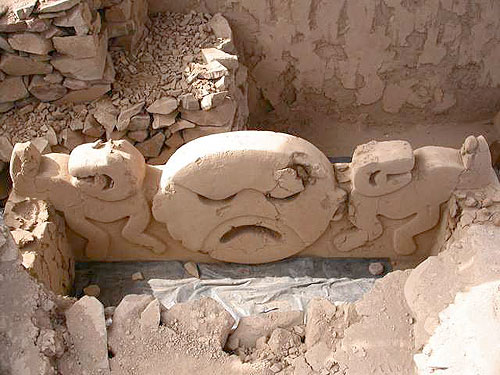
Among the most impressive finds was a massive clay sculpture — an ancient version of the modern frowning ‘sad face’ icon flanked by two animals. The disk, protected from looters beneath thousands of years of dirt and debris, marked the position of the winter solstice.
‘It’s really quite a shock to everyone … to see sculptures of that sophistication coming out of a building of that time period’, said archeologist Richard L. Burger of Yale University’s Peabody Museum of Natural History, who was not involved in the discovery.
The find adds strong evidence to support the recent idea that a sophisticated civilization developed in South America in the pre-ceramic era, before the development of fired pottery sometime after 1500 BC.”
[Full Story]
“‘Brazilian Stonehenge’ discovered”
May 13, 2006, BBC News Online, UK:
“Brazilian archaeologists have found an ancient stone structure in a remote corner of the Amazon that may cast new light on the region’s past.
The site, thought to be an observatory or place of worship, pre-dates European colonisation and is said to suggest a sophisticated knowledge of astronomy.
|
BBC News/AFP
|
|
Its appearance is being compared to the English site of Stonehenge. It was traditionally thought that before European colonisation, the Amazon had no advanced societies.
The archaeologists made the discovery in the state of Amapa, in the far north of Brazil.
|
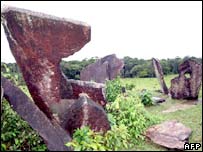
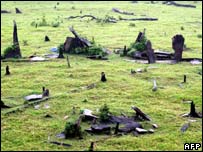
A total of 127 large blocks of stone were found driven into the ground on top of a hill. Well preserved and each weighing several tons, the stones were arranged upright and evenly spaced.
|
BBC News/AFP
|
|
It is not yet known when the structure was built, but fragments of indigenous pottery found at the site are thought to be 2,000 years old.
What impressed researchers was the sophistication of the construction.
|
The stones appear to have been laid out to help pinpoint the winter solstice, when the sun is at its lowest in the sky.
It is thought the ancient people of the Amazon used the stars and phases of the moon to determine crop cycles.”
[Full Story]
“Stonehenge in Brazil?”
May 13, 2006, ShortNews, Germany:
“Archaeologists in Brazil found a stone structure dating back to pre European colonization in the Amazonian state of Amapa (Northern Brazil).
The discovery, which showed sophisticated astronomy knowledge will change the previous thought that the area had primitive societies before European colonization.
The 127 stones were evenly spaced and pinpointed the winter solstice which might have been used to determine crop cycles. The structure is thought to be around 2,000 years old while the British Stonehenge dates to between 3000 and 1600 BC.”
[Full Story]
“2 men discover what may be hemisphere’s
oldest seasonal calendar
May 02, 2006, Bradenton Herald/KRT, USA:
“Vacation. You know, snap a few pictures, buy a few T-shirts, sample a little Peruvian alpaca.
But somewhere between the lost Incan city of Machu Picchu and mountaintop observatories of Cerro Tololo, Chile, retiree Larry Adkins opened a mysterious e-mail from an old childhood pal.
And suddenly, Adkins, 66, of Tustin was solving a 4,000-year-old riddle, wrapped around pyramids, buried temples, mummies and a dark-cloud constellation known as The Fox.
The temple just may be the Western Hemisphere’s equivalent of Stonehenge, an ancient calendrical device intended to mark the seasons by pinpointing the summer solstice sunrise and the winter solstice sunset.
If Adkins and his friend’s discovery stands up to academic scrutiny, ‘It would be the oldest known solstice marker in the hemisphere and one of the oldest in the world’, says Dave Dearborn, co-editor of Archeoastronomy journal.
The day they started excavating the Temple of the Fox – where they unearthed two, 4,000-year-old fox murals and a sacrificial human mummy – a real fox arrived in the hills. And watched. And watched.
‘He stayed till we finished excavating, and then it left’, Benfer says. ‘That was a weird coincidence.’. Weird because he thinks another kind of fox has watched over this temple for more than 4,000 years: a celestial fox.
Peruvian nights reveal a far different sky from our own. One where the Milky Way streaks across the heavens in a white path. Intergalactic dust creates dark shapes inside, called dark star constellations. Andean sky watchers named these after animals: The Llama, the Turtle, the Snake and … the Fox.”
[Full Story]
“Ancient representation of ‘Great Bear’ on a stone
April 20, 2006, Hindustan Times, India:
“A very early representation of the ‘Great Bear’ constellation, also known as ‘Ursa Major’, has been found on a stone at Mudumala village in Mahaboob Nagar district of Andhra Pradesh.
Talking to newspersons here, Hyderabad University Reader Dr KP Rao said a four member team of the University’s Department of History discovered the ‘sky map’ belonged to the megalithic period dated to around 500 BC, and was the earliest physical representation of the sky found in India or even in South Asia.
The representation of the group of stars was found on a squarish table like rock having a flat slanting top in the form of ‘cup marks’ each of which have about four cm diameter with a shallow depth of less than 0.5 cm.
The Great Bear constellation was represented by a group of seven stars which also found an important place in Indian astronomy, where they were known as the ‘Saptarshi Mandala’.”
[Full Story]
“Digging starts on ‘Europe’s first pyramids’ in Bosnia
April 14, 2006, Middle East Times, Egypt:
“Excavation work started on Friday on what a Bosnian explorer claims to be Europe’s first pyramids in an area north of Sarajevo.
A team of experts started digging at the site of a 3.8-kilometer (2.3-mile) tunnel believed to lead to one of the two structures resembling pyramids, about 30 kilometers from the Bosnian capital.
Last year explorer Semir Osmanagic started initial probes in the area convinced that the two ‘constructions’ were the work of builders from an unknown civilization who shaped the hill into a ‘step pyramid’ then coated it with a kind of primitive concrete.
He says that he sees astonishing similarities between the structures and Mexican pyramids dating back to about AD 200, which also come in pairs, one believed to represent the Sun and the other the Moon.”
[Full Story]
“Mannheim Exhibits Bronze-Age Sky Disk
Recovered From Thieves
March 23, 2006, Bloomberg, USA:
“With treasure hunters and crooked art dealers, the tale of the discovery of the Sky Disk of Nebra is like a crime thriller. Harald Meller was a key figure, helping police recover the disk from thieves to secure it for the Halle Museum of Prehistory, where he is the director.
The 3,600-year-old, bronze disk, with gold symbols showing the moon, stars, horizons and a stylized boat, is the oldest surviving illustration of astronomical phenomena.
Treasure hunters using a metal detector found the disk, along with two ceremonial swords, ax blades, a chisel and a bronze spiral, in 1999.
‘A colleague showed me photographs in 2001, and said they were taken by robbers who were asking 1 million German marks for it’, Meller said. Meller then contacted the dealers trying to sell the illegal booty and set up a meeting with the treasure hunters in Basel, Switzerland.
While Meller pretended to run tests, the police moved in and arrested the two men who had illegally dug up the cache of bronze- age items, buried about 1600 B.C. ‘They tried to clean the disk with steel wool and damaged it badly’, says Meller.
The disk accurately represents the sky, along with constellations like the Pleiades and an indication of the eastern and western horizons. ‘This find is important because for the first time we get an idea of the intellectual and spiritual world of the bronze age’, says Meller.”
[Full Story]
“Equinox evokes ancient rite”
March 21, 2006, The Times of Malta, Malta:
“The clatter of conversation fell to a hush at 6.30 a.m. yesterday as 50 people turned to watch the sun glide up over the horizon, casting its light directly down the main apse of Mnajdra temples.
|
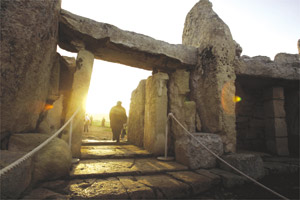
The Times of Malta
|
|
Heritage Malta organises visits to the prehistoric temples for the equinox and the solstice. On the former, yesterday and on September 22, the sun’s rays go down the main axis lighting up the altar at the innermost part of the temple.
On the solstices, the sun comes in at a slight angle lighting up corners just to the right or left of the entrance, guide Marlon Briffa explained.
|
On the solstices, the sun comes in at a slight angle lighting up corners just to the right or left of the entrance, guide Marlon Briffa explained.
On the spring equinox, the sun rises exactly in the east, travels through the sky for 12 hours and sets exactly in the west.
However, it is not just the alignment that is fascinating. The temple is believed to have been built by a civilisation that worshipped a fertility goddess, closely linked to the idea of life beginning in spring.
According to myth, the cycle of life was symbolised by the male sun god meeting Mother Earth.”
[Full Story]
“Ancient rituals”
March 21, 2006, The Malta Independent, Malta:
“Yesterday marked the Spring Equinox – the sunrise that the ancients managed to harness to bathe the Mnajdra temple altar in morning sunlight.
|
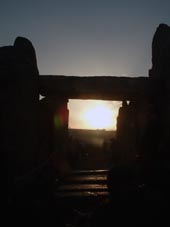
The Malta Independent
|
|
Heritage Malta organised a guided viewing of the phenomenon and it attracted a fair share of visitors – some local, some from as far away as Australia. The crowd started to gather at about 6am, working their way down from Hagar Qim to Mnajdra.
At about 6.30am, the sun’s rays slowly began to poke through the patches of clouds and then the magic took place.
|
The sun’s rays shone straight down the entrance hall to bathe the altar in warm sunlight, making one wonder what rituals the ancients performed on mornings such as yesterday’s over 5,000 years ago.
Whatever ritual used to take place, it must have been a quick one as the effect does not last very long, about 10 minutes before the sun starts to rise high in the sky, changing the angle of how the light hits the temple.
If ever there was evidence that these temples deserve more care and attention, this is it. It is a phenomenon that you do not see in many places – certainly not dating back to the time when these temples were used anyway.”
[Full Story]
“Historic observatory comes in handy again”
March 19, 2006, The Hindu, India:
“Jantar Mantar, the pale pink ancient observatory in the heart of the Capital, will become “useful” again. Introducing amateur astronomers to its finer points this Tuesday, the Nehru Planetarium has organised a lecture tour at the monument to show young enthusiasts the Spring Equinox.
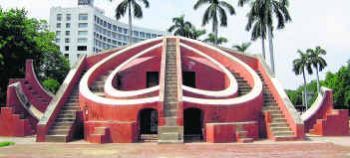
The Hindu, India
A chance to understand the Spring Equinox in not just textbook term, the lecture will give them an idea about the mathematics behind this phenomenon. Giving students the idea of the “zero” angle, the lecture tour has been organised in collaboration with the Archaeological Survey of India, the Amateur Astronomers Association and Apeejay Park Group of Hotels.
Not the first time that the Nehru Planetarium has decided to use Jantar Mantar to explain the mystic working of the sun, this is an attempt to bring alive the historic observatory where each ‘yantra’ is built to measure the movement of the sun.
Apart from introducing young children to science, such lectures also give students an opportunity to learn more about historical monuments. Making them realise the genius of observatories like Jantar Mantar that were built before the advent of modern technology, the idea is to get them to understand how these huge strangely shaped buildings work.”
[Full Story]
“Empire of the sun: An Ancient Egyptian sun temple
has been found in Matariya
March 08, 2006, Al-Ahram Weekly, Egypt:
“During a routine excavation to inspect the site of Souk El-Khamis in Matariya, an Egyptian- German team uncovered the remains of a sun temple dating back to the reign of King Ramses II.
This site is believed to be an important part of the ancient city of Iunu (ancient Heliopolis), which was one of ancient Egypt’s three main cities. In addition to being the city of sun worship, Iunu was an astronomical centre and a literary hub, where intellectuals, including Greek philosophers, studied.
Among the unearthed artifacts were a pink granite colossus, weighing five tonnes, whose features resemble those of Ramses II, and a 1.5 metre sandstone headless statue of a Pharaonic figure, whose back is engraved in hieroglyphic text.
While brushing the sand off, three cartouches of Ramses II were also uncovered, scattered on the temple ground, along with an unidentified pink granite royal head wearing a nemes (head dress).
Zahi Hawass, secretary-general of the Supreme Council of Antiquities, told Al-Ahram Weekly that further excavations revealed a number of talatat (small painted stones) bearing the name of Queen Nefertiti.
‘This suggests that the monotheistic King Akhenaten once built a temple or a shrine in this area’, he said, adding that archaeological evidence of massive constructions of sun temples had been carried out much earlier that the 19th Dynasty.”
[Full Story]
“Bronze Age clock that told man it was spring”
March 02, 2006, The Times, UK:
“The enigma of a priceless Bronze Age disc seems to have been solved by a Hamburg scientist who has identified it as one of the world’s first astronomical clocks.
|
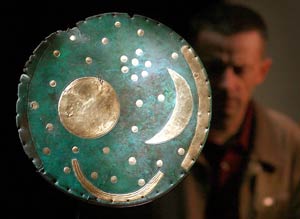
The Times, UK
|
|
The 3,600-year-old Sky Disc of Nebra, which surfaced four years ago when German grave robbers tried to sell it on the international market, shows that Bronze Age man had a sophisticated sense of time.
‘We have been dramatically underestimating the prehistoric peoples’, said Harald Meller, chief archaeologist of Saxony-Anhalt, where the disc was found.
|
The bronze disc is about 30cm in diameter, has a blue-green patina and is inlaid with a gold sun, moon and 32 stars. Robbers using metal detectors found it in 1999 alongside a pile of bronze axes and swords in a prehistoric enclosure on top of a hill in deep forest 112 miles (180km) southwest of Berlin.
The Nebra settlement is close to Europe’s oldest observatory in Goseck. The site appears to have had deep spiritual significance in the Bronze Age.
From the hill it is possible to see the sun set at every equinox behind the Brocken, the highest mountain peak of the Harz range.
And there are about 1,000 barrows, burial grounds for warriors and princes, in the nearby forests.”
[Full Story]
“Bronze Age Sky Disc Deciphered”
February 27, 2006, Deutsche Welle, Germany:
“A group of German scientists has deciphered the meaning of one of the most spectacular archeological discoveries in recent years: The mystery-shrouded sky disc of Nebra was used as an advanced astronomical clock.
|
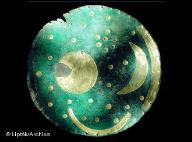
Deutsche Welle, Germany
|
|
The purpose of the 3,600 year-old sky disc of Nebra, which caused a world-wide sensation when it was brought to the attention of the German public in 2002, is no longer a matter of speculation.
A group of German scholars who studied this archaeological gem has discovered evidence which suggests that the disc was used as a complex astronomical clock for the harmonization of solar and lunar calendars.
|
‘This is a clear expansion of what we knew about the meaning and function of the sky disc’, said archeologist Harald Meller.
Unlike the solar calendar, which indicates the position of the earth as it revolves around the sun, the lunar calendar is based on the phases of the moon.
A lunar year is eleven days shorter than the solar year because 12 synodic months, or 12 returns of the moon to the new phase, take only 354 days.
The sky disc of Nebra was used to determine if and when a thirteenth month – the so-called intercalary month – should be added to a lunar year to keep the lunar calendar in sync with the seasons.”
[Full Story]
“Ancient Sun Temple with statues of Ramses II uncovered
February 26, 2006, African News Dimension, South Africa:
“Archaeologists discovered a pharaonic sun temple with large statues believed to be of King Ramses II under an outdoor marketplace in Cairo, Egypt’s antiquities chief said Sunday.
The partially uncovered site is the largest sun temple ever found in the capital’s Aim Shams and Matariya districts, where the ancient city of Heliopolis – the center of pharaonic sun worship – was located, Zahi Hawass told The Associated Press.
Among the artifacts was a pink granite statue weighing 4-5 tons whose features ‘resemble those of Ramses II’, said Hawass, head of the Supreme Council of Antiquities. Also found was a 1.5-meter-high (5 foot-high) statue of a seated figure with hieroglyphics that include three cartouches with the name of Ramses II – and a 3-ton head of royal statue, the council said in a statement.
King Ramses II, who ruled Egypt for 66 years from 1270 to 1213 B.C., had erected monuments up and down the Nile with records of his achievements, as well as building temples – including Abu Simbel, erected near what is now Egypt’s southern border.”
[Full Story]
“UC Davis Researcher Finds Ancient Science
and Math Are Timely”
February 09, 2006, UC Davis, USA: “Two UC Davis researchers are cracking both the hieroglyphic code and cultural and mathematical understandings behind a 5,000-year calendar that is still used today in Mexico and Central America.
Native American studies professor Martha Macri and graduate student Michael Grofe say their study of the Mesoamerican calendar is revealing how Native Americans were able to calculate with computer-like accuracy the movements of the sun, planets and the moon through time.
Macri, a linguistic anthropologist who studies ancient and contemporary languages, used her expertise to match the hieroglyphs — pictorial characters used in Mayan writing — to the 260-day ritual calendar.
With this knowledge, Macri created a theory that says the 260-day Mesoamerican calendrical cycle is based on various segments of the lunar cycle.
Because Central America is located between the tropics of Cancer and Capricorn, the area is an ideal place to develop an accurate calendar, Macri points out. Only in these latitudes is it possible to observe precise solar zeniths, or when the sun is at the center of the sky at noon.
By about 200 B.C., people living along the Gulf Coast in Central America developed the Long Count through their observations of the solar zeniths. The count forms the basis of the more extensive Mesoamerican calendar. The Long Count, with its 13 full cycles of 400 years each, accurately extends back to 3114 B.C., which is when the current era was supposed to have begun.”
[Full Story]
“Celestial and mathematical precision in ancient architechture”
January 07, 2006, The Manitoban, Canada: “Many ancient ruins demonstrate that the people who constructed them had not only a special regard for celestial bodies and mathematics, but also a spot-on accuracy.
From Egypt to Mexico, there is no doubt that past civilizations were involved in incredibly complex space calculations, mathematics and architectural endeavours. Although many historians and archaeologists debate exactly what these civilizations did intentionally and what they did by mere chance, here are a few examples of how ancient architecture was created with mathematics and the cosmos in mind.
The ancient Mayan site of Chichen Itza exemplifies the culture’s celestial orientation. The huge step pyramid (the pyramid of Kukulcan) that is the focus of the site has 91 steps on each of its sides, which add up to 364 steps.
Adding the platform on top, there are 365 steps in total — the number of days in a year. Also, on the vernal and autumnal equinoxes (the first day of spring and fall, when day and night are the same length of time), the sunlight works to create a shadow of a giant serpent on the staircase that faces north.
A building called the Caracol, believed to have served as an observatory, is also found at the site of Chichen Itza. The windows are set up to align with certain points of interest.
Although the top is damaged, remaining windows point to the northern- and southern-most positions of Venus, the position of sunset on the Equinoxes, and the corners of the building itself point to the sunrises and sets of the solstices.”
[Full Story]
“The majestic standing stones of Callanish”
January 03, 2006, The Scotsman, Scotland: “Stone circles are evocative places and the stones at Callanish on the Isle of Lewis must be one of the most haunting. Not only is there the imposing physical presence of the stones and their spectacular landscape setting, there is also the atmosphere of mystery. Callanish (or Calanais) is one of the larger stone settings of Britain.
|
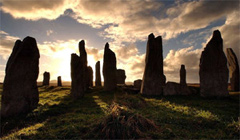
The Scotsman
|
|
The stones tower to a height of nearly four metres and the main monument covers an area of some 5,000 square metres. The circle itself is relatively modest and comprises 13 upright stones with a huge megalith at the centre marking a later burial cairn. Callanish is set apart, however, by two things:
|
The stone settings that run away from the circle in the form of a cross and the presence of at least six other stone circles in the vicinity.
There is general agreement that many of these sites have astronomical associations and Callanish is no exception. It seems to be linked to the rising of the moon in the south when, at a major standstill, it barely enters the sky, seeming to roll along the horizon to set among the stones.
This would be a magical sight that took place every 18.6 years. It required skill to incorporate it into the circle, but the prehistoric population is likely to have been much more familiar with the night sky than we are.
Not only did they lack the distraction of electric light to dim the moon and stars, but they also lacked modern technology and thus had to rely more upon observation to tell the passing of the year and the coming of advantageous weather.”
[Full Story]
|
|
To understand why this News Page is sometimes late here is some information about Fibromyalgia
if you would like to support our marine archaeology research
The Morien Institute
Research Projects
please send us a book

from our Wish List
useful books from our
Astro-Archaeology
Bookshoppe
“A Little History of
Astro-Archaeology”
by
John F. Michell
EU English Edition
“Stonehenge today is a battlefield, not only for police and festivalgoers at midsummer but also for rival camps of archaeologists, astronomers, and other researchers into the mysteries of prehistoric religion and science. Controversy flared up in 1963, when Gerald Hawkins made early use of the computer to identify Stonehenge as an observatory for the sun and moon and an instrument for predicting eclipses. Further studies of megalithic sites by Alexander Thom proved that many of them were also related to the seasonal positions of the heavenly bodies.
The study of astro-archaeology has now expanded worldwide, bringing new revelations about the mystical sciences of antiquity. This “little history” summarizes the issues involved in astro-archaeology, and illustrates its principal sites and personalities. Included are recent findings of British scientists, whose records of anomalous levels of natural energies at stone circles are in accordance with the magical reputations of such places in local folklore.”
“Under Ancient Skies:
Ancient Astronomy and
Terrestrial Catastrophism”
by
Paul Dunbavin

EU Edition Only
but avialable
worldwide
“In all of the world’s myths and religions we find traditions of a Great Flood. There are stories too of a Golden Age: the antediluvian paradise that it destroyed. Might these be real memories of the ancient world? And how can we analyse the subject scientifically? The key to unlock these ancient myths lies in astronomy. “Under Ancient Skies” will examine the astronomical evidence for an ancient cataclysm and in the process will explore a number of related anomalies in prehistory, including: Was there a single great flood in human prehistory, or have there been many?
Could the workings of ancient calendars and the records of ancient eclipses give us clues about the Flood and the antediluvian world? Did the Celtic Druids use a calendar based on the orbit of Saturn; and is this the same antediluvian calendar as is described in Plato’s myth of Atlantis? Do Hindu, Chinese and Mayan cosmology myths recall the years after the Flood when our world wobbled on its axis?
Geologists have recently found the crater in Yucatan, where an asteroid impact destroyed the world of the dinosaurs. Scientists and astronomers have stopped dismissing the theory that a comet could have struck the Earth during prehistory – but any suggestion that a comet impact just a few thousand years ago might have caused the Biblical Flood, remains the last taboo. It is time for this barrier too to be washed away. If you read this book and you understand it then be warned – it may scare you!”
“East Asian Archaeoastronomy: Astronomical Observations of China, Japan and Korea”
by
Xu Zhentao,
Jiang Yaotiao
&
David W. Pankenier

EU English Edition
“Historical astronomical records can play an important role in modern research, especially in the case of ancient Chinese observational data: sunspot and aurora records are important for the study of solar variability; solar and lunar eclipse records for the study of the Earth’s rotation; records of Comet Hally for the study of orbital evolution; “guest star” records for the study of supernova remnants; planetary conjunction records for research in astronomical chronology.
In the past, Western scientists have not been able to exploit these valuable data fully because the original records were difficult to gather and interpret, and complete English translations have not been available. East-Asian Archaeoastronomy is the first comprehensive translation into English of such historical records for modern research.
The book also features an introduction to East Asian astronomy and offers guidance on how to use the records effectively. It will not only be a valuable research tool for astronomers but should also be of great interest to historians of China and Chinese science. Xu; Zhenoao Purple Mountin Observatory,Pankenier; W Department of Modern Foreign Language and Literatur,Yaotiao; Jiang Nanjing University , China.”
“Exploring Ancient Skies: An Encyclopedic Survey of Archaeoastronomy”
by
David Humiston Kelley
&
Eugene F. Milone
EU English Edition
“Exploring Ancient Skies brings together the methods of archaeology and the insights of modern astronomy to explore the science of astronomy as it was practiced in various cultures prior to the invention of the telescope. The book reviews an enormous and growing body of literature on the cultures of the ancient Mediterranean, the Far East, and the New World (particularly Mesoamerica), putting the ancient astronomical materials into their archaeological and cultural contexts.
The authors begin with an overview of the field and proceed to essential aspects of naked-eye astronomy, followed by an examination of specific cultures. The book concludes by taking into account the purposes of ancient astronomy: astrology, navigation, calendar regulation, and (not least) the understanding of our place and role in the universe.
Skies are recreated to display critical events as they would have appeared to ancient observers – events such as the supernova of 1054, the ‘lion horoscope’ or the ‘Star of Bethlehem.’Exploring Ancient Skies provides a comprehensive overview of the relationships between astronomy and other areas of human investigation. It will be useful as a reference for scholars and students in both astronomy and archaeology, and will be of compelling interest to readers who seek a broad understanding of our collective intellectual history.”
“Echoes of the Ancient Skies: The Astronomy of Lost Civilizations”
by
E.C. Krupp

EU English Edition
“All over the world, through countless centuries, people have looked skyward for inspiration and guidance in their lives and activities. For most of the history of humankind, going back to the Stone Age, the sky has served as a tool. The regularity of the motions of celestial objects enabled our ancestors to orient themselves in time and space, satisfying their need for human order. How vast this heavenly influence was, and how awesome the human achievements it engendered were, are illuminated in this extraordinary work of investigation and discovery.
With hundreds of illustrations and photographs, Echoes of the Ancient Skies is a sweeping look at the world of archaeoastronomy from the prehistoric megaliths of Stonehenge, to the medicine wheels of North America, to the Aztec “Calendar Stone.”
The intriguing field of archaeoastronomy–the study of ancient peoples’ observation of the skies and its role in their cultural evolution–seeks to explore the “universal evidence that people have used astronomy as the model for injecting order and predictability on their behavior and on life.” Examining this universal behavior, Dr. E.C. Krupp takes the reader to sites throughout the world (most of which he has personally visited)–from Egypt, China, Babylonia, and Greece, to Turkey, Scotland, Wyoming, and Mexico. He interprets the significance of celestial observation and its relation to the earthly experiences of our ancestors, from practical applications of farming and the measurement of time to philosophical queries into our particular place within the universe.”
“The Stones of Time: Calendars, Sundials, and Stone Chambers
of Ancient Ireland”
by
Martin Brennan
EU English Edition
“The Stones of Time presents one of the most dramatic archaeological detective stories of our time. Predating Stonehenge by at least a thousand years, the stone complexes of ancient Ireland have been extensively studied, yet have refused to give up their mystery. The most complete record of Irish megalithic art ever published.
Martin Brennan is a New York artist who spent three years of study on prehistoric art in Mexico and a similar period in Japan. Of Irish parentage, he was drawn to Ireland and the Boyne Valley, where he spent six years studying the neolithic stone chambers and their symbolic art before formulating the groundbreaking theories set forth in this book.”
“America’s Stonehenge:
The Mystery Hill Story”
by
David Goudsward
&
Robert E. Stone

EU English Edition
“America’s Stonehenge sits atop Mystery Hill in North Salem, New Hampshire. It is an acre of stone structures surrounded by a 12-acre calendar. Alignments and carbon dating indicate the site was built 4000 years ago. In this book the authors explore the historical and prehistoric clues left behind at the archaeology site once described as a ‘mystery wrapped in an enigma’.
The history of the site is examined and traced from the clues left behind from visitors, residents and researchers, and how that has led to today’s research and the current interpretation of the evidence.”
“Skywatchers, Shamans and Kings: Astronomy and the
Archaeology of Power”
by
E.C. Krupp
EU English Edition
“Discover the celestial myths and cosmic rituals of ancient priests and kings … Drawing on intimate knowledge of the more than 1,300 ancient sites he has visited, E. C. Krupp, acclaimed writer and preeminent researcher, takes you to the world’s essential sacred places and celestial shrines. Join him on a rich narrative journey to see where the rulers of old communed with the gods of the sky.
They ruled kingdoms and empires for thousands of years, tracing their lineages to gods in the sky and mastering the forces they believed moved the sun and moon, planets and stars. In an evocative, illustration-rich journey through lost civilizations, E. C. Krupp describes the workings of sky worship practiced by the pharaohs, emperors, lamas, and shamans of old.”
“In Search of Chaco:
New Approaches to an
Archaeological Enigma”
by
David Grant Noble
(Editor)
EU English Edition
“Startling discoveries and impassioned debates have emerged from the “Chaco Phenomenon” since the publication of New Light on Chaco Canyon twenty years ago. This completely updated edition features seventeen original essays, scores of photographs, maps, and site plans, and the perspectives of archaeologists, historians, and Native American thinkers.
Key topics include the rise of early greathouses; the structure of agricultural life among the people of Chaco Canyon; their use of sacred geography and astronomy in organizing their spiritual cosmology; indigenous knowledge about Chaco from the perspective of Hopi, Tewa, and Navajo peoples; and the place of Chaco in the wider world of archaeology.”
“Megaliths, Myths and Men:
An Introduction to
Astro-Archaeology”
by
Peter Lancaster Brown
EU English Edition
“Noted British astronomer’s fascinating study of early astronomical knowledge through the interpretation of Stonehenge, Carnac, other megalithic sites. Stone Age sculpture, astronomical computations, radiocarbon dating, many other topics. Over 140 maps, photos, illustrations. The author has very comprehensively analysed several sites and shown how they can be used as astronomical machines.
He discusses the different interpretations of the sites and includes many diagrams of sites including the important astronomical alignments. Very enjoyable overview of archaeo-astronomy. Brown neatly debunks the lunatic fringe, reveals some of the unsung heroes of the field, and provides a clear summary of current ideas for the lay person.”
“Stonehenge: A New Interpretation of Prehistoric Man and the Cosmos”
by
John David North
EU English Edition
“Argues that Stonehenge’s scientific purpose was to observe the setting midwinter sun, and that astronomical observations made by the ancient Britons were as rational and methodical as they are today. North brings his distinguished background in astronomy to this study of Neolithic monuments. His aim is ‘to discover certain patterns of intellectual and religious behavior through a study of archaeological remains that seem to have been deliberately directed in some way towards phenomena in the heavens.’
Most of this book is a painstakingly detailed on-site investigation. Judging from the scale of Stonehenge and other monuments that incorporated astronomical alignments, North argues that the heavens played a central place in Neolithic and Bronze Age religion.”
“Astronomy in Prehistoric
Britain and Ireland”
by
Clive Ruggles

EU English Edition
“Do prehistoric stone monuments in Britain and Ireland incorporate deliberate astronomical alignments, and if so, what is their purpose and meaning? This work provides an account of megalithic astronomy debates and examines prehistoric man’s concern with celestial bodies and events. For decades debates have boiled among archaeologists and astronomers over the idea that prehistoric stone monuments in Britain deliberately incorporate astronomical alignments.
In this book Clive Ruggles is the first to approach the subject from the perspectives of both disciplines. He analyzes the history and lessons of previous debates, the most current research, and new agendas for future research.”
“Ancient Astronomers
(Exploring the Ancient World)”
by
Anthony F. Aveni
&
Jeremy A. Sabloff
EU English Edition
“Anthony Aveni is well known in scholastic circles for his many excellent and ground-breaking publications in the field of archaeoastronomy. This particular volume is geared toward interested laymen and uninitiated scholars who are not yet well grounded in the history of astronomy or ideas of cosmology from an anthropological perspective. The book is graced with numerous and apt illustrations, while the text reads easily with Aveni’s smooth and informative style.
Chapters were clearly organized thoughtfully, as information builds upon previous explanations and new concepts or ideas are charted out for the neophytes as needed. “Ancient Astronomy” provides an ideal introduction to archaeoastronomy, ethnoastronomy, and cosmology for students in anthropology and the history of astronomy.”
“Prehistoric Astronomy
in the Southwest”
by
J. McKim Malville
&
Claudia Putnam
EU English Edition
“Archaeoastronomy is a discipline pioneered at Stonehenge and other megalithic sites in Britain and France. Many sites in the southwestern United States have yielded evidence of the prehistoric Anasazi’s intense interest in astronomy, similar to that of the megalithic cultures of Europe. The authors describe the astronomical alignments at the well-known sites of Chaco Canyon and Hovenweep and present new evidence, based on recent field work of alignments at Yellow Jacket, Chimney Rock, and Mesa Verde.
Drawing on the archaeological evidence, ethnographical parallels with historic pueblo peoples, and mythology from other cultures around the world, the authors present theories about the meaning and function of the mysterious stone alignments and architectural orientations of the prehistoric Southwest.”
“Stairways to the Stars: Skywatching in Three Great Ancient Cultures”
by
Anthony F. Aveni
EU English Edition
“What is the meaning of Stonehenge? Why was the elaborate Incan city of Cuzco built? What is the significance of the Great Pyramid at the ancient Mayan city of Chichén Itz´? These ancient structures have spellbound natives and tourists alike. This mysterious architecture points to a centuries-old search for celestial order. Anthony Aveni, a professor of astronomy and anthropology, takes us on a stimulating virtual tour of these legendary constructions.
He describes how they were built and straightforwardly and often humorously critiques diverse theories attempting to explain their origin and function. For example, Aveni breathes life into the mysteries of the Great Pyramid and its use as a sacred temple, sacrificial altar, and celestial calendar.”
“Songs from the Sky: Indigenous Astronomical and Cosmological Traditions of the World”
by
Von Del Chamberlain (Editor)
J.B. Carlson (Editor)
M.J. Young (Editor)
EU English Edition
“This substantial collection of papers on indigenous astronomical knowledge is quite unequalled in its scope and extent. The authors are drawn from a variety of academic disciplines, including anthropology, archaeology, astronomy, engineering, art history, history of science, history of religion, folklore, and mythology, and bring a variety of academic perspectives to bear upon aspects of celestial knowledge and perception in diverse social contexts from many different parts of the globe.
The Americas provide the main geographical focus, with twenty of the 32 papers concerning indigenous north American groups such as the Navajo, Lakota, Zuni and Blackfoot, the Mixe and Tzotzil Maya of southern Mexico, the Andean highlands and the Amazonian region of Peru, and southern coastal Brazil. The remaining twelve articles extend to the Arab world, sub-Saharan Africa, southern India, Java, Melanesia, Australia and Polynesia, with a few addressing broader synthetic themes. For a number of the culture areas dealt with in some detail here, other published information about sky knowledge is extremely scant.”
“Stars, Stones and Scholars: The Decipherment of the Megaliths as an Ancient Survey of the Earth by Astronomy”
by
Andis Kaulins
EU English Edition
“In a thought-provoking analysis of prehistoric art, astronomy, archaeology and the history of civilization, “Stars, Stones and Scholars” presents the decipherment of the megaliths (standing stones) by Andis Kaulins, Lecturer at the University of Trier in Germany. “Stars, Stones and Scholars” shows that ancient megalithic sites are remnants of ancient local, regional and worldwide Neolithic surveys of the Earth by astronomy. Circa 40 photographs, 240 drawings and 80 maps show how megaliths were carved and “sculpted” with figures and cupmarks (holes in the stones) to represent stars and constellations, long before the modern astrological Zodiac was known.
Megalithic sites from England (Stonehenge), Wales (Paviland), Scotland (Clava Cairns), Ireland (Newgrange, Knowth), Germany (Externsteine), Benelux (Weris), France (Carnac), Italy (La Spezia), Malta (Tarxien), Greece, Turkey (Anatolia), Scandinavia (Tanum), the Baltic, Russia, the Near East, the Far East (China and Japan), Africa, Central and South America (Tikal, Maya, Aztecs), Oceania (Hawaii), The USA (Cahokia, Miami Circle, Clovis) and Canada (Peterborough Petroglyphs) are included in this fascinating book – which, as it is corroborated over time by the research of others – will become a landmark of human literature.”
“The History and Practice of Ancient Astronomy”
by
James Evans
EU English Edition
“In Ptolemy’s The Almagest, the earth is placed at the centre of the universe and the planets move in crystal spheres against a backdrop of the fixed stars. While these ideas have been swept away since the Scientific Revolution, Ptolemy’s influence on astronomy was profound and long–we’ll be dealing with the Y3K problem before Copernicus’ time of influence catches up.
James Evans, historian and astronomer at the University of Puget Sound, believes that “staying close to the practice of astronomy means explaining a subject in enough detail for the reader to understand what the ancient astronomers actually did. As this unique book teaches you to do astronomy the old-fashioned way, you gain a deeper understanding of what the Greeks and their successors thought and did. “There is all the difference in the world between knowing about and knowing how to do,” says Evans.”
|
