|
“Archaeology magazine picks top 10 discoveries of 2007”
December 20, 2007, People’s Daily, China:
“Archaeology magazine, a publication of the Archaeological Institute of America, has selected the 10 most important archaeological discoveries in 2007, published in its January/February 2008 issue.
Solar Observatory at Chankillo, Peru
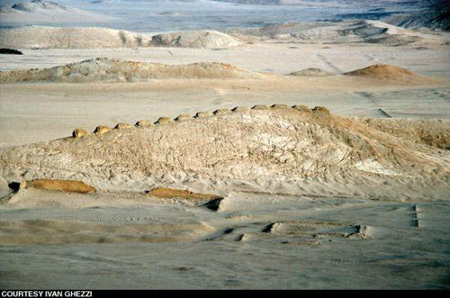
Ivan Ghezzi/The People’s Daily, China
Travelers have noticed the 13 stone towers rising over Peru’s coastal desert since at least the nineteenth century. But researchers only last year discovered the structures’ purpose: they make up a sophisticated solar observatory, one of the earliest known in the Americas.
Greater Angkor, Cambodia
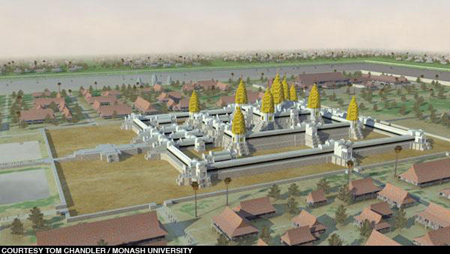
The People’s Daily, China
The capital of a Khmer state that flourished between the ninth and fifteenth centuries, Cambodia’s Angkor is one of the most intensively studied sites in the world. But it continues to inspire more questions than answers, the most fundamental being why the sophisticated Khmer Empire collapsed. In 2007, research into the mysteries of the world’s largest preindustrial city reached a milestone with the completion of a 10-year mapping project, which yielded clues suggesting that the sprawling metropolis may have collapsed under self-induced environmental pressures related to overpopulation and deforestation.
[Analysis of the Angkor complex by Graham Hancock and others has revealed sophisticated astronomical orientation of the whole site, with a wide variety of astronomical principles incorporated into the design and layout. Ed]
The other top ten archaeological discoveries of 2007 are:
* Nebo-Sarsekim Tablet, The British Museum, UK
* New Dates for Clovis Sites, North America
* Early Squash Seeds,Peru
* Ancient Chimpanzee Tool Use
* Urbanization at Tell Brak, Syria
* Lismullin Henge, Tara, Ireland
* Polynesian Chickens in Chile
* Homo habilis & Homo erectus, Kenya
[Full Story with al the images]
“Where to celebrate the world’s oldest holiday”
December 19, 2007, The Independent, Ireland:
“What would the Stone- Age farmers who built Newgrange make of the giant television screens and webcams that will be installed there for the first time this Friday to bring the remarkable spectacle of the winter solstice to a wider audience?
In the same way the ancient Egyptians must have turned in their pyramids at the sight of King Tutankhamun’s leathery mummy being unravelled last month for all the world to see, they would probably find the whole affair rather unsavoury.
But anyone who has witnessed the burial chamber at Ireland’s most ancient treasure fill up with golden sunlight on December 21 will know there are few sights more beautiful and mysterious in the world.
Such is the popularity of the event at what is arguably the planet’s oldest astronomical observatory, more than 24,000 people now apply to a new lottery to enter the tomb on the shortest day of the year after the 15-year waiting list was abandoned.
But seasoned solstice watchers know that the orientation of ancient standing stones towards celestial dates of significance is not confined to Newgrange. Here’s a selection of the best of the rest:
Dawn breaks: Baltray standing stone, Co. Louth, at sunrise on midwinter’s day
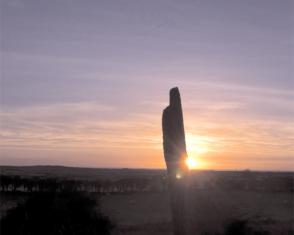
The Independent, Ireland
Let there be light: The solstice at Knowth, Co Meath
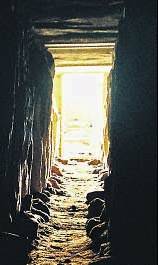
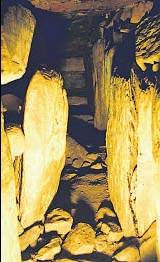
The Independent, Ireland
Some of the other Irish megalithic sites with astronomical alignments include:
* Knockroe, Co. Kilkenny
* Dowth, Bru na Boinne, Co. Meath
* Uisneach, Co. Westmeath
* Drombeg Stone Circle, Co. Cork
* Beltany Stone Circle, Co. Donegal
* Hill of Tara, Co. Meath
and many, many more …..
[Full Story with more images]
“Hurlers may have been built to mirror the stars
say astronomers”
December 19, 2007, Daily Mail, UK:
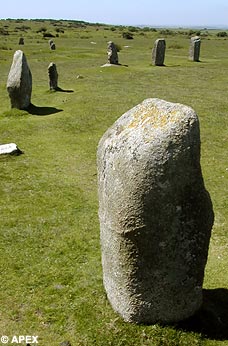
“An amateur astronomer could have finally unravelled the mystery of the ancient Hurlers on Bodmin Moor. The three stone circles in Cornwall have been discovered to align perfectly with the constellation Orion.
|
APEX, Daily Mail
|
|
New research now suggests The Hurlers were built as a primitive calender which indicates the exact date of mid winter.
Once a year at midnight on the winter solstice, they line up exactly with Orion’s position in the night sky.
Brian Sheen, a retired research chemist and astronomer who runs the Roseland Observatory, in St Stephen, Cornwall, said the stones were built around 1500 BC. Using a specialist computer programme that predicts the future position of stars he confirmed the alignment between Orion and the circles would occur.
Mr Sheen said: ‘As far as I can tell these Hurlers, a series of three stone circles, actually mirror the belt of Orion.’
|
‘Just once a year at the winter solstice Orion passes due south at midnight’.
‘It confirms that the people that built the Hurlers around 1500 BC were fully aware of day length and season and had more knowledge of astronomy than we thought.’
[Full Story with more images]
“Oklahoma Indian mounds site will host winter solstice walks”
December 09, 2007, The Dallas Morning News, USA:
“TEXAS & NEIGHBORS Spiro Mounds Archaeological Center in eastern Oklahoma will conduct winter solstice walks Dec. 22.
The center’s nine ancient platform and burial mounds are part of an 80-acre site believed to have been occupied from A.D. 850 to 1450 by American Indians who were part of a Caddoan cultural tradition called the Southern Cult or Southeastern Ceremonial Complex.
Some of the man-made earthen mounds are aligned with the sun at sunset on the winter and summer solstices and the vernal and autumnal equinoxes.
The site is in LeFlore County south of Interstate 40 and near the Arkansas River. It is Oklahoma’s only state archaeological park.”
Contact: 918-962-2062; more details of the event can be found at: www.spiro.lib.ok.us/mounds.htm and www.ou.edu/cas/archsur/coun ties/leflore.htm
“Joseon Dynasty’s Mobile Astrolabe Found”
December 07, 2007, Dong-A Ilbo, South Korea:
“A portable astronomical watch known as an astrolabe, made in Joseon Dynasty in the late 18th Century, had been found and returned to Korea.
Jeon Sang-un, a science historian and member of the Cultural Properties Committee, said on Thursday that he bought and brought the astrolabe that a Japanese person took during the Japanese colonial rule after being made in 1787 back to Korea.
An astrolabe is a mobile astronomical instrument for locating the positions of stars, determining local time, and surveying longitude and latitude. While the Honjeonui, a huge celestial globe, is a fixed astronomical instrument, an astrolabe is one that can be carried.
After ancient times, astrolabes were mainly produced in Arabia, and the astrolabe that was found this time was the first one made in East Asia, Jeon explained.”
[Full Story]
“Rediscoverer of Chaco’s Sun Dagger to meet public”
November 30, 2007, Gallup Independent, USA:
“The woman who rediscovered the Sun Dagger solstice site at Chaco Canyon in 1977 will sign copies of her new book and show her documentary film on Saturday.
The public is invited to meet Anna Sofaer at a reception that runs from 3:30 to 6 p.m. on Saturday at the Red Mesa Center, 105 W. Hill. Sofaer will sign copies of her book, ‘Chaco Astronomy: An Ancient American Cosmology’, following the 3:30 p.m. screening of ‘The Mystery of Chaco Canyon’, a one-hour documentary narrated by Robert Redford.
|
Gallup Independent
|
|
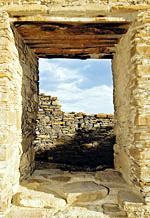
The sun sets over the Chaco Canyon National Monument on Saturday evening. In 1907 the area of Chaco Wash known as Chaco Canyon was named a national monument. [Photo by Matt Hinshaw/Independent]
While working on a field project atop Fajada Butte in Chaco Culture National Historical Park in midsummer of 1977, Sofaer witnessed a remarkable phenomenon: a single shaft of light perfectly bisecting a spiral petroglyph inscribed there long ago by ancestral pueblo people.
|
Recognizing the significance of this site, Sofaer began a three-decade odyssey of intense investigation to recover the meaning of astronomical expressions throughout the architecture and rock art at Chaco Canyon. These efforts changed forever the public’s understanding of what has been termed “America’s Stonehenge.”
The documentary film, which Sofaer produced, explores the astronomy of the ancestral pueblo people.
[Full Story]
“Ancient Chinese Astronomy: New insights from old information”
November 26, 2007, FirstScience, UK:
“China has the world’s longest-running observations of the sky: though based in astrology, they are of unique importance to astronomy today.
|

FirstScience, UK
|
|
In 210 BC, the great First Emperor of China was buried near Xi’an with his famous Terracotta Army of full-sized clay warriors. According a contemporary account, his own tomb – yet to be excavated – was even more lavish, containing a fabulous double map:
‘Below was a map of the Earth. The hundred rivers of the Empire were modeled in mercury: cleverly designed machines made the rivers flow. Above everything was the starry vault.’
|
This map reflected the crucial role that the sky played in ancient Chinese thought. The heavens weren’t remote from everyday life. The sky was a mirror of the Earth.
Every time that something unexpected occurred in the sky, it showed a disruption on the Earth – which, in effect, meant somewhere in China. To pinpoint exactly where, the Chinese split the stars into 283 small constellations, representing different parts of the Empire.
On 7 December, AD 185, for instance, Chinese astronomers spotted a brilliant new star and reported: ‘A guest star appeared within the Southern Gate. It was as large as half a mat; it showed the five colours and it scintillated.’
The Chinese astronomers kept watch from a raised platform, where four observers faced north, south, east and west; while a fifth lay on his back and looked straight upwards – surely the best job! The next morning they reported to the Astronomical Bureau, which kept records from 206 BC to AD 1912 – the longest-lived bureaucracy the world has ever seen.
Today, astronomers can mine this ancient archive for unique information on astronomical events.
[Full Story]
“The Thunderbolts Project”
November 25, 2007, ZP Energy, USA:
“The Thunderbolts Project calls into question not only countless modern scientific assumptions, but also the billions of dollars of big-science government and corporate funding that continues to preserve and entrench questionable theories – elevating them to the status of doctrine – while systematically excluding legitimate alternatives that threaten the status-quo. Alternatives that may represent the future of science.
The Thunderbolts Project offers remarkably simple explanations for ‘black holes’, ‘dark matter’, the electric sun, comets that are NOT made of ice, planetary scarring and many other ‘mysterious’ phenomena.
It proposes that much of the currently observable phenomena of deep space can be intelligently explained by already known principles of electricity. High school students get it immediately. A doctorate in higher math is not required.
This extraordinary new theory also redefines ancient history, linking rock art images carved in basalt 5,000 years ago with identical images found only in Hubble photographs of deep space or in photographs of recently declassified high-energy plasma discharge experiments generated in a billion dollar lab.”
[Full Story]
“Prehistoric Cahokia topic of museum program”
November 17, 2007, The Courier-News, USA:
“This month, clocks were turned back one hour for daylight saving time. But people today are not the first ones to make changes in their lives to make the best use of the rising and setting of the sun.
|
The Courier-News, USA
|
|
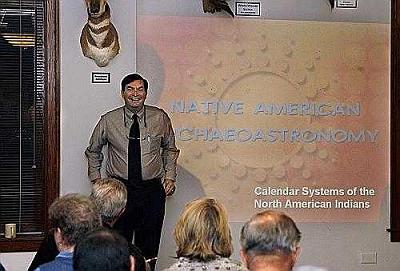
Cahokia Mounds expert William Iseminger talked to area residents on Friday, Nov. 9, at the Elgin Public Museum on how Native American mounds, pyramids and pueblos were designed in relation to the sun. ‘Native Americans relied on the skies to tell them when the seasons began’, Iseminger said.
|
Iseminger showed the reconstructed earthen lodge in Georgia where twice a year the chief’s seat at the entrance is illuminated by sunlight. He also showed El Castillo pyramid at Chichen Itza in Mexico where the shadow of a snake moves along the steps of the pyramid during the spring and fall equinoxes.
At Templo Mayor in Mexico, twin pyramids were built so the sun could be seen rising between them.
[Full Story]
“Four markers for observance of lunar, solar eclipse
revealed at Kokino”
November 02, 2007, MPT Online, Macedonia:
“People possessing great knowledge of the Sun and the Moon, as well as the secret of their eclipse, had existed in the period between 18-20 centuries B.C.
|
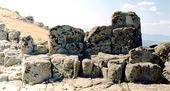
MPT Online, Macedonia
|
|
This people created a lunar calendar and organized its life according to it. This is confirmed by four special markers for observance of the initial cycle of the solar and lunar eclipse, revealed at Kokino observatory, which is more than 35 centuries old, said archaeological research manager Gjore Conev at Thursday’s press conference.
|
‘The archaeological analysis has resulted in two significant revelations, which define Kokino’s lunar calendar, and assist in the measurement of 29- and 30-day lunar months’, Stated Conev.
‘”The oldest revealed marker at Kokino dates from 1917 B.C. The markers are set at a distance of 54 years and 34 days, while the others date from 1863, 1809 and 1755 B.C.’, stressed Conev, adding it is a mystery whether the people disappeared or changed its cult, because there are no markers after the year 1700 B.C..
[Full Story]
“Equinox at Mnajdra”
September 08, 2007, The Malta Independent, Malta:
“Heritage Malta is organising two early-morning visits to the prehistoric Mnajdra Temples, on Saturday 22 and Sunday 23 September for members of the public.
On these days, the rays of the rising sun pass directly through the main doorway, straight down the central axis, and reach the innermost, central apse. This phenomenon can also be seen during the spring equinox.
Although there is no definite proof that the temples were used as calendars, the orientation of these megaliths is so systematic that it is widely believed that this was very probable. In prehistoric agricultural societies, observation of the motion of the stars, the moon and the sun could have been related to the changing seasons and times of planting and harvesting of crops.
Participants will meet at 6am in front of the main gate of Hagar Qim Temples to walk down to the Mnajdra Temples, afterwards they will climb back for a tour of the Hagar Qim Temples.
‘This has been sent away to be dated. The team watched the summer solstice sunrise on 21 June. From the middle spot the sun rolls and rises up the side of Ronas Hill – the highest hill on the Shetland mainland’.“
[Full Story]
“Unveiling Chichén Itzá’s secrets of Quetzalcoatl”
August 17, 2007, The Salt Lake Tribune, USA:
“The Feathered Serpent Quetzalcoatl battled through the cotton-candy cloud, ripping at its billowing corners with razor-sharp talons. He’d been coming here for more than a thousand years, his shadow moving up the side of El Castillo, Chichén Itzá’s largest pyramid, on the spring and fall equinoxes like clockwork.
|

The Salt Lake Tribune
|
|
There was no way the rain god Chaac and his little cloud would stop Quetzalcoatl – at least, that’s what 8,000 modern-day pilgrims and I were hoping as we arched our backs for a better view. We’d gathered at the Mayan-Toltec site’s towering El Castillo pyramid, deep in the heart of Mexico’s Yucatán Peninsula.
|
And then it happened: Quetzalcoatl, the god of wind, creativity and fertility, poked his head through the cloud revealing a glimpse of his snakelike image, an undulating shadow illuminated on the side of the pyramid’s nine-tiered northern staircase.
This is the essence of pilgrimage that lies at the center of the mystery and appeal of Chichén Itzá’s equinox celebrations, held each year on Sept. 22 and March 20. This fall, the ceremony will have added honor: In a recent global poll, Chichén Itzá was named one of the Seven New Wonders of the World.
Devotees have been coming here since the pyramid was built in the ninth century.”
[Full Story]
“READING ROOM: The mysterious mounds in Bulgaria”
August 06, 2007, The Sofia Echo, Bulgaria:
“Nothing but billions of corn and wheat stalks, as far as the passengers could discern as their bus jostled along the bumpy, pot-holed road somewhere between Shoumen and Silistra.
Here and there, among the otherwise flat terrain embellished by the wayside with colourful, plastic bags, small hills jutted out. Partially covered with small trees and bushes, they resembled islets on TV’s Survivor.
But how had these geographical anomalies come about? Were they formed through volcanic activity? Moles? Ants? Transplants from the Caribbean? Mariana Todorova, a city woman, displayed more maturity: ‘Obviously those mounds were constructed as part of a water reservoir system during communism’.
|
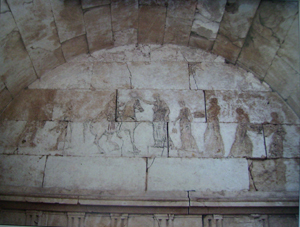
The Sofia Echo, Bulgaria
|
|
Everyone then followed Elena Nedelcheva, our new guide, along a cement road, the only decent so far, into a necropolis – a small section of the ‘Hundred Mounds’ mentioned in mediaeval chronicles that spread over 674 hectares.
At an altitude of 289m, the highest point in Sveshtari is the top of Golyama Mogila (Big Mound).
|
On the surface, literally, the tumuli seemed haphazardly arranged and random in size. Scientists, however, have noticed that they mirrored the brighter constellations such as Gemini, Eridan and Orion. The particular mounds here matched the Canis Major-which includes the North Star. Nedelcheva told us that these had been built by the Getae, a people whose exact origins and identity are still being debated.
No one knows for certain what they mean. Perhaps they are a depiction of Mother Goddesses that in turn represent the continuation of life, revival and bountiful harvests. Or they may symbolise the Getae’s 10-stage cosmology cycle. With individual faces they may also be images of ladies in attendance.
Above the entrance to the chamber, a small, window-like aperture could be seen. Scientists have figured out that at precisely noon on 22 December (the winter solstice) at the end of the 300s BCE, the sun’s ray would penetrate this opening and, as well as illuminating the entire chamber, fall exactly on the king figure. Besides shrouding him in an aura, the light acted as a path for the man’s soul to the heavens.”
[Full Story]
“Scholar revives ancient subject”
August 05, 2007, BBC News Online, UK:
“A Swansea University historian hopes to discover more about an ancient discipline which may have provided ‘the GPS system’ of its day, 500 years ago.
Dr Adam Mosley will study cosmography, a subject believed to combine geography, history and astronomy.
|

BBC News Online, UK
|
|
He will also try to find out how it died out in around the 17th Century.
The lecturer wants to discover more about its study and how strong its links were with the seafarers’ art of navigating by the stars.
|
The subject became popular around 500 years ago but died out and part of Dr Mosley’s work will be to find out why. He is undertaking a two month fellowship at Cambridge University to find out more
Historians believe that cosmography as a discipline originated as the result of a mistake in translating texts recovered from the ancient world. It is first used in a translation of a text by the mathematician, geographer and astronomer Claudius Ptolemy, in a description of the world as it was known to the ancient Greeks and Romans.
‘We are not sure why cosmography died or even to what extent it ever really existed as a subject’, said Dr Mosley, who specialises in the history of early modern science.”
[Full Story]
“Archaeologists rise to solstice circle discovery”
July 05, 2007, The Scotsman, Scotland:
“Archaeologists working on a remote Scottish island have discovered an ancient stone ceremonial enclosure that is perfectly aligned to the winter and summer solstices.
The find was made by members of the Bath and Camerton Archaeological Society (Bacas) working on the island of Foula.
Isobel Holbourn, who owns the land in Foula where the discovery was made, said: ‘We knew there was something there, and the archaeologists found an egg-shaped circle of stones. It turns out that the winter sunrise goes right up the middle, while the summer solstice rises at right angles to it.
‘The circle is egg shaped, and in the centre they dug a trench and found a paved area and a bit of black pottery in between the stones.’
‘This has been sent away to be dated. The team watched the summer solstice sunrise on 21 June. From the middle spot the sun rolls and rises up the side of Ronas Hill – the highest hill on the Shetland mainland’.“
[Full Story]
“Calendar question over star disc”
June 25, 2007, BBC Science News, UK:
“Archaeologists have revived the debate over whether a spectacular Bronze Age disc from Germany is one of the earliest known calendars.
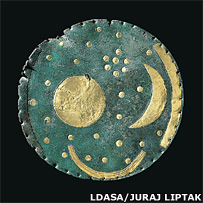
The Nebra disc is emblazoned with symbols of the Sun, Moon and stars and said by some to be 3,600 years old.
|
BBC Science News, UK
|
|
Writing in the journal Antiquity, a team casts doubt on the idea the disc was used by ancient astronomers as a precision tool for observing the sky.
They instead argue that the disc was used for shamanistic rituals.
But other archaeologists who have studied the Himmelsscheibe von Nebra (Nebra sky disc) point to features which, they say, helped Bronze Age people to track four key dates during the year.
|
While many scholars support its status as an object from the Bronze Age, it is claimed to be a fake by others, notably the German researcher Peter Schauer from the University of Regensburg. ‘German archaeologists don’t say clearly that this is a fake. They hide, thinking that the thunderstorm will blow over’, Dr Schauer told BBC News.
Two golden arcs on the outside of the disc may show how far the sunrise and sunset move along the horizon between winter and summer solstices. The arcs are 82.5 degrees long, which is the angle the Sun is seen to travel between the high mid-summer sunset and the low mid-winter sunset.
The precise angle varies from place to place. But Professor Wolfhard Schlosser, from the University of Bochum, in Germany, has pointed out that 82 degrees corresponds to the journey of the sun at the specific latitude in Nebra.”
[Full Story]
“Is this Chaucer’s astrolabe?:
Astronomical instruments were probably made after Chaucer’s designs, not before”
June 08, 2007, Nature, UK:
“Want to see the astrolabe used for astronomical calculations by Geoffrey Chaucer himself? You’ll be lucky, says Catherine Eagleton, a curator at the British Museum in London.
Several astrolabes have been suggested to have once belonged to Chaucer.
|
Nature, UK
|
|
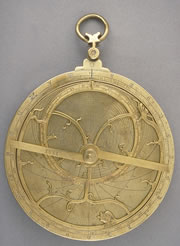
The claims are based on the device in question’s resemblance to one described by Chaucer in his Treatise on the Astrolabe, written in the late fourteenth century.
Perhaps, the claimants argue, the astrolabe they now have in their collection was Chaucer’s own, and served as a model for his work.
But Eagleton argues it’s the other way around.
|
It’s more likely, she says, that these instruments were made after Chaucer’s death, inspired by the design given in the English scholar’s treatise.
‘It is extremely unlikely that any of the surviving instruments were Chaucer’s own astrolabe’, she concludes in a paper soon to be published in Studies in the History and Philosophy of Science
An astrolabe is a pocket-watch shaped device with dials and pointers for calculating the positions of the stars and the Sun. It was used for timekeeping, determining latitude, and making astrological forecasts.”
[Full Story]
“Fathers of the zodiac tracked down:
Astronomer shows when and where his ancient counterparts worked”
June 01, 2007, Nature, UK:
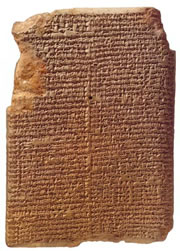
“Using modern techniques — and some rocks — a US astronomer has traced the origin of a set of ancient clay tablets to a precise date and place. The tablets show constellations thought to be precursors of the present-day zodiac.
|
Nature, UK
|
|
The tablets, known collectively as MUL.APIN, contain nearly 200 astronomical observations, including measurements related to several constellations.
They are written in cuneiform, a Middle-Eastern script that is one of the oldest known forms of writing, and were made in Babylon around 687 BC.
But most archaeologists believe that the tablets are transcriptions of much earlier observations made by Assyrian astronomers.
|
Just how much older has been disputed — the estimates go back to 2,300 BC.
Now Brad Schaefer, an astronomer at Louisiana State University in Baton Rouge, says he has dated the observations to 1,370 BC, give or take a century.
The tablets contain a number of different observations, including the day each year that certain constellations first appeared in the dawn sky. These dates change over the millennia because of a tiny wobble in the Earth’s axis.
‘It’s like a big hour hand in the sky’, Schaefer says.”
[Full Story]
“Bid to save Sleeping Goddess from turbines”
June 01, 2007, The Press & Journal, Scotland:
“A Lewis-based archaeologist has hit out at proposals to erect a Western Isles windfarm on a famous and mystical hill formation that resembles a woman lying on her back.
If the plan is successful, Cailleach na Mointeach, the Old Woman of the Moors, would have some of the 53 turbines sprouting from her knees.
The Cailleach, also known as the Sleeping Goddess, can be seen to the south side of the ancient Callanish stone circle.
Ian McHardy says the visual impact of the highest seven turbines will destroy the effect of the ‘major lunar standstill’ around which the mythical site of Callanish appears to have been built about 6,000 years ago.
Every 18.6 years, the moon appears to rise from between the ‘knees’ of the woman and travels in a low arc over her body, lighting it up, until it reaches the end of the ancient avenue of stones at Callanish. At this point, the moon is huge and low in the sky, and a person standing on a ridge in front of it also appears enormous.
The phenomenon, which extends over a year and is unique in Britain, was first noted by archaeologist Margaret Curtis in 1987. It is now believed that the whole complex at Callanish was designed around it. The latest major lunar standstill has been occurring since last year, with this weekend and the end of June good times to observe it.
Mr McHardy said: ‘The landscape around Callanish turns this event into a spectacular piece of natural theatre, which the stones make full use of.’
Mr McHardy said the visual impact of the windfarm will be significant, with parts of seven turbines visible on the ridge.
‘As an archaeologist I think it is tragic if the turbines go up and destroy an area of such significance’, he said.”
[Full Story]
“Roman towns aligned with Sun”
May 16, 2007, ABC News in Science, Australia:
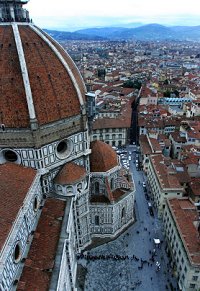
“Ancient Romans built their towns using astronomically aligned grids, an Italian study concludes. The research examines the orientation of virtually all Roman towns in Italy and is published on the arXiv physics website, which is maintained by Cornell University.
|
ABC News in Science, Australia
|
|
‘”It emerged that these towns were not laid out at random. On the contrary, they were planned following strong symbolic aspects, all linked to astronomy’, says Professor Giulio Magli, of the mathematics department at Milan’s Polytechnic University.
The research examined the orientation of some 38 towns in Italy and is part of a wider study published in Magli’s book ‘Secrets of the Ancient Megalithic Towns’.
Magli explains that ancient Roman writers, including Ovid and Plutarch, documented how the foundation of a new town took into account the flight of birds and astronomical references.
|
‘However, the link between Roman towns and sky symbolism has never been fully nvestigated’, Magli says. The Romans founded many towns, or colonies, especially during Rome’s Republican period and the first Imperial period, roughly from the 5th century BC to the 1st century AD.
Among towns with two clear main roads, Magli looked at the orientation of grids’ axes in relation to the movement of the rising Sun at the eastern horizon over the course of the year.
He extracted this orientation from available archaeological maps or by using a precision magnetic compass on site.
‘It emerged that the majority of Roman towns in Italy are aligned to sunrise, in relation to important sacred festivals or to the cardinal points’, Magli says.”
[Full Story]
“Astronomer sees Mayan culture in stars”
May 09, 2007, The Stanford Daily, USA:
“Anthropologist and Archaeoastronomer Timothy King M.A. ‘04 spoke to a packed audience yesterday evening in Pigott Hall to explain how Maya astronomy reflects the rich culture of its people.
King, who also received his Ph.D. from the University last year, presented his latest research findings about ancient Maya depictions of constellations, meteor showers and eclipses.
‘The sky is the only universal topic across all cultures’, King said. ‘It therefore provides for an extremely interesting cross-cultural study.’
Mayan astronomers maintained an extremely detailed record of their findings in codices made from bark paper, King said, but only four codices survived the 16th century Spanish missionaries, who burned them because they believed the writing was the devil’s work.”
[Full Story]
“Fragmentary Knowledge:
Was the Antikythera Mechanism the world’s first computer?”
May 14, 2007, The New Yorker, USA:
“In October, 2005, a truck pulled up outside the National Archeological Museum in Athens, and workers began unloading an eight-ton X-ray machine that its designer, X-Tek Systems of Great Britain, had dubbed the Bladerunner.
Standing just inside the National Museum’s basement was Tony Freeth, a sixty-year-old British mathematician and filmmaker, watching as workers in white T-shirts wrestled the Range Rover-size machine through the door and up the ramp into the museum.
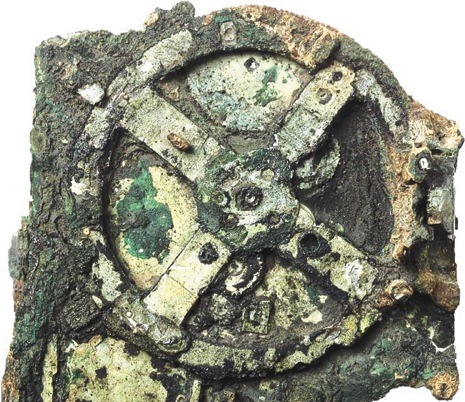
Freeth was a member of the Antikythera Mechanism Research Project—a multidisciplinary investigation into some fragments of an ancient mechanical device that were found at the turn of the last century after two thousand years in the Aegean Sea, and have long been one of the great mysteries of science.
The main fragment of the Mechanism, found after two thousand years under water.
Courtesy
Antikythera Mechanism Research Project
The New Yorker
Freeth, a tall, taciturn man with a deep, rumbling voice, had been a mathematician at Bristol University, taking a Ph.D. in set theory, a branch of mathematical logic. He had drifted away from the academy, however, and spent most of his career making films, many of them with scientific themes.
The Antikythera Mechanism, which he had first heard about some five years earlier, had rekindled his undergraduate love of math and logic and problem-solving, and he had all but abandoned his film career in the course of investigating it. He was the latest in a long line of men who have made solving the mystery of the Mechanism their life’s work.
Another British researcher, Michael Wright, who has studied the Mechanism for more than twenty years, was coincidentally due to arrive in Athens before the Bladerunner had finished its work. But Wright wasn’t part of the research project, and his arrival was anticipated with some trepidation.
It had been Freeth’s idea to contact X-Tek in the hope of finding a high-resolution, three-dimensional X-ray technology to see inside the fragments of the Mechanism. As it happened, the company was working on a prototype of a CAT-scan machine that would use computer tomography to make 3-D X-rays of the blades inside airplane turbines, for safety inspections.
Roger Hadland, X-Tek’s owner and chief engineer, was interested in Freeth’s proposal, and he and his staff developed new technology for the project.
After the lead-lined machine was installed inside the museum, technicians spent another day attaching the peripheral equipment. At last, everything was ready.”
[Full Story]
“The tal-Qadi stone … “
March 26, 2007, di-ve.com, Malta:
“that seems to read the stars and moon
… the stars and moon as interpreted by our forefathers
… our forefathers who left us a priceless heritage …
Once, some 2500 years before the birth of Christ, there lived a people that placed their mark in history with the construction of megalithic temples on the Maltese Islands.
This documentary focuses on one of the megalithic temples known as the tal-Qadi temple situated limits of Burmarrad in Malta. These megalithic people left a unique stone referred to as the tal-Qadi stone that seems to represent the night sky as seen in those times. But is this so?”
[Full Story]
“Ancient Peruvians built towers to track arc of sun”
March 10, 2007, The ChronicleHerald, Canada:
“Early people in Peru, like others in antiquity, went to great lengths to track the rising and setting of the sun through the seasons as a guide for agriculture, an object of worship and a mystical demonstration of a ruler’s power.
Archaeologists have now discovered that a line of elaborate stone towers erected on a low ridge by Peruvians 2,300 years ago formed an artificial toothed horizon with narrow gaps at regular intervals for making alignments almost exactly spanning the annual arc of the sun.
This is the earliest known solar observatory in the Americas. The site precedes by several centuries similar monuments by the Maya in Central America and by almost two millenniums solar observatories of the Inca civilization in Peru.
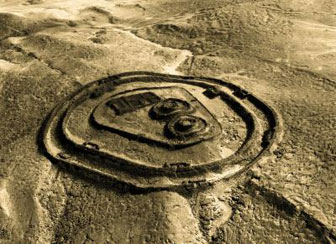
In a report in the current issue of the journal Science, a Peruvian archaeologist and a British archaeoastronomer wrote that the 13 towers, varying in height from two to 7 metres and extending 333 metres, are clearly visible from an imposing complex of concentric circles of relatively well-preserved walls enclosing ceremonial buildings.
They said the position of the towers in relation to observation points inside the walled complex was firm evidence that this was a place for solar study in calendar-making and ritual ceremonies and feasts of sun cults.”
[Full Story]
“The Thirteen Towers: Peruvian Citadel is Site of Earliest
Ancient Solar Observatory in the Americas”
March 03, 2007, Innovations-Report, Germany:
“A 2,300 year old solar observatory in Peru has been identified by new research published today (March 2), in the journal Science, by archaeologists from the University of Leicester and Yale University.
The Thirteen Towers of Chankillo have been discovered to span, almost exactly, the annual rising and setting arcs of the sun when viewed from two specially constructed observation points.
The existence of this observatory predates the European conquests by 1,800 years and even precedes the monuments of similar purpose constructed by the Mayans in Central America.
Chankillo is a large ceremonial centre covering several square kilometers. It was better known in the past for a heavily fortified hilltop structure with massive walls, restricted gates, and parapets. But the purpose of a 300m-long line of Thirteen Towers lying along a small hill nearby had remained a mystery. New evidence now identifies it as a solar observatory.
And the researchers go further-pointing to evidence of an ancient Sun cult participating in public rituals and feasts directly linked to the observation and interpretation of the seasonal passage of the Sun.
They claim Sun worship and related cosmological beliefs could have helped to legitimize the authority of an elite class – two millennia before the Incas.
The research was carried out by Ivan Ghezzi, a graduate student in the Department of Anthropology at Yale University who is now Archaeological Director of the Instituto Nacional de Cultura (National Institute for Culture) in Peru, and Professor Clive Ruggles, of the School of Archaeology and Ancient History at the University of Leicester. Professor Ruggles is one of the world’s leading authorities on archaeoastronomy.
“
[Full Story]
“Towers point to ancient Sun cult”
March 01, 2007, BBC Science News, UK:
“The oldest solar observatory in the Americas has been found, suggesting the existence of early, sophisticated Sun cults, scientists report.
BBC Science News/Ivan Ghezzi
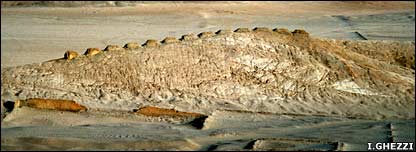
It comprises of a group of 2,300-year-old structures, known as the Thirteen Towers, which are found in the Chankillo archaeological site, Peru.
The towers span the annual rising and setting arcs of the Sun, providing a solar calendar to mark special dates. The study is published in the journal Science.
Clive Ruggles, professor of archaeoastronomy at Leicester University, UK, said: ‘These towers have been known to exist for a century or so. It seems extraordinary that nobody really recognised them for what they were for so long. I was gobsmacked when I saw them for the first time – the array of towers covers the entire solar arc.’
The Thirteen Towers of Chankillo run from north to south along the ridge of a low hill within the site; they are relatively well-preserved and each has a pair of inset staircases leading to the summit.
The rectangular structures, between 75 and 125 square metres (807-1,345 sq ft) in size, and are regularly spaced – forming a ‘toothed’ horizon with narrow gaps at regular intervals.
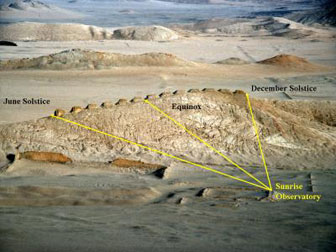
About 230m (750ft) to the east and west are what scientists believe to be two observation points. From these vantages, the 300m- (1,000ft-) long spread of the towers along the horizon corresponds very closely to the rising and setting positions of the Sun over the year.”
[Full Story]
“Archeologists find oldest solar observatory in the Americas”
March 01, 2007, Mongabay, Madagascar:
“Archeologists from Yale and the University of Leicester have identified an ancient solar observatory at Chankillo, Peru as the oldest in the Americas with alignments covering the entire solar year, according to an article in the March 2 issue of Science.
|
The fortified stone temple at Chankillo, photo courtesy of Peru’s National Aerophotographic Service (SAN)
Mongabay/SAN
|
|
Recorded accounts from the 16th century A.D. detail practices of state-regulated sun worship during Inca times, and related social and cosmological beliefs. These speak of towers being used to mark the rising or setting position of the sun at certain times in the year, but no trace of the towers has ever been found. This paper reports the earliest structures that support those writings.
|
At Chankillo, not only were there towers marking the sun’s position throughout the year, but they remain in place, and the site was constructed much earlier – in approximately the 4th century B.C.
|
Simplified diagram of how the solar observatory would have worked, photo curtesy of Ivan Ghezzi
Mongabay/Ivan Ghezzi
|
|
‘Archaeological research in Peru is constantly pushing back the origins of civilization in the Americas’, said Ivan Ghezzi, a graduate student in the department of Anthropology at Yale University and lead author of the paper.
‘In this case, the 2,300 year old solar observatory at Chankillo is the earliest such structure identified and unlike all other sites contains alignments that cover the entire solar year.’
|
‘It predates the European conquests by 1,800 years and even precedes, by about 500 years, the monuments of similar purpose constructed by the Mayans in Central America.’
‘Focusing on the Andes and the Incan empire, we have known for decades from archeological artifacts and documents that they practiced what is called solar horizon astronomy, which uses the rising and setting positions of the sun in the horizon to determine the time of the year’, said Ghezzi.
‘We knew that Inca practices of astronomy were very sophisticated and that they used buildings as a form of ‘landscape timekeeping’ to mark the positions of the sun on key dates of the year, but we did not know that these practices were so old.’.”
[Full Story]
“Ancient solar observatory discovered in Peru”
March 01, 2007, New Scientist, UK:
“The first solar observatory in the Americas may have been uncovered in coastal Peru. The ceremonial site provides evidence of sophisticated ‘cults of the Sun’ operating in South America as early as 2300 years ago.
|
New Scientist/Ivan Ghezzi
|
|
Other ancient structures around the world – such as Stonehenge, which is estimated to be 5000 years old – are aligned with the rising and setting of the Sun on certain days called the solstices.
These occur twice a year, around 22 June and 22 December, when the Sun appears to reach its highest point above or below the equator.
|
Historical records also describe ‘Sun pillars’ suggesting that South America’s Incan civilisation was observing the Sun – possibly to help mark when to plant crops – around 1500 AD, though those pillars have since been destroyed.
The Incas also held public rituals to observe the Sun rise or set at marked positions on the horizon, and Incan leaders claimed authority to rule through kinship to the Sun. Now, Ivan Ghezzi of the Instituto Nacional de Cultura in Lima, Peru, and Clive Ruggles of the University of Leicester, UK, say earlier civilisations in Peru may also have been observing the Sun as early as the fourth century BC.
They base their conclusion on ruins at a walled coastal Peruvian site known as Chankillo. Once thought to be part of a fort, ceremonial centre or fortified temple, the researchers now argue the ruin’s central complex may have actually been used as a solar observatory.
Within Chankillo, 13 regularly spaced rectangular towers run the length of a 300-metre ridge like a spine, creating an artificial horizon from some vantage points.
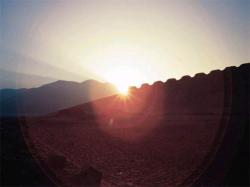
On either side of the ridge are the remains of a western observatory and, lesser so, an eastern observatory, which scientists say were used to watch the Sun rise or set between those towers. On the summer solstice, the Sun rose between Tower 1 and a nearby mountain, Cerro Mucho Malo, and on the winter solstice, the Sun rose around Tower 13.”
[Full Story]
“The Antikythera Mechanism: New imaging technology reveals
the soul of the world’s first computer”
March 2007 Edition, Archaeology Magazine, USA:
“There may be nothing new under the sun after all. It’s been more than two millennia since a large ship went down off the coast of the Greek island of Antikythera, and more than a century since a sponge diver discovered the ship’s valuable cargo, which included bronze and marble statues, pottery, and glass and silver vases.
|
See the HP Labs images of the
Antikythera Mechanism
Archaeology Magazine
|
|
But only now have researchers deciphered one of the wreck’s – and classical archaeology’s – most enigmatic artifacts:
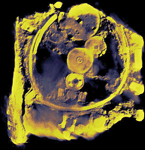
a corroded collection of bronze and wood fragments known as the Antikythera Mechanism.
|
From early on, archaeologists identified pieces of inscribed gear wheels within the corroded lump, which led to the consensus that it was some sort of astronomical device.
Throughout the twentieth century, from its home in the National Archaeological Museum in Athens, the Antikythera Mechanism attracted sporadic visits from archaeologists and historians who marveled at its highly complex, precise, hand-cut gear system and the undeciphered inscriptions on both the gears and wooden casing.
The mechanism attracted sporadic scientific interest, including X-ray studies in the 1970s and ’90s, but no one could completely understand its nature. How exactly did it work, and for what had it been used? Could such a sophisticated device have been created more than 1,400 years before similar objects were known to exist anywhere else in the world?”
[Full Story]
“Egypt festival: Illuminate ancient Pharaoh”
February 28, 2007, CCTV News, China:
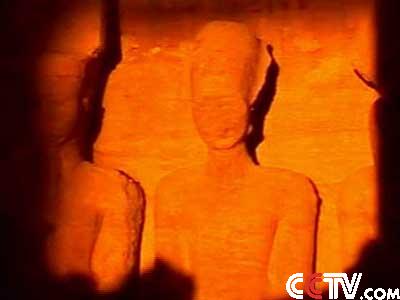
“Thousands of tourists have been flooding to the great temple at Abu Simbel in Egypt to watch the sunrise illuminate the temple’s inner sanctum and with it the statue of the Pharaoh, Ramses the second.
But all is not quite as it seems with this apparently timeless phenomenon.
|
(Watch Video)
CCTV News, China
|
|
The twice yearly festivities in Abu Simbel, in southern Egypt close to the Sudanese border, begin, as is traditional, with performances by Nubian dancers and musicians. Around 6,000 tourists visit Abu Simbel during the festival, with just a lucky few getting inside for the fleeting 20 minutes that the statues are illuminated.
|
Mohammed Hamed, senior inspector of antiquities at Abu Simbel, said, ‘The astronomical phenomenon represents the agricultural season, and the cultivation season for the ancient Egyptians.’
‘Certainly astronomically, the temple has been designed on the 23 latitude and when the sun moves from the south to north it is at a moderate time of Spring, and this lasts for one day on 21st February. ‘
‘And when the sun moves from north to south it is at a moderate time of Autumn.’”
[Full Story]
“Stonehenges all around us”
February 16, 2007, The Los Angeles Times, USA:
“Archaeologists recently discovered what appears to be the other half of Stonehenge, illuminating what they believe is a much larger Neolithic complex than has long been envisioned. What is coming to the surface seems strangely familiar. Looking closely at Stonehenge and other Neolithic sites, we find the formative patterns of our modern world.
Step out of your house and you might notice your street is fixed on a cardinal grid: north, south, east, west. This pattern defines many American and European cities, as well as Neolithic sites such as Anyang in China and the Mexican city of Teotihuacan.
These finds add to the picture of an enigmatic Neolithic religion, in which stone-paved roads are aligned with celestial features and great circles frame the rising and setting sun at key times of the year.
This all has an uncanny resemblance to Neolithic sites in different parts of the world. The Big Horn Medicine Wheel in Wyoming, dating back several hundred years, is a complex celestial calendar, its 28 spokes of aligned stones pointing to risings and settings of the sun and various stars. This medicine wheel, in turn, is similar to the Nonakado Stone Circle of Japan, from the 1st millennium BC, where standing stones mark important, calendrical events on the horizon.
My friend and colleague, Kim Malville, recently discovered an Egyptian Stonehenge in the Sahara dating back more than 6,000 years. Malville believes that it acted as both a calendar and a temple for people living along the edge of an ancient lake, and it is the oldest known megalithic site in the world.
My personal favorite Stonehenge look-alike — at least in concept — is in northern New Mexico, where in the 11th century, the Chaco culture built hundreds of miles of processional “roads.” Rather than rings of giant standing stones, the Chacoans erected enormous masonry temples known as great houses. Many of these great houses are aligned to view celestial events through portals and windows.
The same kind of architecture can be seen in Washington, where countless astronomical alignments are constructed into the Capitol and its surrounding buildings and monuments.”
[Full Story]
“Octagon Earthworks’ alignment with moon likely is no accident”
February 13, 2007, The Columbus Dispatch, USA:
“The Octagon Earthworks in Newark is one remnant of the Newark Earthworks, recently listed by The Dispatch as one of the Seven Wonders of Ohio.
Earlham College professors Ray Hively and Robert Horn demonstrated in 1982 that the walls of this 2,000-yearold circle and octagon were aligned to the points on the horizon, marking the limits of the rising and setting of the moon during an 18.6-year cycle.
The implications of this argument for our understanding of the knowledge and abilities of the ancient American Indian builders of the earthworks are astounding. But how can we know whether they deliberately lined the walls up with the moon or whether the series of alignments is just an odd coincidence?
Hively and Horn focused on five alignments. These are the main axis of the site, which points toward the maximum northerly rise point of the moon, and the orientation of four of the octagon’s eight walls, which align variously with the moon’s maximum southern rise point, the minimum northern rise point, the maximum northern set point and the minimum southern set point.
This does not take into account several other lunar alignments incorporated somewhat more subtly into the earthworks. Neither does it consider the fact that Hively and Horn have shown that High Bank Works in Chillicothe, the only other circle and octagon combination built by the Hopewell culture, also is aligned to the same series of lunar rise and set points.”
[Full Story]
“Sentinels From Prehistory”
February 03, 2007, Tehelka, India:
“Hazaribagh’s prehistoric megaliths are finally receiving the academic and popular attention they deserve.
Subhashis Das has been working tirelessly to preserve them and started the Megalithic Utsav at Punkhri- Barwadih two years ago to generate awareness about these sentinels from the remote past. The Utsav is held on the morning of the two equinoxes each year, when the sun can be seen rising through the V-shaped gap between a pair of tall megaliths.
‘This beautiful astronomical sight can be seen only on equinox mornings here. It’s a rare, spectacular phenomenon’, says Das, who quit his job to research and popularise the megaliths full-time. ‘These ancient stones were actually superb astronomical-astrological observatories’, says Das, who has discovered three megalithic observatories in Jharkhand.
Many megaliths were uprooted and carried away by villagers and used as washing stones. ‘But no longer. The people here have now learnt to love their glorious antiquity’, says Das.”
[This short story is reprinted here in full, but if you follow this link there is an image of the ancient megaliths on the Tehelka website]
“Four lunar markers registered at Kokino”
February 01, 2007, MPT Online, Macedonia:
“After a five-year research, time markers necessary for creation of a calendar have been registered in astrological observatory Kokino.
The revelation of the time markers confirms the observatory’s values at a global level. The revelation shows that there was a culture that created lunar calendars 3,900 years ago, said Canev as Wednesday’s press conference, adding that besides the three Sun markers, additional four markers for monitoring of the Moon’s movement were also found.
A lunar calendar with six winter months of 29 days each, and six summer months with 30 days each was developed in Kokino, repeating itself every 19 years.”
Full Story
“Unearthed: The wild town next to Stonehenge where
the builders partied like it was 2500 BC”
January 31, 2007, The Independent, UK:
“By any standards, it was a wild party: piles of half-eaten pig bones were flung to the floor by revellers who then smashed their food bowls into a “filthy” mud floor. Add to that the fact that this bash took place 4,600 years ago, less than two miles from Stonehenge, and the result is a dramatic step forward in the quest to trace the origins – and purpose – of the world’s most famous standing stones.
Archaeologists have revealed the discovery of a huge ancient settlement in Wiltshire used by the builders of Stonehenge and their descendants to celebrate life and death with lavish feasts of freshly slaughtered livestock.
Professor Mike Parker Pearson, from Sheffield University, who co-led the excavations, said: ‘We believe Durrington was a complementary site to Stonehenge. It was a place for the living to come to celebrate and bring the ashes and bones of ancestors, I think, to be deposited into the river. The village was more than houses.’
‘There was a clear sequence between the sites. People would come to mark the winter and summer solstices, using the avenue to reach the river and then walk back up the other avenue to reach the sacred site.’.
The avenue leading from Durrington is aligned with the sunset for the midsummer solstice while that from Stonehenge would have given a perfect view of the sunset.
Similarly, the Durrington circle was aligned with sunrise for the midwinter solstice and Stonehenge would have framed the sunset, suggesting that generations of inhabitants made twice-yearly pilgrimages along the routes.
The result, according the archaeologists, is evidence that the Durrington village attracted Neolithic tribesmen from across the region for vast midwinter bacchanals. Enormous piles of pig and cattle bones were found along with shards of pottery which contain chemical traces of a milk and meat stew consumed by the pilgrims.
‘The dating of the pigs’ teeth suggests they were killed at nine months in time for the midwinter solstice. It would have been a sort of Neolithic Christmas – they had a really good party.’“
[Full Story]
“Wooden counterpart of Stonehenge found”
January 31, 2007, International Herald Tribune, France:
“New excavations near Stonehenge have uncovered hearths, timbers and other remains of what archaeologists say was probably the village of workers who erected the monoliths on Salisbury Plain in England, and a wooden counterpart of it.
The houses at the site known as Durrington Walls were constructed in the same period as Stonehenge, less than three kilometers, or two miles, away. The village was probably built as a religious center, presumably for people who worshiped the sun.
Over the years, Stonehenge has inspired a wide range of conjecture, though it is now assumed that this was a place of worship that seemed to be related to solar cults. Mike Parker Pearson, a leader of the excavations from the University of Sheffield, said the discoveries last summer supported the emerging recognition that the ring of standing stones and earthworks at Stonehenge was part of a much larger religious complex.
Scholars and other archaeologists not involved with the project reserved judgment on the ramifications of the findings. But Parker Pearson and Thomas emphasized the importance of the Durrington roadway in understanding the two sites’ intimate connection.
They said the road was paved with flint and led straight from the Durrington enclosure to the Avon. A similar road at Stonehenge, discovered in the 18th century, is aligned with the summer solstice sunrise, the archaeologists noted, while the one at Durrington lines up with the summer solstice sunset.
Similarly, the Durrington timber circle was aligned with winter solstice sunrise, while a giant stone monument at Stonehenge frames the winter solstice sunset.”
[Full Story]
“X-ray unlocks mysteries of ancient gears”
January 22, 2007, Engineer Live, UK:
“A microfocus computed tomography system has been used to probe what is believed to a geared device dating back 2000 years. Suzanne Boudier reports.
The Antikythera Mechanism is believed to be one of the world’s oldest known geared devices. It dates from around the 1st century BC and is the most sophisticated mechanism known from the ancient world.
X-Tek is a leading company with a reputation for high-resolution industrial X-ray systems. Founded by British X-ray entrepreneur Roger Hadland, the company was approached in 2000 by freelance film-maker Tony Freeth who had heard about X-Tek’s high-resolution X-ray radiography work and wanted to apply this to investigating the mechanism.
Over the next four years, Freeth brought together researchers from Cardiff University, the National and Kapodistrian University of Athens, the Aristotle University of Thessaloniki and the National Archaeological Museum of Athens to form the Antikythera Mechanism Research Project. The project is funded by the Leverhulme Trust and supported by the Cultural Foundation of the National Bank of Greece.
Recovered in 1901, fragments of the bronze geared mechanism were found by Greek sponge divers on a Roman shipwreck near the island of Antikythera. From readings of the external inscriptions, the device dates from about 100 BC and is technically more complex than any known device for a millennium afterwards, consisting of 80 bronze fragments containing approximately 30 gear wheels.
X-Tek’s X-ray scanner revealed a complicated arrangement of more than 30 precision, hand-cut bronze gears, with up to 223 teeth. With these the mechanism could predict solar and lunar eclipses and planetary positions many decades into the future. The device may also have predicted the positions of some planets, in particular Mercury and Venus.
Following a study of its workings published in the journal Nature, the Antikythera Mechanism will transform the way we think about the technological capabilities of the ancient world.”
[Full Story]
“Earthen mounds in Ohio are a 2,000-year-old mystery”
January 21, 2007, The Dallas Morning News, USA:
“The extensive earthen mounds and walls in southwestern Ohio probably aren’t a fortress, although they may have been used for social gatherings, religious ceremonies and astronomical viewings.
The site, atop a wooded bluff 235 feet above the Little Miami River in Warren County, 75 miles southwest of Columbus, was built 2,000 years ago by Indians whom archaeologists call Hopewells. The intricate series of mounds stretches nearly 3 ½ miles and encloses about 100 acres.
The earthen walls are as tall as 23 feet and as wide as 68 feet. They’re divided by 67 crescent-shaped gateways. Stone pavement survives in some places. Some call Fort Ancient Ohio’s Stonehenge, and it is one of Ohio’s top prehistoric sites.
The earthworks were used for about 600 years from 100 B.C. to 400 or 500 A.D. Evidence suggests that many people stayed outside the earthworks. But recent excavations indicate some people also lived within the enclosure.
The mounds’ builders may have used them to mark the movement of the sun and the moon. Standing near four stone-covered mounds in the North Fort’s northeast corner, researchers have seen how sunrises on the summer and winter solstices and the minimum and maximum northern moonrises align with certain gaps in the mounds.”
[Full Story]
“Officials hope to shed light on cave riddle”
January 21, 2006, The Boston Globe, USA:
“For decades, the identities of the people who built a manmade cave in Upton have been a mystery – and a cause for debate. But with the town’s recent purchase of the so-called ‘Upton Chamber’ and its surrounding property, officials hope to put the mystery to rest.
They hope that a study of the site will settle the long-running argument between those who believe the landmark is simply a place that Colonial settlers built to store their vegetables, and others who believe its existence proves that Europeans crossed the Atlantic Ocean thousands of years before Columbus.
The best way to solve the mystery is to find some sort of artifact – an ax handle, a bit of leather, or a bone – associated with the cave. If the artifact’s age could be determined, it would be a clue to the cave’s age.
So far, just one artifact has been found in the chamber — a small shard of metal believed to be silver. Its owner, Malcolm Pearson, said he has no intention of allowing others to examine it. He believes the chamber was built by an ancient and unrecorded native civilization because of its similarity to structures in the British Isles that are thousands of years old.
‘We’re looking into having an assessment of the site done to better date the structure’, said Barbara E. Burke, Upton Historical Commission’s chairwoman.
The cave interior has been scrutinized so much that the best chance for finding another clue might come from searching the surrounding area, she noted.
[Full Story]
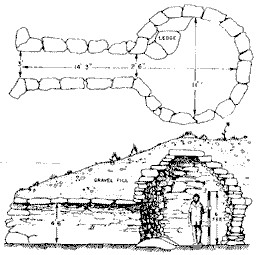
[I visited this site in 1979 and was convinced that it was NOT a “colonial root cellar” as some local people believed. The similarity to chambers in northwest Europe, with typically corballed roofs and long passageways suggest an astronomical explanation, and the Upton Chamber website is well worth a visit if you can’t go to the chamber yourself. It is indeed great news that it has been bought to be protected and studied. Here’s an extract from it with a sketch of the chamber. Ed]:
“The Upton Chamber is one of the largest and most perfectly built of the more than 300 stone chambers catalogued throughout the Northeast.
It is one of several similar structures in New England that are sometimes attributed to pre-Columbian European monks.
|
The Upton Web
|
|
It features a six foot high, fourteen foot long tunnel leading into a hillside, to a bee-hive like domed chamber of small quarried stones measuring 12 feet in diameter and 11 feet high. The chamber is topped with several large oval stones weighing several tons each.
The exact age and origin of the Upton Chamber has been the subject of debate for years. Some experts have suggested that the chamber may have been constructed around 710 A.D.
|
This theory is partially based upon the orientation of the access passage. The access passage is aligned to stone cairns found on nearby Pratt Hill, and also aligned such that the internal chamber is illuminated at the summer solstice.”
[Upton Chamber Website]
“Meteorites from under the pyramids”
January 20, 2007, Science & Scholarship in Poland, Poland:
“Samples of rock and fragments of pyramid walls brought from Egypt are being examined at the AGH University of Science and Technology.
It is very likely that meteorites had dropped near the pyramids. The material was collected during the December expedition of geologists. Another aim of the expedition was to study some geoglyphics, i.e. gigantic pictures drawn on the ground.
According to ‘Dziennik Polski’, the scientists were intrigued by some unusual structures, which resembled craters formed after meteorites hit the ground. They noticed them when analysing satellite pictures of areas north of the great pyramids in Giza.
‘We found very solid metallic fragments in this area. These are probably meteorite fragments’, – says Prof. Maciej Pawlikowski from the Mineralogy, Petrography and Geochemistry department at AGH University, who was the supervisor and main organiser of the geological expedition.
‘We hope that further tests on the patina covering the rocks, which formed during the meteorites’ fall, will help us to establish the exact time of the event’ – the scientists said.”
[Full Story]
“Korean astronomy roots date back to Bronze Age: scholars”
January 19, 2007, Yonhap News, South Korea:
“The roots of South Korean astronomy date back to the time of the dolmens and the Bronze Age, local scholars said Friday.
In a report released at a scientific symposium in Seoul, Park Chang-bom, an astronomer at the Korea Institute for Advanced Study, claimed that detailed studies of dolmens on the Korean Peninsula showed that patterns carved on the cover stones of these graves copied the known constellations in the night sky.
Dolmens, found throughout the peninsula and Manchuria, are believed to be graves of local leaders. Most in South Korea date between 2,000 B.C. and around A.D. 200. The region has one of the highest concentrations of dolmens found anywhere in the world.
Park and Yang Heung-jin, a researcher at the Korea Astronomy and Space Science Institute, said that this early interest in astronomy was carried over by Goguryeo (B.C. 37-A.D. 668), Goryeo (918-1392) and Joseon (1392-1910) kingdoms.
In the past, Korean astronomers and historians did not pay serious attention to astronomy in prehistoric times.”
[Full Story]
|
|
To understand why this News Page is sometimes late here is some information about Fibromyalgia
if you would like to support our marine archaeology research
The Morien Institute
Research Projects
please send us a book

from our Wish List
useful books from our
Astro-Archaeology
Bookshoppe
“A Little History of
Astro-Archaeology”
John F. Michell
EU English Edition
“Stonehenge today is a battlefield, not only for police and festivalgoers at midsummer but also for rival camps of archaeologists, astronomers, and other researchers into the mysteries of prehistoric religion and science. Controversy flared up in 1963, when Gerald Hawkins made early use of the computer to identify Stonehenge as an observatory for the sun and moon and an instrument for predicting eclipses. Further studies of megalithic sites by Alexander Thom proved that many of them were also related to the seasonal positions of the heavenly bodies.
The study of astro-archaeology has now expanded worldwide, bringing new revelations about the mystical sciences of antiquity. This “little history” summarizes the issues involved in astro-archaeology, and illustrates its principal sites and personalities. Included are recent findings of British scientists, whose records of anomalous levels of natural energies at stone circles are in accordance with the magical reputations of such places in local folklore.”
“Under Ancient Skies:
Ancient Astronomy and
Terrestrial Catastrophism”
Paul Dunbavin

EU Edition Only
but avialable
worldwide
“In all of the world’s myths and religions we find traditions of a Great Flood. There are stories too of a Golden Age: the antediluvian paradise that it destroyed. Might these be real memories of the ancient world? And how can we analyse the subject scientifically? The key to unlock these ancient myths lies in astronomy. “Under Ancient Skies” will examine the astronomical evidence for an ancient cataclysm and in the process will explore a number of related anomalies in prehistory, including: Was there a single great flood in human prehistory, or have there been many?
Could the workings of ancient calendars and the records of ancient eclipses give us clues about the Flood and the antediluvian world? Did the Celtic Druids use a calendar based on the orbit of Saturn; and is this the same antediluvian calendar as is described in Plato’s myth of Atlantis? Do Hindu, Chinese and Mayan cosmology myths recall the years after the Flood when our world wobbled on its axis?
Geologists have recently found the crater in Yucatan, where an asteroid impact destroyed the world of the dinosaurs. Scientists and astronomers have stopped dismissing the theory that a comet could have struck the Earth during prehistory – but any suggestion that a comet impact just a few thousand years ago might have caused the Biblical Flood, remains the last taboo. It is time for this barrier too to be washed away. If you read this book and you understand it then be warned – it may scare you!”
“East Asian Archaeoastronomy: Astronomical Observations of China, Japan and Korea”
Xu Zhentao, Jiang Yaotiao,
David W. Pankenier

EU English Edition
“Historical astronomical records can play an important role in modern research, especially in the case of ancient Chinese observational data: sunspot and aurora records are important for the study of solar variability; solar and lunar eclipse records for the study of the Earth’s rotation; records of Comet Hally for the study of orbital evolution; “guest star” records for the study of supernova remnants; planetary conjunction records for research in astronomical chronology.
In the past, Western scientists have not been able to exploit these valuable data fully because the original records were difficult to gather and interpret, and complete English translations have not been available. East-Asian Archaeoastronomy is the first comprehensive translation into English of such historical records for modern research.
The book also features an introduction to East Asian astronomy and offers guidance on how to use the records effectively. It will not only be a valuable research tool for astronomers but should also be of great interest to historians of China and Chinese science. Xu; Zhenoao Purple Mountin Observatory,Pankenier; W Department of Modern Foreign Language and Literatur,Yaotiao; Jiang Nanjing University , China.”
“Exploring Ancient Skies: An Encyclopedic Survey of Archaeoastronomy”
David Humiston Kelley
&
Eugene F. Milone
EU English Edition
“Exploring Ancient Skies brings together the methods of archaeology and the insights of modern astronomy to explore the science of astronomy as it was practiced in various cultures prior to the invention of the telescope. The book reviews an enormous and growing body of literature on the cultures of the ancient Mediterranean, the Far East, and the New World (particularly Mesoamerica), putting the ancient astronomical materials into their archaeological and cultural contexts.
The authors begin with an overview of the field and proceed to essential aspects of naked-eye astronomy, followed by an examination of specific cultures. The book concludes by taking into account the purposes of ancient astronomy: astrology, navigation, calendar regulation, and (not least) the understanding of our place and role in the universe.
Skies are recreated to display critical events as they would have appeared to ancient observers – events such as the supernova of 1054, the ‘lion horoscope’ or the ‘Star of Bethlehem.’Exploring Ancient Skies provides a comprehensive overview of the relationships between astronomy and other areas of human investigation. It will be useful as a reference for scholars and students in both astronomy and archaeology, and will be of compelling interest to readers who seek a broad understanding of our collective intellectual history.”
“Echoes of the Ancient Skies: The Astronomy of Lost Civilizations”
E.C. Krupp

EU English Edition
“All over the world, through countless centuries, people have looked skyward for inspiration and guidance in their lives and activities. For most of the history of humankind, going back to the Stone Age, the sky has served as a tool. The regularity of the motions of celestial objects enabled our ancestors to orient themselves in time and space, satisfying their need for human order. How vast this heavenly influence was, and how awesome the human achievements it engendered were, are illuminated in this extraordinary work of investigation and discovery.
With hundreds of illustrations and photographs, Echoes of the Ancient Skies is a sweeping look at the world of archaeoastronomy from the prehistoric megaliths of Stonehenge, to the medicine wheels of North America, to the Aztec “Calendar Stone.”
The intriguing field of archaeoastronomy–the study of ancient peoples’ observation of the skies and its role in their cultural evolution–seeks to explore the “universal evidence that people have used astronomy as the model for injecting order and predictability on their behavior and on life.” Examining this universal behavior, Dr. E.C. Krupp takes the reader to sites throughout the world (most of which he has personally visited)–from Egypt, China, Babylonia, and Greece, to Turkey, Scotland, Wyoming, and Mexico. He interprets the significance of celestial observation and its relation to the earthly experiences of our ancestors, from practical applications of farming and the measurement of time to philosophical queries into our particular place within the universe.”
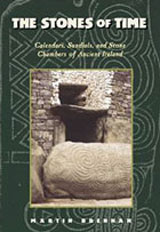
“The Stones of Time : Calendars, Sundials, and Stone Chambers
of Ancient Ireland”
Martin Brennan
EU English Edition
“The Stones of Time presents one of the most dramatic archaeological detective stories of our time. Predating Stonehenge by at least a thousand years, the stone complexes of ancient Ireland have been extensively studied, yet have refused to give up their mystery. The most complete record of Irish megalithic art ever published.
Martin Brennan is a New York artist who spent three years of study on prehistoric art in Mexico and a similar period in Japan. Of Irish parentage, he was drawn to Ireland and the Boyne Valley, where he spent six years studying the neolithic stone chambers and their symbolic art before formulating the groundbreaking theories set forth in this book.”
“America’s Stonehenge:
The Mystery Hill Story”
David Goudsward
&
Robert E. Stone

EU English Edition
“America’s Stonehenge sits atop Mystery Hill in North Salem, New Hampshire. It is an acre of stone structures surrounded by a 12-acre calendar. Alignments and carbon dating indicate the site was built 4000 years ago. In this book the authors explore the historical and prehistoric clues left behind at the archaeology site once described as a ‘mystery wrapped in an enigma’.
The history of the site is examined and traced from the clues left behind from visitors, residents and researchers, and how that has led to today’s research and the current interpretation of the evidence.”
“Skywatchers, Shamans and Kings: Astronomy and the
Archaeology of Power”
E.C. Krupp

EU English Edition
“Discover the celestial myths and cosmic rituals of ancient priests and kings … Drawing on intimate knowledge of the more than 1,300 ancient sites he has visited, E. C. Krupp, acclaimed writer and preeminent researcher, takes you to the world’s essential sacred places and celestial shrines. Join him on a rich narrative journey to see where the rulers of old communed with the gods of the sky.
They ruled kingdoms and empires for thousands of years, tracing their lineages to gods in the sky and mastering the forces they believed moved the sun and moon, planets and stars. In an evocative, illustration-rich journey through lost civilizations, E. C. Krupp describes the workings of sky worship practiced by the pharaohs, emperors, lamas, and shamans of old.”
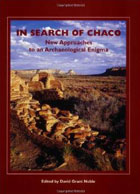
“In Search of Chaco:
New Approaches to an
Archaeological Enigma”
David Grant Noble
(Editor)
EU English Edition
“Startling discoveries and impassioned debates have emerged from the “Chaco Phenomenon” since the publication of New Light on Chaco Canyon twenty years ago. This completely updated edition features seventeen original essays, scores of photographs, maps, and site plans, and the perspectives of archaeologists, historians, and Native American thinkers.
Key topics include the rise of early greathouses; the structure of agricultural life among the people of Chaco Canyon; their use of sacred geography and astronomy in organizing their spiritual cosmology; indigenous knowledge about Chaco from the perspective of Hopi, Tewa, and Navajo peoples; and the place of Chaco in the wider world of archaeology.”
“Megaliths, Myths and Men:
An Introduction to
Astro-Archaeology”
Peter Lancaster Brown
EU English Edition
“Noted British astronomer’s fascinating study of early astronomical knowledge through the interpretation of Stonehenge, Carnac, other megalithic sites. Stone Age sculpture, astronomical computations, radiocarbon dating, many other topics. Over 140 maps, photos, illustrations. The author has very comprehensively analysed several sites and shown how they can be used as astronomical machines.
He discusses the different interpretations of the sites and includes many diagrams of sites including the important astronomical alignments. Very enjoyable overview of archaeo-astronomy. Brown neatly debunks the lunatic fringe, reveals some of the unsung heroes of the field, and provides a clear summary of current ideas for the lay person.”
“Stonehenge: A New Interpretation of Prehistoric Man and the Cosmos”
John David North
EU English Edition
“Argues that Stonehenge’s scientific purpose was to observe the setting midwinter sun, and that astronomical observations made by the ancient Britons were as rational and methodical as they are today. North brings his distinguished background in astronomy to this study of Neolithic monuments. His aim is ‘to discover certain patterns of intellectual and religious behavior through a study of archaeological remains that seem to have been deliberately directed in some way towards phenomena in the heavens.’
Most of this book is a painstakingly detailed on-site investigation. Judging from the scale of Stonehenge and other monuments that incorporated astronomical alignments, North argues that the heavens played a central place in Neolithic and Bronze Age religion.”
“Astronomy in Prehistoric
Britain and Ireland”
Clive Ruggles

EU English Edition
“Do prehistoric stone monuments in Britain and Ireland incorporate deliberate astronomical alignments, and if so, what is their purpose and meaning? This work provides an account of megalithic astronomy debates and examines prehistoric man’s concern with celestial bodies and events. For decades debates have boiled among archaeologists and astronomers over the idea that prehistoric stone monuments in Britain deliberately incorporate astronomical alignments.
In this book Clive Ruggles is the first to approach the subject from the perspectives of both disciplines. He analyzes the history and lessons of previous debates, the most current research, and new agendas for future research.”
“Ancient Astronomers
(Exploring the Ancient World)”
Anthony F. Aveni
&
Jeremy A. Sabloff
EU English Edition
“Anthony Aveni is well known in scholastic circles for his many excellent and ground-breaking publications in the field of archaeoastronomy. This particular volume is geared toward interested laymen and uninitiated scholars who are not yet well grounded in the history of astronomy or ideas of cosmology from an anthropological perspective. The book is graced with numerous and apt illustrations, while the text reads easily with Aveni’s smooth and informative style.
Chapters were clearly organized thoughtfully, as information builds upon previous explanations and new concepts or ideas are charted out for the neophytes as needed. “Ancient Astronomy” provides an ideal introduction to archaeoastronomy, ethnoastronomy, and cosmology for students in anthropology and the history of astronomy.”
“Prehistoric Astronomy
in the Southwest”
J. McKim Malville
&
Claudia Putnam
EU English Edition
“Archaeoastronomy is a discipline pioneered at Stonehenge and other megalithic sites in Britain and France. Many sites in the southwestern United States have yielded evidence of the prehistoric Anasazi’s intense interest in astronomy, similar to that of the megalithic cultures of Europe. The authors describe the astronomical alignments at the well-known sites of Chaco Canyon and Hovenweep and present new evidence, based on recent field work of alignments at Yellow Jacket, Chimney Rock, and Mesa Verde.
Drawing on the archaeological evidence, ethnographical parallels with historic pueblo peoples, and mythology from other cultures around the world, the authors present theories about the meaning and function of the mysterious stone alignments and architectural orientations of the prehistoric Southwest.”
“Stairways to the Stars: Skywatching in Three Great Ancient Cultures”
Anthony F. Aveni
EU English Edition
“What is the meaning of Stonehenge? Why was the elaborate Incan city of Cuzco built? What is the significance of the Great Pyramid at the ancient Mayan city of Chichén Itz´? These ancient structures have spellbound natives and tourists alike. This mysterious architecture points to a centuries-old search for celestial order. Anthony Aveni, a professor of astronomy and anthropology, takes us on a stimulating virtual tour of these legendary constructions.
He describes how they were built and straightforwardly and often humorously critiques diverse theories attempting to explain their origin and function. For example, Aveni breathes life into the mysteries of the Great Pyramid and its use as a sacred temple, sacrificial altar, and celestial calendar.”
“Songs from the Sky: Indigenous Astronomical and Cosmological Traditions of the World”
V.D. Chamberlain (Editor)
J.B. Carlson (Editor)
M.J. Young (Editor)
EU English Edition
“This substantial collection of papers on indigenous astronomical knowledge is quite unequalled in its scope and extent. The authors are drawn from a variety of academic disciplines, including anthropology, archaeology, astronomy, engineering, art history, history of science, history of religion, folklore, and mythology, and bring a variety of academic perspectives to bear upon aspects of celestial knowledge and perception in diverse social contexts from many different parts of the globe.
The Americas provide the main geographical focus, with twenty of the 32 papers concerning indigenous north American groups such as the Navajo, Lakota, Zuni and Blackfoot, the Mixe and Tzotzil Maya of southern Mexico, the Andean highlands and the Amazonian region of Peru, and southern coastal Brazil. The remaining twelve articles extend to the Arab world, sub-Saharan Africa, southern India, Java, Melanesia, Australia and Polynesia, with a few addressing broader synthetic themes. For a number of the culture areas dealt with in some detail here, other published information about sky knowledge is extremely scant.”
|
