1997 Spring Equinox Expeditiontext translation service for many worldwide languages
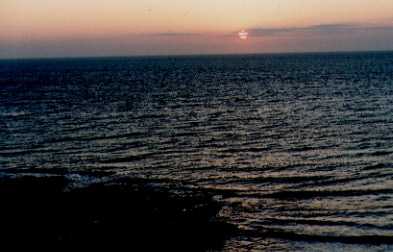
the 1997 Spring Equinox sunset over Church Bay, Ynys Môn, North Wales
In 1997 the remains of a hitherto undiscovered stone circle were found on the Great Orme at Llandudno, only a mile or so from the 'druid college' reputed to have existed in the Deganwy area for many centuries. Unfortunately the site at Siambr Lligwy is not at all accessible as you have to pass through a 'kissing-gate' to gain entry. From this site we followed an alignment of other sites across the island. These alignments stretch for many miles and have been named 'ley lines'. Their true function, and even their very existence, is a matter of debate, de-bunking and constant controversy.
In the past few years, Prof. John North has entered the debate with his description of accurate alignments in his book "Stonehenge: A New Interpretation of Prehistoric Man and the Cosmos". The Morien Institute takes the view that ancient peoples were far more capable of accurately surveying the landscape than has been previously acknowledged - and in this we are most certainly not alone. There are so many examples of alignments of ancient sites coming to light from so many areas around the world that their existence is now beyond any reasonable doubt. Despite this their very existence is still questioned by many academics. The alignment that was travelled on the morning of the 1997 Spring Equinox passed over several megalithic sites, and covered the length of the island. Below are some of the standing stones that were visited, and which are to be found on this and other so-called 'ley lines' on the island of Ynys Môn (Anglesey). Many of the alignments point towards the Snowdonia mountains, which form an ideal horizon to the east and south-east of the island, and it is difficult to imagine they were not used for astronomical observations in ancient times.
above and below are two of the standing stones that seem to have been originally placed
Barclodiad y Gawres (the apronful of the giantess), is a chambered mound that was built on the edge of what is now the Welsh coastline at Rhosneigr, Ynys Môn (Anglesey). The origin of this placename is shrouded in mystery. It is part of local oral tradition that the 'giantess' is said to have walked across from Ireland, and dropped the stones she was carrying in her apron onto the ground, thereby forming the mound. It has been 'refurbished' in recent years and has some of the best petroglyphs inscribed on some of the stones inside the chamber.
copyright © march 1997 morien institute
Of course, any chambered mound is a lot more complex than just a pile of stones, and the Morien Institute takes the view that they may have been used to observe 'daytime' meteor showers/storms which would have been more visible from inside the darkened interior of the chamber - acting as some form of practical observation tunnel. Perhaps the 'stones' that were dropped from the sky were really meteorites originating from a 'radiant' in a constellation, or group of stars, that were depicted in that locality in ancient times as a 'giantess'. The name of this ancient chambered mound could well be a folk memory of such a celestial/terrestrial interaction - an encounter with a periodic meteor shower, or storm, that occasionally resulted in severe meteorite bombardments. Such terrifying events would have easily motivated the peoples of those times to contruct monuments mimicking caves, with the main passage oriented towards specific directions, and the entrances functioning as 'windows' that would have helped them see fainter objects on the horizon than is possible outside a cave in daylight. This effect would have been noticed from very early times, when ancient peoples would have sheltered in caves from whatever came down from the sky - rain, hail, snow or even meteorite bombardments. The 'dark-adjustment' of the eyes that occurs when a person moves progressively backward into a cave, and the subsequent dilating of the pupils to compensate for the lack of light, would have been utilised by ancient peoples to help them see the fainter objects on the horizon such as meteors, and to predict early the unwelcome return of particular star groups to specific points on that daytime horizon. The burials found in many of these mounds may well have been carried out much later by the descendents of the survivors of such catastrophes who retained only a sketchy knowledge of the one-time importance of such monuments as aids to naked-eye observation. Unfortunately little or no detailed knowledge of the original functions of these monuments as they may have been intended by their sky-watching builders has survived to the present. Perhaps there is astronomical data encoded in the local oral traditions about these enigmatic monuments, which appear to be constructed as 'artificial caves'.
...
Croeso Mabyn Newydd ...
a comprehensive selection of books about
Were Megalithic Structures built as Cosmic Impact Early-Warning Systems? The Pumpsaint Zodiac Temple - a Landscape Starchart in West Wales The 6th Century A.D. Dragon/Comet and the European Dark Ages Nora Chadwick and the Druids | T. D. Kendrick and the Druids "Barddas - the Bardo-Druidic System of the Isle of Britain" The "Hanes Taliesin" - the Charlotte Guest translation The "Hanes Taliesin" - the D. W. Nash translation Stanton Drew - circles of wood before stone Caer Sidi - the key to Druidic Astronomy The Sacred Druid Library - Ynys Môn
read Owen Morien Morgan's classics
"The Mabin of the Mabinogion" the key to the ancient druidic astro-mythology
please take a look at our Ancient Mysteries Bookshoppe for a wide selection of books
Home | Research Projects | Skywatching | News & New Discoveries | MarketSpace | Contact Us Marine Archæology News Archive | Astro-Archæology News Archive
all material on this page |