|
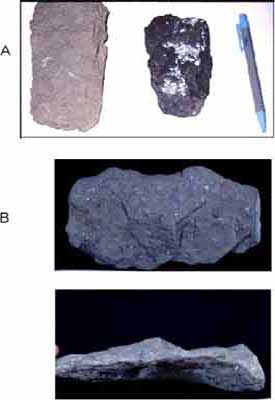
A number of 'stone tools' have also been discovered at various locations in the East China Sea, and the images below show three 'adzes' that are similar in shape and size. The top two (A) are shown alongside a pen so that their size can be appreciated. The darker one to the right was recovered from a depth of about 50 feet to the south of Iseki Point, while the lighter-coloured one to the left is a stone tool from Taiwan ...
how many more artifacts might be down there
waiting to be discovered is anyone's guess
Copyright © 2002 Dr. Masaaki Kimura
--
Okinawa, Japan
--
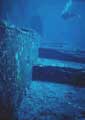
Below them (B) are a top-view and a side-view of a stone tool recovered from the sea-bed at a depth of around 35 feet off San'ninu-dai, to the east of Yonaguni-jima. Unlike Professor Masaaki Kimura, most scientists are not divers, and those archæologists and geologists who have dived at Iseki Point have spent most of their time underwater battling simply to stay alive in the notoriously strong currents around the 'No.1
Monument', rather than studying the structures, or looking for ancient artifacts ...
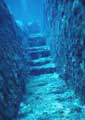
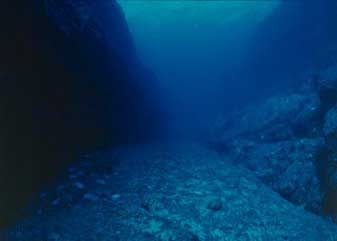
part of the 'loop road' which runs along the bottom of
the 'No.1 Monument' and gives access to the
areas where the artifacts were found

Copyright © 2002 Dr. Masaaki Kimura
--
Okinawa, Japan
--
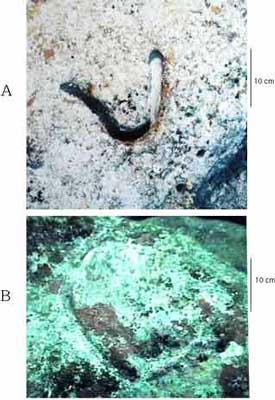
Also many 'petroglyphs' have been found carved on rocks on the sea-floor around Yonaguni-jima. The image (A) seems to be either a "U" or "V" symbol, and may have been intended to indicate a 'direction'. This carving was discovered at a depth of around 35 feet off Iri-zaki, the westernmost tip of Yonaguni island itself, and it resembles another symbol found on the 'line-engraved tablet' recovered from the sea-floor at the southern part of Iseki Point. Below that (B) is another 'petroglyph' that has been found near the 'entrance' of the 'Arch Gate', and if it was meant to indicate a direction it points directly towards the 'Arch Gate' ...
Copyright © 2002 Dr. Masaaki Kimura
--
Okinawa, Japan
--
Please left-click on any of the images on this page to directly access Professor Kimura's own 'Japanese language' website. To download Japanese fonts for a 30-day trial period please
click here. Those wishing to use Professor Kimura's images should please request permission by sending him an email. If you do not want to use Japanese fonts, the email link on Professor Kimura's site renders as üô characters near the top of each page on his website. Images of Professor Kimura's students exploring Yonaguni-jima are here
Marine Archæology Underwater Discoveries
News Archive 1997 - 2008
History's Mysteries
"Do undersea relics near Okinawa offer proof of a sophisticated civilization during the last ice age? Archeologists have long believed that civilization as we define it -- intelligent, tool-making, monument building, social humans -- began about 5,000 years ago. But submerged beneath the waves near the Japanese island of Yonaguni is evidence that may well overturn that long-held theory.
A small but persuasive number of scholars and scientists have long thought that "advanced" societies may have existed as long as 10,000 years ago. Their theories, however well reasoned and defended, have been hamstrung by a lack of evidence. But recent discoveries of man-made artifacts on the Pacific seafloor may well prove to be the smoking gun that will propel this alternative view of civilization to prominence".
see the evidence with 'unique underwater footage' of
the Yonaguni structures in the NEW DVD of the
'History Channel' television programme
"Japan's Mysterious Pyramids"
ONLY AVAILABLE ON DVD
|