|
the interview with Professor Masaaki Kimura continues
…
Morien Institute :
According to the abstract, at the Hawaii symposium you also said that the Yonaguni structure resembles ancient Okinawan castles such at Shuri Castle and Nakagusuku Castle on Okinawa Island. How old are these castles, and who built them?
Professor Masaaki Kimura :
“Giant gusukus such as Shuri Gusuku Castle (the most important building in Okinawa, now) were built about 500 years ago. The names of who built them are well known. They are “Aji” – the same as a “king” in Europe.”
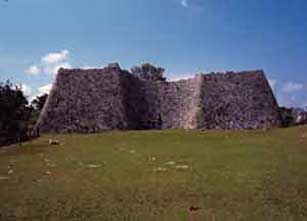
the ‘Nakagusuku’ on Okinawa island which is typical of
the Ruykyu Dynasty era (c.13th century)
—
Okinawa, Japan
—
|
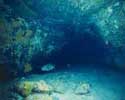
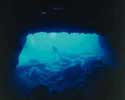
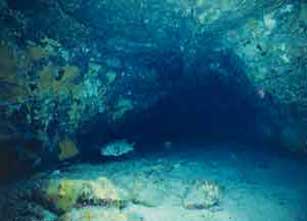
the ‘gusuku cave’ discovered on the seafloor shows a similar-shaped ‘worked’ entrance as dry land castles
—
Okinawa, Japan
—
|
|
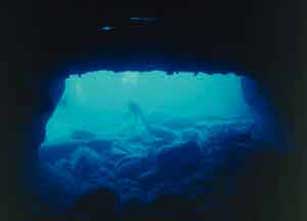
the same ‘gusuku cave’ showing the
‘worked’ entrance as seen by divers
inside the cave looking outwards
—
Okinawa, Japan
—
|
Morien Institute :
From the map I see that there are another two structural features some distance from the Iseki Point. These have been named as ‘the stadium’ and ‘Goshintai’. Can you reveal when they were discovered, and why these features came to be so named?
Professor Masaaki Kimura :
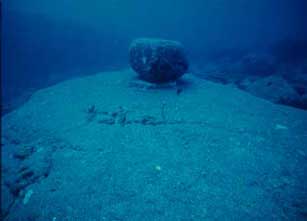
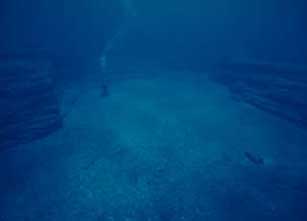
“A feature similar to a stadium in also found 200 m southeast of the No.1 monument. “Goshintai” means symbolized o”of God”, however it is thought to be a solar clock. We call it “Teda-ishi” (sun stone).”
Morien Institute :
Are we then talking about a’complex’ of megalithic structures around Yonaguni Island, and does this complex reach as far as Okinawa and other Japanese Islands?
Professor Masaaki Kimura :
“I think the complex reaches as far as Okinawa and other Japanese Islands where the Jomon Culture was since 16,000 years before present”
|
the ‘Goshintai’, called ‘Teda-ishi’, is
regarded by Professor Kimura and other
Yonaguni divers as a ‘solar clock’
—
Okinawa, Japan
—
|
|
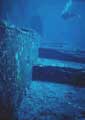
the ‘Stadium’ is a flat area about
500 metres southeast of ‘Iskei Point’
and has ‘steps’ leading up to it
—
Okinawa, Japan
—
|
Morien Institute :
There are topographical features which some have said are ‘ancient structures’ underwater off the coasts of the Kerama Islands, Aguni-Jima and also Chatan. Do they have any features in common with No. 1 monument at Iseki Point off Yonaguni Island?
Professor Masaaki Kimura :
“They show in part a similar structure to a stepped pyramidal one off Kerama Islands, and a stepped broad terrace off Chatan near Okinawa mainland. Scientific data, however, are lacking in both.”
Morien Institute :
I am given to understand that the Okinawa culture is different to that of mainland Japan. How old would you estimate the Okinawa Culture to be?
Professor Masaaki Kimura :
“The Okinawa Culture has been said to be different to that of mainland Japan. The Okinawa one is said to be newer, since 12 Centuries. The oldest man in Japan, however, was found in Okinawa. For my idea, it would be 10,000 years old.”
tr>
|
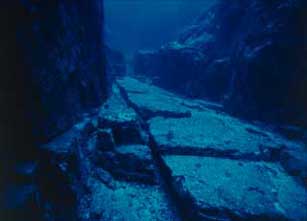
a path leading to the ‘Stadium’ has
what look like ‘drainage gutters’ that
seem carved from the living bedrock
—
Okinawa, Japan
—
|
|
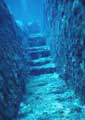
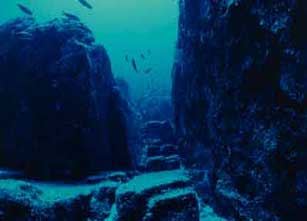
this ‘flights of steps’ which gives
access to the ‘Stadium’ is at a depth
of approximately ’35 metres’
—
Okinawa, Japan
—
|
Morien Institute :
Do you think that the ancient Jomon culture of Japan 10,000 years ago could in any way influenced the design, and the position in the landscape, of the structures that you have found in the Yonaguni area?
Professor Masaaki Kimura :
“I can see many common cultures of stones such as stone circles and monuments. However, there is definitely a difference between the Jomon and Yonaguni Cultures as regards the construction. The former showed only holes used for poles excavated in the mudground, but the latter did megalithic pyramidal structures.”
|
|
Books About
Prehistoric Japan
“Ancient Jomon of Japan”
by
Junko Habu
Get This Book From:
Amazon.com
Amazon.co.uk
“Prehistoric Japan:
New Perspectives on Insular East Asia”
by
Keiji Imamura
Get This Book From:
Amazon.com
Amazon.co.uk
“In the Wake of Jomon: Stone Age Mariners and a Voyage Across
the Pacific”
by
Jon Turk

Get This Book From:
Amazon.com
Amazon.co.uk
“An Archaeological History of Japan, 30,000 B.P. to A.D. 700”
by
Koji Mizoguchi
Get This Book From:
Amazon.com
Amazon.co.uk
“Sacred Texts and Buried Treasure:
Issues on the Historical Archaeology of Ancient Japan”
by
William Wayne Farris
Get This Book From:
Amazon.com
Amazon.co.uk
“Shinto:
The Sacred Art of Ancient Japan”
by
Victor Harris
(Editor)
Get This Book From:
Amazon.com
Amazon.co.uk
“Jomon of Japan:
The World’s Oldest Pottery”
by
Douglas Moore Kenrick
Get This Book From:
Amazon.com
Amazon.co.uk
if you would like to support
The Morien Institute
marine archaeology research
please send us a book

from our Wish List
|