Prehistory ‘paradigm-shift’ Debate
“for every expert there’s an equal and opposite expert”
text translation service for many worldwide languages
On Thursday November 4th 1999 the BBC broadcast the second part of their controversial “Horizon” programme about Atlantis. Amongst those interviewed for the programme were:
We decided to quote from the first several minutes of episode two of the “Horizon” Atlantis programmes because the content sums up the positions of both sides of the often heated debate about prehistory that has been building up in the past few decades. It is a debate which gets hotter each time something new is discovered that orthodox archæologists are either unwilling or unable to plausibly explain. The full transcripts of both programmes are available from the BBC’s “Horizon” website, and comments from viewers disgusted with the programmes in the form they were edited and broadcast can be found at Hancock’s website. The site also includes the full contents of Hancock’s and Bauval’s letters of complaint to the BBC following the broadcast. The programme began with the narrator announcing :
“Graham Hancock is determined to re-write history. His books about the ancient past have sold in their millions, making him a leading figure in a group of influential and radical authors. Hancock has a huge following who believe passionately in his controversial views that civilisation was invented by a God-like people ignored by orthodox historians.”
Hancock: “It’s possible we may have lost from the record an entire civilisation and I feel that the evidence for this lost episode in human history is mounting.” Barlow: “Hancock’s theory is a challenge to orthodox archaeology.”
Throughout the programmes the pyramids at Giza, Egypt, were the starting and ending points of almost every aspect of the issues raised, and the programme-makers often cut back to these pyramids even when discussing monuments at other locations around the world. Barlow: “For over a century archaeologists have been investigating the origins of civilisation. Now they believe they’ve uncovered the true story of the past. According to this orthodox view, Stone-Age peoples slowly evolved complex cultures at different times and in different parts of the world. 13,000 years ago groups of hunter/gatherers began to settle and to farm. Over many thousands of years they developed writing, religions and astronomy. Eventually they built the great monuments of the Ancient World. But not everyone was satisfied with the archaeologists’s explanation.
For them there was a tantalising mystery. Ancient people in far-flung parts of the world, who seem to have had no contact with each other, were doing very similar things – building pyramids and studying the stars. How could these puzzling resemblances be explained? One explanation for the puzzle was a fabulous and enduring myth about the past – Atlantis. The story goes that Atlantis was the home of an ancient civilisation of astonishing sophistication. When it was destroyed in a flood, it’s survivors travelled the world bringing the gift of civilisation to less developed peoples. If Atlantis was the cradle of all other civilisations, as many believed, then there’s no longer a mystery about all those strange resemblances. But the idea of Atlantis was scorned by historians.”
Enter Dr. Ken Feder, an archæologist at the Central Connecticut State University, USA :
“If Atlantis were true, if there was one source, it would be very easy to test archaeologically and the evidence would be clear. The fact that it’s not clear, the fact that that kind of evidence is not present is indicative of the fact that the cultures developed independently and were not derived from a single source.” Barlow: “Graham Hancock believes that the idea of Atlantis deserves a second chance. He does not claim to be a scientist, but he has used science to revive an old idea. Ten years ago Hancock set out on a quest. He came back with a radical vision, one that he hoped would overturn established ideas about the past.” Hancock: “What we’re looking at here is an accumulation of discordant evidence and information which doesn’t quite fit in with the orthodox picture. Bits and pieces of a jigsaw puzzle that seem to have been just scattered and thrown all around the world, and yet the feeling that if we can put those pieces together slowly, methodically, painstakingly, they will show us something that we’ve forgotten about ourselves, a great civilisation lost in prehistory”
Barlow: “In his research Hancock became intrigued by the ideas of writers who have linked ancient monuments with the stars as they appeared long ago. The patterns of the constellations don’t change, but the precise angle of groups of stars in relation to the horizon alters over time. It’s the result of a process called precession. The earth spins on its axis every 24 hours, but the axis has a very slow wobble which lasts 26,000 years. This is precession and it slowly changes our view of the stars. It means that their position in the sky is unique to different moments in time.
Astronomers have calculated the slowly changing position of the stars back in time. Using an astronomical software programme, Hancock made an intriguing discovery. Some of the wonders of the Ancient World appear to mirror the stars at a precise moment in the past: 10,500BC. It was a date that was to assume an extraordinary significance for his theory.”
Hancock: “Groups of monuments in Egypt, and another large group of monuments far away in Cambodia, are copying constellations in the sky as they looked, not at the time when those monuments were constructed, but in a much earlier epoch, the epoch of 10,500BC.”
Barlow: “In other words, if looked at from above, groups of monuments mirrored the unique position of the stars as they looked at that crucial moment in the past. For Hancock, the implications were stunning.”
Hancock: “We are looking at the vestiges of an ancient world-wide religious system, a sky-ground religion. The essential thing that it had to do was to build architectural copies of groups of stars in the sky and we’re looking at the vestiges of that system spread out around the world.” Barlow then went on to detail the history of Hancock’s personal interest in many ancient archæological anomalies, but focussed on the success of his books and his TV series, “The Search for the Lost Civilisation”, bemoaning the fact that he was part of a fast-growing movement of radical, alternative, historians who could reach audiences much wider than orthodox archæologists could command. This seemed to scratch all the wrong itches with Feder, whose apparent ‘sour grapes’ were edited in at this point. Feder: “Certainly one thing that they’re doing is selling a lot of books. There’s a long and ignoble history of this sort of thing and I view it as merely the latest incarnation of somebody obviously quite fascinated by the past, a populariser of the past, but someone who doesn’t want to adhere to the scientific method.” Hancock: “It is inevitable that this is a threat to orthodox views of the past. It can’t simply be accepted by a historian that the whole burden of his work over many, many years is wrong.”
Barlow: “If Hancock and his fellow authors are right, we will have to rewrite history. The only way to find out if they are is to test the theory. It is Ancient Egypt that provides most of these writers with their key evidence. In particular the pyramids built 4,500 years ago on the Giza plateau near modern Cairo.”
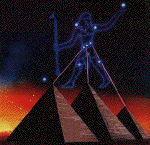
At this point Hancock tries to explain that there has always been a mystery surrounding the pyramids at Giza, and introduces the theories of Robert Bauval regarding the similarities between the groundplan/layout of the three Giza Pyramids, and the pattern of the stars in the belt of the constellation Orion. This seemed to be the crux of the argument that the “Horizon” team appeared eager to disprove, and indeed the sophisticated astronomical capabilities of ancient peoples from cultures all over the world has been a thorn in the side of orthodox archæologists since the time that Sir Norman Lockyer began his researches in this field over 100 years ago. Asked to give details of his position about the Pyramids of Giza, Hancock, author “Heaven’s Mirror”, explained :
“I accept Egyptological opinion that the great Pyramids were built in 2500 BC. I am not saying that the Pyramids were built earlier than that. What I’m saying is that they were built in 2500 BC, but designed to commemorate architecturally, symbolically and astronomically an earlier epoch.” Barlow: “If Bauval and Hancock are right the implications are astounding.”
Krupp: “In The Orion Mystery there’s a nice double page spread, and anybody looking at this would say ah, Giza pyramids, belt of Orion, one kind of looks like the other, you know you’ve got 3 in a row, slanted. We’ve got a map and what I was bothered by turned out to be really pretty obvious.
In the back of my head I knew that something was wrong with these pictures, and what’s wrong with these pictures in their presentation is that north for the constellation of Orion is here at the top of the page. North for the Giza pyramids is down here. Now they’re not marked, but I knew which way north was at Giza and I knew which way north was in Orion. To make the map of the pyramids on the ground match the stars of Orion in the sky you have to turn Egypt upside down, and if you don’t want to do that then you’ve got to turn the sky upside down.”
Hancock: “Ed Krupp’s argument that the pyramids are somehow upside down in relation to the patterns of the stars in the sky to my mind is a very pedantic and nit-picking and ungenerous attitude. I think that what we’re proposing, that the Ancient Egyptians were making a pleasing, symbolic resemblance to what they saw in the sky on the ground is a very reasonable argument” Barlow:
“But Hancock does offer other kinds of evidence for his theory. The Sphinx was carved out of the limestones of the Giza Plateau. Mainstream archaeologists think that it was built four and a half thousand years ago. But Hancock believes it is 12,000 years old. Some of his evidence is again astronomical. The constellation, Leo, rose above the horizon directly East of the Sphinx in 10,500 BC. But there is no evidence that this constellation was recognised by the ancient Egyptians.
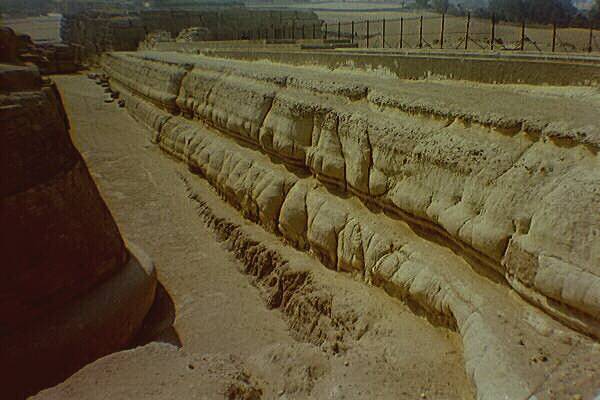
But Hancock also claims there is geological evidence. Egypt has had a dry climate since the time the Pyramids were built. But the Sphinx and its surrounding enclosure are deeply eroded. It has been argued by Hancock and others that the erosion was caused by heavy rainfall, and that this means the Sphinx must have been carved many thousands of years earlier than we thought – when the climate was wetter.” “But the erosion argument has not stood up to the scrutiny of Geologists. Erosion on the Giza Plateau does not depend on water. The grey limestones contain salts, and these have proved to cause destructive levels of erosion in very short periods of time. There is no hard evidence that the Sphinx is any older than the orthodox date.”
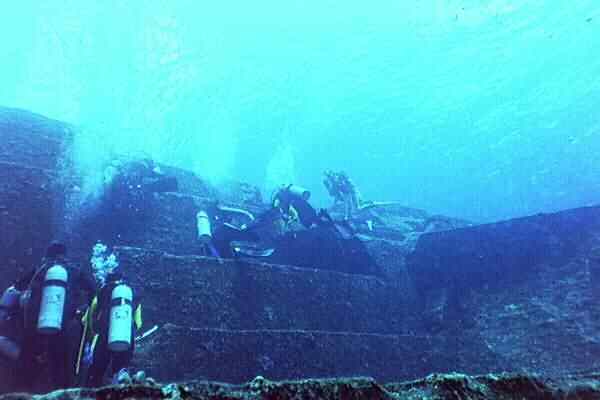
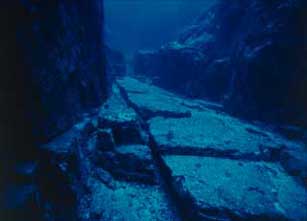
The Sphinx erosion dialogue above was accompanied by shots of the Great Sphinx and the seriously eroded enclosure, though there was no mention of Dr Robert M. Schoch, arguably the leading world expert on the Sphinx erosion. This was surprising, as another BBC team flew Dr Schoch out to the Sphinx in June 1999 to comment on the causes of the erosion, and it’s difficult to imagine that the “Horizon” team could have been unaware of Dr Schoch’s well-known views that precipitation was the likely cause of at least some of the erosion on the Great Sphinx enclosure. Copyright July 1999, Dr Robert M. Schoch From the Sphinx the programme then jumped to South America, cutting to an image of Tiwanaku, Bolivia. There were shots of Hancock explaining his beliefs about Tiwanaku, and his opinion regarding the pioneering work of Arthur Poznansky. The “Horizon” team rushed to dismiss this work by referring to the absence of Radio-Carbon-Dating during Poznansky’s time, stating he couldn’t have therefore known he was wrong in his dates based on astronomical calculations of equinoctial precession. This snippet was offered as if it were the definitive word on the obviously ‘non-radio-carbon-datable’ megalithic structures at Tiwanaku. In another astonishing world-hop it then cuts to Antarctica. The narrator commented about geologists drilling for ice-cores, stating how they are very accurate, like tree-rings, and that as some of the ice-cores date back 400,000 years it was impossible for Atlantis to ever have been there 12,000 years ago. Hancock responded that he “doesn’t need” Antarctica for his hypothesis, and so it cut to scenes of people swimming around the enigmatic underwater structure that was discovered 13 years ago off the coast of Yonaguni Jima, Japan.
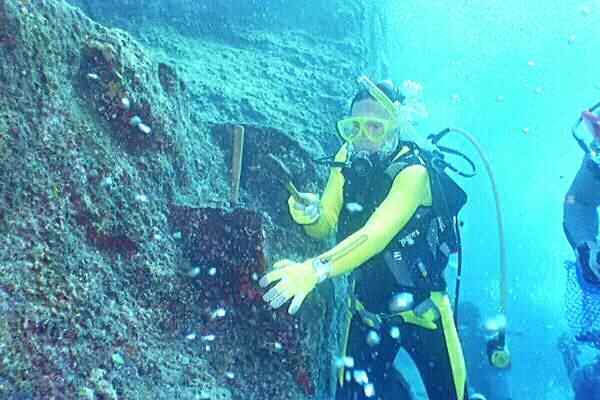
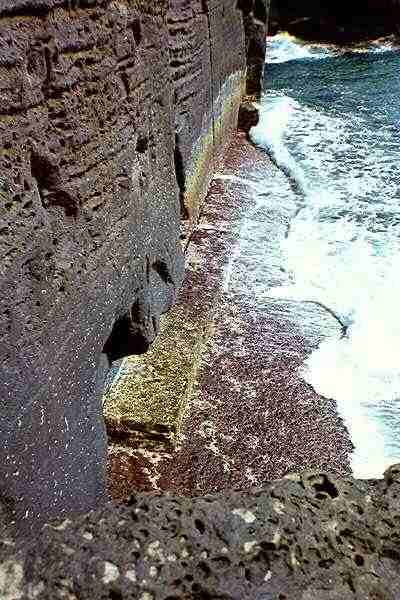
a sequence of underwater shots of Hancock, Schoch, and others exploring the structure discovered by a local fisherman in 1987 off the southernmost island of Yonaguni..
Copyright July 1999, Dr
Robert M. Schoch It then cut to footage of Dr Schoch walking towards the Giza Pyramids for some strange reason. Perhaps the editor had problems with sequential thought, or simply didn’t like what he had to say about the water-based erosion evident in the Sphinx enclosure, from where the body of the Sphinx was cut out of the bedrock. Barlow: “He invited the Boston University Geologist, Robert Schoch, to inspect the site. Prof. Schoch has taken a keen interest in unorthodox views of the past, and he welcomed the chance to examine the underwater discovery. Schoch dived with Hancock several times at Yonaguni.”
Cut to a talking-head of Dr Schoch in a studio environment, who explains : “I went there, in this case, actually hoping that it was a totally man-made structure that was submerged underwater, that dated maybe back to 6000 BC or more. When I got there, and I got to dive on the structure, I have to admit I was very disappointed because I was basically convinced after a few dives that this was primarily, possibly totally, a natural structure.”
Copyright July 1999, Dr Robert M. Schoch Another Barlow voice-over with a tinge of childish glee:
“Professor Schoch has not changed his mind.” Back to Dr Schoch in the studio again:
“I suppose portions of it look like they were man-made, but when you looked at it in context – you look at the shore features etc, and you see how in this case fine sandstones split along horizontal bedding planes, that give you these regular features – I’m convinced it’s a natural structure.” Cut to underwater views of rolling waves, and yet another Barlow voice-over:
“Graham Hancock is still scouring the oceans of the world for a lost civilisation. He has also investigated Pyramids, and a giant stone face on the planet Mars. But he has yet to find firm evidence that there really was a forgotten civilisation of God-like astronomers 12,000 years ago.” And back to Hancock, who seemed upset:
“I believe passionately that the past has been misrepresented, and that people today are not being given the full picture. And I don’t think that my arguments are ever going to be successfully destroyed by nit-picking.” As a final nail-in-the-coffin attempt to discredit Hancock, and especially Bauval, whose work Hancock relied upon for his radically different view of prehistory, the programme then cut to Dr. Ed Krupp in Griffith Observatory:
“After having invested a lot of time, doing what I think very few other people do, which is saying ‘OK, You’ve made this claim. Let’s see if it holds up’, and so subjecting it to the rules of evidence, and then coming to a conclusion. My conclusion is – NO. I don’t think they’re right. And I don’t think they’re right because I don’t think the evidence fits the hypothesis.”
The title of Part II was “Atlantis Reborn”, though many viewers were left with the feeling that the programme would have been more appropriately entitled “Get Hancock!”. Hancock, for his part, reacted unwisely with his sideswipes at everyone who disagreed with him, even though it was obvious that the programme had been selectively edited to make him and Bauval, and anyone who agreed with them, look as mad as possible.
Hancock’s comments about the underwater Yonaguni structure, his opinion that Boston University geologist, Dr Robert M. Schoch, needing to do “..a lot more diving..”, and his feelings that “..before anybody pronounces definitively on this monument they should put in a minimum of 50 dives..”, came across sadly as ‘sour grapes’.
Copyright July 1999, Dr Robert M. Schoch
If nothing else the “Horizon” programmes made a lot of people very angry, and in an ironic way has actually helped the debate about civilisation in prehistory to reach a much wider audience. What appears to have been edited out seems to be just as important as the actual content of the programme as broadcast, which must have broken most rules of impartial journalism – a major discredit to the BBC’s otherwise well-respected “Horizon” team. But Graham Hancock never gave up in what he believed, and equally, not all geologists are in agreement with Dr Schoch. Recent underwater discoveries off the western tip of Cuba, and in northwest India, in the Gulf of Khambhat (Cambay), make it more likely that the Yonaguni structure is at least ‘terraformed’ – that is, originally a natural structure whose shape has been considerably enhanced at some time or another by human hands. The recent (February/March 2002) programmes on UK Channel 4, “Flooded Kingdoms of the Ice Age”, which accompanied the release of Hancock’s “Underworld”, detail the recent discoveries that have been found in depths of up to 300 feet of water on various coastal shelves around India, and in the mediterranean around Malta.
… exclusive …
October 2002 Morien Institute illustrated interview with Professor Masaaki Kimura of the University of the Ruykyus, Okinawa, Japan, about the discovery of:
“More megalithic structures found off the coast of Yonaguni-jima, Japan”
But submerged beneath the waves near the Japanese island of Yonaguni is evidence that may well overturn that long-held theory. A small but persuasive number of scholars and scientists have long thought that “advanced” societies may have existed as long as 10,000 years ago. Their theories, however well reasoned and defended, have been hamstrung by a lack of evidence. But recent discoveries of man-made artifacts on the Pacific seafloor may well prove to be the smoking gun that will propel this alternative view of civilization to prominence”.
see the evidence with ‘unique underwater footage’ of the Yonaguni structures in the NEW DVD of the ‘History Channel’ television programme
Now On DVD
please take a look at our Ancient Mysteries Bookshoppe for a wide selection of books that challenge orthodox views of prehistory on every continent
|