|
Impact Craters throughout the Solar System
Interactive Map
of Major Impact Craters on Earth
Earth
Africa
(largest known craters)
Vredefort Crater –
Free State, South Africa
Morokweng Crater –
Kalahari Desert, South Africa
Oasis Crater –
al-Kufra, Libya
Gweni-Fada Crater –
Fada, Chad
Aorounga Crater –
Aorounga, Chad
FULL LIST OF KNOWN
IMPACT CRATERS IN
Africa
easy-to-use
Interactive Map
Asia
(largest known craters)
Popigai Crater –
Siberia, Russia
Kara Crater –
Nenetsia, Russia
Kara-Kul Crater –
Pamir Mountains, Tajikistan
Elgygytgyn Lake Crater –
Chukchi Peninsula, Russia
Zhamanshin Crater –
Irgiz, Kazakhstan
FULL LIST OF KNOWN
IMPACT CRATERS IN
Asia
easy-to-use
Interactive Map
Australasia
(largest known craters)
Acraman Crater –
South Australia, Australia
Woodleigh Crater –
Western Australia, Australia
Tookoonooka Crater –
Queensland, Australia
Yarrabubba Crater –
Western Australia, Australia
Gosses Bluff Crater –
Northern Territory, Australia
FULL LIST OF KNOWN
IMPACT CRATERS IN
Australasia
easy-to-use
Interactive Map
Europe
(largest known craters)
Lake Siljan Crater –
Dalarna, Sweden
Keurusselkä Crater –
Central Finland
Kamensk Crater –
Western Russia
Lake Lappajärvi Crater –
Lappajärvi, Finland
Boltysh Crater –
Kirovohrad Oblast, Ukraine
FULL LIST OF KNOWN
IMPACT CRATERS IN
Europe
easy-to-use
Interactive Map
North America
(largest known craters)
Sudbury Basin Crater –
Ontario, Canada
Lake Manicouagan Crater –
Quebec, Canada
Chesapeake Bay Crater –
Virginia, USA
Charlevoix Crater –
Quebec, Canada
Montagnais Crater –
Nova Scotia, Canada
FULL LIST OF KNOWN
IMPACT CRATERS IN
Canada
USA & Central America
easy-to-use
Interactive Map
South America
(largest known craters)
Chicxulub Crater –
Yucatán Peninsula, Mexico
Pantasma Crater –
Northern Nicaragua
Araguainha Crater –
Goiás/Mato Grosso, Brazil,
Iturralde Crater –
Iturralde, Bolivia
Vargeão Dome Crater –
Santa Catarina, Brazil
FULL LIST OF KNOWN
IMPACT CRATERS IN
South America
easy-to-use
Interactive Map
Earth’s Moon
FULL LIST OF KNOWN
IMPACT CRATERS ON
Earth’s Moon
Mercury
Where Lava Flowed on Mercury
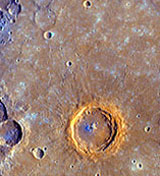
Science / AAAS
FULL LIST OF KNOWN
IMPACT CRATERS ON
Mercury
Venus
FULL LIST OF KNOWN
IMPACT CRATERS ON
Venus
Mars
Martian crater in Mamers Valles
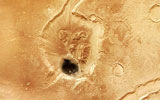
ESA
Craters and channels in Hephaestus Fossae
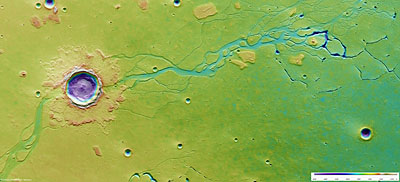
ESA
FULL LIST OF KNOWN
IMPACT CRATERS ON
Mars
Links to other sites
The Largest Impact Crater in the Solar System
Earth Impact Database
Interactive Asteroid Impact Sites Map
Impact Craters Teachers Page
Impact Craters Students Pages
Chronological List of Terrestrial Impact Craters
Do the building blocks of life travel throughout the universe on comets and on asteroids?
Below is a small selection of books suggesting that it probably does
“Life in the Universe: A Beginner’s Guide To Astrobiology”
by
Lewis Dartnell
Get This Book From:
Amazon.com
Amazon.co.uk
“An excellent introduction into the newly emerging and exciting field of astrobiology. An essential, enjoyable and highly readable insight into life in its cosmic context.”
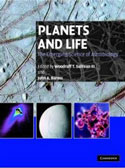
“Planets and Life: The Emerging Science of Astrobiology”
by
Woodruff T. Sullivan III
(Author, Editor)
&
John Baross
(Editor)
Get This Book From:
Amazon.com
Amazon.co.uk
“Astrobiology involves the study of the origin and history of life on Earth, planets and moons where life may have arisen, and the search for extraterrestrial life. It combines the sciences of biology, chemistry, palaeontology, geology, planetary physics and astronomy. This textbook brings together world experts in each of these disciplines to provide the most comprehensive coverage of the field currently available.”
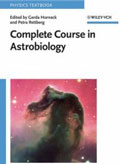
“Complete Course in Astrobiology”
(Physics Textbook)
by
Gerda Horneck
(Editor)
&
Petra Rettberg
(Editor)
Get This Book From:
Amazon.com
Amazon.co.uk
“This up-to-date resource is based on lectures developed by experts in the relevant fields and carefully edited by the leading astrobiologists within the European community. Aimed at graduate students in physics, astronomy and biology and their lecturers, the text begins with a general introduction to astrobiology, followed by sections on basic prebiotic chemistry, extremophiles, and habitability in our solar system and beyond.”
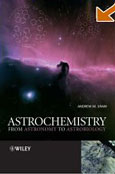
“Astrochemistry: From Astronomy
to Astrobiology”
by
Andrew M. Shaw
Get This Book From:
Amazon.com
Amazon.co.uk
“The dynamic field of astrochemistry brings together ideas of physics, astrophysics, biology and chemistry to the study of molecules between stars, around stars and on planets. Astrochemistry: from Astronomy to Astrobiology provides a clear and concise introduction to this rapidly evolving multidisciplinary subject. Starting with the Molecular Universe, the text covers the formation of the elements, simple models of stars and their classification. It then moves on to draw on the theme of the Origins of Life to study interstellar chemistry, meteorite and comet chemistry as well as the chemistry of planets.”
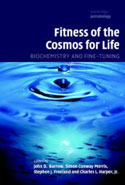
“Fitness of the Cosmos for Life: Biochemistry and Fine-Tuning”
by
John Barrow
(Editor)
Simon Conway Morris
(Editor)
Stephen Freeland
(Editor)
Charles Harper
(Editor)
Get This Book From:
Amazon.com
Amazon.co.uk
“This highly interdisciplinary book highlights many of the ways in which chemistry plays a crucial role in making life an evolutionary possibility in the universe. Cosmologists and particle physicists have often explored how the observed laws and constants of nature lie within a narrow range that allows complexity and life to evolve and adapt. Here, these anthropic considerations are diversified in a host of new ways to identify the most sensitive features of biochemistry and astrobiology. Celebrating the classic 1913 work of Lawrence J. Henderson, The Fitness of the Environment for Life, this book looks at the delicate balance between chemistry and the ambient conditions in the universe that permit complex chemical networks and structures to exist.”
“Astrobiology: A Multi-disciplinary Approach”
by
Jonathan Lunine
Get This Book From:
Amazon.com
Amazon.co.uk
“Astrobiology: A Multidisciplinary Approach is the most comprehensive textbook available for emerging upper-level courses in astrobiology. Internationally renowned authority Jonathan Lunine gives students with a variety of backgrounds a solid foundation in the essential concepts of physics, chemistry, biology, and other relevant sciences to help them achieve a well-rounded understanding of the fascinating study of the origin of life, planetary evolution, and life in the cosmos.”
“National Geographic Video Asteroids
Deadly Impact”
by
Mike D. Reynolds
DVD Region 1
(this product requires a North American or
Multi-Region DVD Player
& NTSC compatible TV)
Available in the EU
“Asteroids and comets: Every year, millions of these ‘stray bullets’ streak through the skies, and tons of small meteorites strike our planet! Some 65 million years ago, dinosaurs were wiped off the face of the earth – in what many believe was the aftermath of a massive cosmic collision. Could something like this happen again? Scientists believe that the impact of an asteroid only a mile wide would be globally catastrophic.”
“Comets II”
by
Michel C. Festou
H. Uwe Keller
Harold A. Weaver
(Editors)
Get This Book From:
Amazon.com
Amazon.co.uk
“Comet science is a field that has seen tremendous advances in recent years, far surpassing the knowledge reflected in the original Comets volume published as part of the Space Science Series in 1982. This new volume, with more than seventy contributing authors, contains the most extensive collection of knowledge yet assembled in the field. It will enable scientists involved in their study to make connections across disciplinary boundaries and will set the stage for discovery and new understanding in the coming years.”
“Cometary Science after Hale-Bopp, Volume I”
by
Hermann Bohnhardt
Michael Combi
Mark R. Kidger
Rita Schulz
(Editors)
Get This Book From:
Amazon.com
Amazon.co.uk
“Comet Hale-Bopp defines a milestone event for cometary science: it is the first “really big” comet observed with modern equipment on the ground and from space and due to that; it is considered the new reference object in cometary sciences. At the beginning of a new era in spacecraft exploration of comets and five years after Hale-Bopp’s perihelion passage these proceedings of invited and contributed papers for IAU Colloquium 186 “Cometary Science after Hale-Bopp” review the state-of-the-art knowledge on comets, the icy, dusty and most primordial left-overs of the formation disk of our own solar system.”
“A Sumerian Observation of the Kofels’ Impact Event”
by
Mark Hempsell
&
Alan Bond
Get This Book From:
Amazon.com
Amazon.co.uk
“Around 700 BC an Assyrian scribe in the Royal Place at Nineveh made a copy of one of the most important documents in the royal collection. Two and a half thousand years later it was found by Henry Layard in the remains of the palace library. It ended up in the British Museum’s cuneiform clay tablet collection as catalogue No. K8538 (also called ‘the Planisphere’), where it has puzzled scholars for over a hundred and fifty years.
In this monograph Bond and Hempsell provide the first comprehensive translation of the tablet, showing it to be a contemporary Sumerian observation of an Aten asteroid over a kilometre in diameter that impacted Kofels in Austria in the early morning of 29th June 3123 BC.”
“Sites of Impact: Meteorite Craters Around the World”
by
Stan Gaz

Get This Book From:
Amazon.com
Amazon.co.uk
“Meteorite Craters and Impact Structures of the Earth”
by
Paul Hodge
Get This Book From:
Amazon.com
Amazon.co.uk
“Impacts in Precambrian Shields”
(Impact Studies)
by
Jüri Plado
&
Lauri J. Pesonen
(Editors)
Get This Book From:
Amazon.com
Amazon.co.uk
“Meteorite Impact!
The Danger from Space and South Africa’s
Mega-Impact The
Vredefort Structure”
by
Wolf Uwe Reimold
&
Roger L. Gibson
(Authors)
Get This Book From:
Amazon.com
Amazon.co.uk
“The Chesapeake Bay Crater: Geology and Geophysics of a Late Eocene Submarine
Impact Structure”
by
Wylie Poag
Wolf Uwe Reimold
&
Christian Koeberl
(Authors)
Get This Book From:
Amazon.com
Amazon.co.uk
|
|
Terrestrial & Solar System
Impacts and Impact Craters
News & New Discoveries 2006 – 2009
News & New Discoveries 2010 – 2012
News & New Discoveries 2012 – 2014
For many years academics in the historical sciences were content in their belief that terrestrial impacts by solid bodies from space was something that only happened in the very early history of our planet, whilst the average person had never heard the word ‘asteroid’. Then in 1980 the Nobel prizewinning physicist, Luis Alvarez, and his colleagues published their famous paper in “Science” which argued that a cosmic impact had led to the extinction of the dinosaurs. He showed that large amounts of the element iridium present in geological layers dating from about 65 million years BP had a cosmic origin, and proposed a radical theory that it was a massive ‘asteroid impact’ 65 million years ago which finally wiped out the dinosaurs.
Over the following decade interest began to rise in the idea of ‘terrestrial impacts’, and by 1990 most scientists at least accepted that the craters on our Moon were caused by impacts of cometary debris and asteroids of varying sizes, and not the volcanoes they had previously thought responsible.
As space exploration continued, the images sent back to Earth, especially by the Voyager spacecraft, allowed astronomers to build a picture of the sort of dynamic solar system first suggested by Victor Clube and Bill Napier in their groundbreaking books “Cosmic Serpent”, published 1982, and developed further in “Cosmic Winter” published 1990.
This was a new model of the solar system. One where regular influxes of comets from the various areas of space transitted by our solar system in its orbit through the galaxy suggested inevitable, and multiple, collisions with all the planetary bodies and their respective moons. Technologicl advances in space imaging have since shown a multitude of impact craters on all the inner planets and their moons. But some 12 years after the theories about the cosmic impact which led to the extinction of the dinosaurs were first proposed, the possibility of cometary bombardments still seemed something that belonged way back in the very early history of our solar system – even to most scientists.
It was on March 24 1993 that astronomers, husband and wife team Carolyn S. and Eugene M. Shoemaker, and David H. Levy, discovered a new comet in our solar system. Observations over the next few months determined that the comet was, at least temporarily, in orbit around Jupiter, and that on July 7 1992 the tidal forces of the largest planet in our solar system had caused the comet, by then named P/Shoemaker-Levy 9, to disintegrate. Over the next year or so astronomers on Earth
observed the fragments proceeding around the Sun and heading back on a collision course directly for Jupiter. From July 16th to 22nd 1994 they watched in awe as the 21 fragments bombarded the visible surface of Jupiter causing ‘fireballs’ 50 times the size of Earth and leaving huge scars on Jupiter’s southern hemisphere.
This was a wake-up call even for those who understood what was going on, and resulted in more funding being requested by astronomers to research the frequency of impacts throughout the solar system, but also to search for any evidence of past impacts on Earth. Following this event, there was an abrupt realisation by astonomers that if it can happen to Jupiter now, it can also happen to Earth in the future, and the search began in earnest to identify the exact orbital paths of all Earth-orbit-crossing celestial objects.
If anyone is in any doubt as to exactly how dangerous a place our planet occupies in the solar system they should simply look at our Moon. There for all to see with the naked eye, and in even greater detail using a pair of good binoculars or a small telescope, are impact craters galore. There doesn’t appear to be one square mile of the lunar surface that is not pockmarked with impact craters, and while some are undoubtedly very ancient they also contain within their crater rims a multitude of newer craters from much more recent impacts. The reason why there are so many visible craters on the Moon from ancient impacts was summed up well by astronomer, Duncan Steel, in his 1995 book,
“Rogue Asteroids and Doomsday Comets”:
“Craters are relatively swiftly eroded on Earth by rain, snow, and wind, whereas on the Moon they remain for eons until a new projectile happens to erase the scar left by some cousin countless millennia before.”
So this explains, partially, why there are so few visible craters on Earth. But raises the obvious question as to why we can’t see more given that, if our Moon is so cratered, surely our planet must be an even bigger target in the same area of the solar system? The answer is at once simple and also very complex. Firstly, there is approximately 71% of the surface area of the Earth covered with oceans – leaving just 29% dry land surface area. This gives a 3 to 1 chance that any incoming impactor will, if it doesn’t explode a few miles up like whatever happenned at Tunguska in 1908, impact one of the oceans and leave no easily visible trace.
Secondly, any crater on dry land would be at the mercy of the elements, and should there have been collisions with cometary debris, or asteroids, in the Amazon Basin, say, then vegetation would without doubt obscure them in a very short time indeed. But these are not the only factors, as Duncan Steel explained:
“The length of time that a crater will survive depends not only on the regions in which it is formed, but also on it’s size. Obviously a crater 50 kilometers across will last longer than a comparatibe pipsqueak just 100 meters in diameter. For example, in Australia there are 19 known craters – probably there are dozens more awaiting discovery – and of those, four are less than about 6,000 years old. Those are the four smallest however, all being less than 200 meters in diameter.”
At the time that Duncan Steel was writing
“Rogue Asteroids and Doomsday Comets” in 1994/1995, there were then only about 140 known terrestrial impact craters. But in the years since then, spurred on by a new-found sense of urgency following the events on Jupiter in July 1994, the search picked up steam, and many more have been discovered.
The current tally is just under 1000, and there is an interactive map of all the terrestrial impact craters accessible at the
University of Arizona website. This is an excellent resource for anyone wishing to see just how many have so far been discovered on just the 29% of the surface area of our planet that is currenly dry land.
Another good resource for information about terrestrial impact craters which also has an interactive map is accessible at the
University of New Brunswick Canadian website. The first paragraph or so of their introduction to the subject is worth quoting from here, as it puts the dynamic history of the solar system into a proper perspective:
“Until recently, impacts by extraterrestrial bodies were regarded as an interesting but, perhaps, not an important phenomenon in the spectrum of geological process affecting the Earth. Our concept of the importance of impact processes, however, has been changed radically through planetary exploration, which has shown that virtually all planetary surfaces are cratered from the impact of interplanetary bodies. It is now clear from planetary bodies that have retained portions of their earliest surfaces that impact was a dominant geologic process throughout the early solar system.
For example, the oldest lunar surfaces are literally saturated with impact craters, produced by an intense bombardment which lasted from 4.6 to approximately 3.9 billion years ago, at least a 100 times higher than the present impact flux. The Earth, as part of the solar system, experienced the same bombardment as the other planetary bodies.”
On this page we have tried to compile a photographic collection of impact craters on Earth to demonstrate just how many there actually are. Asteroids vary in their composition. Some are composed purely of stoney materials, some are composed of nickel & iron, while others have varying combinations of both. It should be understood that many of the asteroids which are made up of stoney materials do not survive the journey through our atmosphere. They explode in the upper atmosphere as the white-hot matter caused by friction upon entry hits the freezing cold air.
This has happened as recently as 1908 over the Tunguska region of Siberia, where the ‘air-burst’ caused an explosion the equivalent of many hundreds of nuclear bombs. Because the asteroid, or fragment of cometary debris, detonated in the upper atmosphere there was no impact crater to show what had happened, but many thousands of square miles of forest lands were completely flattened all around the
detonation area.
The Tunguska airburst, Siberia – June 1908
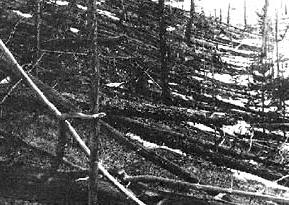
How many times has this happened before? And how soon will it be before an something like this happens again? …
“10 Greatest Major-Impact Craters on Earth”
Environmental Graffiti, USA, 17 July 2008
Click the image below or the headline above
to access this story
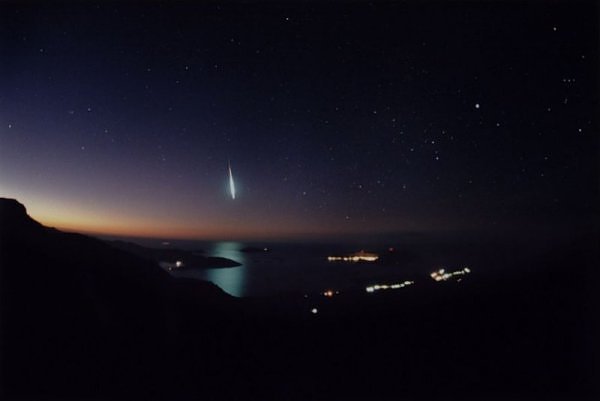
NASA
Imagine staring into the sky and seeing a tiny yellow dot, gradually getting closer. That dot doubles in size every second, until it slowly darkens the sky. You realize that this dot is actually the size of New York City and is screeching through the atmosphere faster than the speed of sound, coming right for you. This massive object will cause tsunamis, earthquakes and obliterate natural daylight for years … oh … and it will kill you.
Similar asteroid impacts have and will happen on numerous occasions in our earth?s history. Today we?ll show you the biggest impact craters by diameter.
Over 100 Years Since The Tunguska Event
June 30, 1908
Taken during the 1927 Leonid Kulik expedition, this photograph
shows trees destroyed by the blast nearly 20 years before
It has now been 100 years since the events of June 30, 1908, when a bolide of some description exploded over the Tunguska River region of Siberia. A conference to mark the anniversary took place in Moscow, Russia in 2008.
TUNGUSKA 2008 INTERNATIONAL CONFERENCE
“Tunguska: 100 years of wondering”
ABC Science News, Australia
02 July 2008
One hundred years ago, an explosion bigger than an atomic bomb blasted Tunguska, Siberia. We still don’t know what caused it, but there are plenty of theories!
In 1991, Italian scientists still found evidence
of fallen trees near the blast site
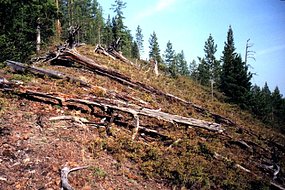
University of Bologna
Early on the morning of June 30, 1908, a massive explosion rocked the Siberian wilderness flattening more than 2,000 square kilometres of forest.
Villagers 100 kilometres away from the Podkamennaya Tunguska river basin reported seeing a fireball in the sky, feeling intense heat, hearing loud thumps and being thrown off their feet.
‘The split in the sky grew larger, and the entire Northern side was covered with fire. At that moment I became so hot that I couldn’t bear it, as if my shirt was on fire; from the northern side, where the fire was, came strong heat.’
‘I wanted to tear off my shirt and throw it down, but then the sky shut closed, and a strong thump sounded, and I was thrown a few yards’, reported one villager.
The explosion lit up the sky as far away as London for several days.
Nearly two decades later, the first expedition into the area led by Russian meteorite specialist Leonid Kulik found a region of scorched trees 50 km in diameter, but no crater.
It’s now believed that the Tunguska event ? as it’s now known ? was hundreds of times more powerful than the atomic bomb dropped on Hiroshima
Tunguska has long fascinated scientists, enthusiasts and sci-fi fans. Over the years, the mystery of the event has prompted a number of theories with varying degrees of scientific plausibility. These have ranged from a meteorite to the crash of an alien spacecraft; an explosion of methane or the result of Nikola Tesla’s experiments with electricity near New York.”
[Full Story]
Geographic Distribution of Known Impact Structures
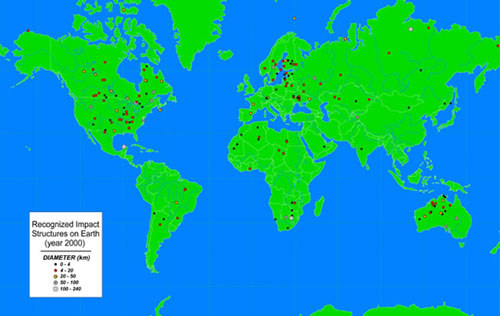
Lunar & Planetary Institute
A few of the previously known
Terrestrial Impact Craters:
Barringer’s Meteor Crater
Arizona, USA
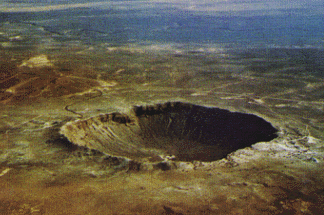
The Barringer’s Meteor Crater which is near Winslow, Arizona, is one the worlds best known
craters. It is estimated to have been created at least 50,000 years ago. The crater is named after ‘Daniel Monroe Barringer’ because he was the first to theorize that the depression was created by a meteor. He based his conclusion on the observation of the many minerals surrounding the impact.
Nearly a mile wide, and 570 feet deep, it was originally thought to have been caused by an explosion of super heated steam resulting from volcanic activity that might have occurred far below the surface. But this was wrong.
The absence of any volcanic rocks in the area, coupled with the discovery of ‘meteoritic iron’ in the crater rim, and finely pulverised silica, convinced Barringer it was an impact crater.
Aorounga Crater
Chad, Central Africa
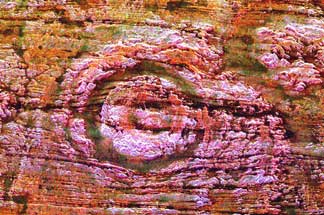
A team of scientists believes they have discovered a chain of impact craters in the Central African country of Chad that suggests ancient Earth may have been hit by an asteroid or fragmented comet similar to the cometary fragments from
Shoemaker-Levy 9 that slammed into Jupiter in 1994.
Discovered using Spaceborne Radar images, scientists believe that this apparent string of impact craters date back about 360 million years, to a time when the Earth was undergoing a period of mass biological extinction.
The most prominent of the craters, is called Aorounga South. It has been observed in Landsat) satellite-based images and has been verified by ground work in 1992. The other two craters, Aorounga Central and Aorounga North, have not yet been scientifically confirmed through similar fieldwork.
Manicougan Crater
Quebec, Canada
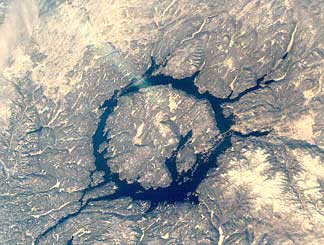
The Manicougan crater in Quebec, Canada, is believed to have been caused by an impact around 200 to 300 million years ago. At roughly 60 miles across, the Manicougan crater ranks as joint 5th largest crater in the world, along with the Popigai crater in Russia, which is about the same size.
It has been thought previously that the impact which caused this crater was responsible for the Triassic-Jurassic extinction event, but scientists have pointed out that, at approx 214 million years old, this impact occurred well before what has become known as ‘the TJ event’.
Kara-Kul Crater
Tajikistan, Central Asia
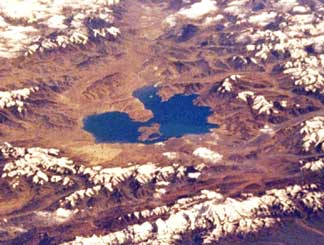
Partially filled with the waters of the Kara-Kul Lake, this impact crater is estimated to be less than 10 million years old. It is located in the ‘Pamir Mountain Range’ of Tajikistan, close to the border with Afghanistan in central Asia. The crater is 28 miles in diameter, and the lake is 16 miles across.
NASA’s Johnson Space Center in Houston, Texas, has made available a collection of photographs of the Karakul crater taken by astronauts. You can access these at the website of the
Astronaut Photography of Earth – Display Record.
At around 20,000 feet above sea-level it is one of the highest impact craters in the world, and only recently has impact-shock features been found in local ‘breccias’ and ‘cataclastic rocks’. As the country opens up to co-operation with Western scientists, more data will become available.
Clearwater Lakes Crater
Canada
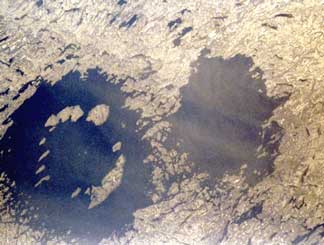
The Clearwater Lakes craters are the only examples on Earth of a pair of impact craters that were formed simultaneously by two separate meteorite impacts. This shows that in the past our planet has suffered from at least one major ‘multiple bombardment’ of cometary debris from space.
It has been estimated that these twin craters were formed some 290 million years ago and research scientist at the Geological Survey of Canada began studying craters 25 years ago on the Apollo program. Many more impact craters all over Canada have come to light since that time.
Clearwater Lake East (left) has a raised central area covered with impact melts, and these form the circle of islands. The lake to the right is also fomred by an impact crater, but this one has a central peak that is submerged.
Bosumtwi Crater
Ghana, West Africa
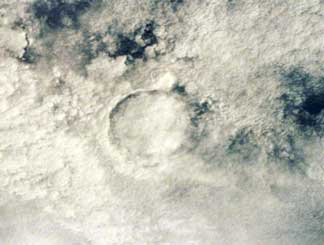
The Bosumtwi crater in Ghana, West Africa, shown here partly obscured by clouds, has a rim diameter of 6.5 miles. It is estimated to be around 1.3 million years old, and is filled almost entirely by Lake Bosumtwi.
Beginning January 2000, researchers from the
University of Syracuse started to explore the ‘crater lake’ to gather data that would help them assess the changes that occur after a major impact by a meteorite or asteroid.
Led by Professor Christopher Scholz, the expedition had one major objective, as explained by Prof. Scholtz:
“Our data should provide information about what happens when an impact hits hard, pre-Cambrian, crystalline rocks that are a billion years old”
Mistastin Lake Crater
Newfoundland/Labrador, Canada
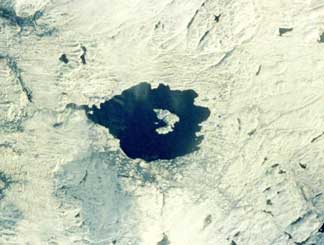
The view of this crater lake to the left was taken by astronauts aboard the Space Shuttle. The crater has been heavily eroded over time, especially by the eastward-moving glaciers, which have reduced the rim exposing the crater floor. The breccias have almost disappeared as a result.
At the centre of the crater lake is ‘Horseshoe Island’, which is formed by the central uplift of the crater floor. This winter view shows the crater-lake, and the island at its centre, starkly contrasted against the snow.
Scientists estimate the crater to be around 38 million years old, and the rim diameter is a little under 17.5 miles. Just beyond the margins of the lake are vestiges of the impact melt sheet that contains evidence of meteoritic features in quartz, feldspar and diaplectic glasses.
Wolfe Creek Crater
Australia
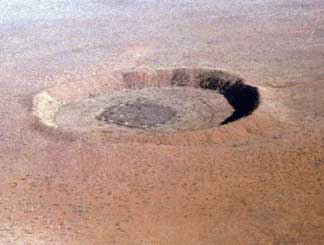
Discovered during an aerial survey in 1947, Wolfe Creek meteorite crater is just over half a mile wide – rim to rim. The crater is now thought to have been formed by a meteorite or asteroid impact around 300,000 years ago.
It has been known by Aboriginal peoples as ‘Kandimalal’ for countless centuries, and Aboriginal Dreamtime lore tells of:
” … two rainbow snakes who formed the nearby Sturt and Wolfe Creeks as they crossed the desert. The crater is believed to be the place where one snake emerged from the ground.”
Now a protected reserve, Wolfe Creek was named in 1889 after Robert Wolfe, chairman of the Kimberley Goldfields Roads Board, a prospector and storekeeper of Halls Creek.
Tunguska airburst
Tunguska, Siberia – 1908
Some incoming asteroids and cometary debris are of a mainly stoney composition. At 7:14 a.m. on 30 June 1908 a ‘fireball’ exploded about 5 miles above the Tunguska River valley in Siberia. For thousands of square miles around the area of the ‘airburst’ the trees were flattened.
The force of the blast was equivalent to 1000 Hiroshima bombs. The heat incinerated herds of reindeer and burned tens of thousands of evergreen trees across eastern Siberia.
For several days the sky was bright with an eerie orange glow that was seen for thousands of miles around. It was widely reported that as far away as western Europe people were able to read newspapers and books ‘in the middle of the night’ without using a lamp or candle.
News & New Discoveries 2017 onwards ….
“A Huge Ring-Like Structure on Ganymede Might be the Result of an Enormous Impact”
August 12 2020, Universe Today, USA
“Ganymede’s surface is a bit of a puzzle for planetary scientists. About two-thirds of its surface is covered in lighter terrain, while the remainder is darker.
The Valhalla Crater on Jupiter’s moon Callisto
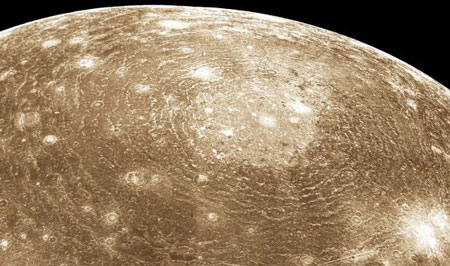
The Valhalla Crater on Jupiter’s moon Callisto
Public Domain
Both types of terrain are ancient, with the lighter portion being slightly younger. The two types of terrain are spread around the moon, and the darker terrain contains concurrent furrows.
For the most part, scientists think that the furrows were caused by tectonic activity, possibly related to tidal heating as the moon went through unstable orbital resonances in the past.
But a new study says that a massive impact might be responsible for all those furrows.”
[Read The Full Story and see the many images]
[An excellent story from Universe Today. The best newly discovered crater for several years. It’s really well worth the visit to read the full story – Ed.]
“Eberswalde crater delta – 3D”
February 04 2019, ESA, France
“This intricate structure of an ancient river delta once carried liquid water across the surface of Mars.
To best enjoy this image, produced with infrared and visible filters on the Colour and Stereo Surface Imaging System (CaSSIS) of the ESA-Roscosmos ExoMars Trace Gas Orbiter, view through red/green ‘3D’ glasses.
To create a stereo view like this, the orbiter’s camera uses a motor to rotate its telescope and take photos from different angles.
The two views can be put together to make a three-dimensional view.
Click
here
to see one of the pair of images that comprise the ‘stereo pair’.”
[Read The Full Story and see the many images]
[Not an impact crater as such, but the image is really clear, and observers can appreciate the river delta which provides ‘proof’ that water once flowed on Mars. It’s really well worth the visit to read the full story – Ed.]
“Huge Asteroid Impact Crater Found
Just Under the Ice in Greenland”
November 16 2018, Universe Today, USA
“An international team of scientists have discovered what lay hidden under Arctic ice for thousands or even hundreds of thousands of years.
Using data primarily from NASA’s Operation IceBridge, they discovered one of the 25 largest impact craters anywhere on Earth.
And its discovery may re-ignite an old climate debate.
This impact crater is buried under more than a half mile of ice.
It was originally spotted by a team of scientist using freely-available data from Operation IceBridge, NASA’s on-going mission to image the planet’s polar ice.
The crater’s in northwest Greenland under the Hiawatha glacier, and it’s about 300 meters deep (1,000 ft.) and about 30.5 km (19 miles) in diameter. (For a comparison, the largest crater on Earth is the Vredefort crater, at 160 km. in diameter.)
[Read The Full Story and see the many images]
[An exciting discovery in Greenland, and it’s possible link to the impact that triggered the Younger Dryas ‘extreme cold event’ shows this to be one of the most important discoveries made in many years. It’s really well worth the visit to read the full story – Ed.]
“Recent tectonics on Mars”
September 20 2018, NASA Earth Observatory, USA
“These prominent trenches were formed by faults that pulled the planet’s surface apart less than 10 million years ago.
The images were taken by ESA’s Mars Express on 27 January, and capture part of the Cerberus Fossae system in the Elysium Planitia region near the martian equator.
The fossae – meaning ‘ditches’ or ‘trenches’ in Latin – stretch for more than 1000 kilometres from the northwest to the southeast.
They cut through impact craters and hills along the way, as well as 10 million year old volcanic plains, indicating the relative youth of their formation.
Cerberus Fossae tectonic features
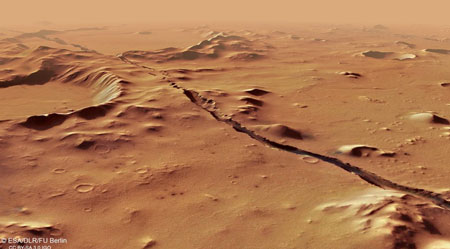
Perspective view of Cerberus Fossae
ESA/DLR/FU, Berlin, Germany
CC BY-SA 3.0 IGO
They vary in width, typically from a few tens of metres to over a kilometre wide, and are thought to be tectonic features originating from faults that stretch the upper layers of the surface apart.
They could be linked to injections of lava at depth deforming the surface above, perhaps originating from the trio of volcanoes that are located to the northwest.
[Read The Full Story and see the many hi-res images]
[This is a great story with many hi-res images. Read the full story and see the images. It’s really worth the visit – Ed.]
“Vredefort Crater”
September 01 2018, NASA Earth Observatory, USA
“About two billion years ago, an asteroid measuring at least 10 kilometers across hurtled toward Earth.
The impact occurred southwest of what is now Johannesburg, South Africa, and temporarily made a 40-kilometer-deep and 100-kilometer-wide dent in the surface.
Almost immediately after impact, the crater widened and shallowed as the rock below started to rebound and the walls collapsed.
The world’s oldest and largest known impact structure was formed.
Neukum Crater
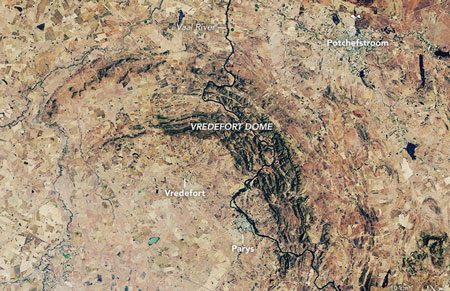
Colour view of Vredefort Crater in South Africa
NASA Earth Observatory, Earth Orbit
Scientists estimate that when the rebound and collapse ceased, Vredefort Crater measured somewhere between 180 and 300 kilometers wide.
But more than 2 billion years of erosion has made the exact size hard to pin down.”
[Read The Full Story and see the hi-res images]
[This is an excellent story and we recommend you read the full story – Ed.]
“Crater Neukum named after Mars Express founder”
January 18 2018, ESA, Germany
“A fascinating martian crater has been chosen to honour the German physicist and planetary scientist, Gerhard Neukum, one of the founders of ESA’s Mars Express mission.
The International Astronomical Union named the 102 km-wide crater in the Noachis Terra region “Neukum” in September last year after the camera’s leader, who died in 2014.
Professor Neukum inspired and led the development of the high-resolution stereo camera on Mars Express, which helped to establish the regional geology and topography of Mars.
Neukum Crater
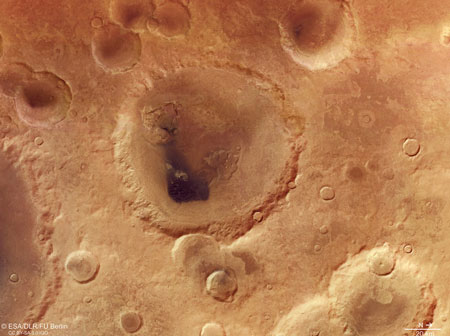
Colour view of Neukum Crater in the Noachis Terra region on Mars
ESA/DLR/FU Berlin, CC BY-SA 3.0 IGO
The crater is about 102 km wide and 1 km deep, with two shallow depressions and a dune field in its interior.
The crater was named after Gerhard Neukum, who developed the High Resolution Stereo Camera on ESA’s Mars Express.”
[Read The Full Story and see the hi-res images]
[It’s good to see such a great creative man honoured in this way – Ed.]
“Window to a watery past on Mars”
June 08 2017, ESA, France
“This 70 km-wide crater and its surrounds offer a window into the watery past of the Red Planet.
The scene, captured by ESA’s Mars Express, is a composite of two images taken in March 2007 and February 2017.
Margaritifer Terra and Erythraeum Chaos
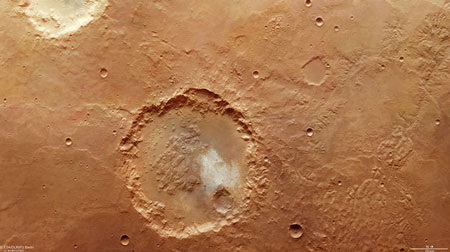
Remnants of valley networks across the scene indicate that water once flowed through this region, shaping the features seen today
Copyright © ESA/DLR/FU Berlin, CC BY-SA 3.0 IGO
It focuses on a large crater in the Margaritifer Terra region in the southern hemisphere of Mars, and includes a portion of Erythraeum Chaos to the north (right in the main colour image below).
The region is located at the northern edge of Noachis Terra, which at 3.7–4 billion years old, represents some of the oldest and most heavily cratered terrain on Mars.”
[Read The Full Story and see the hi-res images]
[Amazing hi-res images! Another great story from ESA showing the Margaritifer Terra and Erythraeum Chaos on Mars – Ed.]
“Crater triplets on Mars”
April 06 2017, ESA, France
“At first glance this scene may seem nothing out of the ordinary, but the large elongated crater marks the imprint of an impacting body that may have broken into three before it hit Mars.
The images were acquired by ESA’s Mars Express on 28 January, and focus on one of the oldest regions on Mars, Terra Sirenum, in the southern highlands.
Topography of a triple crater
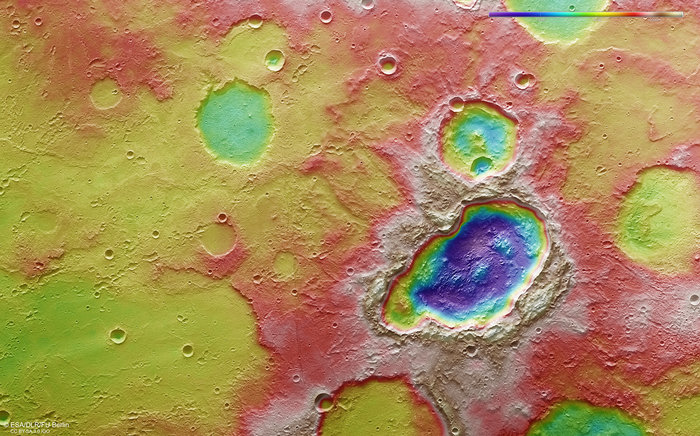
The colour-coded topographic view shows relative heights
and depths of the ‘triple crater’
Copyright © ESA/DLR/FU Berlin, CC BY-SA 3.0 IGO
The elongated trough at centre stage in this scene is 45 km long and 24 km across.
Two groups of raised material can be seen in the crater floor.
These peaks are created as the initial crater cavity produced by the impact collapses under gravity.
The smaller crater also has a hint of a central peak.”
[Read The Full Story and see the hi-res images]
[Amazing hi-res images! Another great story from ESA showing the triple-impact-crater on Mars and the ejecta areas – Ed.]
“A chunk of interplanetary debris recently slammed into
Mars and left this fresh crater and spray of ejecta”
January 06 2017, Astronomy Magazine, USA
“Small asteroids and chunks of cometary debris frequently slam into the surface of Mars, gouging out new craters.
Thanks to a high-resolution camera aboard NASA’s Mars Reconnaissance Orbiter, scientists can often spot such impacts relatively soon after they occur.
Fresh Mars Impact Crater
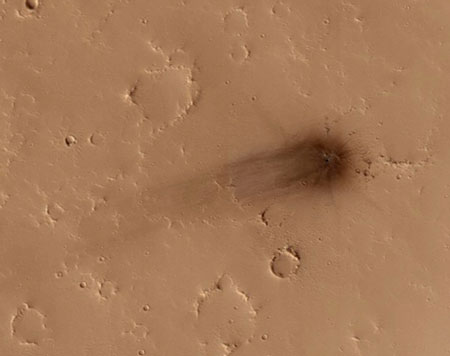
A small crater and surrounding blast zone on Mars, as imaged by the HiRISE instrument on NASA’s Mars Reconnaissance Orbiter on November 27, 2016
Copyright © NASA/JPL/University of Arizona
The image above, acquired by the orbiter’s High Resolution Imaging Science Experiment is a compelling example.
It shows a crater and blast zone from an impact that likely occurred as recently as this past August, and no later than January 2014, according to HiRISE scientists.
The crater is about 13 feet across.
That means the asteroid or comet fragment that gouged it out was probably about three to six feet across.”
[Read The Full Story and see the hi-res images]
[Wow! What a great image of the newly discovered impact crater on Mars and the ejecta area – Ed.]
News & New Discoveries 2016 onwards ….
“Wolfe Creek, Australia”
Decmber 09 2016, ESA, France
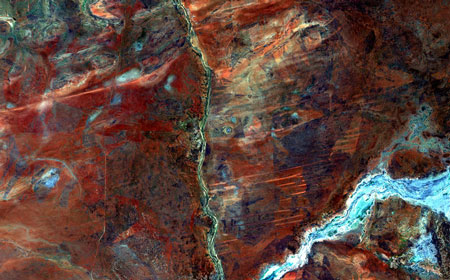
“The Copernicus Sentinel-2A satellite takes us over the northern part of Western Australia to the Wolfe Creek Crater National Park.
The area pictured is close to the edge of the Great Sandy Desert, the country’s second-largest, and presents a landscape of desert plains and grasslands.
Wolfe Creek Impact Crater
An ESA Image
Copyright © contains modified Copernicus Sentinel data (2016), processed by ESA
At the centre of the image we can see the Wolfe Creek Crater, the remnant of a meteorite crash some 300,000 years ago.
The crater measures about 875 m across, and plants grow at the centre, likely thriving off water reserves from seasonal rain.”
[Read The Full Story and see the hi-res image]
[This is a good image of the Wolfe Creek area showing the impact crater near the centre of the satellite image – Ed.]
“Rock core from dinosaur-killing impact reveals how enormous craters form”
November 17 2016, Nature, UK
“Drilling into ground zero of the asteroid impact that killed off the dinosaurs 66 million years ago has uncovered the origin of its mysterious ring of mountains.
The drill core penetrated a circle of mountains, known as a peak ring, in Mexico’s buried Chicxulub crater.
Only the largest impacts are powerful enough to form peak rings.
Understanding how these mountains formed at the 200-kilometre-wide Chicxulub could help to reveal how cosmic collisions shaped other bodies, such as the Moon and Venus.”
[Read The Full Story and see the images]
[This is a really good and important report which casts more light on the science of how impract craters form and the opportunities they create for life to exist around and within them. It’s well worth a visit to read the full story and follow the many links to related stories – Ed.]
“Mars Express spies a nameless and
ancient impact crater”
July 18 2016, ESA, Germany
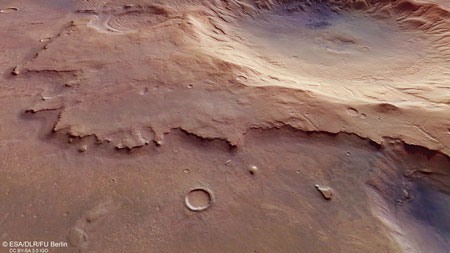
“This striking perspective view from ESA’s Mars Express shows an unnamed but eye-catching impact crater on Mars.
Mars Ancient Impact Crater
An ESA Image
Copyright © ESA/DLR/FU Berlin, CC BY-SA 3.0 IGO
This region sits south-west of a dark plain named Mare Serpentis (literally ‘the sea of serpents’), which in turn is located in Noachis Terra (literally ‘the land of Noah’).
Noachis Terra is one of the oldest known regions on the Red Planet, dating back at least 3.9 billion years— in fact, the earliest martian era, the Noachian epoch, is named after it.
Noachis Terra is representative of ancient Mars’ surface, which is characteristically peppered with craters that have been preserved for billions of years, although many have degraded over time.”
[Read The Full Story]
“Clues to ancient giant asteroid found
in western Australia”
May 17 2016, Astronomy Magazine, USA
“Scientists have found evidence of a huge asteroid that struck Earth early in its life with an impact larger than anything humans have experienced.
Tiny glass beads called spherules, found in northwestern Australia, were formed from vaporized material from the asteroid impact, said Andrew Glikson from The Australian National University (ANU).
‘The impact would have triggered earthquakes orders of magnitude greater than terrestrial earthquakes, it would have caused huge tsunamis, and would have made cliffs crumble’, said Glikson.
‘Material from the impact would have spread worldwide. These spherules were found in sea floor sediments that date from 3.46 billion years ago.’
The asteroid is the second oldest known to have hit Earth and one of the largest.
Glikson said the asteroid would have been 20 to 30 kilometers across and would have created a crater hundreds of kilometers wide.”
[Read The Full Story]
“Cut crater in Memnonia Fossae”
May 17 2016, ESA, Germany
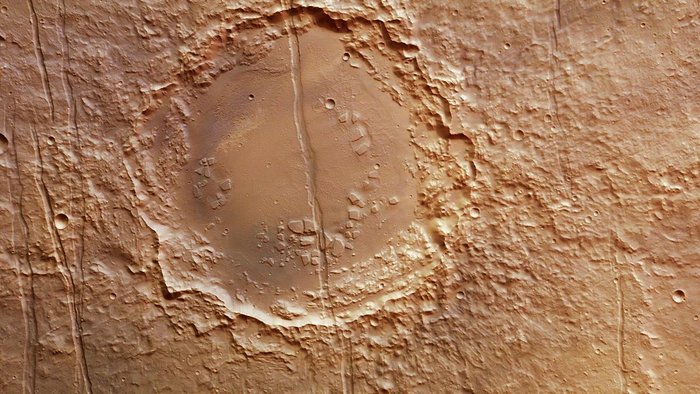
“An extensive network of fault lines cut through this region of Mars, including one that slices clean through an ancient 52 km-wide crater.
Cut crater in Memnonia Fossae
An ESA Image
Copyright © ESA/DLR/FU Berlin, CC BY-SA 3.0 IGO
The fault network is likely linked to the formation of the Tharsis Bulge, a region to the east that is home to several large volcanoes, including Olympus Mons.
Vast volumes of lava that erupted from these volcanoes in the past were deposited onto the surface, building up thick layers.
The load imposed on the crust by the lava resulted in immense stress, which was later released by the formation of a wide-reaching fault and fracture system.”
[Read The Full Story]
“Geologists to drill into heart of dinosaur-killing impact”
March 31 2016, Nature, UK
“Geophysicists are returning to Earth’s most famous cosmic bullseye.
Around 7 April, from a drill-ship off the coast of Yucatán, Mexico, they will start to penetrate the 200-kilometre-wide Chicxulub crater, which formed 66 million years ago when an enormous asteroid smashed into the planet.
The aftermath of the impact obliterated most life on Earth, including the dinosaurs.
The expedition is the first to directly probe one of Chicxulub’s most striking features – its ‘peak ring’, a circle of mountains that rises within the crater floor.
Scientists have yet to fully explain how peak rings form, even though they are common in big impact craters across the Solar System.
At Chicxulub, researchers will look for evidence to explain how a 14-kilometre-wide asteroid could have punched a hole that pushed rocks from the surface down some 20-30 kilometres.”
[Read The Full Story]
“SMART-1 views a cluster of the Moon’s craters”
February 15 2016, ESA, France
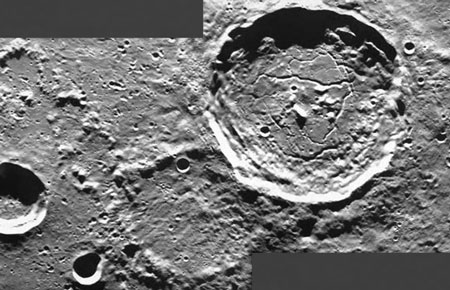
“This image shows a crater-filled region in the northeastern part of the Moon. Several features are visible here, including, to the left of the frame, the small Keldysh crater peeking into view.
A cluster of the Moon’s craters
An ESA Image
Copyright © ESA/SMART-1/AMIE camera team/Space Exploration Institute
Below and to the right of Keldysh is the small depression of Hercules F, which sits to the left of the faint and eroded rim of Atlas E.
The largest and most prominent feature, visible towards the top right of the frame, is Atlas crater.
Atlas is a couple of kilometres deep and nearly 90 km in diameter, with an outline that is slightly more polygonal than circular.
The crater floor is peppered with hills, rifts and fractures that surround a clearly visible central mountain (seen casting a shadow).”
[Read The Full Story]
News & New Discoveries 2015 onwards ….
“The youngest crater on Charon?”
November 02 2015, Astronomy Magazine, USA
“New Horizons scientists have discovered a striking contrast between one of the fresh craters on Pluto’s largest moon Charon and a neighboring crater dotting the moon’s Pluto-facing hemisphere.
The crater, informally named Organa, caught scientists’ attention as they were studying New Horizons’ highest-resolution infrared compositional scan of Charon.
Organa and portions of the surrounding material ejected from it show infrared absorption at wavelengths of about 2.2 microns, indicating that the crater is rich in frozen ammonia, and from what scientists have seen so far, unique on Pluto’s largest moon.
The infrared spectrum of nearby Skywalker crater, for example, is similar to the rest of Charon’s craters and surface, with features dominated by ordinary water ice.
Using telescopes, scientists first observed ammonia absorption on Charon in 2000, but the concentrations of ammonia around this crater are unprecedented.”
[Read The Full Story With Inages]
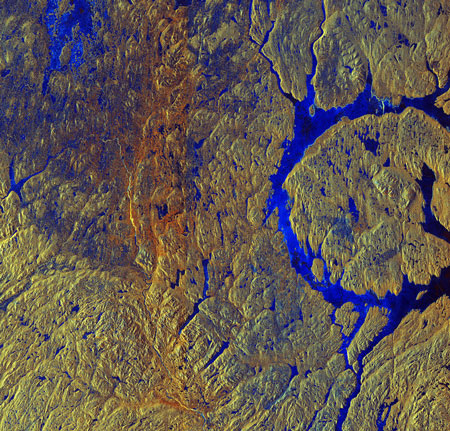
“Manicouagan Crater, Canada”
October 30 2015, ESA Sentinel-1A, Earth Orbit
“This false-colour image featuring the Manicouagan Crater was captured by the Sentinel-1A satellite on 21 March.
Manicouagan Crater, Canada
An ESA Image
Copyright © Copernicus Sentinel data (2015)/ESA
Carved out by an asteroid strike some 214 million years ago, this crater in Quebec, Canada is known to be one of the oldest and largest impact craters on the planet. Experts believe that glaciers have since played a large part in its erosion.
Its concentric structure results from the shock waves transmitted by the impact. These somewhat resemble the rings that form when a pebble is dropped into water.
So big and distinct, the crater can easily be observed from space.
The multiple-ring structure is some 100 km across, with the 70 km-diameter inner ring its most prominent feature.”
[Read The Full Story]
“On the rim of Schiaparelli crater”
October 19 2015, ESA/DLR/FU Berlin, Germany
“A 42 km-wide impact crater and numerous smaller craters straddle the northwestern rim of the 460 km-diameter Schiaparelli basin in this image taken by ESA’s Mars Express on 15 July 2010.
The large basin is named for Italian astronomer Giovanni Schiaparelli (1835–1910).
The entry, descent and landing demonstrator module of the joint ESA–Roscosmos ExoMars 2016 mission also honours the astronomer with the name Schiaparelli.
Giovanni Schiaparelli is famous for observing straight-line features on Mars that he called ‘canali’.
This term was mistakenly translated into English as ‘canal’ instead of ‘channel’, conjuring up images of vast irrigation networks constructed by intelligent beings.
We now know that Schiaparelli’s canali were illusions created by the comparatively poor telescopes of the time and that there are no water-filled channels on Mars today – but there is plenty of evidence that water was once present in Mars’ past.
The Schiaparelli basin may be one such location: layers in its walls and deposits on its floor suggest it once hosted a lake. The scene shown here has also been modified by lava flows and wind erosion.”
[Read The Full Story]
“Study questions dates for cataclysms
on early Moon, Earth”
October 19 2015, Astronomy Magazine, USA
“Zircons are used to date some of the earliest and most dramatic cataclysms of the solar system, but a study of zircons from a gigantic meteorite impact in South Africa casts doubt on the methods used to date lunar impacts.
Phenomenally durable crystals called zircons are used to date some of the earliest and most dramatic cataclysms of the solar system.
One is the super-duty collision that ejected material from Earth to form the Moon roughly 50 million years after Earth formed.
Another is the late heavy bombardment, a wave of impacts that may have created hellish surface conditions on the young Earth, about 4 billion years ago. Both events are widely accepted but unproven, so geoscientists are eager for more details and better dates.
Many of those dates come from zircons retrieved from the Moon during NASA’s Apollo voyages in the 1970s.
A study of zircons from a gigantic meteorite impact in South Africa, now online in the journal Geology, casts doubt on the methods used to date lunar impacts.”
[Read The Full Story]
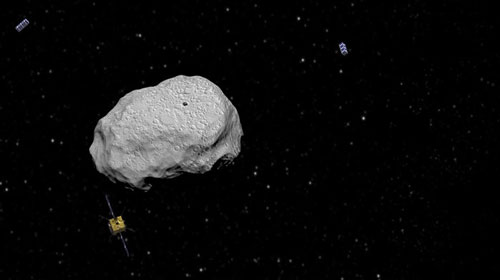
“Four to Didymos: Asteroid Impact Mission Spacecraft”
May 21 2015, ESA ScienceOffice.org, Germany
“ESA’s Asteroid Impact Mission, being studied for a 2022 arrival at the Didymos double asteroid, involves not just one but four spacecraft.
Asteroid Impact Mission Spacecraft
An ESA Image
Copyright © ESA-ScienceOffice.org, Germany
The main spacecraft (seen here towards bottom left) would carry a small lander (seen here in dark on the asteroid) to touch down on the 180 m-diameter secondary asteroid, or ‘Didymoon’.
It would also release at least two CubeSats (seen at the top left and towards the right of the image).
These multiple spacecraft would allow AIM to test deep-space intersatellite relays, while the lander would gather experience in low-gravity proximity operations.
These multiple spacecraft would allow AIM to test deep-space intersatellite relays, while the lander would gather experience in low-gravity proximity operations.”
[Read The Full Story] –
[Watch This New ESA Video]
ESA-ScienceOffice.org, Germany
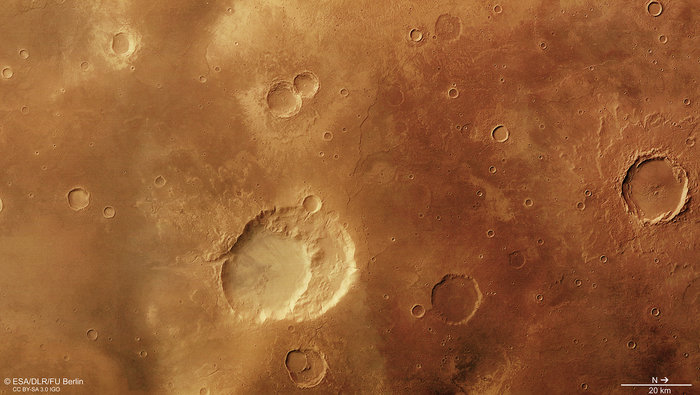
“Siloe Patera: Impact crater or supervolcano caldera?”
May 21 2015, Mars Express, ESA, Berlin, Germany
“At first glance, the region covered by this latest Mars Express image release appears to be pockmarked with impact craters.
But the largest structure among them may hold a rather explosive secret: it could be remains of an ancient supervolcano.
Siloe Patera
A Mars Express Image
Copyright © ESA/DLR/FU Berlin, CC BY-SA 3.0 IGO, Germany
The images presented here were taken by the high-resolution stereo camera on ESA’s Mars Express on 26 November 2014, and focus on the Siloe Patera feature in the Arabia Terra region of Mars.
Siloe Patera comprises two large nested craters, close to the centre of the main colour image.
The outer rim measures about 40 x 30 km and, at its deepest point, the crater dips as low as 1750 m below the surrounding plains.
Some scientists believe that Siloe Patera and a number of similar features in Arabia Terra are calderas, the collapsed centres of volcanoes. But not just any volcanoes: these are thought to be martian supervolcanoes.”
[Read The Full Story]
ESA/DLR/FU Berlin, CC BY-SA 3.0 IGO
“World’s largest asteroid impacts found
in central Australia”
March 23 2015, Australian National University, Australia
“A 400 kilometre-wide impact zone from a huge meteorite that broke in two moments before it slammed into the Earth has been found in Central Australia.
The crater from the impact millions of years ago has long disappeared. But a team of geophysicists has found the twin scars of the impacts – the largest impact zone ever found on Earth – hidden deep in the earth’s crust.
Lead researcher Dr Andrew Glikson from the ANU School of Archaeology and Anthropology said the impact zone was discovered during drilling as part of geothermal research, in an area near the borders of South Australia, Queensland and the Northern Territory.
‘The two asteroids must each have been over 10 kilometres across – it would have been curtains for many life species on the planet at the time’, said Dr Glikson, who is also affiliated with the ANU Planetary Science Institute.
The revelation of such ancient violent impacts may lead to new theories about the Earth’s history.”
[Read The Full Story]
The Australian National University
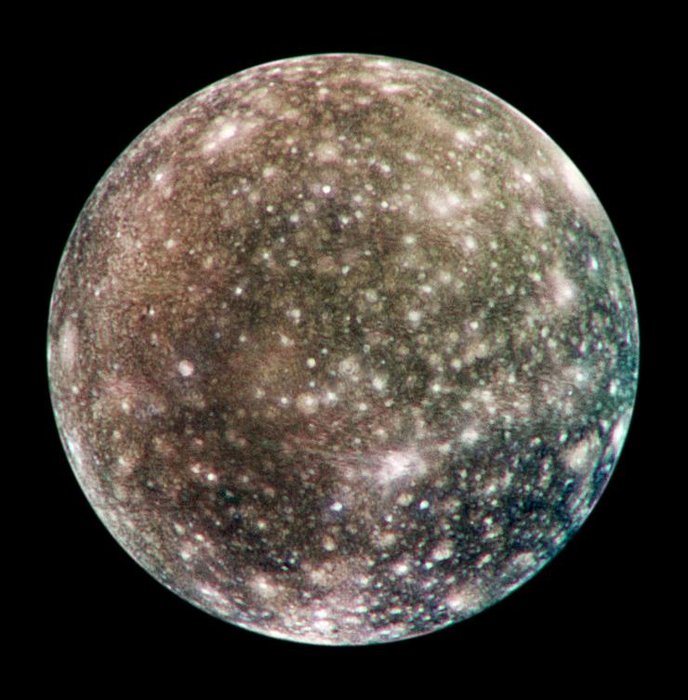
“Jupiter’s cratered moon, Callisto”
January 26 2015, NASA/JPL/DLR, USA/Germany
“The speckled object depicted here is Callisto, Jupiter’s second largest moon.
This image was taken in May 2001 by NASA’s Galileo spacecraft, which studied Jupiter and its moons from 1995 until 2003.
Jupiter’s cratered moon, Callisto
A NASA Galileo Image
Copyright © NASA/JPL/DLR, USA/Germany
Similar in appearance to a golf ball, Callisto is covered almost uniformly with pockmarks and craters across its surface, evidence of relentless collisions. In fact, Callisto is the most heavily cratered object in the Solar System.
The moon is made up of equal parts of rock and ice – the brighter parts of Callisto’s surface are thought to be mainly water ice, whereas the darker patches are regions of highly eroded and ice-poor rocky material.
Callisto is roughly the same size as the planet Mercury, but only about a third of the mass.
It is the outermost of Jupiter’s four large Galilean satellites, a group consisting of Io, Europa, Ganymede and Callisto.”
[Read The Full Story]
NASA/JPL/DLR, USA/Germany
“Mysteries in Nili Fossae”
January 22 2015, ESA/DLR/FU Berlin, Germany
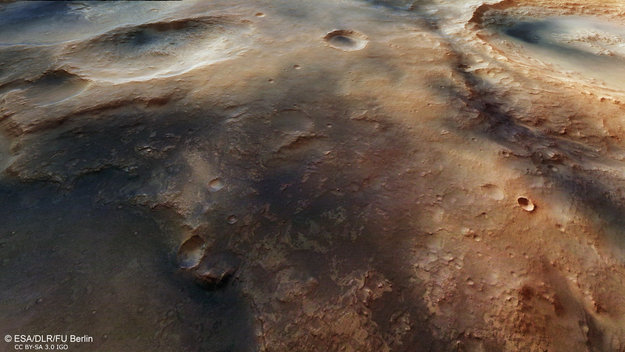
“These new images from the hi-res stereo camera on ESA’s Mars Express show Nili Fossae, one of the most enticing regions on Mars.
This ‘graben system’ lies northeast of the volcanic region of Syrtis Major on the northwestern edge of the large Isidis impact basin – and intriguing hints of methane have been seen here.
Perspective view of Nili Fossae
A Mars Express Image
Copyright © ESA/DLR/FU Berlin, CC BY-SA 3.0 IGO
Grabens are blocks of land that have fallen between parallel faults, sometimes forming rift valleys.
The graben system in Nili Fossae contains numerous troughs oriented concentrically around the edges of an impact basin, as can be seen in the context map.
The easternmost of these troughs is partially visible at the lower left of the images.
It is perhaps most obvious as a depression in the topography map from Mars Express.”
[Read The Full Story]
ESA/DLR/FU Berlin, CC BY-SA 3.0 IGO
“Chasms and cliffs on Mars”
January 05 2015, ESA/DLR/FU Berlin, Germany
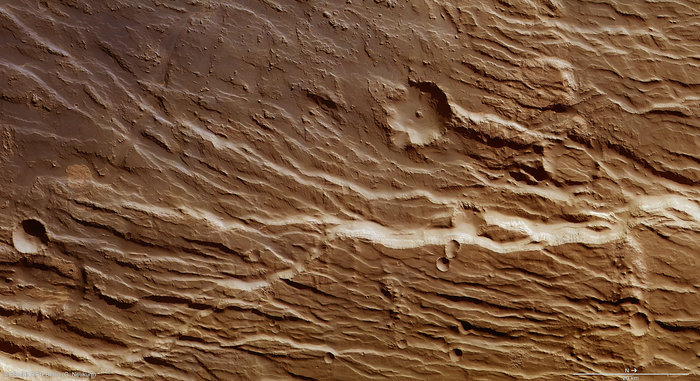
“Although Mars is a very alien planet, some aspects of its geology are surprisingly familiar. This Mars Express image shows a snippet of a region of Mars filled with cliffs, trenches, faults, giant plateaus and volcanoes.
The flowing cracks and fault-like lines in this image form part of the Claritas Rupes escarpment, a 950 km-long network of steep cliffs and sloping outcrops.
Chasms and cliffs on Mars
A Mars Express Image
Copyright © ESA/DLR/FU Berlin, CC BY-SA 3.0 IGO
This escarpment lies within a larger geological system named Claritas Fossae, a weaving network of ‘grabens’ (a German term meaning ditch or trench) that stretches for some 2000 km.
The many chasms, fractures and cracks in this area are thought to have been caused by stress in the planet’s crust as it stretched and pulled apart, triggered by the formation of a nearby raised mound known as the Tharsis Bulge.
This bulge, located within the volcanic Tharsis region, extends to a height of about 10 km at its peak.”
[Read The Full Story]
ESA/DLR/FU Berlin, CC BY-SA 3.0 IGO
Terrestrial & Solar System
Impacts and Impact Craters
News & New Discoveries 2006 – 2009
News & New Discoveries 2010 – 2012
News & New Discoveries 2012 – 2014
|
|
Below are some images of the larger known asteroids
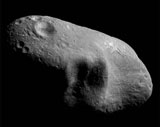
Asteroid Eros
NEAR, JHU APL, NASA
“Several spacecraft have orbited or landed on asteroids and sent pictures of these bodies back to Earth. The NEAR Shoemaker mission, launched in 1996, was the first spacecraft to land on an asteroid, touching down on Eros on February 12, 2001.”
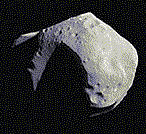
Asteroid 253 Mathilde
NEAR, JHU APL, NASA
On June 27, the NEAR (for Near Earth Asteroid Rendezvous) spacecraft, traveling some 36,000 kilometers per hour, streaked past an asteroid named Mathilde far beyond the orbit of Mars. It was just a brief encounter along a long journey to a different asteroid, Eros.
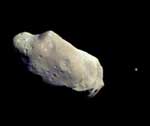
Asteroid Ida
copyright © 2002 NEAR, JHU APL, NASA
“Liquid water, carbon-based molecules and a relatively stable environment are critical elements for life. Comets and asteroids can bring water and the chemicals on which life is based, but can also bring widespread destruction. If future impacts are inevitable, what should we do?”
“The 2300 BC Event – Vol. 1:
Archaeology and Geophysics
& The Meteoroid Stream”
by
M. M. Mandelkehr
Get This Book From:
Amazon.com
Amazon.co.uk
“The 2300 BC Event takes a new look at an old puzzle: what happened at this date to cause the advanced societies on the Earth to simultaneously collapse?
Civilizations in Anatolia and Greece, through Egypt and the Middle East, and eastward to India and Central Asia were at their height. The collapse of these civilizations due to earthquakes and climatic changes has been mirrored by similar interruptions on all continents, in the Arctic, and extending into the Pacific.
The discontinuities have long puzzled archaeologists and historians. New religions and accompanying mythologies appeared at this time in all cultural regions describing bombardment and flooding from the skies.
Strangely, the dominant aspect of the mythologies, however, is the observation and worship of a ring appearing to surround the Earth, oriented to the two Ursa (Bear) constellations.”
“The 2300 BC Event Vol. 2:
Mythology
The Eyewitness Accounts”
by
M. M. Mandelkehr
Get This Book From:
Amazon.com
Amazon.co.uk
“Some time around 2300 BC the Eath encountered a dense clustering of space debris, the early Southern & Northern Taurid meteoroid stream. The result was an intense fall of meteoroids, some of them sufficiently large to cause surface destruction.
Simultaneous with the meteoroid fall was a huge downpouring of water which caused flash flooding. Extensive destruction and loss of life resulted. An astonishing aspect of the event was the formation of a ring surrounding the Earth, reflecting sunlight during the day, hiding some stars at night, and moving around the sky through a 24-hour period.
Following the ‘main event’, there were crustal movements which shifted the location of water sources, and caused earthquakes which destroyed settlements. Abrupt severe climate changes occurred.”
“The 2300 BC Event Vol. 3:
Mythology
The Eyewitness Accounts 2″
by
M. M. Mandelkehr
Get This Book From:
Amazon.com
Amazon.co.uk
“The Northern/Southern Taurid meteoroid stream is identified as the specific meteoroid stream that the Earth encountered at 2300 BC.
The Earth’s encounter with a dense cluster of large objects would produce atmospheric phenomena very different from the pleasant and interesting night displays of meteor trails that are within our own experience.
The rain of objects would have generated extraordinary visual and auditory effects combined with ground vibrations; and under extreme conditions would bring about severe surface destruction and loss of life.
The overall event was associated by the people with powerful deities and formed the basis for major religions. The mythologies and traditions are, in large part, the residues of those religions.”
“Natural Catastrophes During Bronze Age Civilisations”
(British Archaeological
Reports)
by
Benny J. Peiser
Trevor Palmer
Mark E. Bailey
(Editors)
Get This Book From:
Amazon.com
Amazon.co.uk
Research in the field of neo-catastrophism and impact cratering has quickened its pace since the early 1980s. Scholars such as Victor Clube, Bill Napier, Mark Bailey, Sir Fred Hoyle and Duncan Steel claim that a more ‘active’ sky might have caused major cultural changes of Bronze Age civilizations, belief systems and religious rituals.”
“Comets: A Chronological History of Observation, Science, Myth
and Folklore”
by
Donald K. Yeomans
Get This Book From:
Amazon.com
Amazon.co.uk
“A Sumerian Observation of the Kofels’ Impact Event”
by
Mark Hempsell
&
Alan Bond
Get This Book From:
Amazon.com
Amazon.co.uk
“Around 700 BC an Assyrian scribe in the Royal Place at Nineveh made a copy of one of the most important documents in the royal collection. Two and a half thousand years later it was found by Henry Layard in the remains of the palace library. It ended up in the British Museum’s cuneiform clay tablet collection as catalogue No. K8538 (also called “the Planisphere”), where it has puzzled scholars for over a hundred and fifty years. In this monograph Bond and Hempsell provide the first comprehensive translation of the tablet, showing it to be a contemporary Sumerian observation of an Aten asteroid over a kilometre in diameter that impacted Kofels in Austria in the early morning of 29th June 3123 BC.”
“The Chesapeake Bay Crater: Geology and Geophysics of a Late Eocene Submarine Impact Structure”
by
Wylie Poag
Wolf Uwe Reimold
&
Christian Koeberl
(Authors)
Get This Book From:
Amazon.com
Amazon.co.uk
“This volume synthesizes 16 years of geological and geophysical studies which document an 85-km-wide impact crater buried 500 m beneath Chesapeake Bay in south eastern Virginia, USA. The authors integrate extensive seismic reflection profiling and deep core drilling to analyze the structure, morphology, gravimetrics, sedimentology, petrology, geochemistry, and paleontology of this submarine structure. Of special interest are a detailed comparison with other terrestrial and extraterrestrial craters, as well as a conceptual model and computer simulation of the impact. The extensive illustrations encompass more than 150 line drawings and core photographs. An accompanying CD-ROM includes selected seismic profiles, scaled cross sections, detailed maps, and downhole geophysical logs.”
“Bombarded Britain: A Search for British Impact Structures”
by
Richard Stratford
Get This Book From:
Amazon.com
Amazon.co.uk
“Describes a search for geological evidence of meteorite impact structures in Britain. The statistics of impact structures indicate that Britain should have Phanerozoic impact structures up to tens of kilometres in diameter. A constant theme is the importance of atmospheric break-up of small asteroids and comets. These fragmenting bodies produce anomalously shallow craters with low rims and central peaks; three British structures of this type are identified. Analysis of fireball statistics implies that damaging fireball explosions occur over the British Isles on a time-scale of decades. On a time-scale of millennia, however, more damage is done by Atlantic impact tsunami.”
“The Big Splat, or How Our Moon Came to Be:
A Violent Natural History”
by
Dana Mackenzie
Get This Book From:
Amazon.com
Amazon.co.uk
“Mackenzie prefaces his absorbing account of the new “giant impact” theory of the moon’s origin with the fascinating story of humanity’s long relationship with Earth’s only natural satellite. Evidence of that relationship begins with what is very probably a lunar calendar among the famous Lascaux cave paintings, and continues in early civilizations’ timekeeping uses of the moon and classical Greek ideas about the moon’s composition. In the fifth century B.C.E., Anaxagoras correctly realized that the moon was made of rock. Later, Aristotle didn’t agree, and his view held sway for centuries.”
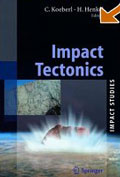
“Impact Tectonics”
by
C. Koeberl
(Editor)
&
Herbert Henkel
(Editor)
Get This Book From:
Amazon.com
Amazon.co.uk
“This volume is the 8th in a series of impact books resulting from the activities of the scientific program “Response of the Earth System to Impact Processes” (IMPACT), by the European Science Foundation. The book resulted from an international meeting at Mora, Sweden, which was held as part of the IMPACT program. The papers cover various structural geologic, geochemical, and geophysical topics on research of asteroid impact structures on Earth and Mars.”
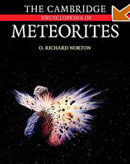
“The Cambridge Encyclopedia
of Meteorites”
by
O. Richard Norton
Get This Book From:
Amazon.com
Amazon.co.uk
“In recent years, meteorites have caught the imagination of scientist and collector alike. An army of people are now actively searching for them in the hot and cold deserts of Earth. Fascinating extraterrestrial rocks in meteorites are our only contact with materials from beyond the Earth-Moon system.”
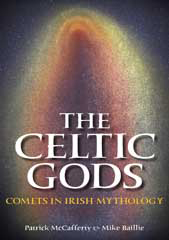
“The Celtic Gods:
Comets in Irish Mythology”
by
Mike Baillie
&
Patrick McCafferty
Get This Book From:
Amazon.com
Amazon.co.uk
“The Celtic myths, involving heroic warriors such as Finn and CuChulinn, can be read as simple primitive stories, but closer examination reveals strange descriptions and relationships.
The authors of this ground-breaking book argue that all the principal characters are aspects of the one Celtic sky god, Lugh, who was a comet. Against the background of a comet scenario this re-interpretation of about ten key Celtic myths shows how many of the descriptions in the myths fit the appearance of comets.
The fact that these comets on occasions produced abrupt environmental changes, that can be traced in the tree-ring and ice-core chronologies, pins the stories to a central reality. With a novel twist this original book confirms the widespread belief that these stories must contain ‘a core of truth’.”
“Rogue Asteroids and
Doomsday Comets
by
Duncan Steel
(Author)
Arthur C. Clarke
(Foreword)
Get This Book From:
Amazon.com
Amazon.co.uk
“Could both Stonehenge and the pyramids of Egypt have been constructed to observe and commemorate a period of phenomenal meteor storms and asteroid detonations produced by a burst of activity in the Taurid Complex 4,500 to 5,000 years ago? Author Duncan Steel examines the evidence indicating rogue asteroids and doomsday comets may have been behind these and other ancient phenomena.”
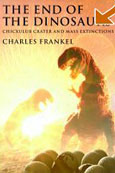
“The End of the Dinosaurs:
Chicxulub Crater and
Mass Extinctions”
by
Charles Frankel
Get This Book From:
Amazon.com
Amazon.co.uk
“The End of the Dinosaurs gives a detailed account of the great mass extinction that rocked the Earth 65 million years ago, and focuses on the discovery of the culprit: the Chicxulub impact crater in Mexico. It recounts the birth of the cosmic hypothesis, the controversy that preceded its acceptance, the search for the crater, its discovery and ongoing exploration, and the effect of the giant impact on the biosphere. Other mass extinctions in the fossil record are reviewed, as is the threat of asteroids and comets to our planet today. The account of the impact and its aftermath is suitable for general readers. The description of the crater geology is in enough detail to interest students of the earth sciences. A detailed index and bibliography are included.”
“Meteorite Craters and Impact Structures of the Earth”
by
Paul Hodge
Get This Book From:
Amazon.com
Amazon.co.uk
“During its five billion year history, Earth has been hit countless times by asteroids and meteorites. Over 150 crater-producing events have been identified, and this book describes all 139 sites worldwide at which evidence of the impacts can be seen. They range in age from recent craters formed this century to the highly eroded billion-year old ancient craters. Some are spectacular to visit, such as the Barringer Crater in Arizona, the ring-shaped mountains of Gosses Bluff, Australia, and the huge crater at Ries in Germany.
For each site there is a summary table giving location, size, age and present condition. Maps are included where necessary. The author has visited many of the sites and his photographs enrich this thorough survey. Meteorite craters are fascinating to visit, so the descriptions include guidance about access and suggested itineraries for the large structures.”
“Meteorite Hunter: The Search
for Siberian Meteorite Craters”
by
Roy A. Gallant
Get This Book From:
Amazon.com
Amazon.co.uk
“On the morning of June 30, 1908, a fireball cascaded down the Siberian sky and exploded with 2000 times the force of the nuclear blast that devastated Hiroshima, Japan. Weighing some 100,000 metric tons, the cosmic missile cut into the atmosphere and shattered in a rapid series of bursts, felling trees and incinerating an area of 2150 square miles – now known as the Tunguska ‘event’.
In the spring of 1992, Roy Gallant was invited by the Siberian branch of the National Academy of Sciences to take part in the annual Tunguska Expedition, to investigate this largest meteorite explosion in human history.”
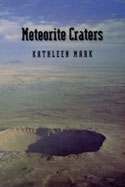
“Meteorite Craters”
by
Kathleen Mark
Get This Book From:
Amazon.com
Amazon.co.uk
“In the early years of the twentieth century, an enormous bowl-shaped hole in the high plains of northern Arizona was investigated by a mining engineer and his associates. The hole was almost three quarters of a mile wide-a little over one kilometer¹-and it penetrated thick layers of subsurface rock.
The investigators concluded that it was created thousands of years ago when a mass of meteoritic iron struck the earth, and they produced extensive evidence in support of their claim.”
“Rocks from Space: Meteorites and Meteorite Hunters”
by
O. Richard Norton
&
Dorothy S. Norton
(Illustrator)
Get This Book From:
Amazon.com
Amazon.co.uk
“Norton (astronomy, Central Oregon Community College) tells the story of meteorites and our attempts to read their history. Topics include the development of the interdisciplinary science of meteoritics, asteroids, current classifications of meteorites, and the impact of the comet Shoemaker-Levy on Jupiter in 1994.
“Falling Stars: A Guide to
Meteors and Meteorites”
by
Mike D. Reynolds
Get This Book From:
Amazon.com
Amazon.co.uk
“A straightforward, thorough look at all aspects of meteors and meteorites, including how and where meteors originate, when and where to watch for them, and how to classify, collect, and preserve meteorites. Meteor showers, interesting meteorite craters, and tektites are all discussed in detail. Also contains a comprehensive listing of meteorite organisations, dealers, museums, and references.”
|


