The Morien Institute - The events of July 16th to 22nd 1994, when the remnants of a fragmenting comet, P/Shoemaker-Levy 9, bombarded the surface of Jupiter causing fireballs many times the size of our own planet, were an abrupt wake-up call even for those who were aware of them. The historical sciences generally, and archæology in particular, have collectively painted a picture of the past as if our planet stands alone in empty space. Nothing could be further from reality. Our resilient planet exists in a solar system that has experienced a very dynamic history over the past 20 to 30 millennia, and it is only from this wider solar system perspective that the true history of human civilisation will ever be fully understood. The Morien Institute archive therefore contains relevant material from many disciplines.

an image of a meteor flashing through the sky

Image of a revolving globe showing current sea levels since the last ice age, before which many ancient societies like Atlantis flourished all over planet Earth on what are now sunken lands.

Terrestrial Archæology, Marine Archæology & Astro-Archæology
News Headlines Archive
May 2013

text translation service for many worldwide languages


As we enter the 21st century technological advances are coming to the aid of scientists of all descriptions. But it will likely be the Marine Archæologists, whose discoveries on the continental shelves that were once the coastal plains of the archaic world that will most significantly change our picture of the past. We cannot go on thinking of the past from the scant knowledge available to us from excavations of the remains of ancient peoples discovered solely on the dry land we now live on.

This dry land comprises just 29% of the total surface area of our planet and the remaining 71% is currently ocean. Over the last 15 years The Morien Institute has been carefully documenting as much information about new discoveries underwater as we can find, and The Morien Institute Marine Archæology Archive gives just a glimpse of the many recent discoveries showing evidence of sometimes vast coastal settlements that were inundated by the seas in ancient times.

During the last Ice Age the sea-levels were more than 300 feet lower than they are today, and a wide band either side of the equator enjoyed a pleasant enough climate for human civilisation to have flourished in many parts of the world. When the sea levels rose as the ice sheets melted many coastal settlements disappeared under the waves - forgotten except in the oral traditions of peoples in every land. These oral traditions represent an invaluable archive of knowledge from the archaic world, but they are almost always dismissed by academic archæologists and prehistorians who have traditionally regarded them simply as 'quaint myths' which they claimed have no bearing on reality.

But that is a very foolish perspective. What remains of the oral traditions of the many ancient societies that once developed on our planet must be preserved at all costs so that future peoples can study the wisdom of ancient peoples with an open mind that was sadly absent from 20th century academic thinking. These oral traditions are now acknowledged as being the invaluable "Indigenous Knowledge" of ancient peoples, and represent a collective understanding of the natural world that had developed through careful observation over countless millennia. Despite the scepticism expressed in some academic disciplines, we cannot afford to let this ancient knowledge die out simply because the supposed "experts" of today cannot understand it.

Neither can we continue to look at the prehistory of human societies and civilisations as if our planet somehow stands alone in empty space. Nothing could be further from reality. Our immediate solar system environment is more of a cosmic shooting gallery' than a vast expanse of emptiness, and a great body of evidence is building which shows that the environmental impact of encounters with comets, asteroids and cometary debris has been responsible for the destruction of numerous ancient civilisations on many occasions in the archaic world over the past 10 to 20 millennia.

Throughout the last few hundred years, and quite probably before that, individual researchers ranging from the eccentric 'Gentleman Antiquarians' of the 17 & 1800s to the so-called 'dissident professors' of the 20th century have pursued lines of enquiry which has horrified general academia. Those individuals were ridiculed and vociferously opposed by academic archæologists and prehistorians who had often invested a lifetime's work in what the more honest amongst them might reluctantly admit in private company to have been a totally inaccurate view of human prehistory.

Theories that many megalithic sites began life as some form of observatories acting as 'early-warning systems' for imminent impacts of cosmic debris from the break up of a giant comet have been emerging over the last 30 years or so. Evidence supporting these theories is helping not only to date some of these monuments, but also illustrates how well their builders were oriented in time and space. A new appreciation that our ancestors were acutely aware that the Earth orbited the Sun, and that it periodically encountered streams of cometary debris, suggests that ancient peoples understood the dynamics of the solar system to a far greater degree than has previously been acknowledged.

Dr. Duncan Steel, then of Spaceguard Australia, presented a paper to the Society for Inter-Disciplinary Studies conference at Fitzwilliam College, Cambridge, in July of 1997, in which he gave details of his research suggesting that the earlier 'henge circle' which preceded the stone circles at Stonehenge could have been deliberately constructed to function as a 'cosmic impact early warning system'. His paper, "Before the Stones: Stonehenge I as a Cometary Catastrophe Predictor" is must reading for all serious students of ancient astronomy, astro-archæology and prehistory.

The Cambridge Conference focussed primarily on the effects of natural catastrophes resulting from the impacts of cometary debris. These impacts were presented as being the likely causes of the sudden collapse and in many cases the total destruction of various Bronze Age civilisations, giving rise to radical cultural changes, and to a number of new religions with accompanying astro-mythologies that had hitherto been impossible for academia to understand.

The simultaneous collapse of these civilizations has long puzzled archæologists and prehistorians as the vast areas affected ran right across the 'fertile crescent' destroying the most advanced societies of the time, ranging in distance from Greece and Anatolia through to Mesopotamia and Afghanistan and continuing eastwards to encompass India and Central Asia.

The cause of this most perplexing 'Bronze Age Event' around 2350 - 2300 BC has only recently become clear as a wide variety of assorted 'ologists from various disciplines have begun reviewing the mythologies of the time. What they have found throughout numerous inter-disciplinary studies are the accurate observations of ancient skywatchers describing cosmic bombardment and flooding which in every case, and in every region, came directly from the ancient skies.

These natural cosmic catastrophes were recorded by all ancient societies and passed down through many generations to become the oral traditions that are held sacred by the peoples whose ancestors directly experienced them, but which are often dismissed as being 'quaint myths that have no bearing on reality' by so-called scholars who have never even tried to understand them. Bombardment of our planet by cosmic debris is, like all things in the natural world, a cyclical phenomenon. It has happened many times in the past, and if we dismiss the records kept by ancient peoples simply because they were recorded in a language that our modern scientists cannot understand, then we will not be prepared when it happens again.

The sophistication and unprecedented accuracy of the astronomical phenomena that was an integral part of almost all of the megalithic structures that have been discovered on most continents suggests a long period of development, yet academic archæologists and prehistorians have been at a loss to expain them. Most have simply ignored the astronomy, or made idiotic statements about ancient peoples not being capable of that level of understanding, but there they are for all the world to see.

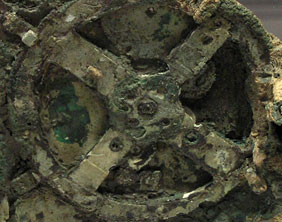
In October 1900, Captain Dimitrious Kondos was leading a team of sponge divers near the island of Antikythera off the coast of Greece. They noticed a shipwreck about 180 feet below the surface and began to investigate. Amongst the artifacts that they brought up was a coral-encrusted piece of metal that later archæologists found was some sort of gear wheel. The rest of the artifacts, along with the shape of the boat, suggested a date around 2000 years ago, which made the find one of the most anomalous that had ever been recovered from the Greek seas. It became known as "The Antikythera Mechanism".

In 2006 the journal "Nature" published a letter, and a full paper about the mechanism was published in 2008, detailing the findings of Prof. Mike G. Edmunds of Cardiff University. Using high-resolution computed tomography to study the fragments of the anomalous Antikythera Mechanism, they found that it was in fact a bronze mechanical analog computer that could be used to calculate the astronomical positions and various cycles of the Moon - as seen from the Earth.

This incredible discovery is indisputable evidence that ancient peoples were far more capable of understanding the cyclical nature of heavenly bodies than they had previously been given credit for, and "The Antikythera Mechanism Research Project" showed they could also construct devices which could predict them. There was much discussion about its supposed anomalous nature, but it is only anomalous if viewed in isolation or in the context of a completely inaccurate view of prehistory. In the context of the astronomical knowledge embedded into megalithic structures a long period of development becomes evident, and is deserving of radical review in light of the discovery of The Antikythera Mechanism.

Over the past 15 years The Morien Institute has archived new archæological discoveries as well as new interpretations of old archæological discoveries. In our news pages we list many items that may not seem directly related to a better understanding of what our ancestors saw and experienced in ancient skies. But astromythology and its interpretation, and constant review of our poor appreciation of the scientific achievements of our ancestors remains the common theme that we feel ties most of them together. It is only an open-minded approach to prehistory, and a willingness to accept what is found rather then attempting to make new discoveries fit into some pre-conceived paradigm, that will help us gain a better understanding of our ancient past than is currently taught in our schools, colleges and universities.

some news sources require registration but this is usually free

all links are active at the time of posting

To understand why our News Page updates are sometimes late
here is some information about Fibromyalgia symptoms


Morien Institute News Headlines Archive for
2013

January | February | March | April | June | July | August
September | October | November | December

2013 | 2012 | 2011 | 2010
2009 | 2008 | 2007 | 2006 | 2005 | 2004 | 2003 | 2002 | 2001 | 2000

Marine Archæology News Archive | Astro-Archæology News Archive

Marine Archæology 2013 News | Astro-Archæology 2013 News


Lunar Phases


Top May 2013 New Discoveries ...

"Babylon's hanging garden: ancient scripts give clue to missing wonder"     "Stunning Astronomical Alignment Found at Peru Pyramid"     "Megafauna victims of 'climate not humans'"     "40,000 boxes of artifacts unearthed during Marmaray excavations locked in warehouse"     "Origins of Chinese agriculture pushed back by 12,000 years"     "Mystery of the Mexican 'goldenballs' cave"     "Ancient paintings discovered in Aydin"     "Properties of near-sun asteroids"     "From The Trenches: Thracian Treasure Chest"     "The Ries impact, a double-layer rampart crater on Earth"     "The Antikythera Mechanism Research Project"    


Bookmark this page

 Today is  


News Headlines Digest
May 2013

"End of the road for ancient Mayan temple"
IOL (South Africa)
"Acoustic archaeology: A sound approach"
Spectroscopy Now (UK)
"Log-boat found in Boyne could be 5,000 years old"
Irish Independent (Ireland)
"Archaeologist will uncover Stonea Camp’s secrets at special event"
Cambs Times (England)
"Archaeologists Unearth Lost Temple of Apollo"
Popular Archaeology (USA)
"Researchers find trickery in ancient Chinese divination"
XinhuaNet (China)
"LiDAR and lost cities in Central America"
Past Horizons (UK)
"Scandalous Construction in Bulgarian Black Sea Archaeology Site Halted"
Novinite (Bulgaria)
"Ancient Mayan pyramid destroyed for road fill"
Toronto Sun (Canada)
"Minoan civilization was made in Europe"
Nature (UK)
"Earliest cemetery in Southeast Asia discovered?"
Business Standard (India)
"Reconstruction of the face of an ancient Maltese woman"
Stone Pages Archaeo News (Italy)

"Earliest Archaeological Evidence of Human Ancestors Hunting and Scavenging"
Science Daily (USA)
"A recent Baylor University research study has shed new light on the diet and food acqui555sition strategies of some the earliest human ancestors in Africa.

Beginning around two million years ago, early stone tool-making humans, known scientifically as Oldowan hominin, started to exhibit a number of physiological and ecological adaptations that required greater daily energy expenditures, including an increase in brain and body size, heavier investment in their offspring and significant home-range expansion.

Demonstrating how these early humans acquired the extra energy they needed to sustain these shifts has been the subject of much debate among researchers.

A recent study led by Joseph Ferraro, Ph.D., assistant professor of anthropology at Baylor, offers new insight in this debate with a wealth of archaeological evidence from the two million-year-old site of Kanjera South (KJS), Kenya. The study's findings were recently published in
PLOS One.

'Considered in total, this study provides important early archaeological evidence for meat eating, hunting and scavenging behaviors -cornerstone adaptations that likely facilitated brain expansion in human evolution, movement of hominins out of Africa and into Eurasia, as well as important shifts in our social behavior, anatomy and physiology', Ferraro said."
[Full Story]

"From rumour to bulldozer"
Al-Ahram Weekly (Egypt)
"Lost Lands Found by Scientists"
EurekAlert (USA)
"Highway Construction Uncovers Spectacular 1500-Year-old Mosaic"
The Jewish Press (Irael)
"Unique workshop of Palaeolithic hunters discovered in Silesia"
Nauka w Polsce (Poland)
"Genetics Reveal Europe Is One Big Family"
The New York Times (USA)
"Google Earth fuelling ‘armchair archaeology’"
Australian Geographic (Australia)
"Secret Streets of Britain's 'Atlantis' Are Revealed"
Science Daily (USA)
"20 Years of the Gdansk Archaeological Expedition's Work in Sudan"
Sudan Vision (Sudan)
"Lost Lands Found by Scientists"
NatGeo Daily News (USA)
"Revealed: Malta’s 5,000 year old face"
DI-VE (Malta)
"Duns Law finally gives up its Beaker burial ground"
The Berwickshire News (Scotland)
"Plague Helped Bring Down Roman Empire"
Discovery News (USA)
"Ancient quarry, key unearthed in Jerusalem"
The Times of Israel (Israel)

"Traces of prehistoric supercontinent discovered off the coast of Brazil"
Science Recorder (USA)
"It's not the legendary Atlantis, but researchers are claiming to have found traces of a long-lost continent buried in the Atlantic Ocean near Brazil.

The researchers announced on Tuesday that samples of rock from the site appear to be remnants of Pangea, the prehistoric supercontinent from which the Americas, Africa, and other present-day land masses eventually emerged.

A Brazilian-Japanese team that included researchers from the Brazilian Geological Survey, the Oceanographic Institute of Sao Paolo, and Japan's Agency for Marine-Earth Science and Technology found the rocks during an expedition to study the Rio Grande Elevation, a high-rising mass of ocean floor about 930 miles from the shore of Rio de Janeiro.

Over a month of study, the team examined the formation up close through a series of dives in a three-person submersible craft to as far down as 21,000 feet below the surface."
[Full Story]

"Dog-sized dino shows prehistoric diversity"
ABC Science News (Australia)
"Prehistoric Balangoda human skeletons found at Kuragala sent for International testing"
Hiru News (Sri Lanka)
"Spearheads found locally could be thousands of years old"
The Cheshire Citizen (USA)
"Underwater archaeologists search for secrets among the waters of Louisbourg"
CTV News (Canada)
"New excavations to find lost Pictish kingdom"
The Scotsman (Scotland)
"Babylon's hanging garden: ancient scripts give clue to missing wonder"
The Guardian (UK)
"Libya still at risk from the plunder and smuggling of antiquities"
Libya Herald (Libya)
"Hunt for the site of the Battle of Lewes"
Sussex Express (England)
"Ice Age words stand the test of time"
ABC Science News (Australia)
"Stunning Astronomical Alignment Found at Peru Pyramid"
Live Science (USA)
"Treasure trove of Bronze Age artefacts discovered by metal detectors in Vale of Glamorgan"
Wales Online (Cymru)
"Ancient Milan church yields tombs, coins from 4th century"
ANSA (Italy)

"Earliest Archaeological Evidence of Sustained Carnivory by Human Ancestors’"
Popular Archaeology (USA)
"The whereabouts of one of the seven wonders of the ancient world - the fabled Hanging Garden of Babylon - has been one of the great mysteries from antiquity.

The inability of archaeologists to find traces of it among Babylon's ancient remains led some even to doubt its existence.

Now a British academic has amassed a wealth of textual evidence to show that the garden was instead created at Nineveh, 300 miles from Babylon, in the early 7th century BC.

After 18 years of study, Stephanie Dalley of Oxford University has concluded that the garden was built by the Assyrians in the north of Mesopotamia - in modern Iraq - rather than by their great enemies the Babylonians in the south.

She believes her research shows that the feat of engineering and artistry was achieved by the Assyrian king, Sennacherib, rather than the Babylonian king, Nebuchadnezzar."
[Full Story]

"Megafauna victims of 'climate not humans'"
ABC Science News (Australia)
"Linguists identify 15,000-year-old ‘ultraconserved words’"
The Washington Post (USA)
"40,000 boxes of artifacts unearthed during Marmaray excavations locked in warehouse"
Hürriyet Daily News (Turkey)
"Archaeologists to dig in Derbyshire villagers' gardens"
BBC News (UK)
"Chola period Buddha statue found by archeologists near Nagapattinam"
Times of India (India)
"Scholars find cannibalism at Jamestown settlement"
Las Vegas Sun (USA)
"Two-millenia-old Aizanoi inspiring Istanbul bourse"
Hürriyet Daily News (Turkey)
"The fall of the 'Ancient Alien' hypothesis"
Troy Media (USA)
"Origins of Chinese agriculture pushed back by 12,000 years"
Past Horizons (UK)
"First Nations group outraged at destruction of ancient rock art sites"
The Record (Canada)

"Mystery of the Mexican 'goldenballs' cave"
Mail Online (UK)
"Hundreds of mysterious golden-coloured orbs have been found buried in a hidden chamber deep beneath the Temple of Feathered Serpent in Mexico.

The discovery was made by archaeologists from the Mexico National Institute of Anthropology and History, who admit they have no idea what the spheres are for.

A tiny robot called Tláloc II-TC, which has been scanning tunnels deep beneath the famous temple, found the orbs using infrared scanners.

They were hiding in a previously unexplored ancient chamber at the end of a stretch of 2,000-year-old unexplored tunnel on the Teotihuacan site, near the Pyramid of the Sun.

The spheres are made of clay and range from 1.5 to 5 inches in circumference. They get their yellow colour from a material called jarosite."
[Full Story]

[There are many excellent photos of the site, the spheres, the excavation, and a video of the robot roaming around the unexplored tunnels under the Pyramid of the Sun. A MUST SEE - Ed.]

"Perfect example of medieval holy well is being restored"
This is Cornwall (England)
"Is Every Civilization Destined to Collapse?"
NatGeo News (USA)
"Ancient 300 AD Roman cemetery found under parking lot in UK"
First Post (India)
"Hundreds of mysterious yellow orbs found under Mexico’s Temple of the Feathered Serpent"
The Independent (UK)
"Ancient paintings discovered in Aydin"
Hürriyet Daily News (Turkey)
"Winged raptor dined on fish"
Nature (UK)
"Robot finds mysterious spheres in ancient temple"
NBC News Science Blog (USA)
"Richard III team seek a second body"
The Scotsman (Scotland)
"Egyptians rally against looting of pyramids"
France 24 (France)
"Archaeological dig on Miami River - in pictures"
Miami Herald (USA)

"The Antikythera Mechanism Research Project"
Cardiff/Athens Universites (Cymru/Greece)
[In October 1900, Captain Dimitrious Kondos was leading a team of sponge divers near the the island of Antikythera off the coast of Greece. They noticed a shipwreck about 180 feet below the surface and began to investigate. Amongst the artifacts that they brought up was a coral-encrusted piece of metal that later archaeologists found was some sort of gear wheel.

The rest of the artifacts, along with the shape of the boat, suggested a date around 2000 years ago, which made the find one of the most anomalous that had ever been recovered from the Greek seas. It became known as The Antikythera Mechanism.

In 2006 the journal "Nature" published a
letter, and another paper about the mechanism was published in 2008, detailing the findings of Prof. Mike G. Edmunds of Cardiff University. Using high-resolution X-ray tomography to study the fragments of the anomalous Antikythera Mechanism, they found that it was in fact a bronze mechanical analog computer that could be used to calculate the astronomical positions and various cycles of the Moon - as seen from the Earth: - Ed]


Part of the Antikythera Mechanism
an image of Part of the Antikythera Mechanism, which is also a clickable link directly to the Lichfield Blog story
Copyright © 2006
Antikythera Mechanism Research Project


2000-year-old analog computer recreated


More Antikythera Mechanism Information & Commentary:

"Return to Antikythera: Divers revisit wreck where ancient computer found"
The Guardian Science Blog (UK)
"In search of lost time"
Nature (UK)
"World’s First Computer Displayed Olympic Calendar"
Wired Gadget Lab (USA)
"Antikythera Mechanism - World's earliest existing analogue computer"
HotnHit News (India)
"In search of lost time"
Nature (UK)
"Imaging the Antikythera Computer"
Wired Gadget Lab (USA)
"Decoding an Ancient Computer: Greek Technology Tracked the Heavens"
Scientific American (USA)
"2,000 Year Old Computer Yields Her Secrets"
Wired Gadget Lab (USA)
"Watch a video explaining the Antikythera mechanism"
Nature (UK)
"Antikythera mechanism"
Wikipedia (USA)
"World's First Computer Rebuilt, Rebooted After 2,000 Years"
Wired Gadget Lab (USA)
"Antikythera: A 2,000-year-old Greek computer comes back to life"
The Guardian Science Blog (UK)
Google image search results for The Antikythera mechanism
Google (USA)


Sponsored Links:


"Decoding the Heavens:
Solving the Mystery of the World's First Computer"

by
Jo Marchant
William Heinemann Ltd

an image/link direct to this product at amazon.com

Get This Book From:
Amazon.com
Amazon.co.uk


"Mysteries and Discoveries of Archaeoastronomy:
From Giza to Easter Island"

by
Giulio Magli

an image/link direct to this product at amazon.com

Get This Book From:
Amazon.com
Amazon.co.uk


"A Little History of
Astro-Archaeology:
Stages in the Transformation
of a Heresy"

by
John Michell

an image/link direct to this product at amazon.com

Get This Book From:
Amazon.com
Amazon.co.uk


"Canada's Stonehenge: Astounding Archaeological Discoveries in Canada, England, and Wales"
by
Gordon Freeman

an image/link direct to this product at amazon.com

Get This Book From:
Amazon.com
Amazon.co.uk


"Under Ancient Skies:
Ancient Astronomy and
Terrestrial Catastrophism"

by
Paul Dunbavin

an image/link direct to this product at amazon.com

Get This Book From:
Amazon.com
Amazon.co.uk


"Stairways to the Stars: Skywatching in Three Great Ancient Cultures"
by
Anthony Aveni

an image/link direct to this product at amazon.com

Get This Book From
Amazon.com
Amazon.co.uk


"Megaliths, Myths &
Men: An Introduction to Astro- Archaology"

by
Peter Lancaster Brown

an image/link direct to this product at amazon.com

Get This Book From:
Amazon.com
Amazon.co.uk


"Ancient Astronomers:
Exploring the Ancient World"

by
Anthony F. Aveni,
Jeremy A. Sabloff
(Editor)

an image/link direct to this product at amazon.com

Get This Book From:
Amazon.com
Amazon.co.uk


"A Sumerian Observation of the Kofels' Impact Event"
by
Mark Hempsell
&
Alan Bond

an image/link direct to this product at amazon.com

Get This Book From:
Amazon.com
Amazon.co.uk


May 2013
Monthly Magazine Articles

"On the Trail of the Mimbres: Archaeologists are tracking the disappearance of a remarkable type of pottery"
Archaeology Magazine (USA)

"On the origin of the extreme-ultraviolet late phase of solar flares"
The Astrophysical Journal (USA)

"The Ries impact, a double-layer rampart crater on Earth"
Geology (USA)

"Cultural hybridity and social status: elite tombs on China's Northern Frontier during the third century BC"
Antiquity (UK)

"A super-earth-sized planet orbiting in or near the habitable zone around a sun-like star"
The Astrophysical Journal (USA)

"From The Trenches: Thracian Treasure Chest"
Archaeology Magazine (USA)

"Growth and form of the mound in Gale Crater, Mars: Slope wind enhanced erosion and transport
Geology (USA)

"Feasting in Viking Age Iceland: sustaining a chiefly political economy in a marginal environment"
Antiquity (UK)

"Properties of near-sun asteroids"
The Astronomical Journal (USA)

"From The Trenches: A Major New Venue - ancient Roman outdoor theater discovered in Britain"
Archaeology Magazine (USA)

"A four-tier approach to the protection of cultural property in the event of armed conflict"
Antiquity (UK)

"Evidence for atmospheric carbon injection during the end-Permian extinction"
Geology (USA)

"Photometric and spectroscopic properties of novae in the large Magellanic cloud"
The Astronomical Journal (USA)

"Illuminating the Late Mesolithic: residue analysis of ‘blubber’ lamps from Northern Europe"
Antiquity (UK)

"Constraints on dark matter annihilation in clusters of galaxies from diffuse radio emission "
The Astrophysical Journal (USA)

Make All Online Science Journals Free For Students


Morien Institute News Headlines Archive for
2013

January | February | March | April | June | July | August
September | October | November | December

2013 | 2012 | 2011 | 2010
2009 | 2008 | 2007 | 2006 | 2005 | 2004 | 2003 | 2002 | 2001 | 2000


Google
  Web The Morien Institute


please take a look at our Ancient Mysteries Bookshoppe for a wide selection of books
that challenge orthodox views of prehistory on every continent

Visit Our Ancient Mysteries DVD Store

Home | About Us | Skywatching Calendar | News & New Discoveries | MarketSpace

Marine Archæology News Archive | Astro-Archæology News Archive

Marine Archæology 2013 News | Astro-Archæology 2013 News

all material on this page
Copyright © 1996-2013 The Morien Institute
all rights reserved