|
With satellite imagery increasingly being used for archaeological investigations The Morien Institute has decided to report
discoveries in our Astro-Archaeology news archive
Likewise, many ancient legends that have previously been dismissed as purely “mythological” are now proving to be based on fact, and so
The Morien Institute has decided to also report these new
discoveries in our Astro-Archaeology news archive
Alongside thes will be material about ancient astrological beliefs which were inextricably inter-linked with ancient astronomical science
“Satellites unearthing ancient Egyptian ruins”
December 23, 2008, CNN, USA
“Archaeologists believe they have unearthed only a small fraction of Egypt’s ancient ruins, but they’re making new discoveries with help from high-tech allies — satellites that peer into the past from the distance of space.
The enclosure wall of the Great Aten temple in Egypt
as seen from the QuickBird satellite.
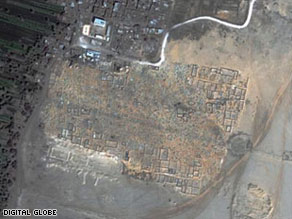
Digital Globe/CNN
‘Everyone’s becoming more aware of this technology and what it can do’, said Sarah Parcak, an archaeologist who heads the Laboratory for Global Health at the University of Alabama at Birmingham. ‘There is so much to learn.’
mages from space have been around for decades. Yet only in the past decade or so has the resolution of images from commercial satellites sharpened enough to be of much use to archaeologists. Today, scientists can use them to locate ruins — some no bigger than a small living room — in some of the most remote and forbidding places on the planet.
Today, scientists can use them to locate ruins — some no bigger than a small living room — in some of the most remote and forbidding places on the planet.
In this field, Parcak is a pioneer. Her work in Egypt has yielded hundreds of finds in regions of the Middle Egypt and the eastern Nile River Delta.”
[Full Story]
“Ancient skywatchers passed along information in story, song”
December 22, 2008, Kennebec Journal, USA
“Students of prehistory tell us that people were watching the sky, tracking the behavior of the sun, moon, planets and stars, from earliest times.
As they understood these movements, and correlated them with the seasons, they were also passing down this knowledge.
In the days before writing, and before the existence of separate languages of science or mathematics — that is, for most of human history — people passed down knowledge by memory, through stories, songs, dances and art, and by monuments, of which the best-known is Stonehenge, but examples of which exist all over the world.
And it was probably inevitable that the knowledge of astronomy, natural history and other bedrock survival knowledges became intertwined with religion, law, art, myth and literature, as the stories and dances that once may have had a utilitarian purpose migrated and shaded into other areas of human thought and activity.
In fact, today the Greek myths, the Scandinavian myths, the Native American myths and other myths from human cultures can be seen to contain traces of this prehistorically gathered astronomical lore.
For example, Mercury, Mars, Venus, Saturn, Jupiter, Neptune, the sun and the moon and all Greek and Roman deities are also the names of the heavenly bodies we can see with the naked eye and that dance against the background of the stars. The stories we still rehearse of their battles, their love affairs, their adventures and their travels may be the metaphorical traces of a language that once upon a time was a way to report on and transmit essential knowledge of the world.
The stories we still rehearse of their battles, their love affairs, their adventures and their travels may be the metaphorical traces of a language that once upon a time was a way to report on and transmit essential knowledge of the world.”
[Full Story]
***
One of the first dedicated Astro-Mythologists was Owen ‘Morien’ Morgan.
Born in the Rhondda (Fawr) Valley, South Wales,in 1836, Morien became intrigued by Welsh oral traditions which he gathered and studied, comparing them to similar traditions from many other cultures around the world.
A journalist with the Cardiff-based “Western Mail” newspaper, he wrote from 1870 until his death in 1921 about the traditions of druidism, the remnants of which he found in the folklore of the South Wales valleys. Traditions that focussed on the safe haven at Dinas, Rhondda, the ancient druid centre to which many now believe the surviving druids fled, secretly regrouping again after their dramatic massacre by the Romans on Ynys Môn (Anglesey), North Wales, around AD 78.
A journalist with the Cardiff-based “Western Mail” newspaper, he wrote from 1870 until his death in 1921 about the traditions of druidism, the remnants of which he found in the folklore of the South Wales valleys. Traditions that focussed on the safe haven at Dinas, Rhondda, the ancient druid centre to which many now believe the surviving druids fled, secretly regrouping again after their dramatic massacre by the Romans on Ynys Môn (Anglesey), North Wales, around AD 78.
In particular Morien focused his researches on the oral traditions of what he termed the ‘sacred mountain’ of the druids of Morganwg (the Siluria of the Romans). This, according to Morien’s interpretation of the oral traditions of the South Wales valleys, was ‘Mynydd Dinas’ in the Rhondda Valley – the focal point of the area, rising steeply from the ancient druid city of Dinas, Rhondda, which was entered via the gate to the city at Porth, Rhondda. From the summit of Mynydd Dinas, Morien claimed that local tradition maintained that in ancient times the druids gathered on the winter solstice eve to observe the death of the old sun (representing the death of the old year) as it set over Gilfach Goch.
The next day, the Winter Solstice, when the sun stands still – rising no higher nor sinking any lower in the sky – the druids of Morganwg are said to have maintained a vigil until the dawn of the following morning some 40 hours later.
At sunrise Morien claims local tradition told that the sun was regarded as a new-born sun, the son of the old sun, the ‘Mabyn’, whose rising marked the turning of the solar year. With this rising the sun, depicted as a new-born baby boy, starting to rise higher again each day until the summer solstice. Local traditions collected by Morien spoke of a time when the whole community would observe these ‘marker points’ of the natural solar year, the extreme positions of the sun as it moved back and forth along the horizon, marking the seasons and governing the local calendar of festivities.
the new-born sun rising over Mynydd Dinas, Rhondda, December 22nd 1998
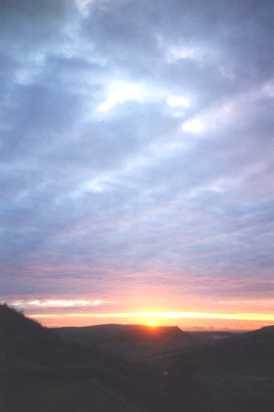
Copyright © December 22, 1998 John Michael, Morien Institute
According to local tradition this was the ancient druidic sacred centre of Morganwg, South Wales, and Morien maintained that in those ancient traditions the new-born sun was represented as the sacred
“Mabyn of the Mabynogion”
As with many ancient peoples the celtic druids were renowned for their knowledge of the movements of the stars, and several classical writers referred to their teaching of ‘natural philosophy’ and astronomy in their open-air universities and ‘hedge schools’. At that time the celtic druids controlled all of the islands of Prydain, which they shared with the Picts and pre-celtic ‘hyperboreans’, who were likely the direct descendents of the megalith builders.
Morien spent many years decoding the local druidic oral traditions into a clear account of the solar year, and the associated seasonal activities of the local communities, whose science and religion appears like that of many ancient societies to have been one and the same. Carefully, during the
course of his studies, he pieced together the remnants of both ‘re-enactments’ on the ground of past celestial events, and ‘simultaneous enactments’ of ‘live-sky’ celestial phenomena, ritual activities that according to local tradition were once practiced by the peoples of South Wales.
His pioneering approach to what is now termed astro-mythology was not limited to local traditions, and he compared the astro-mythology of the Druids of Morganwg to those of the many ancient cultures in which he discovered similar themes. Students of comparative mythology will find his books a treasure trove, while others may become confused at the veritable wealth of material he covers, and the similar ‘patterns of the solar year’ he found in mythologies worldwide. [Ed.]
“Passage graves from an astronomical perspective”
December 18, 2008, EurekAlert, USA
“Passage graves are mysterious barrows from the Stone Age. New research from the Niels Bohr Institute at the University of Copenhagen indicates that the Stone Age graves’ orientation in the landscape could have an astronomical explanation.
The Danish passage graves are most likely oriented according to the path of the full moon, perhaps even according to the full moon immediately before a lunar eclipse. The results are published in the scientific journal Acta Archaeologica.
Shown here is the passage grave ‘Nordenhoj’
at Kaerby near Kalundborg in Denmark
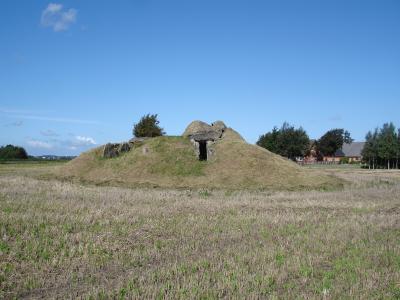
The National Museum of Denmark
Claus Clausen, who graduated as astronomer from the Niels Bohr Institute, has also always been interested in archeology. There are many Stone Age graves in Denmark, where archaeologists estimate that around 40.000 large stone graves were built from around 3500 to 3000 BC.
Only about 500 of the large passage graves, called giant tombs (in Danish Jaettestuer) are preserved today, but one of the great mysteries is their orientation in the landscape
With the help of GPS, a compass and a surveying instrument Claus Clausen measured the orientation of entrance tunnels of approximately 100 passage graves. It turned out that there was a remarkable concentration of certain orientations. Claus Clausen had a theory that it could be a calendar system, but the theory did not hold up.
Astronomer and supervisor of the special project, Per Kjærgaard Rasmussen suggested that he look at the connection between the sun and the moon and especially lunar eclipses, because there were two orientations that occurred frequently and that could suggest something with specific full moons.”
[Full Story]
“Riddle Of Giant Rock ‘Sculptures'”
December 04, 2008, Sky News, UK
“A British discoverer who says he has found the world’s largest rock sculptures is poised to prove his claims.
Bill Veall used the latest satellite imaging techniques to search the Peruvian mountains for ancient shapes and formations.
Can you spot the reclining lamb?
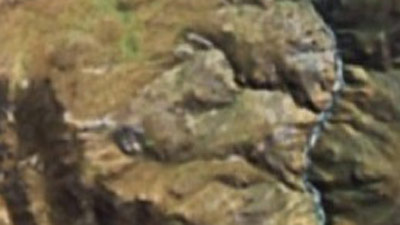
Bill Veall for Sky News
He was astonished to discover a series of designs, carved into the Andean Cordillera. Mr Veall made a film of his discovery and uploaded it to skynews.com/yourvideos.
You can see a selection of the images by clicking here.
A ‘sacred lamb’ image, measuring 1400m by 1000m, was identified next to an altar stone, an antelope head and two staring faces of the ‘Sun God’ and Venus.”
[Full Story & Video]
***
Readers of this story might be interested in seeing an aerial photograph of the ‘head of a goat’ discovered by the editor during the ‘Caer Sidi Expeditions’ in northern Carmarthenshire, Mid Wales, in 1974.
The ‘Caer Sidi Expeditions’ continued the work began in 1972 with The Pendragon Society’s visit to the area to check out the reports in the now defunct Atlantis Research” magazine of a “Zodiac Temple” that was discovered in 1947 by Welsh antiquarian and prehistorian, Lewis Edwards.
The last of these annual expeditions was in 1979. They were led by John Michael, who obtained the aerial photographs of the “Zodiac Temple” area from the RAF.
The words, “Caer Sidi”, have been translated to mean “revolving castle”, but was also the phrase used by the Druidic astronomers of ancient Britain for “the ecliptic”, the apparent path of the Sun in its annual course through heavens with the backdrop of the constellations which have been known in various cultures since ancient times as “The Zodiac”.
The remarkable thing about this geoglyph is that it is meant to represent the constellation of ‘Capricorn’ in the so-called ‘Pumpsaint Zodiac Temple’ and it is in its correct position relative to the other geoglyphs representing the rest of the zodiacal constellations. You can read Lewis Edwards’ original research notes by clicking on the ‘Pumpsaint Zodiac Temple’ link.
It may well be that what Bill Veall has discovered in the Andean Cordillera mountains is an ancient Peruvian “Zodiac Temple” from pre-Nazca times [Ed.]
“The sundials of Malta”
November 24, 2008, Times of Malta, Malta
“The time-honoured practice of sundialling might be considered as an old or forgotten practice, yet it is a tradition that has been carried down through Maltese generations.
The sundial is essentially an instrument used to measure time according to the position of the sun. However, the principles of the function of sundials are nowhere near straightforward and require the skills of a true engineer.
One of the sundials found on three sides of the cloisters
of the Dominican Priory in Rabat.
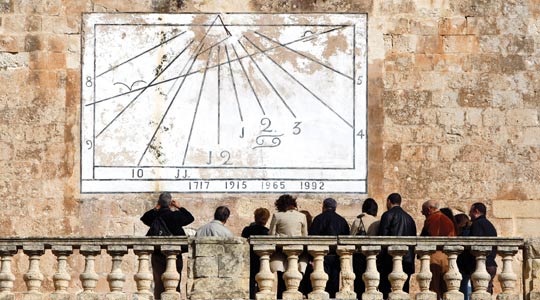
Darrin Zammit Lupi/Times of Malta
They are not precise devices and, according to the month of the year, the time indicated by the shadow created by the gnomon (a thin rod attached to the face of the sundial at a 36 degree angle) may be off by up to 14 minutes, sundial expert Frank Ventura notes.
These intriguing instruments do not only tell you the time of the day, some also reveal the month, which is generally indicated by rudimentary zodiac symbols that are commonly associated to astrology.
Besides the generally symmetrical divisions on the sundial’s face marking the time of day, other divisions indicate the spring and autumn equinoxes as well as the summer and winter solstices.”
[Full Story]
“Was climate change responsible for driving
ancient Scots out of glen?”
November 08, 2008, The Scotsman, Scotland
“A Scots religious site that predates the pyramids and Stonehenge may have been abandoned because of climate change, it was claimed yesterday.
Kilmartin Glen, in Argyll, has one of the most important concentrations of Neolithic and Bronze Age remains in Europe. The glen contains at least 350 ancient monuments, many of them prehistoric, including burial cairns, rock carvings and standing stones.
The most spectacular of the remains is the fortress of the Scots at Dunadd, capital of the kingdom of Dalriada.
But archaeologists have identified a period of almost 1,000 years in which no monuments were erected and the population there ‘diminished’.
They claim this period is marked by the start of a colder, wetter climate. Dr Alison Sheridan, an archaeologist and head of early prehistory at the National Museum of Scotland, who has studied Kilmartin Glen for more than 20 years, said:
‘The earliest activity dates back to hunter-gatherers around 4,500BC, who left behind nothing more than a few pits, charcoal and some flint.’
‘It was a sacred landscape from at least as early as 3,700BC until as late as 1,100BC. It was a place for ceremony, for burying people and observing the movements of the sun and the moon.’.”
[Full Story]
“IAU0808: UNESCO and the IAU sign key agreement on
Astronomy and World Heritage Initiative”
PRESS RELEASE – OCTOBER 30th 2008
October 30, 2008, SpaceRef, USA
“A Memorandum of Understanding is to be signed today, 30 October 2008, between UNESCO and the International Astronomical Union (IAU). The IAU will be integrally involved in the process of developing UNESCO’s Astronomy and World Heritage Initiative, helping to promote astronomical sites of ‘Outstanding Universal Value’.
The world-famous UNESCO World Heritage Convention is renowned for its work protecting and promoting sites that celebrate the heritage of humanity. Examples include the Pyramids of Giza in Egypt, the Mayan city of Chichen Itza in Mexico, and the Stonehenge in the United Kingdom.
However, astronomical heritage is currently under-represented. All too often, neglect and mistreatment cause irreversible harm. The new Memorandum will place the Astronomy and World Heritage Initiative in a better position to reverse this trend by raising awareness of the cultural importance of astronomical sites, both ancient and modern.
However, astronomical heritage is currently under-represented. All too often, neglect and mistreatment cause irreversible harm. The new Memorandum will place the Astronomy and World Heritage Initiative in a better position to reverse this trend by raising awareness of the cultural importance of astronomical sites, both ancient and modern.
Adopting the successful strategy previously applied to architectural and natural sites, the new UNESCO Astronomy and World Heritage initiative will officially recognise, promote and preserve astronomical sites that are of outstanding significance to humankind. The places in question include landmarks whose design or location relate to celestial events, whether with symbolic or direct connection with astronomy.
Historic sites, instruments and representations help to broaden and enhance our perception of the sky. This theme is integral to the upcoming International Year of Astronomy 2009. The initiative is therefore designated as one of the Year’s key Cornerstone projects, which are being organised to increase public understanding and appreciation of astronomy throughout the coming year and around the world.
In order to fulfil its commitment to the UNESCO Initiative, the IAU has set up a new Working Group on Astronomy and World Heritage under the chairmanship of Professor Clive Ruggles, Emeritus Professor of Archaeoastronomy at the University of Leicester, UK. Ruggles, who is also Vice-President of the IAU’s Commission 41 on the History of Astronomy, has already worked with UNESCO in the early stages of developing the initiative.
He said: ‘The globalisation of human culture is proceeding at a relentless pace, and it is becoming increasingly urgent to preserve some of the more fragile aspects of our common cultural heritage. ‘Fine’, you might say, ‘but why worry about astronomy in this regard?’ The main reason, I think, is that every human culture has a sky, and strives to interpret what people perceive there. The understanding they develop inevitably comes to form a vital part of their fundamental knowledge concerning the cosmos and their place within it. Astronomy is not just a modern science but a fundamental reflection of how all people, past and present, understand themselves in relation to the Universe.’
At present, States Parties to the World Heritage Convention may nominate sites for inscription on the World Heritage List for a variety of reasons; but until now, there have been few precedents and no guidelines for nominations relating principally to astronomy. Identifying and defining criteria that demonstrate ‘Outstanding Universal Value’ in relation to astronomy is not a straightforward task. They must encompass a wide range of sites, from prehistoric monuments to modern observatories.
Helping to establish such criteria is the IAU Working Group’s top priority. As Ruggles says, ‘without such guidelines member states of UNESCO will have little motivation to put forward astronomical sites for the World Heritage List, since they will have very little idea of their chances of success.’ The agreement between UNESCO and the IAU is designed to set the wheels in motion. As a result, astronomical heritage will become much better represented in the World Heritage List.”
[This is the full text of the Press Release]
“Quickbird Discovers Site of Human Sacrifices”
October 24, 2008, SatNews Daily, USA
“Imagine a piece of history being hidden for as much as 2,000 years only to be detected by a new remote sensing technology that peeled away layers of mud and rock near Peru’s Cahuachi desert to reveal an ancient adobe pyramid.
Italian researchers Nicola Masini and Rosa Lasaponara of Italy’s National Research Council (CNR) discovered the pyramid by analyzing images from the satellite Quickbird, which they used to penetrate the Peruvian soil.
A QuickBird image showing the pyramid discovered near Cahuachi
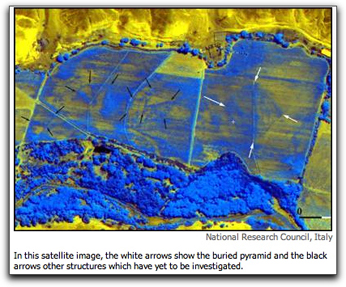
National Research Council, Italy/SatNews
Via Quickbird, Masini and colleagues collected high-resolution infrared and multispectral images.
After the researchers optimized the data with special algorithms, the result was a detailed visualization of a pyramid extending over a 97,000-square-foot (9,000-square-meter) area. .
Cahuachi is the best-known site of the Nazca civilization, which flourished in Peru between the first century B.C. and the fifth century A.D. and slid into oblivion by the time the Inca Empire rose to dominate the Andes.
[Full Story]
“Antikythera mechanism exhibition”
October 22, 2008, ANA, Greece
“The first specialized exhibition focusing on the controversial Antikythera Mechanism opens Wednesday at the Ionian Centre for Scientific Studies in Plaka, downtown Athens, in cooperation with the team of scientists studying the device.
The visitors of the exhibition, that will run until December 14, 2008, will learn about unknown applications of the Mechanism in ancient Greek calendars, the study of the movement of the Sun and the Moon, and eclipse prediction.
The exhibition is held under the auspices of the ministry of culture and in cooperation with the National Archaeological Museum of Athens where the Antikythera Mechanism is housed.
The Antikythera mechanism is believed to be an ancient mechanical calculator (also described as a ‘mechanical computer’) designed to calculate astronomical positions.
It was discovered in the Antikythera wreck off the Greek island of Antikythera, between Kythera and Crete, and has been dated to about 150-100 BC. Technological artifacts of similar complexity appeared a thousand years later.”
[Full Story]
“Ancient Egyptian Astronomy”
October 17, 2008, Innovations-Report, Germany
“The constellations we are currently familiar with originate from ‘Ptolemy’s 48 constellations’ compiled from ancient Greek constellations by Claudius Ptolemaeus (from 90 A.D. to about 168 A.D.).
He was a Greek astronomer flourishing in Alexandria, Egypt in the second century A. D. Though it is believed these constellations originate from Mesopotamia or ancient Greece, there are still various views on the origin of constellations. Ancient Egypt had its own constellations.
Ancient Egyptians called the northern stars around the circumpolar star ‘Ikhemw-sek’ (imperishable stars) and the southern stars ‘Ikhemw-wredj’ (unwearying stars).
This naming (tireless stars) is probably because the southern stars especially on and about the celestial equator travel a very long distance after they rise above the East horizon before they sink below the West horizon, while the northern stars move counterclockwise around the celestial north pole.
On ancient Egyptian tombs and ceilings of temples, northern constellations were discovered. These stars are called ‘Ikhemw-sek’ (imperishable stars) because they are generally assumed to be ‘northern circumpolar stars’ never sinking below the horizon.
The oldest existing northern constellation is a constellation named ‘Meskhetyw’. It was drawn as a forefoot of a bull on the interior lid of the wooden coffin for the man named Idy which dated from the First Intermediate Period (from 2145 B.C. to about 2025 B.C.) and was excavated in Asyut.
This constellation corresponds to our ‘Big Dipper’. On the left of the foreleg, hieroglyph showing ‘Meskhetyw m pet mehetet’ (Meskhetyw in the northern sky) was vertically written.
[Full Story]
“Jaipur astrologers irked over Jantar Mantar renovation”
September 22, 2008, Sify News, India
“Jaipur’s world famous Jantar Mantar, which has collection of architectural astronomical instruments and literal calculation instruments, is attracting wide public attention following the ongoing renovation at the ancient astronomical observatory. The renovation work has not gone down well with traditional Indian astrologers.
Absence of knowledgeable and experienced astrologers in the supervisory or advisory committee is being cited as one of the reasons, which has led to the vintage historical gadgets and other aids getting disturbed in the renovation process.
One of the main complaints is that the concerned authorities have deployed inefficient personnel for carrying out the renovation process. They say these employed personnel have no basic knowledge of such aids vis-à-vis astronomy and astrology.
‘In 1901, Jantar Mantar was renovated. But that time a council of astrologers was involved in the renovation. It was done under the supervision of the group of astrologers. Now, they have fiddled with the instruments on their own which they shouldn’t have done as such this dislocation of gadgets can have a negative effect on the future calculations’, said Pandit Akhilesh Sharma, an astrologer in Jaipur.
Jantar Mantar is an open-air observatory complex of astronomical gadgets and was built by Maharaja Jai Singh, the second. He constructed a total of five such labs at different locations, including the ones at Delhi and Jaipur. The Jaipur observatory is the largest of these.
These gadgets play a key role, as the reflections of the Moon are studied at night and the Sun by day based on which astrologers compute their forecasts.
The observatory consists of 14 major geometric devices for measuring time, predicting eclipses, tracking stars in their orbits, ascertaining the declinations of planets, and determining the celestial altitudes and related ephemeredes.
[Full Story]
“Research Underway at Ancient Observatory in Kokino, Macedonia”
September 19, 2008, Balkan Travellers, Bulgaria
“Researchers from the Kumanovo Museum are intensely studying the megalithic observatory at the ancient Kokino site in north-eastern Macedonia, national media reported recently.
The excavations at Kokino will continue until October, the publication noted.
The archaeological site of Kokinovo is located about 30 kilometres from the northeastern Macedonian town of Kumanovo. The megalithic observatory discovered in 2001, is around 3,800 years old.
The oldest archaeological finds from the site date from the Early Bronze Age, but many objects from the Middle Bronze Age were also excavated, including ceramic vessels, stone-mills and moulds.
Stone markers used to track the movement of Sun and Moon were also discovered at the site.
[Full Story]
“Ancient messages from Picture Canyon”
September 18, 2008, Colorado Springs Gazette, USA
“In this corner of Colorado, so far south and east you can see cows grazing in Oklahoma, the smooth swells of the prairie suddenly break on the rocks of unexpected canyon lands.
It is here, in a narrow sandstone crevice called Crack Cave that one of the region’s oldest, most mysterious messages is pecked. On the cave wall, 15 feet from the mouth, a small lump of stone juts into the passage. Dozens of hand-pecked lines cover the lump at odd angles.
No one knows who made the marks, or when, or why. Theories abound.
A few amateur rock-art devotees think the lines are an ancient astrological calendar with letters spelling out in ancient script, ‘On the day of the equinox, the sun shines here.’
Sure enough, twice a year, on the equinox, the first rays of dawn fall directly into the cave, lighting up the lump and the ancient markings.
In interpreting the site, it’s not just a matter of separating ancient from modern. It’s a matter of separating ancient from really ancient.
[Full Story]
“Ancient calculator found”
August 30, 2008, The Brantford Expositor, Canada
“Researchers say an astronomical calculator, considered a technological marvel of antiquity, was also used to track dates of the ancient Olympic games.
Experts from Britain, Greece and the United States say they detected the word ‘Olympia’ on a bronze dial, as well as the names of other games in ancient Greece on the device known as the Antikythera Mechanism. Their findings were reported in the British science journal Nature.
The 2,100-year-old Antikythera Mechanism was recovered from an ancient shipwreck in 1901 near Antikythera, a small island off Greece’s south coast. Its insides look like a clock.
About 30 bronze gears were cranked to calculate phases of the moon, eclipses and other celestial information specific to a certain date.
Researchers soon found the gear structure – including the number of teeth cut into the wheels – corresponded to known theories of celestial cycles.”
[Full Story]
“‘Pristine’ Amazonian region may have hosted large
urban civilization”
August 28, 2008, Fresh News, India
“A research paper has suggested that ancient settlements in the Amazon, now almost entirely obscured by tropical forest, were once large and complex enough to have hosted large, urban civilizations.
The paper has been co-authored by anthropologists from the University of Florida (UF) and Brazil, and a member of the Kuikuro, an indigenous Amazonian people who are the descendants of the settlements’ original inhabitants.
The researchers argue that the size and scale of the settlements in the southern Amazon in North Central Brazil means that what many scientists have considered virgin tropical forests are in fact heavily influenced by historic human activity.
The new paper reports that the settlements consisted of clusters of 150-acre towns and smaller villages organized in spread out ‘galactic’ patterns.
Among other repeated features, each Amazonian settlement had an identical formal road, always oriented northeast to southwest in keeping with the mid-year summer solstice, connected to a central plaza.”
[Full Story]
“Chinese Architecture, a Miniature of the Cosmos”
August 21, 2008, The Epoch Times, China
“Modern architecture juts into the sky, declaring its dominance over us mere humans. It doesn’t connect us with the heavens; it seems to challenge heaven for a fight.
An example of the framed construction of Chinese architecture

Joerg 1975/Epoch Times
Over thousands of years, the Chinese people have developed their own architectural style. Based on the tenets of Taoism and Buddhism, they reflect Chinese understanding that the heavens, the earth and human beings are intimately connected. Japan, Korea and much of Asia copied this style.
Confucianism ascribed to the principle of harmony between heaven and earth. Nature is the big cosmos and a human being is a small one. Because it is a miniature of nature, a human being must live and act within the laws of nature’s cosmos.
This traditional view held for all areas of Chinese life, including architecture. More than location and its practical use, a building had to harmonize with nature both inside and out.
Chinese architects designed elements of the cosmos into every structure. From primitive caves and simple buildings to complex construction, one finds consistently the elements of the cosmos embedded in Chinese architecture. In a very real way, architecture was a miniature of the cosmos.
[Full Story]
“Medieval astronomy tool helped tell time”
August 09, 2008, The Sault Star, Canada
“A rare astronomy tool that helped medieval scientists tell time will remain in Britain after the British Museum scrambled to come up with the money to buy it.
The brass device, called an astrolabe quadrant, had been sold at auction last year, and the museum was outbid. But money from the National Heritage Memorial fund, The Art Fund and the British Museum Friends helped the museum purchase it recently for 350,000 pounds (C$700,000).
‘The quadrant will be a very important addition to our medieval collection as an object which can explain the sophistication of science in the Middle Ages and the transfer of knowledge between Muslim, Jewish and Christian communities’, deputy director of the British Museum Andrew Burnett said in a statement Thursday.
The invention of the astrolabe is credited to Islamic scientists in the 9th century who learned about the concept from studying ancient Greek science. The devices were later adopted by Europeans in the 10th century and were used through the 1600s.”
[Full Story]
“Calendars with Olympiad display and eclipse prediction
on the Antikythera Mechanism”
July 31, 2008, Nature, UK
“Previous research on the Antikythera Mechanism established a highly complex ancient Greek geared mechanism with front and back output dials.
The upper back dial is a 19-year calendar, based on the Metonic cycle, arranged as a five-turn spiral. The lower back dial is a Saros eclipse-prediction dial, arranged as a four-turn spiral of 223 lunar months, with glyphs indicating eclipse predictions. Here we add surprising findings concerning these back dials.
Though no month names on the Metonic calendar were previously known, we have now identified all 12 months, which are unexpectedly of Corinthian origin. The Corinthian colonies of northwestern Greece or Syracuse in Sicily are leading contenders—the latter suggesting a heritage going back to Archimedes. Calendars with excluded days to regulate month lengths, described in a first century bc source9, have hitherto been dismissed as implausible.
We demonstrate their existence in the Antikythera calendar, and in the process establish why the Metonic dial has five turns. The upper subsidiary dial is not a 76-year Callippic dial as previously thought8, but follows the four-year cycle of the Olympiad and its associated Panhellenic Games.
Newly identified index letters in each glyph on the Saros dial show that a previous reconstruction needs modification6. We explore models for generating the unusual glyph distribution, and show how the eclipse times appear to be contradictory. We explain the four turns of the Saros dial in terms of the full moon cycle and the Exeligmos dial as indicating a necessary correction to the predicted eclipse times.
The new results on the Metonic calendar, Olympiad dial and eclipse prediction link the cycles of human institutions with the celestial cycles embedded in the Mechanism’s gearwork.”
[Full Story]
Watch a video explaining the Antikythera mechanism”
“Scientists unlock new secrets of Antikythera mechanism”
July 31, 2008, The Australian, Australia
“AN ancient device retrieved from the wreck of a 1st century BC Roman merchant vessel not only predicted astronomical events like the equinox and phases of the moon, it also recorded the time and place of the original Olympic games
The claim comes from British, Greek and US researchers who have uncovered and interpreted previously unknown components of the Antikythera Mechanism, discovered in 1901 by Greek divers collecting sponges in the Mediterranean Sea.
The mechanism is about the size of a wall clock, with bronze gearwheels, dials and inscriptions on both sides. It has long-puzzled experts, keen to determine where it was made and precisely what it did.
‘We knew that this 2100-year-old ancient Greek mechanism calculated complex cycles of mathematical astronomy. It really surprised us to discover that it also showed the four-year cycle of ancient Greek games, including the Olympic Games’, said team member Tony Freeth, a mathematician and filmmaker with Images First in London.
Writing overnight in the journal Nature, Dr Freeth and his international colleagues debunked the previous belief that the intricate device was made in the Eastern Mediterranean, probably Rhodes.
They did so by using 3D X-ray technology to read all the month names on a dial for the 19-year ‘Metonic’ calendar, a system that combined solar and lunar years.”
[Full Story]
Watch a video explaining the Antikythera mechanism”
“Ancient Greek ‘computer’ displayed Olympics calendar”
July 30, 2008, The Guardian, UK
“An ancient Greek ‘computer’ used to calculate the movements of the sun, moon and planets has been linked to Archimedes after scientists deciphered previously hidden inscriptions on the device.
X-ray images of the bronze mechanism, which was recovered from a shipwreck more than a century ago, also revealed a sporting calendar that displays the cycle of the prestigious ‘crown’ games, including the Olympics, which were held every four years.
The 1st century BC machine may have been inspired by the work of Archimedes
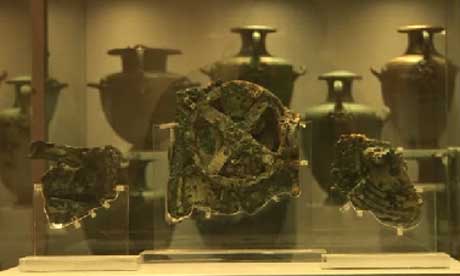
The Guardian, UK
Corroded remains of the device were found in 1901 by spongedivers, who happened upon the shipwreck of a Roman merchant vessel while sheltering from a storm near the tiny Greek island of Antikythera.
The ship, which was laden with treasures from the Greek world including bronze statues, pottery and glassware, is believed to have met its fate in the notoriously dangerous stretch of water en route to Italy.
The remarkably complex machine has been dated to around 150 BC, but it has puzzled researchers who have spent decades examining its 80 or so corroded fragments in the hope of learning how it worked and perhaps even who made it.
The device is thought to be the earliest known mechanism to use geared wheels, a feat of engineering that was not to reappear for at least another thousand years in the astronomical clocks of medieval Europe.
[Full Story]
Watch a video explaining the Antikythera mechanism”
“Was ancient Greek ‘computer’ used to teach astronomy?”
July 30, 2008, New Scientist, UK
“Inscriptions on a mysterious 2000-year-old clockwork device suggest that the artefact was inspired by earlier devices made by the great Greek mathematician Archimedes.
The so-called ‘Antikythera mechanism’ has puzzled historians since it was salvaged from an ancient shipwreck near the Greek island of Antikythera in 1901. It dates back to about 100 BC, and consists of more than 30 bronze gear wheels and pointers, enclosed in a wooden case.
The Antikythera mechanism
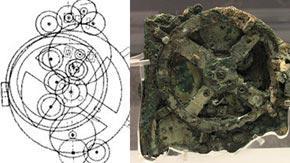
New Scientist
The device is by far the most advanced scientific instrument to survive from antiquity – nothing else close to its complexity shows up in archaeological records for more than 1200 years, when mechanical clocks appeared in medieval Europe.
The Antikythera mechanism is thought to be a mechanical computer, which used sophisticated algorithms to calculate the motions of celestial bodies. A dial on the front showed the position of the sun, moon and probably the planets in the zodiac, while the back displayed a 19-year lunisolar calendar, as well as the timing of eclipses (Source: Nature, DOI: 10.1038/nature05357; Interdisciplinary Science Reviews, vol 32, p 27).
The mechanism may have been used by philosophers to show the workings of the heavens, as suggested by the Roman author Cicero, who wrote in the 1st century BC of bronze devices that erroneously modelled the movements of the sun, moon and planets around Earth.
The origin of the Antikythera mechanism was a mystery, but newly deciphered inscriptions show that its calendar used local month names. They match those used by Greek colonies founded by the city of Corinth, and a prime candidate is Syracuse, in Sicily (Source: Nature, DOI: 10.1038/nature07130 ).”
[Full Story]
“Google Earth finds more than 450 new archaeological sites
in Afghanistan”
July 24, 2008, 3News, New Zealand:
“More than 450 archaeological sites, some dating back millenia, have been discovered in Afghanistan thanks to mapping website Google Earth.
The site makes it possible to find sites of interest in the war-torn country that could not otherwise not be visited by archaeologists.
Talking to Marcus Lush on RadioLive this morning, Melbourne’s La Trobe University phD student David Thomas said prior to Google Earth there was only one known archaeological site and the last person to visit for archaeological purposes was in the 1970s.”
Full Story –
Listen in Audio
“Archaeologists google an ancient find”
July 21, 2008, ABC Science News, Australia:
“Indiana Jones’s next adventure may well be in front of a computer if Hollywood scriptwriters decide to embrace a new approach to archaeological research in war-torn zones.
A satellite image of the Bust citadel in Afghanistan
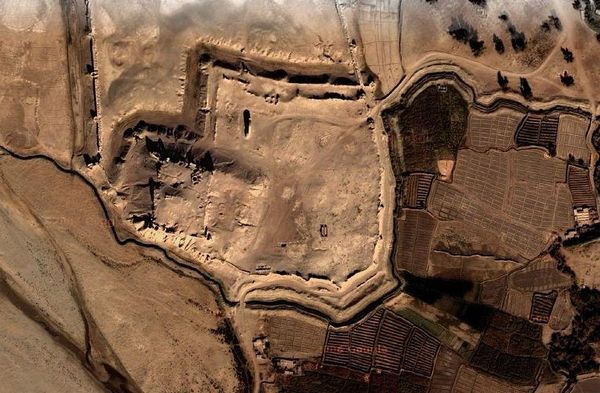
ABC Science/Google Earth
David Thomas, a PhD student in La Trobe University’s archaeological program in Melbourne, has used Google Earth to safely uncover historic sites in a remote part of war-torn Afghanistan.
Using the free internet resource, Thomas found up to 450 possible archaeological sites in Registan, which borders Helmand and Kandahar provinces in southern Afghanistan.
The decision to use Google Earth was ‘partly born out of adversity’, Thomas says when a planned field trip was cancelled because of security concerns.
The region has been made inaccessible because of the ongoing military conflict between western and Afghan government forces and the former Taliban government.
Since the Soviet invasion in 1979, Afghanistan has been increasingly difficult for archaeologists to visit, he says.
However, Google Earth allows archaeologists to overcome the perils of war zones.”
Full Story
“Turkey’s first astronomy heritage list coming soon”
July 16, 2008, Turkish Daily News, Turkey:
“Work is underway to create a list of important Turkish sites related to astronomy, as the United Nations declares 2009 the International Year of Astronomy to celebrate the 400th anniversary of Galileo Galilei’s first-ever recorded use of a telescope.
Turkey’s first heritage list of cultural assets relating to astronomy has been undertaken as part of the U.N. Educational, Scientific and Cultural Organization’s Astronomy and World Heritage Initiative, said Mehmet Emin Özel, a professor of physics at Onsekiz Mart University in Çanakkale province.
The Turkish National Commission for UNESCO has given Onsekiz Mart University the responsibility for preparing the new list, according to Özel.
A collection of works on astronomy that dates back to Ottoman times and that is kept at the Bogazici University Kandilli Observatory and Earthquake Research Institute may also be added to the list, as well as two ancient sites, Nevali Çori and Göbekli Tepe, in the southeastern province of S,anl?urfa.
These two sites include obelisks dating back to 9,000 years B.C. and are about 5,000 years older than the Stonehenge megalithic site in Britain, said Özel.”
Full Story
“Secret chamber may solve Mexican pyramid mystery”
July 14, 2008, The Daily Telegraph, UK:
“Archaeologists are to open a long-sealed cave under a Mexican pyramid in the hope that it will unlock the mystery of one of ancient civilisation’s greatest cities. Hundreds of Mexicans stiil gather at the Pyramid of the Sun to receive energy from the sun during spring equinox.
The Aztecs believed the city was divine and identified it with the place where the sun was created
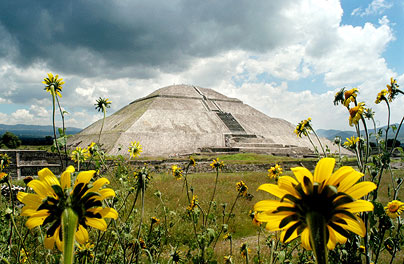
The Daily Telegraph, UK
With its soaring stone pyramids and geometric temples, Teotihuacan was once the biggest city in the Americas and possibly the world.
However, experts have never been able to say with certainty who built it and why it was suddenly abandoned.
An international team of experts believes the answer may lie under the Pyramid of the Sun, the centre point of the vast ruined city 25 miles outside Mexico City.
At the end of this month, they are to investigate a man-made tunnel and cave system underneath the pyramid – the third biggest in the world – to test theories that it was used for rituals including human sacrifice.
‘We think it had a ritual purpose. Offerings were placed at the very end of the tunnel as part of the pyramid’s construction process’, said Alejandro Sarabia, Teotihuacan’s director of archaeology.
He will lead a team of Mexican, American and Japanese experts into a 295 ft long, 8 ft high tunnel some 20 ft below the pyramid.
‘We want to find out why the Teotihuacan people sealed it and when’, Mr Sarabia said. ‘Excavating the cave could give us some clues about what happened at Teotihuacan, about the fate of the city.’
At its zenith between 150 AD and 450 AD, Teotihuacan was home to up to 200,000 people of various ethnic origins and thought to have been larger than any European city at the time, including Rome.”
Full Story
“Ancient astronomy no universal theory”
June 28, 2008, American Chronicle, USA:
“For tens of thousands of years, human beings have been fascinated by the patterns of stars in the sky above Earth. Early on, they noticed that the Moon changed shape from night to night as well as its position among the stars.
Early people noticed constellations of stars in the sky that looked like animals and people, and made up stories about what they thought they saw. In fact, the oldest records we have of astronomical observations are 30,000-year-old paintings found on the walls of caves.
Long before recorded history, which began about 5000 years ago, people were aware of the close relationship between events on the Earth and the positions of heavenly bodies, the Sun in particular. People noted that changes in the seasons and floods of great rivers like the Nile in the Egypt occurred when the celestial bodies, including the Sun, Moon, planets and stars, reached a particular place in the heavens.
Early agrarian cultures, which were dependent on the weather, believed that if the heavenly objects could control the seasons, they must also strongly influence all Earthly events.
This belief undoubtedly was the reason that early civilizations began keeping records of the positions of the celestial objects.”
Full Story
“The end of an odyssey – Homer’s epic is finally pinned down”
June 24, 2008, The Independent, UK:
“For years, debate has raged over Homer’s epic. Now research on astronomical detail in the story of Odysseus dates its dramatic climax to one particular day …
The Odyssey is one of the great works of ancient Western literature, written eight centuries before the birth of Christ and four centuries after the fall of Troy.
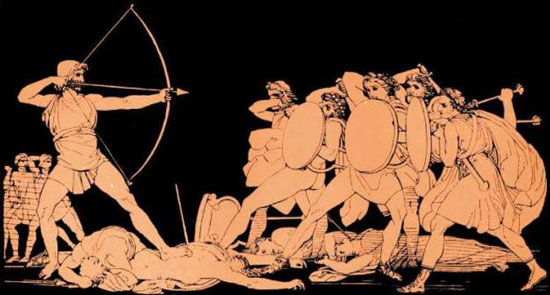
Odysseus killing his wife’s suitors after returning home
Alamy/The Independent, UK
Generations of classicists have pored over the many lines of Homer’s epic description of the long journey taken by the hero Odysseus to his home island of Ithaca. Now two scholars have found evidence to support the idea that one line, in the poem’s 20th book, refers to a total solar eclipse that occurred on 16 April 1178 BC – the day when Odysseus returned home to kill his wife’s suitors.
If true, this would date the fall of Troy itself to precisely 1188 BC.
The Odyssey is the story of a long and great journey involving the beautiful nymph Calypso – who enslaves Odysseus for seven years as her lover – helpful divinities such as Athena and vengeful gods such as Poseidon.
Odysseus eventually escapes from Calypso, survives a shipwreck where all his compatriots are drowned and is befriended by the Phaeacians, a race of skilled mariners who finally deliver the hero safely to Ithaca, where he takes on the guise of a beggar to learn how things stand at home.
It is during this later phase of The Odyssey that Homer is said to make reference to a total solar eclipse. The key phrase comes in a speech by the seer Theoclymenus, who foresees the deaths of the unruly young men who sought the hand of Penelope while Odysseus was away. It ends with the words: ‘The Sun has been obliterated from the sky, and an unlucky darkness invades the world.’
The idea that The Odyssey refers to a total solar eclipse, when the Moon blocks out the Sun completely, is not new. It was first suggested by ancient scholars, but it was only in the 1920s that astronomers were able to calculate that such an eclipse over Greece around that time could only have taken place on 16 April 1178 BC.
However, few people were convinced that the passage in The Odyssey was actually a reference to a mythical total solar eclipse, never mind a real one. It might just have been poetic licence, for instance, especially as Homer is said to have written it several centuries after the events that were said to have unfolded.
But two modern astronomers believe they have convincing evidence to support the 16 April eclipse by analysing other passages in the poem that refer to four other astronomical events that are known to occur quite independently of one another.”
Full Story
“Is an eclipse mentioned in ancient Odyssey poem?”
June 23, 2008, New Scientist, UK:
“A solar eclipse that occurred more than 3000 years ago may be mentioned in the Odyssey, an ancient poem based on Greek mythology, a new study suggests.
The poem, attributed to the poet Homer, describes the 10-year journey that its hero, Odysseus, took to return home to Ithaca, a Greek island in the Ionian Sea, after the end of the Trojan War. The war was waged over the beautiful Helen of Troy, a daughter of the god Zeus.
Days before Odysseus returned home to kill the 108 suitors courting his wife, a prophet predicted the men’s doom. ‘The Sun is blotted out of heaven, and a blighting gloom is over all the land’, the sage said.
In fact, a total solar eclipse – in which the disc of the Sun was blocked by the Moon – is calculated to have taken place on 16 April 1178 BCE over the Ionian Islands.
That is around the estimated end of the Trojan War, which despite its appearance in mythology may represent an actual conflict or series of conflicts in the city of Troy in the 12th century BCE.”
Full Story
“Backing sought for Saar Temple theory”
June 22, 2008, Gulf Daily News, Bahrain:
“A Saudi archaeologist, certain that he holds the key to a 4,000-year-old secret, gave a tour of the historic Saar Temple yesterday in his 12th attempt to convince Bahraini heritage chiefs that he is right.
Nabiel Al Shaikh, a photographer and archaeologist at Dammam Regional Museum, Saudi Arabia, is also hoping to drum up support among the Bahraini public.
He thinks the unusual corner of an ancient temple, located at the Saar settlement, was once a device used to measure the position of the sun – proving that the Dilmun civilisation followed a solar calendar.
The tour of the temple, which was meant to coincide with sunset was given from 5.30pm yesterday. On the summer solstice, which falls on June 21 every year, he says the sun would set directly over the unusual corner.
Although the theory is yet to be officially recognised, it has won support from others in the field including Saudi-based Australian archaeologist Claire Reeler. Among those present were Ms Reeler and American photographer Kay Erickson.”
Full Story
“Saar key to an ancient secret”
June 20, 2008, Gulf Daily News, Bahrain:
“A Saudi archaeologist, certain that he holds the key to a 4,000-year-old secret, is once again hoping to convince Bahraini heritage chiefs that he is right at the 12th attempt.
Nabiel Al Shaikh, a photographer and archaeologist at Dammam Regional Museum in Saudi Arabia, is also hoping to drum up support among the Bahraini public.
He thinks the unusual corner of an ancient temple, located at the Saar Settlement, was once a device used to measure the position of the sun – proving that the Dilmun civilisation followed a solar calendar.
On the summer solstice, which falls on June 21 every year, he says the sun would set directly over the unusual corner. The summer solstice is the first day of summer and also the day when the sun reaches its most northern point in the sky.
However, his theory has been undermined by the fact that the sun no longer sets directly over the corner of the temple when viewed from the inside.
Mr Al Shaikh has made an annual pilgrimage to the Saar settlement since 1996 to watch the sunset from the temple, which he believes was a tool for identifying the seasons – allowing priests to know the best times for harvesting, fishing, sailing and farming.
‘When the sun shone directly through what was probably a small window in the temple, the priest could announce the start of a new year’, he said.
Mr Al Shaikh says the fact that the sun does not set directly over the temple corner could be attributed to movement of the soil – backing up his claim by pointing out the slanting walls and doorways. ‘The wall most likely tilted due to the high water table in the Saar area’, he said.”
Full Story
“The oldest Stonehenge in the World !!!! Armenia or England???”
June 16, 2008, PR-Inside, Austria:
“Tourists familiar with Scottish heritage would be astonished to discover the possibility of famous Stonehenge been originated in Armenia, claiming the fact that the Armenian land is the real cradle of civilization.
Famous professor and world’s known specialist on stone monuments Gerald. S. Hawkins had acknowledged that Karahunj is 7,500 years old, which means that it is 3,500 years older than Scotland Stonehenge, older than Karnak in France and Newgrenge in Ireland. It may prove what some people already suspect that Armenia is the cradle of the civilization.
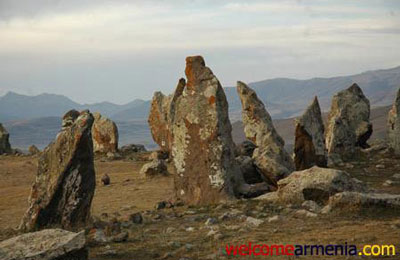
Karahunj – from the Welcome Armenia archive. Click on the image to go directly to the archive
where there are many more images of this unique ancient astronomical observatory
Welcome Armenia, Armenia
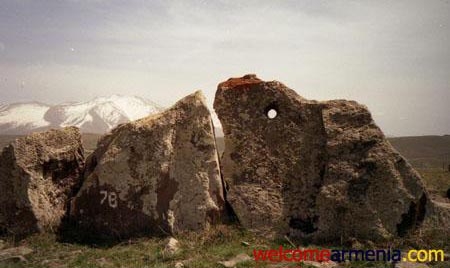
On the territory of 7 hectares, 223 huge vertical stones like soldiers stand on the hill, some with holes pierced in them. The rough- cut stones aligned irregularly for a purpose, 84 were found to have holes.
One of the many holed stones at Karahunj
Click on the image to go directly to the Welcome Armenia archive
Welcome Armenia, Armenia
Many unique astronomic instruments consisting of one, two or three Stones were identified and using these, many observations of the Sun, Moon and stars. It is commonly assumed to be an early observatory, the evidence of ancient astronomical culture in Armenia.
These stones have been attributed with mystical and cosmic powers. The Armenian scientists in ancient times could accurately measure latitude, knew that the Earth was ball-shaped, had an accurate calendar, and many more.”
Full Story
“Summer solstice to be marked at prehistoric temples”
June 02, 2008, The Times of Malta, Malta:
“Heritage Malta is organising guided tours of Hagar Qim and Mnajdra on June 21 starting at around 5.30 a.m. to mark the summer solstice.
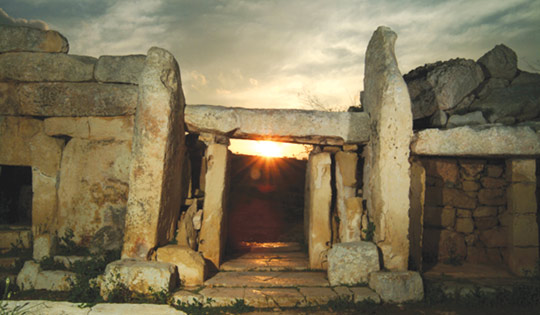
Only 50 people will be allowed in the two temples: 40 at Mnajdra (below) and 10 at Hagar Qim
The Times of Malta, Malta
Heritage Malta said that sunrise on the first day of each season underlines the relationship between the temples and celestial bodies. Although it is not known for certain whether these orientations were intentional, they are so systematic that this is most probable.
On June 21, the first rays of the sun light up the edge of a megalith found to the left of the central doorway connecting the first pair of chambers to the inner chamber of the lower Mnajdra temple.”
Full Story
“Archaeologist Uses Satellite Imagery To Explore
Ancient Mexico”
May 27, 2008, Photonics Online, USA:
“Satellite imagery obtained from NASA will help archeologist Bill Middleton peer into the ancient Mexican past. In a novel archeological application, multi- and hyperspectral data will help build the most accurate and most detailed landscape map that exists of the southern state of Oaxaca, where the Zapotec people formed the first state-level and urban society in Mexico.
‘If you ask someone off the street about Mexican archeology, they’ll say Aztec, Maya. Sometimes they’ll also say Inca, which is the wrong continent, but you’ll almost never hear anyone talk about the Zapotecs’, says Middleton, acting chair of the Department of Material Culture Sciences and professor in the Department of Sociology and Anthropology at Rochester Institute of Technology. ‘They had the first writing system, the first state society, the first cities. And they controlled a fairly large territory at their Zenith — 250 B.C. to 750 A.D.’
The process of state formation varied across the Zapotec realm. Sometimes it involved conquest, and other times it was more economically driven. Archeologists like Middleton are interested in different aspects of society that emerged in the process, such as social stratification and the development and intensification of agriculture and economic specialization.
Middleton’s study will explore how the Oaxacan economy and environment changed as the Zapotec state grew and then collapsed into smaller city-states. Funding from NASA and National Geographic will also help Middleton build a picture of how climate and vegetation patterns have changed over time.
‘For the past 4,000 years, human activities have been a factor in environmental change’, Middleton says. ‘And there are some parts of Mesoamerica that we have pretty good evidence that the environment we see today is the catastrophic result of ancient agricultural practices.’ Middleton will focus on two sites in the Chichicapam Valley located in between two of the major arms of the central valleys of Zapotec.
The National Geographic-funded portion of the study began last summer when he documented important archeological sites and selected candidates for excavation.”
Full Story
“‘Armenia’s Stonehenge’ opens as tourist site”
May 26, 2008, RIA Novosti, Russia:
“Authorities in southern Armenia have opened a 5,000-year-old prehistoric monument dubbed ‘the Armenian Stonehenge’, but known locally as Carahunge, as a tourist site.
The monument, located some 200 km (124 miles) away from the capital, Yerevan, consists of over 200 shaped stones, some bearing smooth angled holes of 4 to 5cm in diameter, directed at different points at the sky.
‘This territory will be developed for tourism’, said Samvel Musoyan, deputy chief of the Armenian culture ministry’s department for cultural heritage.
Funding has already been raised from the country’s budget to develop the tourist site, build a transparent wall around the monument and for maintenance and security of the site.
Following excavation of the site, it is believed to have served simultaneously as a temple of Ari, the ancient Armenian deity of the sun, a university and an observatory. According to recent archaeological findings, the site could be used to define the precise name of sunrise and lunar phases and the day when a year began.”
Full Story
“Namibia clams up over ‘delicate’ treasure ship talks”
May 25, 2008, The Times, South Africa:
“The Namibian government has gagged senior mining and minerals personnel, banning them from talking about a shipwreck discovered in a restricted diamond mining zone.
Namibia and Portugal have held diplomatic talks over excavating the 16th century ship, believed to be Portuguese in origin, and considered to be the most significant maritime archaeological find in Southern Africa.
Rare find: Bruno Werz of the Southern Africa Institute of Maritime Archaeological Research
with two of the astrolabes that could date back to Africa’s earliest explorers

The Times, South Africa/AP
Portuguese Consul-General in South Africa, Dr Domingos Alvim, on Friday confirmed top-level contact with the Namibian government to facilitate the speedy excavation of the shipwreck site in the Sperrgebiet, south of Luderitz.
The Portuguese are eager to assist in the excavation to ensure the best possible recovery of historically valuable items, he said.
Two of the artefacts are believed to be valuable navigational tools called nautical astrolabes, of which there are only about 30 left in the world.”
Full Story
“Star watch – Archaeologists discover a ‘cosmic clock'”
May 25, 2008, Tenerife News, Canary Islands:
“Overcrowded in their lower reaches they might be, but the Canary Islands still possess some solitary mountain wilder-nesses, places little visited thanks to their rugged inaccessibility, and which have hardly changed since they were frequented by the pre-colonial aboriginal islanders.
The ‘Cosmic Clock’ Petroglyph
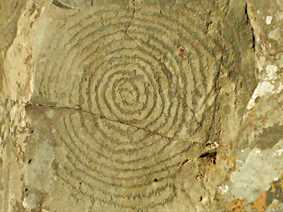
Tenerife News, Canary Islands
And traces of their presence are still turning up, often in the form of petroglyphs, enigmatic scratched marks on rocks and boulders which held some special significance about which we can only guess today. The latest find is, say archaeologists, one of the most exciting.
They are calling it a cosmic clock, a description guaranteed to get the imagination of any sci-fi fans racing. But there are no flashing lights and strange dials. The reality, a piece of stone 44 centimetres high and 34 wide, would certainly disappoint them, but the experts are hailing the Summer Stone as a major discovery.
The system used depended upon the alignment of three piles of stones with a facing mountain, from behind which the spring and autumn equinoctial sun rose – and still does.”
Full Story
“Last of the ancient wonders IV: The pyramid face angle”
May 23, 2008, Al-Ahram Weekly, Egypt:
“Assem Deif investigates the face angle of Egypt’s pyramids. Although it relies on the culmination of Sirius, the brightest star in the sky, it is rounded to match the nearest Egyptian unit, seqed
When the Egyptians witnessed the rising of Sirius just before dawn (known as the heliacal rising), they knew that the Nile would soon flood; for they depended upon the flooding for the agriculture and fertility of their land. The heliacal rising, which falls close to the summer solstice, marked the beginning of the New Year coinciding with the month of Thoth.
But the deadly fireball found along Rock Creek, south of Assiniboia near the U.S.-Canada border, can only be seen with the most powerful microscope — an infinitesimal bead of carbon-rich chemicals, but one of trillions now believed to have been ejected from Mexico’s famous Chicxulub Crater and sent around the world in a super-heated shower of asphyxiating, oily rain.
Since Sirius brought prosperity to Egypt, tracing of the star was crucial. At the Isis-Hathor Temple of Denderah there is a statue of Isis which was oriented to the rising of Sirius. When the priests saw the rays from Sirius penetrating the temple to fall upon the gemstone she wore, they announced that a New Year had begun. In the temple appears the inscription, ‘Her majesty Isis shines into the temple on New Year’s Day, and she mingles her light with that of her father on the horizon.’”
The builders designed their structure so that at culmination Sirius’s rays fell perpendicular to the pyramid’s south face; thus giving its maximum blessing to the deceased king and his ka. In other words, Sirius transmitted its benediction from the climax of its throne to the deceased.
This view, which is credited wrongly to the German engineer Neuberger in 1919, is in fact a property of Mahmoud Hamdy Pacha, k Al-Falaki, the famous Egyptian engineer and astronomer who lived in the mid 19th century, and founded the first Egyptian observatory. Among his several books is one written 60 years prior to Neuberger and devoted to the Pyramids of Giza in which he calculated the age of the great edifice. The results he published in 1862 in the Belgian Royal Academy put him on the lead in the science of archeoastronomy.
For after carrying out measurements for the Great Pyramid during the vernal equinox, he discovered that its four faces are inclined equally towards the horizon; meaning that they possess the same slope. Al-Falaki concluded that this could not be coincidental. The planes of the pyramid were also inclined in such a way that the rays of Sirius, while at culmination, fell at a right angle with the southern face; a necessity that must be ascribed to the religion.
So upon measuring the face angle and calculating its complement, he proceeded backward to calculate when Sirius attained its maximum altitude. He found that the Great Pyramid must have been erected c. 3303 BC, deviating greatly from the agreed date.”
Full Story
“Did Sask. spheroid kill the dinosaurs?”
May 08, 2008, The Star Phoenix, Canada:
“It’s a cratered spheroid, just the kind of object one imagines striking the Earth about 65 million years ago and wiping out 70 per cent of the planet’s species – including the dinosaurs
And the pockmarked orb discovered at a geological site in southern Saskatchewan is, indeed, the latest clue in science’s most enduring whodunit — new evidence that could overturn prevailing theories about the asteroid-impact
‘extinction event’ that doomed Edmontosaurus and most of the other plants and animals living at the cataclysmic end of the Cretaceous age.
But the deadly fireball found along Rock Creek, south of Assiniboia near the U.S.-Canada border, can only be seen with the most powerful microscope — an infinitesimal bead of carbon-rich chemicals, but one of trillions now believed to have been ejected from Mexico’s famous Chicxulub Crater and sent around the world in a super-heated shower of asphyxiating, oily rain.
The finding challenges the traditional view that the massive explosion sparked forest fires that suffocated species around the globe and blotted out the sun with smoke for years.
Instead, argues a study in Geology by the team of scientists from New Zealand, the U.S., Britain and Italy, the asteroid struck ‘with such force that carbon deep in the Earth’s crust liquified, rocketed skyward, and formed tiny airborne beads that blanketed the planet.’”
Full Story
“The Urals intends to develop pilgrimage to
the ‘Russian Stonehenge'”
May 08, 2008, InterFax, Russia:
“A new museum complex to study and preserve ancient megaliths (ceremonial structures of massive stones) will be soon created in the Isle of Vera, Lake Turgoyak of the Chelyabinsk region.
According to Senior Research Scientist of the Chelyabinsk Research Center of the Institute for History and Archeology of the Urals department of RAS Stanislav Grigoryev, researchers have a great work on hands to restore megaliths and improve the territory of the island.
‘The Isle of Vera is well known among tourists; about 15 thousand people come to see it every year. Its territory is now grassless and has almost no underbrush. Archeological monuments have also suffered from tourists. Many of them are now in an unsafe condition and need restoration’, said Grigoriev at an Interfax press conference in Chelyabinsk.
‘Among the most interesting monuments of the isle are its megaliths, similar to the famous megaliths of the Western Europe and Middle East. The largest of them is about 18 meters long, and weighs about 17 tons. Most likely, it is a temple complex related to the sun calendar cult’, added Grigoryev.”
Full Story
“Archaeologists find Queen of Sheba’s palace
at Axum, Ethiopia”
May 07, 2008, EarthTimes, UK:
“Archaeologists believe they have found the Queen of Sheba’s palace at Axum, Ethiopia and an altar which held the most precious treasure of ancient Judaism, the Ark of the Covenant, the University of Hamburg said Wednesday. Scientists from the German city made the startling find during their spring excavation of the site over the past three months.
The Ethiopian queen was the bride of King Solomon of Israel in the 10th century before the Christian era. The royal match is among the memorable events in the Bible. Ethiopian tradition claims the Ark, which allegedly contained Moses’ stone tablets on which the Ten Commandments were written, was smuggled to Ethiopia by their son Menelek and is still in that country.
The University said scientists led by Helmut Ziegert had found remains of a 10th-century-BC palace at Axum-Dungur under the palace of a later Christian king. There was evidence the early palace had been torn down and realigned to the path of the star Sirius.
The team said evidence for this included Sirius symbols at the site, the debris of sacrifices and the alignment of sacred buildings to the rising-point of Sirius, the brightest star in the sky.”
Full Story
“Ancient Asteroid Impact Coated Earth in Blanket of Beads”
May 06, 2008, Space.com, USA:
“The asteroid linked to dinosaurs’ demise 65 million years ago slammed into the Yucatan Peninsula with such force it pulverized Earth’s crust. The result was a veil of airborne carbon beads that blanketed the planet, a new study finds.
Spanning about 124 miles (200 kilometers), the giant indentation left by the asteroid impact continues to be a treasure trove of clues for scientists piecing together the wipe-out of 70 percent of life on Earth, including non-avian dinosaurs. Called the Chicxulub Crater, this CSI-site is located just west of Mexico’s Yucatan Peninsula.
The asteroid that hit Earth 65 million years ago
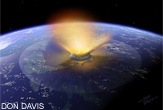
Don Davis, USA
Geologists generally agree an asteroid slammed into Earth at the end of the Cretaceous period; that the catastrophic impact sent molten rock and super-hot ash airborne; and that as the molten material fell from the sky, it ignited flammable flora, sparking forest fires.
More perplexing has been the formation of carbon particles called cenospheres hiding out in rocks of the Chicxulub Crater and other sites. One idea was that the carbon beads were charred remnants formed as a result of the plant-burning.”
Full Story
“Megalithic period pottery found”
April 27, 2008, The Hindu, India:
“Pottery items including bowls, dishes and urns, from the Megalithic period, have been excavated at Sembiyankandiyur near Kuthalam in Mayiladuthurai taluk of Nagapattinam district by the Tamil Nadu Archaeology Department.
An important finding: eight urns aligned in a particular manner, three of them with human bones inside. These might be of members of one family, according to department officials. The pottery included black-and-red ware, black ware and red ware.
Pottery with graffiti marks found at Sembiyankandiyur village in Nagapattinam district
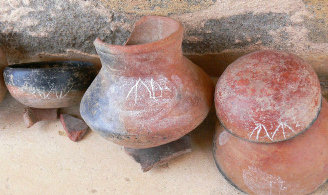
The Hindu, India
The site yielded a rich collection of pottery with graffiti marks. A few iron pieces were also found.
The discoveries were made at the site where in 2006 school teacher V. Shanmuganathan found a polished Neolithic celt (tool) that had engravings resembling the Indus script. This celt caused a stir in archaeological circles.
Important findings from the trenches were bowls, dishes, broken urns, full-size urns and so on. Eight urns were found to be aligned in a particular manner, three of them with human bones.
Full-shape pots had the graffiti depicting a fish, a ‘damaru’, sun, star and a swastika. Geometric designs and marks depicting fish, sun and star and graffiti marks are often found on black-and-red ware and black ware, with the symbols sometimes repeated.”
Full Story
“Clay tablet holds clue to asteroid mystery”
March 31, 2008, The Daily Telegraph, UK:
“British scientists have deciphered a mysterious ancient clay tablet and believe they have solved a riddle over a giant asteroid impact more than 5,000 years ago.
Geologists have long puzzled over the shape of the land close to the town of Köfels in the Austrian Alps, but were unable to prove it had been caused by an asteroid.
The tablet shows drawings of constellations and pictogram-based text known as cuneiform
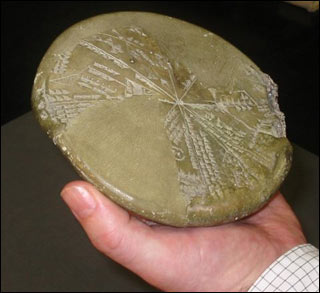
The Daily Telegraph
The circular clay tablet was discovered 150 years ago by Sir Austen Henry Layard, a leading Victorian archaeologist, in the remains of the royal palace at Nineveh, capital of ancient Assyria, in what is now Iraq.
The tablet, on display at the British Museum, shows drawings of constellations and pictogram-based text known as cuneiform – used by the Sumerians, the earliest known civilisation in the world.
Now Alan Bond, the managing director of a space propulsion company, Reaction Engines, and Mark Hempsell, a senior lecturer in astronautics at Bristol University, have cracked the cuneiform code and used a computer programme that can reconstruct the night sky thousands of years ago to provide a new explanation.
They believe their calculations prove the tablet – a copy made by an Assyrian scribe around 700 BC – is a Sumerian astronomer’s notebook recording events in the sky on June 29, 3123 BC. The pair say its symbols include a note of the trajectory of a large object travelling across the constellation of Pisces which, to within one degree, is consistent with an impact at Köfels.
However, the Bond-Hempsell theory, outlined in their book published today, “A Sumerian Observation of the Köfels Impact Event”, suggests that the asteroid left no crater because it clipped a mountain and turned into a fireball.”
Full Story
“Mysterious iron-filled mammoth tusks intrigue scientists”
March 09, 2008, Daily News-Miner, USA:
“A giant meteor may have exploded over Alaska thousands of years ago, shooting out metal fragments like buckshot, some of which embedded in the tusks of woolly mammoths and the horns of bison.
Simultaneously, a large chunk of the meteor hit Alaska south of Allakaket, sending up a dust cloud that blacked out the sun over the entire state and surrounding areas, killing most of the life in the area.
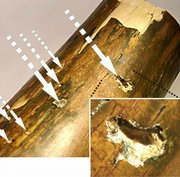
Embedded iron particles surrounded by carbonized rings in the outer layer of a mammoth tusk from Alaska. The inset photo shows how an object ripped through the tusk.
Daily News-Miner/Richard Firestone
Such is the scenario envisioned by Rick Firestone, a staff scientist at the Lawrence Berkeley National Laboratory in California. Firestone and his colleagues have found mammoth tusks and a bison skull with nickel-rich iron particles in them on one side, suggesting the metal fragments all came from the same direction.
Firestone’s theory emerged when his colleague, Alan West of Dewey, Ariz., saw at a Phoenix gem and mineral show a mammoth tusk peppered with tiny bits of metal. Intrigued, West and Firestone looked at tusks owned by the same dealer in Calgary.
By passing a magnet over mammoth tusks in Calgary, Firestone and West found seven mammoth tusks collected somewhere near the Yukon River and a bison skull from Siberia that had tiny iron fragments burned into them. The fragments also contained nickel.”
Full Story
“Satellite images reveal extent of harm to
Iraqs archaeological sites”
March 03, 2008, ThaIndian News, Thailand:
“New images obtained from a commercial satellite imaging company have revealed the extent of harm to archaeological sites in southern Iraq after the countrys invasion by the US and its allies in March 2003.
The images were captured by Digital Globe Corporation (DGC) and examined by archaeologist Elizabeth Stone at Stony Brook University in New York.
Modern-day Iraq contains relics from some of the world’s oldest cities and is often referred to as the ‘cradle of civilisation’.
According to a report in New Scientist, many of Iraq’s cultural treasures were looted after the US and its allies stepped in the country in 2003.
After examining almost 10,000 square kilometres of imagery, containing some 1900 archaeological sites, Stone was able to reveal the extent of damage to the countrys archaeological treasures.”Full Story
“Satellites Provide Clues to Ancient Mayan Civilization”
February 21, 2008, RedOrbit, USA:
“Five years ago, archaeologists began working with NASA scientists to better understand the mysterious end of the ancient Mayan civilization that thrived for over 1,000 years in Central America and southern Mexico.
Satellite image of Guatemala jungle

RedOrbit
The work is paying off, according to archeologist William Saturno, who discovered ruins of hidden Mayan cities in the Guatemalan jungle with assistance from satellite images.
The ruins consisted of five sprawling sites with hundreds of buildings. Saturno discovered the ruins through the use of a spy satellite that can see through clouds and forest to reveal differences in vegetation on the ground.
Saturno said the satellite images made it considerably easier to find ruins that were for hundreds of years hidden by dense jungle vegetation. ‘It was like shooting fish in a barrel’, he told Reuters.”
Full Story
“New center sheds light on astronomy as
a major player in Hawaiian life”
February 17, 2008, Winston-Salem Journal, USA:
“Ancient Hawaiians placed great importance on the night sky. After all, the stars helped guide Polynesian navigators to these lush islands in the vast reaches of the Pacific Ocean some 2,000 years ago.
The stars still shine brightly in Hawaii, where strict laws on light pollution and a lack of air-polluting industries make views of the night sky clearer than in most places.
On the Big Island of Hawaii, scientists from around the world study the heavens through 13 giant telescopes on Mauna Kea, a dormant volcano whose 13,796-foot summit rises above 40 percent of Earth’s atmosphere.
At the ’Imiloa Astronomy Center of Hawaii, which opened in 2006, visitors can learn about the importance of astronomy in Hawaii’s past, present and future.
They can learn about the reverence that Hawaiians, past and present, hold for the great mountain Mauna Kea that connects earth and sky. They can also learn about the rich culture of Hawaii, a culture once suppressed but now being celebrated on the islands.”Full Story
“Mapping the heavens”
February 01, 2008, The Hindu, India:
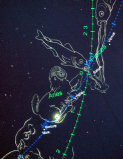
“In the east, heavenly maps were created as early as 2000 B.C. Heavenly maps were made by numerous non-Western cultures long before Europeans began to systematically catalogue the skies.
Computer generated: Sky chart
AP/The Hindu
Islamic astronomers made many meticulous maps of the skies, providing a framework for later observers. The tenth-century astronomer Abd al-Rahman al-Sufi recorded the first description of the nebulosity of the Andromeda nebula in his star atlas.
In ancient India, astronomical references date from 2000 B.C. Indian astronomers created brilliant innovations in mathematics, and translations of their texts played a pivotal role in the advancement of Arabic and European astronomy.
Around 499 A.D., the Indian astronomer Aryabhata conceptualised the first heliocentric model of the solar system (about a thousand years before Copernicus).”
Full Story
“First month brings events of astronomical proportion”
January 01, 2008, NewsOK, USA:
“Today is New Year’s Day, but only according to the Gregorian calendar that we use. There are many calendar systems in use today, and they don’t all agree when the year begins. All calendars have their roots in astronomical phenomena.
In prehistoric times, there were only a few natural events that recurred on a regular basis. The period from sunrise to sunrise, the most obvious naturally occurring interval, defined our day.
The cycle of the moon from new to full to new again signified the passage of one month, or ‘moonth’, with the four phases dividing the month into four weeks.
The sun’s rising position along the eastern horizon changed from well north of due east, with long, hot days, to equally far south, with short and sometimes frigid days. This natural cycle took about 365 days and is the basis of our year.
Some cultures, notably cultures east of the Mediterranean Sea, used a lunar-based calendar. They defined the year as 12 lunar cycles. But since that corresponds to about 354 days, they usually added an 11-day holiday period or mini-month so that the moon and the sun calendars would coincide.
Some cultures didn’t even bother with that, keeping a purely lunar calendar, such as that still used by Muslim cultures. Jan. 10 is the Muslim New Year’s Day, the start of year 1429 A.H.”Full Story
|