|
Books by
Maria Reiche
“Markings: Aerial Views of Sacred Landscapes
by
Maria Reiche
Charles Gallenkamp
Keith Critchlow
Lucy Lippard
(Contributors)
Marilyn Bridges
(Photographer)
Haven O’More
(Preface)
EU English Edition
“Mystery on the desert: A study of the ancient figures and strange delineated surfaces seen from the air near Nazca, Peru”
by
Maria Reiche
Unknown Binding
1949 Edition
“Geheimnis Der Wuste/
Mystery on the desert/
Secreto De La Pampa”
German/English/Spanish
by
Maria Reiche
Hardcover
1968 Edition
“Peruanische Erdzeichen/Peruvian Ground Drawings
German & English
by
Maria Reiche
(Author)
Malcolm G. Leybourne
(Translator)
Dr. Hermann Kern
(Translator)
Hermann Kern
(Foreword)
1974 1st Edition
“Geheimnis Der Wuste/
Mystery on the desert/
Secreto De La Pampa –
Preliminaries for a Scientific Interpretation of the Pre-Histori c Ground-Drawings of Nazca, Peru and Introduction to Their Study“
German/English/Spanish
by
Maria Reiche
Hardcover
1989 7th Edition
Signed by author
Books about the Nazca
lines & geoglyphs
“Maria And The Stars Of Nazca / Maria Y Las Estrellas De Nazca”
Spanish & English
by
Anita Jepson-Gilbert
Rodger Osban
EU English Edition
“Ancient Nasca
Settlement & Society”
by
Helaine Silverman

EU English Edition
“Nasca society arose on the south coast of Peru 2000 years ago and evolved over the course of the next 700 years. This text examines the range of sites occupied by the people responsible for some of the most exquisite art and ingenious hydraulic engineering of the pre-Columbian world.
“The Nasca
(Peoples of America)”
by
Helaine Silverman
&
Donald A. Proulx
EU English Edition
“Ancient Nasca culture of the south coast of Peru is famous for its magnificent polychrome ceramics, textiles, and other works of art, as well as the enigmatic ground markings on the desert plain at Nasca. In the past two decades much has become known about the people who produced these fascinating works. This scholarly yet accessible book provides a penetrating examination of this important civilization.”
|
|
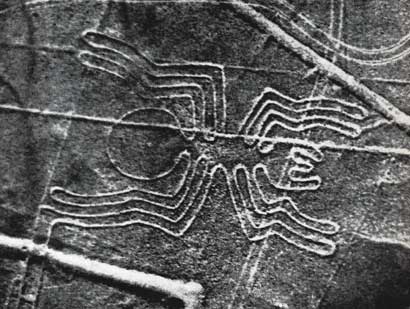
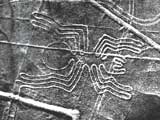
The spider geoglyph, despite it being just 150 feet long, is one of the most spectacular on the Nazca plain. Since its discovery by Dr Paul Kosok, and its preservation was championed by Maria Reiche, it has been claimed that on it’s thin waist the stars of Orion’s belt fit neatly, with the other stars of that constellation positioned on its legs.
Maria Reiche said that this magnificent figure was the second one to be discovered by Dr Kosok, who had gone to Peru in the mid-1930s to study ancient irrigation systems, which is what the figures were initially thought to have once been a part of:
“When the largest drawings were first seen from airplanes, they were taken to be remnants of ancient irrigation. No special attention was given them until Dr. Paul Kosok came to Peru to study ancient irrigation on the coast. After finding that they had nothing to do with it, he initiated the study of the figures with the discovery and re-tracing of a huge figure of a bird.
The next figure to be discovered was the huge image of a spider, after this dozens of other figures of animals were encountered.”
Copyright © 1949, Maria Reiche
The straight lines that pass through this geoglyph have been said to point to the various directions that the stars of Orion have risen over the local horizon for many, many centuries. Other lines are said to have orientations towards the points of the rising of these stars well into the future, though it is a major bone of contention between archæologists as to whether this was designed by the builders, or is pure coincidence.
That, of course, refers only to the archæologists who are prepared to concede that the ancient Nazca people had developed a sophisticated knowledge of astronomy – most do not.
Some say that careful observation at specific times of the year will show that equinoctial and solsticial sunrises and sunsets are marked by lines laid down hundreds of years ago.
Others maintain that, at the time the geoglyphs were built, the local inhabitants of the Nazca plain lived a subsistence-farming lifestyle, and that because of this they would have had no time to spare for such a knowledge of astronomy to have developed.
Regretably, the tendency by the archæological community worldwide has been to dismiss all talk of astronomical significance at Nazca since Gerald Hawkins is said to have put the orientations of many of the straight lines found on the pampa into a computer, and is said to have found no significant astronomical alignments.
However, since that time, many others have worked patiently on the pampa, and much of the astronomical phenomena known to have been observed by ancient peoples around the world, such as the sun-rises at the equinoxes and solstices, have been discovered all over the area where the geoglyphs are concentrated.
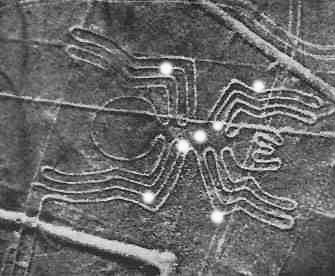
Copyright © 1949, Maria Reiche
The aerial photograph of the spider geoglyph above has had white dots placed where the ‘stars of Orion’ have been superimposed over it in the way that some theories have contended.
Bottom right is ‘Rigel’ (Beta Orionis), a 0.1 magnitude star that is more than 775 light years away from Earth.
Top right is ‘Bellatrix’ (Gamma Orionis), which has a visual magnitude of 1.6, but this star is much closer at a mere 360 light years away from Earth.
Top left is ‘Betelgeuse’ (Alpha Orionis). This also has a visual magnitude of 1.6 and is often spoken of as the partner of ‘Bellatrix’, but this star is a little further away at around 430 light years distant from Earth. It is a red super-giant, one of the largest to be yet discovered, having a diameter some 800 times that of our Sun, and mass some 20 times greater. Its brightness varies in an irregular way between M0.4 and M0.9, and it does so roughly in about 5 years.
Its placing is directly on one of the lines respresenting the inside of one of the back legs of the spider, although the phrase, ‘one of the lines’, is a bit of a misnomer, as the outlines of the spider figure is, like all the other animal figures on the pampa, traced by one continuous line – in the Nazca style.
Recalling the time when the geoglyphs were first discovered, Maria Reiche, in her ‘Introduction’ to her book about the Nazca drawings, “Mystery on the Desert”, described the scene flying over them:
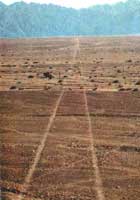
“Looking down on the plains, terraces and tablelands, there appear in different places triangles, rectangles and trapezoids neatly outlined in a lighter colour on the brownish surface. The lines cross over straightedged fields, run beside or radiate from them, intersecting each other and forming intricate networks.
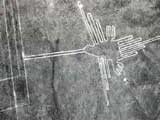
Other shapes, instead of being abstract and geometrical, represent animals, appearing in different places among the straight lines. Being clearly visible even from altitudes of about 1500 feet, one can imagine their enormous size. It is evident, that all these figures and lines are man-made, having been preserved intact over centuries and escaping detection only by their large-scale making them unrecognizable from the ground.
In order to take stock of the countless numbers and infinite variety of the mysterious drawings, the author had to traverse the pampas (in Peru pampa means barren flat land) on foot. The next figure to be discovered was the huge image of a spider, after this dozens of other figures of animals were encountered.”
Centre left is ‘Alnitak’ (Zeta Orionis), a star with a visual magnitude of 1.8 which marks the start of the so-called ‘Belt of Orion’. It is a massive 1110 light years away from Earth.
At the centre of the spider figure’s waist, and representing the centre star of the three stars of Orions’ belt, is ‘Alnilam’ (Epsilon Orionis). This has a visual magnitude of 1.7 and is further away still at around 1210 light years distant from Earth.
Finally, on centre left, is ‘Mintaka’ (Delta Orionis). Less bright than the other stars in this constellation it has a visual magnitude of 2.2, is around 920 light years away from Earth, and its name, as with many stars, is of Arabic origin and actually means “The Belt”.
While this name may seem relevant to those of us brought up on classical astronomical names for the stars and constellations, it should not be forgotten that, if the spider geoglyph on the Nazca plain was ‘meant’ to represent the stars of Orion by its builders, then this may not be the case. But, on the other hand, where else would a belt be worn if not around the waist?
all quotes on these tribute pages are from
“Mystery on the Desert”
by Maria Reiche
if you would like to support our
astro-archaeology research projects
please send us a book

from our Wish List
|
|
To understand why this News Page is sometimes late here is some information about Fibromyalgia
“Pathways to the Gods: The Mystery of the Andes Lines”
by
Tony Morrison
EU English Edition
“Nazca: Eighth Wonder of the World?”
by
Anthony F. Aveni
EU English Edition
“Between the Lines: The Mystery of the Giant Ground Drawings of Ancient Nasca”
by
Anthony F. Aveni
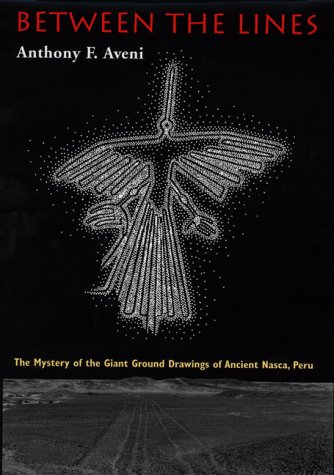
EU English Edition
“The Cities of the
Ancient Andes”
by
Andriana von Hagen
& Craig Morris
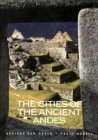
EU English Edition
“The largest empire of pre-Columbian America was toppled in under a decade by a handful of Spanish invaders who looted the fabled riches of its greatest city, Cuzco, and severed its 15,000 mile system of roads. But this Inca empire was only the final link in a chain of urban development stretching back to 2500 B.C. How did cities evolve in the ancient Andes?”
“The Nasca
(Peoples of America)”
by
Helaine Silverman
&
Donald A. Proulx
EU English Edition
“Ancient Nasca culture of the south coast of Peru is famous for its magnificent polychrome ceramics, textiles, and other works of art, as well as the enigmatic ground markings on the desert plain at Nasca. In the past two decades much has become known about the people who produced these fascinating works. This scholarly yet accessible book provides a penetrating examination of this important civilization.”
Nazca News
more information
about the Nazca lines
& geoglyphs on
:
Landscape Geometry
Lines Over Mountains
Animals & Landscape
Figures On The Plain
The Human Scale
Birds On The Pampa
The Spider Geoglyph
& The Stars Of Orion
Spirals In The Desert
|

 |
|  |
|  |
|  |
|  |
|  |
|  |
|  |
|  |
|  |
|  |
|  |
|  |
|