text translation service for many worldwide languages
Morien Institute Skywatching Calendars for:
The Morien Institute Skywatching Expeditions have developed out of a series of familiarity sessions that have happened over many years. Identifying the stars and star patterns which form the constellations in the northern hemisphere is a process which is essentially one of re-orientation. After three or four successive clear nights the observer begins to appreciate the vastness of the universe, often for the first time, and the sporadic meteors that can be seen every night bring home the reality that it is a perpetually changing, living cosmos …
Once the basics of constellation-recognition has been achieved, time spent noticing the movements of the planets across the background of fixed stars seems to last longer, as the greater time-frames of our solar system are ‘experienced’. The pre-occupation with the cosmos that governed the lives of ancient peoples becomes less of a mystery as new skywatchers ponder with awe the vastness before them. Observing a meteor storm gives skywatchers a 3-D appreciation of our solar system, and drives home the discomforting reality that ‘space’ is far from ’empty’ … The skies we saw on November 18/19 2002 provided a glimpse of the sort of ‘dynamic skies’ that were common in ancient times, when regular bombardments of cometary debris on the surface of the Earth came to be the most dreaded of natural phenomena. It is likely that this ‘dread’ of death and destruction coming from the skies is what originally gave rise to the age-old superstition of making a wish upon seeing a shooting-star. The ‘ancient wish’ is likely to have been a desperate prayer that ‘thunderbolts’ would not be thrown at mortal beings by the shape-changing immortal gods – the comets …
The Annual Perseid Meteor Shower peaks on Wednesday, August 13th 2003 …
It’s time to get ready for the Perseid meteor shower. The Perseids are probably the best-watched of any annual meteor shower. They come in mid-August when it’s warm and comfortable to be outside at 4 o’clock in the morning. They are bright, numerous, and dependable.This year the shower peaks on Wednesday, August 13th. For more information about this year’s shower and the Perseid Meteor Shower generally please go to the Science@NASA website.
There will be the usual Morien Institute Summer Skywatches held in various parts of Wales, though the location of observation sites have not yet been finalised. PLease call for further details and maps …
those interested in joining us should please contact us as soon as possible …
The Annual Perseid Meteor Shower Skywatch August 12th 2003 …
The annual Morien Institute Perseid Meteor Shower Skywatch will take place on Ynys Mon near to Bryn Celli Ddu. The ‘peak’ of this year’s Perseid Meteor Shower will be just before dawn on Wednesday August 13th. It is expected that there will be approximately 100 meteors (shooting stars) per hour, though the fainter meteors will be very difficult to see due to the full Moon on August 13th also. But this is made up for because the planet Mars is approaching it’s closest position relative the the Earth for some 50,000 to 60,000 years, so it will be possible for skywatchers to get very good views of the polar ice caps, even with strong binoculars. More information can be found by following the links below …
The 2003 Perseid Meteor Shower
The 2003 Perseids in Moonlight
those interested in joining us should please contact us as soon as possible …
An Annular Solar Eclipse on May 31st 2003 … There will be a Morien Institute Skywatching Expedition to the Scottish Islands specifically to see the ‘annular solar eclipse’ on May 31st. We will base ourselves on the Orkney Islands to observe this event. Anyone is welcome to join us, and the final decision of observation point will be made in situ on the island, but will be either the Ring of Brodgar megalithic stone circle, or the Stones of Stenness. Visitors wanting to find these sites on their own would be wise to get a copy of the Landranger Map No.6, which shows the location of all megalithic sites on the Orkney Islands …
those interested in joining us should please contact us as soon as possible …
Total Lunar Eclipse on May 15/16 2003 …
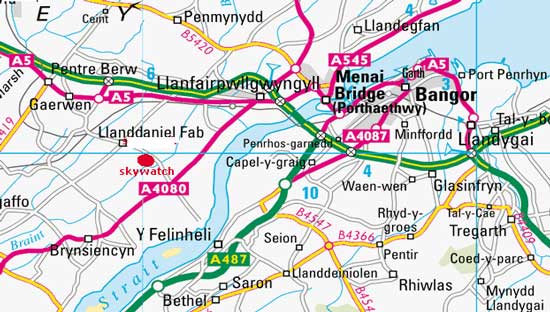
There will be a Morien Institute Skywatching Expedition to Bryn Celli Ddu to observe the ‘total lunar eclipse’ on May 15/16th 2003. On May 15th and 16th the moon will glide through Earth’s shadow for the first time this year, and the eclipse begins at 10:00 p.m. EDT, 7:00 p.m. PDT on Thursday evening, May 15th, or 02:00 Universal Time UT on Friday morning, May 16th … At first the moon will seem pale and bright, as usual. During the hour that follows, however, it will plunge into the darkest part of our planet’s shadow–a region astronomers call “the umbra”. On May 15th the moon will be inside the umbra for about 52 minutes, from 11:14 p.m. to 12:06 a.m. EDT (8:14 to 9:06 p.m. PDT) or 03:14 to 04:06 UT on May 16th … This Ynys Môn Skywatch will be held on Thursday May 16th from Midnight until 04:00 the next morning at the ‘Bryn Celli Ddu CADW car park’ in Llanedwen. From Menai Bridge follow the A4080 to the fork at Llanfair P.G., then turn ‘left’ along the Brynsciencyn Road and stay on that road (A4080) until you reach Plas Newydd. Just past Plas Newydd turn ‘right’ and follow the Llanddaniel Fab road for about a mile. The ‘Bryn Celli Ddu CADW car park’ is on the left just over the stream. Ring the mobile if you get lost. IF IT RAINS THE SKYWATCH WILL BE CANCELLED …
those interested in joining us should please contact us or meet us there …
May 6 2003 – NASA ScienceNews – USA “Mercury transits the Sun”
May 11th, 2003 – For 5 hours on May 7th, 2003, the planet Mercury passed directly between Earth and the sun. Sky watchers on 5 continents photographed the rare transit, and you can access most of the results here …
May 7th, 2003 – the planet, Mercury, will be so close to the sun that even space station astro-photographers won’t be able to separate the two. For the first time since 1999, Mercury and the sun will actually overlap. The planet’s silhouette, a tiny black disk, will slowly cross the face our star …
the five-hour transit begins at 05:13 UT (GMT) which is (01:13 EDT) …
People in Europe, Africa and Asia using properly shielded telescopes will have no trouble observing the close encounter. The crew of the ISS could see it, too, except for one thing: they don’t have a telescope onboard. Mercury’s black disk will be too small to see without one …
some useful links for this event:
NASA Goddard Space Flight Center Animated image of transit at Spaceweather.com
March 27 2003 – AP at Yahoo News – USA “Meteor Showers Rocks on Midwestern Homes”
INDIANAPOLIS, USA – “The midnight sky flashed an eerie blue early Thursday over four Midwestern states as a meteorite exploded in the atmosphere, sending rocks as big as softballs crashing through some houses. Residents in Illinois, Indiana, Ohio and Wisconsin reported seeing the disintegrating meteorite flash across the sky about midnight. Police were soon deluged with reports of falling rocks striking homes and cars.
Chris Zeilenga, 42, of Beecher, Ill., said he and his wife, Pauline, were watching TV war coverage around midnight:
“The sky lit up completely from horizon to horizon. We’ve seen lightning storms, but this was nothing like that,” he said. “A minute or so later the house started rumbling and we heard all these tiny particles hitting the house”
Rick Callahan
A Rare Meteor shower/storm on March 1st 2003 …
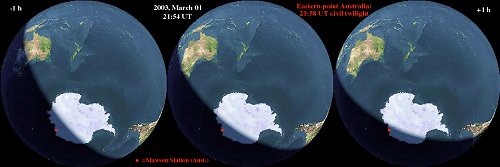
Earth is approaching a cometary debris stream that might trigger an unusual Antarctic meteor shower this weekend, March 1st/2nd 2003. According to
“On March 1, 2003, around 21:54 universal time (UT), our planet will encounter a stream of dusty comet debris “only 12,000 km from Earth. That’s as close as the Leonid debris stream was in 1966,” says Bill Cooke of the NASA Marshall Space Flight Center’s Space Environments Team.
The source of the dust this time is Comet Bradfield (C/1976 D1) – a dim comet discovered in 1976 by Bill Bradfield of Australia. It swings through the inner solar system approximately every 1000 years.
“We’ve never observed a meteor outburst from Comet Bradfield before,” ays Cooke. That’s no surprise: The comet’s orbit is tilted so the shower is visible only from the far-reaches of our planet’s southern hemisphere. The best viewing spots are near the coast of Antarctica … “and onboard the International Space Station,” adds Cooke.”
Image credit: Peter Jenniskens of NASA Ames Above: Incoming meteoroids from Comet Bradfield will fall on Earth’s southern hemisphere. These three frames depict Earth as seen from the meteoroid stream one hour before (left), during (middle) and one hour after (right) the expected outburst. But this meteor shower/storm can also be ‘heard by radio listeners’ all over the world. Please click on the image above to go to the NASA website for further details …
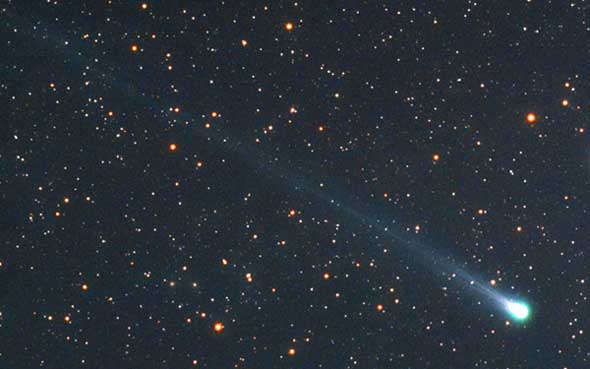
Comet C/2002 V1 (NEAT) has just passed the Sun on February 24 2003 …
please click on the image below to access Gary W. Kronk’s Cometography website
Copyright © 2003 by Michael Jäger (Austria) This photograph was obtained by Michael Jäger using a 200/300 Schmidt camera on 2003 January 28.74. It is a combination of two 6-minute exposures obtained with Kodak Ektachrome 100S and one 7-minute exposure obtained with Kodak TP. You can see more images on Gary W. Kronk’s website …
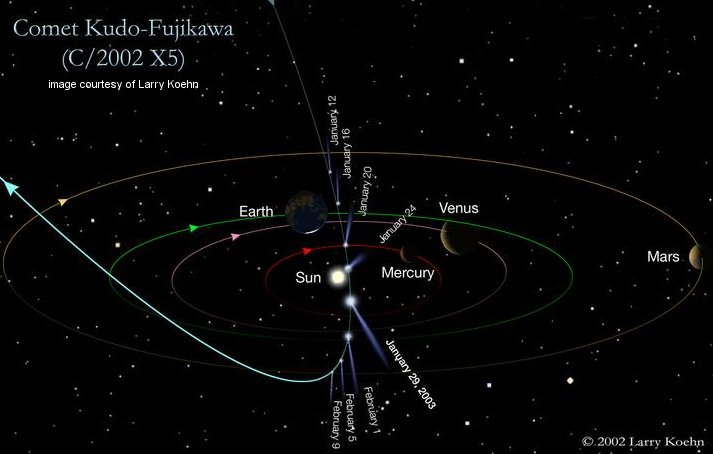
Comet C/2002 X5 (Kudo-Fujikawa) is plunging toward the Sun in January 2003 …
please click on the image below to access Nasa’s 3D orbit visualization
Comet C/2002 X5 (Kudo-Fujikawa) is plunging toward the Sun. On Jan. 29th, it will pass closer to our star than the planet Mercury. Intense sunlight will hide the encounter from sky watchers, but not from the Solar and Heliospheric Observatory (SOHO), which is able to block the Sun’s glare using onboard coronagraphs. C/2002 X5 will enter SOHO’s field of view this weekend and remain visible until approximately the end of the month. How bright will the comet become? How big will its tail grow? Will the comet break apart? No one knows. You can watch the encounter by following links from:
please visit our for a wide range of ‘telescopes’, ‘binoculars’, ‘eyepieces’, ‘filters’, ‘tripods’ and whatever ‘accessories’ you could possibly need …
the Morien Institute supports:
please take a look at our astronomy programs & night-sky software for PCs and our Ancient Cosmic Impacts bookshoppe for a wide selection of books that explore human prehistory from the perspective that our planet has been regularly bombarded by cometary debris …
<
|