|
Books about the Great
Sphinx & Pyramids
“Pyramid Quest: Secrets of the Great Pyramid and the Dawn of Civilization”
by
 Dr Robert M. Schoch Dr Robert M. Schoch
&
Robert Aquinas Mcnally
“How is it that the Great Pyramid exercises such a gripping hold on the human psyche adding cryptic grace and framing myriad claims of New Age “pyramid power”? In “Pyramid Quest”, Robert M. Schoch and Robert Aquinas McNally use the rigorous intellectual analysis of scientific inquiry to investigate what we know about the Great Pyramid and develop a stunning hypothesis: this ancient monument is the strongest proof yet, that civilisation began thousands of years earlier than is generally thought, extending far back into a little-known time.
In tracing that story, we come to understand not only the Great Pyramid but also our own origins as civilised beings.”
Get This Book From:
Amazon.com
Amazon.co.uk
“Voices of the Rocks:
A Scientist Looks at
Catastrophes and
Ancient Civilizations”
by
Dr Robert M. Schoch
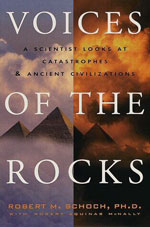
“The great 19th-century battle between catastrophists and uniformitarians seemed to end with the notion of global cataclysms being dismissed as a back door to the supernatural.
But the catastrophist theory has gradually become more and more plausible, so that now, less than a hundred years later, it is widely believed that mass extinctions are linked to meteor strikes.”
Get This Book From:
Amazon.com
Amazon.co.uk
“Voyages of the
Pyramid Builders”
by
Dr Robert M. Schoch

Get This Book From:
Amazon.com
Amazon.co.uk
|
|
“Lawton and Ogilvie-Herald (page 313) agree with me that the current arid climatic regime of the Giza Plateau began approximately in the middle of the third millennium B.C. (circa 2350 B.C. by one standard dating scheme) and there were various periods of relatively heavy rainfall from about 10,000 or 8,000 B.C. up until the onset of the predominant aridity that has existed in the area for the last 4500 years or so.
Lawton and Ogilvie-Herald also correctly point out that there were occasional rains, even heavy rains, during dynastic Egyptian times and up through the present day, resulting in periodic flash floods.
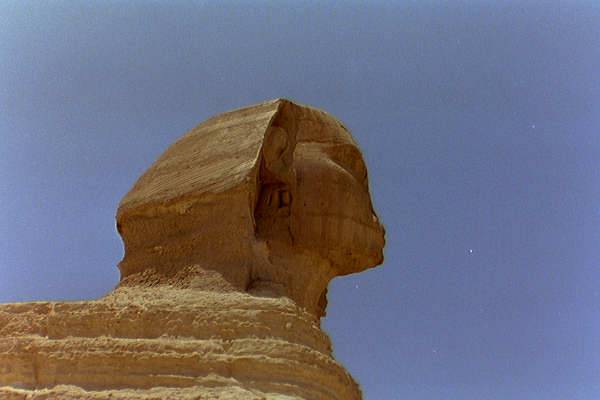
Still, as will be discussed further below, such flash floods actually have little bearing on the weathering, erosion, and ultimately the determination of the age of the oldest portion of the Sphinx (here it is important to remember that the Great Sphinx was refurbished and partially recarved, including a recarving of the head, in dynastic times).
Sporadic heavy rains and the resulting flash floods (due to the inability of the rain to penetrate and soak into the land’s surface and thus it runs off and collects in valleys, wadis, and other depressions) commonly found in arid regions do have tremendous potential to move loose debris and even cause serious erosion.
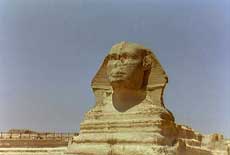
However, in my opinion as a geologist, the nature and especially degree of weathering seen in the Sphinx enclosure and on the body of the Sphinx itself, is incompatible with sporadic flash floods since dynastic times.
Even if occasional heavy rains occur on the Giza Plateau, the fact remains that currently on average only about an inch of rain each year occurs in the region (25 to 29 mm annually).
I do not believe that there has been enough rainfall in the area over the last 5000 years to account for the tremendous degradation of the actual limestone bedrock as seen on the western end of the Sphinx enclosure, much less to account for the extreme weathering and erosion seen on the core body of the Sphinx itself. The latter is an important point, because in the case of the body of the Sphinx only the back (top) of the Sphinx serves as a catchment area for any subsequent runoff.
From what we understand of the climate of the area, it strains credulity to suggest that this weathering and erosion is the result of rainfall during the last 4,500 years.
This is even more so the case when we take into account the calculations of Lawton and Ogilvie-Herald (page 312) that the Sphinx enclosure and body of the Sphinx have been buried in sand, and thus effectively protected from this type of erosion, for 3,100 of the last 4,500 years.
Furthermore, based on the perceptive analysis of the geologist Colin Reader (discussed below), since at least the time of Khufu (circa 2550 B.C. according to one standard chronology), the Sphinx has not even been situated in a position where it could receive the brunt of such flash floods.
Among ancient Egyptian structures, those that show clear signs of having been damaged or otherwise significantly affected by the occasional heavy rains and resulting flash floods are those situated in valleys, wadis, and other low areas that serve as channels for the collected water.
Lawton and Ogilvie-Herald cite the Valley of the Kings at Luxor as a case in point, and other authors have cited Reisner’s suggestions of flood damage to the Menkaure valley temple on the Giza Plateau. Potential flood damage to Menkaura’s valley temple is very different in kind and degree than the actual erosion and degradation of limestone bedrock as seen in the Sphinx enclosure.
According to Lehner (1997, “The Complete Pyramids”, Thames and Hudson, London, p. 137), Menkaure’s valley temple “lies at the mouth of the main wadi” (as is clear from maps of the site, as well as personal inspection of the area) which would situate it to receive the brunt of any ephemeral flash floods and hardly is relevant to the western end of the Sphinx enclosure or the body of the Sphinx itself.”
Furthermore it was apparently finished in mudbrick by Shepseskaf, then rebuilt (after being ‘flooded’ at some point) during the 6th Dynasty. To use an argument from Menkaure’s valley temple or the Valley of the Kings at Luxor in an attempt to keep some semblance of the traditional date for the Sphinx, or at least keep it dynastic, just doesn’t work.”
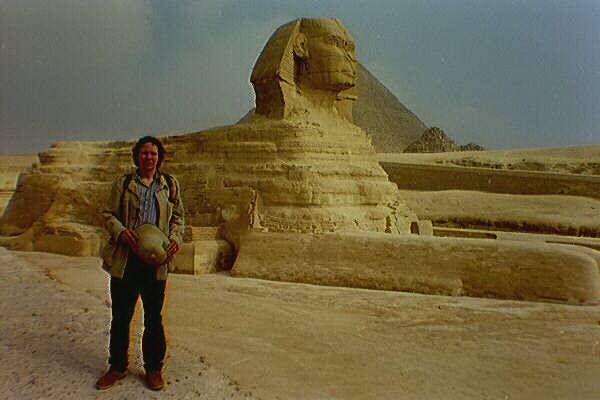
Dr Robert M. Schoch’s response to criticisms by Ian Lawton & Chris Ogilvie-Herald in their book
“Giza: The Truth” continues on:
Page Three
|
|
Publication Date
September 10 2015
“Magicians of the Gods: The forgotten wisdom of earth’s lost civilisation – the sequel to Fingerprints of the Gods”
by
Graham Hancock

“The evidence revealed in this book shows beyond reasonable doubt that an advanced civilization that flourished during the Ice Age was destroyed in the global cataclysms between 12,800 and 11,600 years ago.
Near the end of the last Ice Age 12,800 years ago, a giant comet that had entered the solar system from deep space thousands of years earlier, broke into multiple fragments.
Some of these struck the Earth causing a global cataclysm on a scale unseen since the extinction of the dinosaurs.
At least eight of the fragments hit the North American ice cap, while further fragments hit the northern European ice cap.
The impacts, from comet fragments a mile wide approaching at more than 60,000 miles an hour, generated huge amounts of heat which instantly liquidized millions of square kilometers of ice, destabilizing the Earth’s crust and causing the global Deluge that is remembered in myths all around the world.
A second series of impacts, equally devastating, causing further cataclysmic flooding, occurred 11,600 years ago, the exact date that Plato gives for the destruction and submergence of Atlantis.
But there were survivors – known to later cultures by names such as ‘the Sages’, ‘the Magicians’, ‘the Shining Ones’, and ‘the Mystery Teachers of Heaven’.
They travelled the world in their great ships doing all in their power to keep the spark of civilization burning.
They settled at key locations – Gobekli Tepe in Turkey, Baalbek in the Lebanon, Giza in Egypt, ancient Sumer, Mexico, Peru and across the Pacific where a huge pyramid has recently been discovered in Indonesia.”
Get This Book From:
Amazon.com
Amazon.co.uk
“The Pyramids and Temples of Gizeh”
by
W. M. Flinders Petrie
Get This Book From:
Amazon.com
Amazon.co.uk
|