|
“‘Goldmine’ for archaeologists”
December 30, 2007, The New Straits Times, UK: “With 10 shipwrecks discovered in its waters since 1990, Malaysia is regarded as a wreck haven by international archaeologists.
Swedish naval architect and adventurer Sten Sjostrand said the shipwrecks were discovered in both the South China Sea and the busy Straits of Malacca.
He said a wide variety of historical items of Chinese, Thai and Portuguese origin, dating back between the 11th and 19th century, had been found on the seabed.
‘Eight of the shipwrecks were located in the South China Sea while the other two were spotted in the Straits of Malacca. The discovery of these sites has attracted scores of archaeologists to investigate sunken ships. This augurs well for the country as well as for its historical significance’, he said at the Treasures of the Nanhai exhibition at Traders Hotel here yesterday.
The exhibition is open until Jan 6 from 10am to 9pm.”
“Spain’s seabed goldmine”
December 29, 2007, The Independent, UK: “Spain’s seabed is home to the wrecks of hundreds of ships laden with treasures plundered during the country’s imperial zenith. Now the battle is on to reclaim them.
Gazing from the beaches of southern Spain into the blue waters of the Mediterranean, few tourists have any idea what really lies beneath the waves. Aside from jellyfish, the occasional whale and the usual flotsam and jetsam, at the bottom of one of the world’s busiest waterways lies something many a holidaymaker would love to get their hands on.
Maritime historical experts say that, scattered around the Spanish coastline, lies more gold and silver than in the vaults of the Bank of Spain. There are said to be the 700 shipwrecks, from Roman barges, to Spanish Golden Age galleons and British aircraft carriers.
Many of the galleons were laden with a fortune in gold, silver and bronze plundered from colonies between the 16th and 19th centuries when Spain’s empire stretched from the Americas to the Philippines.
Freak storms, the gall of audacious pirates or the guns of rival navies all sent them to the bottom while they sailed the perilous India Run, bringing treasures from Spain’s colonies in the Philippines and the Americas. Marine archaeologists believe that lying under the waves in the Mediterranean alone could be sunken treasure worth $100bn (£73bn), but all acknowledge the real value will probably never be known.
Elsewhere, scattered around parts of the globe, in the Atlantic, Caribbean and Pacific, lie more sunken millions. Now, hundreds of years after the gold baubles and silver ducats went to the bottom of the briny, there is an international battle to lay claim to this treasure.
Centuries on from the Spanish conquistadores, their modern descendants are determined the millions in gold and silver will not be claimed by 21st-century pirates who employ hi-tech gear to retrieve the treasures.”
“Brock University professor anxious to dive on
December 27, 2007, St. Catherines Standard, USA: “The last time anyone touched the artifacts Elizabeth Greene is after, Rome was a new empire and climate change had just pushed the Scandinavians into Europe.
A trade hub in ancient times for Greece and Turkey, the Mediterranean has thousands of ancient shipwrecks, ‘more than we’ll ever be able to excavate’, Greene said.
They are so old that most of the actual ships are gone, eaten by underwater creatures or dissolved after thousands of years. But the remaining cargo provides an unhindered glimpse of how goods were transported then.
It answers important questions about trade and economy before money existed, she said.”
“Remains of ancient civilisation discovered
December 27, 2007, RIA Novosti, Russia: “An international archeological expedition to Lake Issyk Kul, high in the Kyrgyz mountains, proves the existence of an advanced civilization 25 centuries ago, equal in development to the Hellenic civilizations of the northern coast of the Pontus Euxinus (Black Sea) and the Mediterranean coast of Egypt.
The expedition resulted in sensational finds, including the discovery of major settlements, presently buried underwater. The data and artefacts obtained, which are currently under study, apply the finishing touches to the many years of exploration in the lake, made by seven previous expeditions. The addition of a previously unknown culture to the treasury of history extends the idea of the patterns and regularities of human development.
Kyrgyz historians, led by Vladimir Ploskikh, vice president of the Kyrgyz Academy of Sciences, worked side-by-side with Russian colleagues, lead by historian Svetlana Lukashova and myself. All the Russians involved were experienced skin-divers and members of the Russian Confederation of Underwater Sports. We were responsible for the work done under water. Scuba divers ventured into the lake many times to study its bottom.
Last year, we worked near the north coast at depths of 5-10 metres to discover formidable walls, some stretching for 500 meters-traces of a large city with an area of several square kilometers. In other words, it was a metropolis in its time.
We also found Scythian burial mounds, eroded by waves over the centuries, and numerous well preserved artifacts-bronze battleaxes, arrowheads, self-sharpening daggers, objects discarded by smiths, casting molds, and a faceted gold bar, which was a monetary unit of the time.”
“Ancient ship raised from S China Sea”
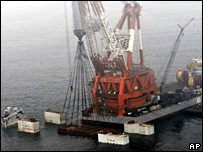
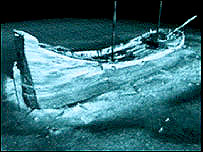
December 21, 2007, BBC News Online, UK: “Chinese archaeologists have raised a merchant ship which sank in the South China Sea 800 years ago while transporting a cargo of precious porcelain.
‘It lay in about 25m (82ft) of water and was covered in mud – perfect conditions for preservation. Both the ship and its contents are in exceptionally good condition.’
As many as 6,000 artefacts have already been retrieved from the 13th Century vessel, mostly bluish white porcelain, as well as personal items from crew members, including gold belt buckles and silver rings.
A further 70,000 artefacts are believed to be still on board, many still in their original packing cases.”
“Chinese team ready to salvage 800-year-old ship
December 20, 2007, XinhuaNet, China: “A Chinese salvage team is getting ready to recover the wreckage of an ancient merchant ship loaded with exquisite porcelain from the South China sea on Saturday.
‘If the weather is cooperative, the boat, which has been in the sea for about 800 years, will see the light of day again two days later’, said Wu Jiancheng, head of the excavation project.
According to Wu, the excavation is scheduled to begin at 10 a.m. and the ship is expected to be hoisted out of water in two hours.
The ship dates back to the early Southern Song Dynasty (1127-1279) and is 30.4 meters long and 9.8 meters wide. It was the first ancient vessel discovered on the ‘Marine Silk Road’ of the South China Sea. It was named ‘Nanhai No. 1’, meaning ‘South China Sea No.1’.
Wu said, Nanhai No. 1 left port in southern China to trade with foreign countries and sank probably due to stormy waves. It was quickly buried by silt. It was estimated there were probably 60,000 to 80,000 relics on board.”
“Ship wreck provides historic data”
December 20, 2007, The Famagusta Gazette, Cyprus: “A shipwreck off the south coast may provide valuable information about the nautical and economic history of the region, according to the Department of Antiquities.
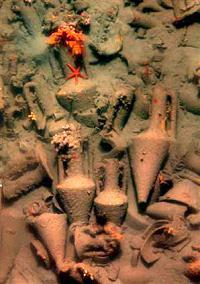
Part of the cargo of the ship lies on the sea bottom and consists of amphorae, most probably from Chios.”
“Study of shipwreck reveals treasure trove of details”
December 20, 2007, Cyprus Mail, Cyprus: “The Department of Antiquities yesterday announced the completion of the first underwater research project of the Mazotos shipwreck.
Its study is expected to be of great significance for the nautical and economic history of the Eastern Mediterranean as it is one of the very few shipwrecks of the Classical period found in such a good state of preservation, the department said.
‘The results will throw light on important research questions such as the commercial relations between the North Aegean and the South Eastern Mediterranean and the role of Cyprus in these transport routes during the last phases of the Cypriot city-kingdoms as well as on types and sizes of ships amongst others’, it said.
The project was undertaken by the Research Unit of Archaeology of the University of Cyprus in agreement with the Department of Antiquities and with funding and logistical support from the Thetis Foundation. It is the first time a project of this kind has been exclusively undertaking by Cypriot institutions.”
“Indiana University Discovers 1699 Captain Kidd Shipwreck”
December 13, 2007, NewsWise, USA: “Resting in less than 10 feet of Caribbean seawater, the wreckage of Quedagh Merchant, the ship abandoned by the scandalous 17th century pirate Captain William Kidd as he raced to New York in an ill-fated attempt to clear his name, has escaped discovery – until now.
Beeker, director of Academic Diving and Underwater Science Programs in IU Bloomington’s School of Health, Physical Education and Recreation, said it is remarkable that the wreck has remained undiscovered all these years given its location, just 70 feet off the coast of Catalina Island in the Dominican Republic, and because it has been sought actively by treasure hunters.
‘I’ve been on literally thousands of shipwrecks in my career’, Beeker said. ‘This is one of the first sites I’ve been on where I haven’t seen any looting. We’ve got a shipwreck in crystal clear, pristine water that’s amazingly untouched. We want to keep it that way, so we made the announcement now to ensure the site’s protection from looters.’
The find is valuable because of the potential to reveal important information about piracy in the Caribbean and about the legendary Capt. Kidd, said John Foster, California’s state underwater archaeologist, who is participating in the research.”
“Professor of nautical archaeology was a world authority”
December 09, 2007, Los Angeles Times, USA: “J. Richard Steffy, a self-taught expert on ancient shipbuilding who helped revolutionize the field of underwater archaeology and earned a reputation as ‘the Sherlock Holmes of ancient ship reconstructors’, has died. He was 83.
Steffy, a professor emeritus of nautical archaeology at Texas A&M University and a board member of the affiliated Institute of Nautical Archaeology, died of chronic obstructive pulmonary disorder Nov. 29 in a nursing home in Bryan, Texas, said his son Loren.
‘He was really considered the world authority on the subject of ancient ship reconstruction’, said George Bass, a professor emeritus at the university and founder of the institute.
Bass said he has been receiving messages from around the world in response to the death of the man who helped make shipwreck analysis a scholarly discipline. ‘He was a pioneer in so many ways’, Bass said. ‘I doubt there ever was a course in the history and theory of wooden-hull construction before the one he taught here.’
Steffy was a pioneer of the art of reconstructing entire ships, such as the wreck of a 2,300-year-old Greek ship found off Kyrenia, Cyprus.
In the early 1970s, Steffy and a team of archaeologists reconstructed the ship from thousands of fragments of wood — an endeavor chronicled in the National Geographic in 1974.
‘Since then, guided largely by him, the Greeks built a full-scale replica and sailed it to Cyprus,’ he said. ‘It went through a gale and handled beautifully. In fact, we learned so much about how Greek ships handled from what he did.’“
“Ram Sethu ‘man-made’, says government publication”
December 08, 2007, Sify News, India: “The controversial Adam’s bridge off the Tamil Nadu coast could be ‘man-made’ and has an ‘echo in the ancient mythological epic, the Ramayana’, says a government publication tabled in parliament last week – a development that could put the Congress-led government in a piquant spot.
A book Images India published by Hyderabad-based National Remote Sensing Agency (NRSA) that comes under the Department of Space, says the satellite images have revealed an ‘ancient bridge between India and Sri Lanka in Palk strait’.
‘The origin of the bridge is a mystery. Archaeological studies have revealed that the bridge dates back to the primitive age, that is about 1,750,000 years.’
‘Its structure suggests that it may be man-made’, it says on page 39 of the coffee table book under the sub-title ‘Stunning Structures’.
It goes on to say: ‘This has an echo in the ancient Indian mythological epic, the Ramayana. According to the epic, such a bridge was built by Lord Rama and his followers to reach Sri Lanka. Studies are still on but the bridge is seen as an example of ancient history linked to the Indian mythology.’“ [Readers wanting to find out more information about the ongoing Ram Sethu controversey, including images, can Click Here, while anyone wanting to see the full coverage of the Ram Sethu controversey on Sify News over the last few months should Click Here to access the headline links. Given that there have been many underwater discoveries in many areas around the coasts of India over the past decade, including the discoveries in 2002 off the coast of nearby Mahabalipuram in Tamil Nadu, and the extensive urban remains discovered in 2001 off the coast of Cambay in the Gujurat peninsula which may well prove to be the actual city of Dwaraka, which was similarly thought at one time to have been the ‘equally mythological’ capitol city of Lord Krishna, it is of the utmost importance for world heritage that this structure not be destroyed to make a canal until exhaustive studies have been completed. After all, the city of Troy was also once thought to have simply been a mythological city until excavations discovered its location exactly where ancient traditions said it would be.] Ed.
“Life of underwater adventure”
December 03, 2007, The Courier, Scotland: “IT IS a tale of American treasure hunters, an unidentified shipwreck with coins worth an estimated $500 million, and a court battle with the Spanish government – and it involves an archaeologist who lives in St Andrews.
Neil Dobson is principal marine archaeologist for Odyssey Marine Explorer, the Florida-based underwater salvage company which is in dispute with Spain over ownership of a shipwreck which has yielded 500,000 silver coins.
The discovery of the wreck, code-named Black Swan, was announced in May. Odyssey insists it was found in international waters.
However the Spanish government has contended that if the colonial era ship belonged to Spain – or was, as it believes, found in territorial waters – it is entitled to the haul.
Due to the legal proceedings Mr Dobson refused to discuss the row over the Black Swan, which is making headlines worldwide, but he told The Courier about his pioneering work in reclaiming pieces of history from the bottom of the sea.
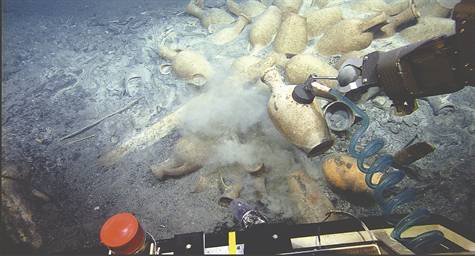
Working from the Odyssey research vessel M/V Odyssey Explorer—which was detained in a Spanish port a couple of months ago—Mr Dobson works with remotely operated vehicles (ROVs) similar to those used in the oil and exploration industry.
‘The ROV is my eyes and hands and enables me to investigate and excavate deep-water shipwrecks’, he said. ‘Fitted with specialised tooling and state-of-the-art HD cameras and lighting I am able to conduct archaeology to acceptable standards of my profession … ‘
‘My challenge was to see if robotic technology can do the job of an archaeologist in the depths of the oceans. Odyssey now has equipment and systems that can recover artefacts and cargo from deep-water shipwrecks in an archaeologically sound manner.’“
“Wessex Archaeology to embark on marine heritage promotion”
November 29, 2007, 24-Hour Museum, UK: “Wessex Archaeology is embarking on a voyage into the waters of marine heritage promotion in the South West.
The new project, supported by £50,000 from the Heritage Lottery Fund, aims to educate both school children and the public about the new ways marine heritage is being explored, and some of the amazing new discoveries that have been made.
It covers four counties – Wiltshire, Dorset, Somerset and Gloucestershire – and will involve ‘time travel’ learning packs for use in the classroom and on the web.
‘In the last few years there has been an upsurge in the amount of work done on marine archaeology,’ explained project leader Euan McNeill. ‘This ranges from surveying the submerged landscapes that Britain’s first pre-historic settlers walked on; to World War Two aircraft crash sites.’
The Wessex Archaeology website is at www.wessexarch.co.uk“
“Ramar Sethu is a man-made sea ridge: Study”
November 25, 2007, IndiaInteracts, India: “A recent scientific research using archeo-astronomy tools has sought to prove that Ramar Sethu is not natural but a man-made sea ridge. It’s a testimony to the civil engineering marvel of an ancient civilisation, that stands even today as a man-made accretion over a natural formation in the sea.
DK Hari, conceptualiser of Bharath Gyan, a NGO which is in to collating specific, scientific knowledge of India has, at a presentation on ‘Historical Rama’ here on Saturday, said the records compiled together talk about Ramar Sethu’s usage until 1480. But it went into disrepair after a debilitating cyclone in 1480, he pointed out.
Hari said Rama indeed was a historical hero and lived nearly 7200 years ago. To rescue Sita from the clutches of Ravana, Lord Rama and his team built the bridge. With the help of Nala as the architect, he designed and executed the project along with the help of ‘Vanara’ tribe. So Rama named the bridge after Nala.
Hari said that the scientific corroborating evidences is the outcome from the analysis of astronomical skycharts using modern scientific tools, geological surveys and research, archaeological research, historical notes of travellers, published Government Gazettes and historical records of the British.
Today, there is a natural sea ridge formation over the seabed linking the land masses of India and Sri Lanka. Hari said ‘the sea level has risen nine feet above the bridge in the last 7000 years. The bridge is covered under the layers of hardened sands.’“
“Baltic yields ‘perfect’ shipwreck”
November 15, 2007, BBC News Online, UK: “A near-intact shipwreck apparently dating from the 17th century has been found in the Baltic Sea, Swedish television has said.
The broadcaster said the Baltic’s low oxygen content and low temperature had helped preserve the wreck. SVT said the origins of the ship were unclear but its features resembled the work of Dutch ship-builders from the period.
‘Experts who have studied video of the ship conclude that it is probably the best-preserved ship ever seen from this period’, the station said.
A press release provided by SVT quoted marine archaeologist MR Manders as saying he was ‘overwhelmed’ by the condition of the wreck.”
“Contents of 2400-yr-old shipwreck revealed”
November 14, 2007, Zee News, India: “Scientists have revealed the contents of an ancient shipwreck dating back to the era of the Roman Republic and Athenian empire using genetic analysis.
The 2400-year-old shipwreck lies 230 feet (70 meters) deep, roughly a half-mile (one kilometre) off the coast of the Greek island of Chios in the Aegean Sea.
Revealed in early 2006, the cargo of the shipwreck was mainly olive oil flavoured with oregano. Besides this, the other contents included jars. The contents were further analysed to reveal other details as well.
By deploying a robot to the wreck to collect two amphoras (two-handled earthenware jars often used by ancient Greeks and Romans), the research team was able to obtain DNA samples by scraping the insides of the ceramics.”
“Fishing nets reveal history”
November 06, 2007, Turkish Daily News, Turkey: “Through their nets, fishermen often reveal thousands of years of history in one catch: In deep waters a dragnet sweeps across the seabed and fills the net with sponges and somestimes different types of amphorae.
Amphora is a type of ceramic vase dating back as the 15th century. But the amphorae tear the nets and so the fishermen quickly throw them back into the sea.
Having collected over 700 antique amphorae in 30 years, Mustafa Aydemir owns the most extensive amphora collection in Turkey: ‘Because amphorae fall in the dragnet and tear it, fishermen get angry and throw them back into the sea, breaking them into pieces. This hurts me and so I decided to protect the amphorae’, he told the Turkish Daily News while he also referred to the many problems collectors face. ‘If you are interested in history and decide to have a collection, you are of course watched by the police. In Turkey, collectors are assumed to be smugglers’, Aydemir said.
Assault boat raids both in national and international waters pose a threat to amphora collectors. If fishermen keep amphorae they are accused of smuggling. Aydemir began his journey as a painter skin-diver under the leadership of George Base from the Institute of National Archeology at University of Pennsylvania in the United States.
Aydemir first received a collector certificate in 1980 from Istanbul Archeology Museum. Then he placed all his amphorae into a building he hired. Each of these historic artifacts, which are two-handled storage jars found throughout the ancient Mediterranean for carrying and keeping many commodities but primarily wine and oil, was assigned a number by the museum officials. Though the officials counted amphora during monthly controls, unexpected raids were the case.”
“Shipwrecks lure divers to Lycian coast”
November 02, 2007, Turkish Daily News, Turkey: “Gripping the broken hull of the ‘Duchess of York’, a 19th-century steamer, I struggle with a dilemma: Do I swim further down into one of the best wrecks along the Turkish coast or do I heed my dive computer’s warning that I am running out of time?
In 1982, at Uluburun near Kas,, a bronze-age ship was discovered together with a cargo of copper ingots. Egyptian ebony logs, the earliest known intact ingots of glass, Cypriot ceramics, Canaanite jewelry and bronze tools were all excavated, according to the Institute of Nautical Archaeology.
The original 14th-century B.C. shipwreck is now housed in the Underwater Archaeology Museum down the coast in Bodrum. Still, two replicas were made, one of which was sunk last year in Kas, as part of a new Underwater Archaeology Park, a tourist attraction and training ground.
Some underwater sites are so sensitive, they are off limits to divers. To see the partially submerged city of Kekova, I took a sea kayak. You need calm water and good eyesight to see the sunken walls that date back 2,000 years, before earthquakes destroyed the city.
Many structures though are still above the surface – steps of ancient houses eerily descending into the water, tops of buildings with square grooves to support long-vanished beams.”
“Ancient ship in seabed for 800 years to be lifted in China”
November 02, 2007, The Hindu, India: “An ancient ship in China, lying on the sea bed for more than 800 years, is just weeks away to be lifted out of the water after months of salvage operation that took three years for planning.
Sunken cargo vessel the Nanhai No.1 with an estimated 80,000 cultural relics, including porcelain, gold artifacts, copper coins, jewelry and copper mirrors from the Southern Song Dynasty (1127 to 1279 AD), is under the sea, 30 nautical miles west of Hailing island near Yangjiang city.
Already, 6,000 items have been salvaged, the official media reported.”
“Koryo Pottery Was Headed for Kaesong”
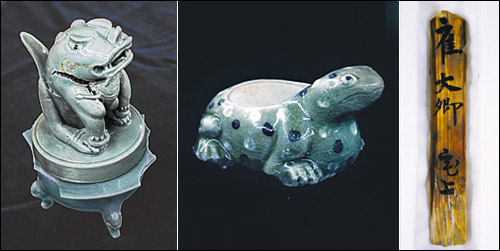
October 21, 2007, Chosun Ilbo, South Korea: “Underwater excavation in the waters near Dae Island off Taean, South Chungcheong Province has unearthed some 19,000 pieces of 12th-century Koryo celadon, including a lion-shaped incense burner, a toad-shaped inkstone a melon-shaped kettle, and countless bowls.
The find was originally made in May, when a fisherman found a pottery shard stuck to the suckers of a webfoot octopus, and an excavation got underway soon afterwards.
Chosun Ilbo, South Korea
The National Maritime Museum on Thursday said wooden tags unearthed in the excavation show that the celadon was on its way to Kaesong after being made at a local government pottery in Gangjin, South Jeolla Province.
The Cultural Heritage Administration unveiled 12th-century Koryo celadon excavated in waters off Taean, South Chungcheong Province at the National Palace Museum of Korea in Seoul on Thursday. The haul became famous because it was ‘found’ by a webfoot octopus. A lion-shaped Koryo celadon incense burner.”
“Museum may be built for sunken cargo ship”
October 16, 2007, People’s Daily, China: “A marine museum is planned for the coastal area of Nan’ao County in Shantou, South China’s Guangdong Province, to display relics yet to be salvaged from the sunken Nanhai II, a source with the local culture bureau said.
The ancient Nanhai II, which was discovered in May in the waters off Nan’ao, is believed to be the second largest ancient cargo ship after the Nanhai I, another ship of the Southern Song Dynasty (1127-1279) discovered in the sea off Yangjiang.
‘We have submitted a proposal to the provincial cultural authority for approval to construct a museum because the Nanhai II is important evidence of the existence of the ancient Maritime Silk Road’, Zhang Wu’ai, deputy director of the Shantou culture bureau, told China Daily yesterday.”
“Probing ancient shipwrecks with DNA”
October 15, 2007, World Science, USA: “Studying an ancient Greek shipwreck, scientists say, they’ve found they can decode ancient DNA to learn about the original contents of jars sunken for over 2,000 years.
It’s a feat ‘no one thought was even possible, wrote Maria Hansson of Lund University in Sweden, one of the researchers, in an email. The discovery ‘opens up a whole new field of molecular archaeology, she added, as scientists could could use the technique to gain insights into ancient agriculture and trading networks.
But researchers trying to learn the jars’ original contents usually come up dry, according to Hansson and colleague Brendan Foley of the Woods Hole Oceanographic Institution in Massachusetts. That’s because the amphorae only infrequently contain visible clues, such as olive pits.”
“Cannon raised from wreck presumed to be
October 15, 2007, Bradenton Herald, USA: “Archaeologists on Monday raised a cannon from a sunken ship that could have belonged to the pirate Blackbeard.
The roughly 8-foot (2-meter)-long cannon was pulled from an ongoing excavation at the presumed site of the ship, the Queen Anne’s Revenge.”
“Researchers find 1559 shipwreck, part of Spanish colonization”
October 11, 2007, Bradenton Herald, USA: “In 1559, a hurricane sent up to seven Spanish sailing vessels to the bottom of Pensacola Bay, hampering Don Tristan de Luna’s attempt to colonize this section of the Florida Panhandle.
Now, almost 500 years later, a second of those ships has been found, helping archaeologists learn about the settlement, which ended in 1561. No trace of it has ever been found on land.
Some 650 pieces of artifacts, mostly pieces of pottery and wood were on display Thursday for about 100 people who gathered at the north end of Pensacola Bay Bridge, about a half-mile from the shipwreck.
‘It’s an amazing site’, said University of West Florida nautical archaeologist Gregory D. Cook.
Teams of West Florida archaeology students last summer discovered what they thought was the shipwreck, picking up pieces of artifacts from the site. A 32-by-24-foot barge covers the shipwreck site to give divers access.
‘Our test excavations suggest that there is approximately 18-20 meters of preserved hull remaining on site, representing a small to medium-sized vessel in the fleet’, he said.”
“Archaeologists to survey the Nile in search of
October 06, 2007, Daily India, USA: “An Egyptian archaeological team will track down the locations of the Nile river’s ancient sunken treasures.
Alaa Mahrous, director of the underwater antiquities department in Alexandria, said that the archaeological team headed by Dr Zahi Hawass, director of the Supreme Council of Antiquities, has selected the Nile to be the subject of their search, as the river has not been excavated till date.
‘The survey will cover the area between the quarries in Aswan and Abydos. Over the centuries this was a significant area – either for the ancient Egyptians or the many rulers of the country who followed. The granite quarries were located in Aswan. The statues and obelisks used to be cut and shaped in the mountains before they were shipped to Luxor and Abydos’, said Mahrous.
Mahrous said the team was hoping to find any such pieces that might have sunk while being loaded on unloaded from ships.
‘It is also possible to discover shipwrecks as many huge boats sank along with their load which consisted of statues, pottery and merchandise. We also have information regarding two small obelisks that settled in the river bed 10 km off Luxor as they were being shipped to Cairo by Maspero’, said Mahrous.”
“Underwater archaeologists find mediaeval artefacts
October 05, 2007, Earth Times, USA: “Archaeologists have made significant mediaeval finds in the northern German lake, the Arendsee, that reveal fishing activities linked to a nearby monastery.
Speaking before the 14th annual meeting this weekend of European underwater archaeologists at the lake, Rosemarie Leineweber of the monuments and archaeology office of the state of Saxony-Anhalt noted in particular the discovery of a dugout.
‘We estimate that the dugout dates back to the end of the 14th century and that fishermen used it to provide fish for a Benedictine convent’, Leineweber said.
Archaeologists, with the aid of the local underwater diving club, have been researching the lake – at 30 metres one of the deepest in this part of Germany – since 2004.
They have found several vessels, as well as a fence-like construction for catching fish dated to the Stone Age. The dugout has been removed from the lake and treated to conserve it.”
“Underwater survey nets traces of 2,400-year-old
September 23, 2007, The Canadian Press, Canada: “Encrusted with tiny shells and smelling strongly of the sea, a 2,400-year-old Greek jar lies in a saltwater bath in Durres Museum, on Albania’s Adriatic coast.
Part of a sunken shipment of up to 60 ceramic vessels, the 66-centimetre storage jar, or amphora, was the top find from what organizers say is the first archeological survey of the small Balkan country’s seabed, conducted by U.S. and Albanian experts.
The light-brown clay amphora, probably used to store wine or oil, was found on the last day of the survey off the ancient town of Butrinti near Saranda, some 300 kilometres from Tirana and opposite the Greek island of Corfu. It dates to the 4th century BC.
The find will stay immersed in water at the museum in Durres, 30 kilometres west of Tirana. Museum workers will gradually reduce the water’s salinity over the next year, to remove salt from the amphora ahead of its conservation.”
“Egyptian Sunken Treasures”
September 20, 2007, ArtLine, Romania: “The Egyptian civilisation has long been admired and imitated, since the Ancient times, but it seems that there is much more to be known, as the show hosted at the Kunst- und Ausstellungshalle der Bundesrepublik Deutschland proves.
This time, curators have focused on several pieces, most of them real treasures, found underwater by the French archaeologist Franck Goddio. Over the years, Goddio explored the seabed near the coast of modern day Alexandria and the Bay of Abukir.
In ten years the passionate researcher managed to recover an impressive number of artefacts, from 700 – 800 AD, important testimonies of Egyptian culture. Some of these pieces have been carefully prepared and exhibited in the show at the museum in Bonn.
Most of this artworks and objects have sank into the sea due to several natural disasters, and range from monumental statues to coins, jewellery, cult items. Despite being in the water for centuries, some of these have miraculously survived very well.”
“Japan’s Ancient Underwater ‘Pyramid’ Mystifies Scholars”
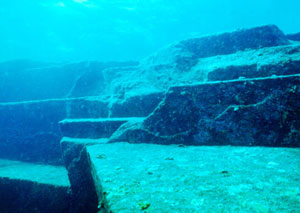
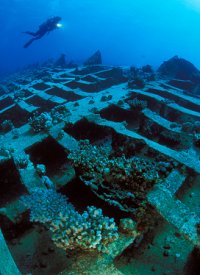
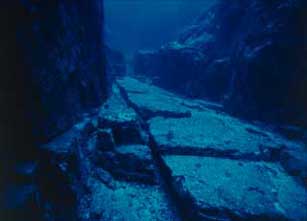
September 19, 2007, National Geographic News, USA: “Submerged stone structures lying just below the waters off Yonaguni Jima are actually the ruins of a Japanese Atlantis—an ancient city sunk by an earthquake about 2,000 years ago.
That’s the belief of Masaaki Kimura, a marine geologist at the University of the Ryukyus in Japan who has been diving at the site to measure and map its formations for more than 15 years.
But like other stories of sunken cities, Kimura’s claims have attracted controversy.
‘I’m not convinced that any of the major features or structures are manmade steps or terraces, but that they’re all natural’, said Robert Schoch, a professor of science and mathematics at Boston University who has dived at the site.
‘It’s basic geology and classic stratigraphy for sandstones, which tend to break along planes and give you these very straight edges, particularly in an area with lots of faults and tectonic activity.’.
And neither the Japanese government’s Agency for Cultural Affairs nor the government of Okinawa Prefecture recognize the remains off Yonaguni as an important cultural property, said agency spokesperson Emiko Ishida.
A local diver first noticed the Yonaguni formations in 1986, after which a promontory on the island was unofficially renamed Iseki Hanto, or Ruins Point.
Some experts believe that the structures could be all that’s left of Mu, a fabled Pacific civilization rumored to have vanished beneath the waves.
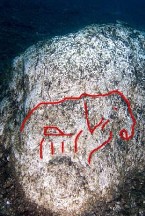
On hearing about the find, Kimura said, his initial impression was that the formations could be natural. But he changed his mind after his first dive. For example, Kimura said, he has identified quarry marks in the stone, rudimentary characters etched onto carved faces, and rocks sculpted into the likenesses of animals.
‘The characters and animal monuments in the water, which I have been able to partially recover in my laboratory, suggest the culture comes from the Asian continent.’
‘One example I have described as an underwater sphinx resembles a Chinese or ancient Okinawan king.’
Whoever created the city, most of it apparently sank in one of the huge seismic events that this part of the Pacific Rim is famous for, Kimura said.
But Kimura is undeterred by critics, adding that the new governor of Okinawa Prefecture and officials from the United Nations Educational, Scientific, and Cultural Organization have recently expressed interest in verifying the site.” [In late June 2002 The Morien Institute contacted Professor Masaaki Kimura at the University of the Ryukyus, in Okinawa, Japan. Over the next few months The Morien Institute founder, John Michael, interviewed Professor Kimura via email, and the following pages contain the questions and answers that passed between us until mid-October 2002. The interview was illustrated with many of Professor Kimura’s photographs and diagrams that he had taken up until that time of the discoveries he made during countless dives over the previous 10 years, and which he generously made available to us in order to ensure this World Heritage site is not lost forever under the waves.] Ed.
“Scholars divided on Setu issue”
September 18, 2007, The Times of India, India: “As it becomes more evident that Archaeological Survey of India (ASI) bungled on the controversial reference to Ram’s historicity in the Sethusamudram affidavit, scholars have begun posturing on the matter and the divide is getting deeper.
Though ASI officials on Monday remained tightlipped, there was a realisation that culture minister Ambika Soni wasn’t as much to blame as ‘someone within’ for the mess-up. ‘The minister had marked the controversial sentence in affidavit for deletion but it was not done for reasons best known to the higher-ups. I am relieved that unlike other times, the axe has not fallen on faceless junior employees. The inquiry should only make things clearer’, an ASI section officer, who had seen the original file, said.
But leading scholars, while agreeing that ASI had no absolute right to comment on history or mythology, offered opposing views on the subject, refusing to arrive at a consensus.
Eminent historian Ram Sharan Sharma, also the founding chairman of Indian Council of Historical Research (ICHR), told TOI, ‘Yeh shodh aur shradha ke beech sangharsh hai; chalta rahe (This is a struggle between research and faith; let it go on)’.
‘Both can co-exist. To begin with, the Ramayana had 6,000 couplets and the number went up to 24,000. Where is the problem then?’“
“Ramayana is not a myth: S.R. Rao”
September 17, 2007, The Hindu, India: “President of the Society for Marine Archaeology in India S.R. Rao said that Ramayana cannot be dismissed as a myth, just as it was done earlier in the case of Mahabharata.
In a press release, the former scientist emeritus said that the discovery of the submerged Kusasthali Dwaraka is a historical truth now and the experts had dubbed Mahabharata as a myth.
In the case of Ramayana, he said strong tradition depicts Hampi in Karnataka as Kishkindha, which was visited by Rama. The culture of Kishkindha at that time was of Neolithic levels, it said.
Prof. Rao, who undertook deep-sea excavations near Dwaraka, discovered the submerged parts of the town where Krishna lived when he was director of National Institute of Oceanography.
He said that the culture (seen in Kishkindha) has several Neolithic sites spread over Patapadu and Pusalpadu in Bellary district. Another important site is Bandi Pushala Chenu in Bellary-Kurnool area where excavations of the Harappan steatite wheel-like beads are found.”
“‘Space photos no proof of Ram Setu'”
September 14, 2007, The Economic Times, India: “US space agency NASA says pictures taken by its astronauts do not prove the existence or otherwise of a manmade Ram Setu bridge as mentioned in the Ramayana.
‘I am not aware of any carbon dating either’, said NASA spokesman Michael Braukus, refuting claims by the Bharatiya Janata Party (BJP) that the agency had the Adam’s bridge in Palk Strait – known as Ram Setu in India – carbon dated as being 1.7 million years old.
‘Some people have taken pictures taken by our astronauts to make their claim. No position can be taken on the basis of these photographs in any way’, Braukus said when asked to comment on the controversy surrounding the site of the proposed Rs 2,400 crore Sethusamudram canal project off India’s southern tip.
‘The age, substratum, geological structure or anthropological status of the ocean bed in Palk strait cannot be determined by the astronauts’ photographs. So there is no basis for these claims’, Braukus said.
Back in October 2002 too the US agency had rebutted a story circulated by an Indian news agency based on claims made by a couple of NRI websites and Hindu news services that ‘space images taken by NASA’ had revealed ‘a mysterious ancient bridge in the Palk Strait’.”
“Underwater survey nets traces of 2,400-year-old
September 12, 2007, IHT, France: “Encrusted with tiny shells and smelling strongly of the sea, a 2,400-year-old Greek jar lies in a saltwater bath in Durres Museum, on Albania’s Adriatic coast.
Part of a sunken shipment of up to 60 ceramic vessels, the 67-centimeter (26-inch) storage jar, or amphora, was the top find from what organizers say is the first archaeological survey of this small Balkan nation’s seabed, conducted by U.S. and Albanian experts.
‘Touch it, touch it. It’s luck’, said mission leader George Robb of the Key West, Florida-based RPM Nautical Foundation. You’re touching something that was made before Plato was born.’
Launched in July, the month-long survey was the first step in compiling an underwater cultural heritage map that could eventually plot the position of sunken fleets from ancient and mediaeval times believed to lie along Albania’s 360-kilometer (220-mile) coastline.
Auron Tare, the project’s local coordinator, said Albanian authorities were hoping to sign a deal with RPM, a non-profit foundation, late this year for a five-year survey.
That would give a boost to a still nonexistent field of archaeological research in the country’, Tare said. It would be a great promotion for local tourism, especially diving tourism, and could possibly lead to the creation of an underwater archaeology museum.’“
“Lost City of ‘Mu’ found”
September 10, 2007, Zee News, India: “A Japanese explorer claims to have uncovered the location of the ruins of the lost city of Mu.
The search for the mysterious city which is said to have sunk somewhere in the Pacific Ocean has captivated the popular imagination of adventurers for years. Many scientists dismiss the existence of Mu (sometimes called Lemuria) as sheer fantasy on the lines of the lost continent of Atlantis.
But marine geologist Masaaki Kimura believes he has found its ruins in the waters off southern Japan.
Undaunted amid persistent scepticism, he has worked for decades on proving that a group of extraordinary rock formations off Japan’s southern-most island of Yonaguni is actually the foundations and evidence of an ancient culture that disappeared into the Pacific over 4,000 years ago.”
“Hunt is on for ancient naval battle site”
September 10, 2007, ABC News in Science, Australia: “Archaeologists will scour the waters off Cyprus next year in a bid to find shipwrecks from one of the ancient world’s greatest naval battles.
Historical accounts suggest the Cape Greco region, a rocky outcrop between the now-popular tourist resorts of Agia Napa and Protaras, saw one of the biggest naval battles of the ancient world.
In 306 BC, according to the ancient Greek historian Diodorus, Macedonian King Demetrios the Poliorketes (Besieger) triumphed over Ptolemy I of Egypt in a battle off Cyprus, with dozens of vessels sunk as the result of combat.
More than 300 ships were believed to have been engaged in the battle.”
“Hunt for underwater treasure”
September 09, 2007, The Sydney Morning Herald, Australia: “Archaeologists have discovered underwater caves on the Sydney coastline that are expected to provide new insights into human life on our shores more than 6000 years ago.
Research will be presented at a conference this month that pinpoints the submerged caves, which experts believe were once rock shelters on dry land.
A team of archaeologists believes further exploration of the ‘drowned’ sites around Port Hacking, within the Royal National Park, will reveal preserved tools and other artefacts used by the area’s pre-European inhabitants.
Maritime archaeologist Cosmos Coroneos, along with David Nutley of the NSW Heritage Office and archaeologist Jim Wheeler, are working on the theory that 6000 years ago the coastline would have been 30 kilometres offshore.
Australia’s earliest human occupation is believed to date back 40,000 to 60,000 years. Sea levels began to rise between 18,000 and 6000 years ago – the first instance of global warming.
‘As sea levels rose, people moved inland and evidence of their occupation disappeared underwater’, Mr Coroneos said.”
“Silent secrets of the sea”
September 09, 2007, The Times of India, India: “The sea, it is said, hides its secrets well. Over centuries, it has concealed sunken cities as well as wrecks of many ships in its depths. No wonder then, that archaeologists believe that there are more historical secrets lying underwater than on surface. Especially, in a country like ours.
‘India has a 7,500 km long coastline and a maritime heritage that is over 5,000 years old. Most of the country’s waters are unexplored and have the potential of containing rich archaeological treasures that can help solve many mysteries of the past’, says Alok Tripathi of the Underwater Archaeology Wing of the Archaeological Survey of India (ASI).
Till now, however, marine or underwater archaeology hasn’t really taken off in India. ‘Marine archaeological excavations in India started only in the early 1980s, though the world over, they started in the 1960s’, says K H Vora, scientist in the marine archaeology division of the National Institute of Oceanography (NIO), Goa.
Agrees Tripathi, ‘The beginning of this stream of archaeology in India can be traced to excavations at Kaveripatnam in Tamil Nadu in 1981, where the submerged remains of a city of the Sangam era were found. This was followed by the offshore survey of an ancient submerged port that was undertaken in the Bay of Bengal in the same year.’
Since then, underwater archaeological excavations have mostly been done on the eastern and western coasts of India, as well as around the islands near the coasts. The most talked about excavation has been the one at Dwarka, off the Gujarat coast.
‘While underwater excavations have been continuing here since 1983 and regular claims have been made of it being the site of Krishna’s capital city, mentioned in the Mahabharata, fresh excavations this year in the intertidal zone and underwater locations here have revealed new evidence which will help determine the actual antiquity of the site’, says Tripathi.
Apart from Dwarka, the island of Bet Dwarka in the Gulf of Kutch has also yielded significant clues to underwater archaeologists. Findings here have included inscriptions and pottery dating to the late Harappan period. There is also an indication of a shipwreck of the Roman period in Bet Dwarka waters, says Vora. This could suggest that there was maritime trade contact between India and the Roman world in ancient times, he says.
Another significant discovery has been at Mahabalipuram. For years, this ancient port town, off the Tamil Nadu coast was known to sailors as the town of seven temples. Present day Mahabalipuram, however, has only one shore temple. The popular belief is that there were six more temples here, which later got submerged.
Excavations by NIO in 2002 revealed some amount of truth in these tales. According to Vora, underwater investigations showed the presence of the remains of walls as well as large stone blocks, which seemed to correspond to the time period of the surviving shore temple.
Excavations carried out by ASI in 2005 also revealed the remains of two structural temples, found near the shore temple. ‘These findings provide prima facie evidence about what was earlier regarded as merely folklore’, says Vora.”
“Ancient naval battle wrecks found?”
September 07, 2007, iAfrica, South Africa: “A shipwreck from the imperial Roman era, found off Cyprus, could lead to the discovery of vessels sunk in antiquity’s largest naval engagement, the Battle of Salamis in 306 BC, said an official statement on Thursday.
‘According to (historian) Diodoros, it was somewhere in the area where in 306 BC the Macedonian (King) Demetrius Poliorketes triumphed over Ptolemy of Egypt in one of the largest naval battles of antiquity’, said Cyprus’ Antiquities Department.
More than 300 ships were believed to have been engaged in the battle that saw Demetrius capture Cyprus.”
“Divers find Roman wreck off Cape Greco”
September 07, 2007, Cyprus Mail, Cyprus: “ARCHAEOLOGISTS have found a Roman wreck dating from the first century A.D. off Cape Greco towards the Protaras area, it emerged yesterday.
During late July and early August, a small international team of archaeologists and students undertook a brief season of underwater diving survey along the island’s east coast.
The project followed four seasons in and around Episkopi Bay on the south coast, and was financially and logistically supported by the Institute of Nautical Archaeology, Texas A&M University, the University of Pennsylvania, and RPM Nautical Foundation, with the additional support of a research vessel and equipment from the Thetis Foundation of Limassol.
Three weeks were spent at sheltered inlets and dangerous promontories in the area of Cape Greco and north towards Protaras area, in collaboration with the Department of Antiquities in an effort to determine the area’s long-term maritime history in advance of eventually locating well-preserved shipwrecks, an announcement said.
‘A total of six stone and metal anchors recorded through the area, testify to a long history from antiquity through at least the mediaeval period of merchants stopping at the numerous natural and manmade ports that dot these shores’, it added.
It said that among the more important findings was an extensive wreck site dating to the early imperial Roman era, around the 1st century AD, which carried a mixed cargo of several amphora types, predominantly jars from the southeast Aegean area.”
“Cyprus to seek ancient shipwrecks”
September 06, 2007, Reuters, UK: “Cyprus is to launch sea surveys in an area where dozens of vessels led by warring successors to Alexander the Great are believed to have sunk in battle for control over the island in 306 BC.
Encouraged by the discovery of one wreck from a later Roman era, the survey slated for the summer of 2008 will extend into deep waters from the south-east tip of the island, known as Cape Greco, the island’s Antiquities Department said.
‘Cyprus is a crossroads and is very rich in ancient shipwrecks’, said Pavlos Flourentzos, director of Cyprus’s Department of Antiquities.
Historical accounts suggest that the Cape Greco region — a rocky outcrop between the now popular tourist resorts of Agia Napa and Protaras, saw one of the biggest naval battles of the ancient world.
According to the ancient Greek historian, Diodorus of Sicily, in 306 BC Demetrios the Poliorketes (Besieger) triumphed over Ptolemy I of Egypt in a naval engagement off Cyprus, with dozens of vessels sunk as the result of combat.
‘It is well known that there was a naval engagement in the region in 306 BC, so there is a potential of finding wrecks, or parts of wrecks, in deeper waters’, Flourentzos told Reuters on Thursday.”
“Mapping Turkey’s sunken heritage”
September 05, 2007, Turkish Daily News, Turkey: “An ambitious five year project mapping Turkey’s underwater history has been launched by the Dokuz Eylül University’s (DEÜ) Marine Sciences and Technologies Institute (DBTE), the first such activity to be carried out by a Turkish university.
‘The lost underwater history of the Aegean and Mediterranean? project, which began in May has already located over 20 shipwrecks, eight underwater ruins, and six sunken locations dating back to the Ottoman era. Our goal is to find the sunken heritage of our country’, said Harun Özdas, project manager and Underwater Archaeology assistant professor at DEÜ.
Some 12 scientists have been assigned to the project including archaeologists, biologists and geophysicists.
‘So far we dived to 15 sunken areas between Anamur and I.zmir. We came across many sunken places in the gulf of Gökova’, Özdas said.
The Piri Reis Research Ship and the Bodrum School Ship are being used for the studies, and diving permission granted by the Culture Ministry allows access to restricted zones.
Upon completion of the project, the data will be published in geography books mapping the sunken history of Turkey.”
“When mastodons ruled northern Michigan”
September 04, 2007, WZZM13 News, USA: Underwater archeologists have found what they suspect is a rock that contains an ancient carving of a Mastodon being hunted by humans. It could be the first proof that humans hunted the large beasts in Northern Michigan up to 10,000 years ago.
Holley notes the image on the boulder is quite clear, but it has not yet been proven that human hands produced it. He says efforts are underway to authenticate the image.”
“Cultural heritage: Whose deep sea treasure is it really?”
September 04, 2007, IHT, France: “The United Nations 2001 convention on protecting underwater cultural heritage was right to oppose the plundering of sunken archaeological treasures for profit. Unfortunately, only 15 countries have ratified the agreement, and the plundering has begun.
In what may become the biggest underwater find ever, Odyssey Marine Explorations, a commercial operation from Tampa, Florida, has reportedly hauled 17 tons of gold and silver from a ship widely believed to be the Spanish galleon Nuestra Señora de las Mercedes that was sunk by a British warship off the coast of Portugal in October 1804.
The company claims ownership of its find. And, of course, Spain is hiring lawyers and preparing its legal claim to the trove, claiming a sovereign nation’s right over its cultural heritage.
It’s clearly going to be a protracted legal battle, but we think it would only be right to let another set of plaintiffs stake their claim to the treasure, too: Spain’s former colonies in Latin America, where the loot was looted in the first place.
The hoard of gold and silver coins that sunk with the Mercedes was probably minted in Peru – from where the galleon set sail for Cadiz, via Montevideo, in March of 1804.
Though a potential Peruvian claim to the treasure would rest on tenuous legal grounds – Peru wasn’t even an independent country in 1804, but part of the Spanish empire – it certainly could make a sound case based on moral considerations:
The Inca didn’t freely give gold and silver to the Spanish invaders. Spain took it by force.”
“Janmashtami, Lord Krishna and Dwaraka”
September 04, 2007, News Today, India: “One of the verses in the Bhagavada says: ‘The yellow glitter of the golden fort of the Dwaraka City in the sea throwing yellow light all round looked as if the flames of Vadavagni came out tearing asunder the sea’.
Then came the deluge and Dwaraka ‘A City of Gold’ vanished under water. Around 1500 BC, the whole Western course of India disappeared along with Lord Krishna’s Capital City of Dwaraka. This is how it was described by Vedavyasa in the Mahabharata:
‘The sea, which had been beating against the shore, suddenly broke the boundary that was imposed on it by nature. The sea rushed into the City of Dwaraka. It coursed through the streets of the beautiful city. The sea covered up everything in the city. I saw the beautiful buildings becoming submerged one by one. In a matter of a few moments it was all over. The sea had now become as placid as a lake. There was no trace of the city. Dwaraka became just a name; just a memory’.
The ruins of ancient Dwaraka city have been found under the sea following recent oceanographic studies conducted near the modern temple-city of Dwaraka. The first Archaeological excavations at Dwaraka were done by the Deccan College, Pune and the Department of Archaeology, Government of Gujarat in 1963 under the direction of an outstanding Archeologist of Ancient India H.D. Sankalia.
It revealed the existence of many artefacts, hundreds of centuries old. The Archaeological Survey of India (ASI), conducted a second round of excavations under the direction of Dr S R Rao, a world renowned Underwater Archeologist. Dr S R Rao is to the discovery of the ancient town of Dwaraka, what Isaac Newton is to the Law of Gravitation or Albert Einstein to the Theory of Relativity.
Between 1983 and 1990, the well-fortified township of Dwaraka was discovered, extending more than half mile from the shore. The township was built in six sectors along the banks of a river. The foundation of boulders on which the City’s walls were erected proves that the land was reclaimed from the sea.
What is amazing is that the general layout of the City of Dwaraka described in the ancient texts agrees with that of the submerged city discovered by the Marine Archaeological Unit. (MAU) of The Archaeological Survey of India (ASI), which carried out its work under the guidance and supervision of Dr S R Rao.
The discovery of Dwaraka by Dr S R Rao confirms that the descriptions found in the text of the Mahabharata and other important Sanskrit texts regarding Dwaraka are true. It also means that the Mahabharata is NOT A MYTH but an important source of information for studying the ancient history of India. “
“Drought offers peek at lost village”
Septembet 03, 2007, The Charlotte Observer: “Joe Liles caught a glimpse of history in 2005, only to see it vanish under a week’s worth of rain. Now a new round of drought has given the Durham educator, students and archaeologists another chance to explore a lost world on the bottom of Falls Lake.
‘I never expected it would happen so soon’, Liles said.
Liles is an outdoorsman and teacher at the N.C. School of Science and Mathematics who tries to find projects that will draw his classes outside and into nature.
One of those opportunities arose in 2003, when the Eno River Association asked him to help plot the course of Fish Dam Road, a colonial byway that stretched out from Hillsborough. Liles and his students traced its nearly obscure remnants through forests and even urban areas of Orange, Durham and Wake counties.
‘The students felt they were explorers’, he said. ‘They felt they were discovering something everyone else had forgotten.’
The students tracked the road west of the Eno River, where it apparently ended in the Falls Lake basin. There, as drought spread across the region in 2005 and the lake level dropped, Liles saw another opportunity.
It appeared as foundations of old buildings that Liles believes to be the village of Fish Dam, a settlement named for a nearby stone weir that American Indians used to catch fish in the Neuse River, which was dammed to create the lake.”
“Japan researcher says has found an Asian Atlantis”
August 27, 2007, Reuters, UK: “A researcher investigating underwater rock formations off the coast of Japan believes they are the remnants of an Asian equivalent of Atlantis – an ancient civilization swallowed up by the ocean.
Marine geologist Masaaki Kimura says he has identified the ruins of a city off the coast of Yonaguni Island on the southwestern tip of Japan.
He has worked for decades to prove the rocks found by scuba diving tourists in 1985 are from an ancient city, which he says may have sparked the fable of Mu – a Pacific equivalent of the tale of the lost city of Atlantis.
‘”Judging by the design and the disposition of the ruins, the city must have looked just like an ancient Roman city’, said Kimura, a professor at Ryukyu University and the chairman of the non-profit Marine Science and Culture Heritage Research Association.” [In late June 2002 The Morien Institute contacted Professor Masaaki Kimura at the University of the Ryukyus, in Okinawa, Japan. Over the next several months The Morien Institute founder, John Michael, interviewed Professor Kimura via email, and the following pages contain the questions and answers that passed between us until mid-October 2002. The interview was illustrated with many of Professor Kimura’s photographs and diagrams that he had taken up until that time of the discoveries he made during countless dives over the previous 10 years, and which he generously made available to us in order to ensure this World Heritage site is not lost forever under the waves. Now that the internet technologies have greatly improved, Reuters have made available this underwater footage and interview with Prof. Kimura about his latest discoveries at Yonaguni over the last 5 years since The Morien Institute founder, John Michael, exclusively brought pictorial details of Prof. Kimura’s work to the global online community. In the intervening period, there have been many unscrupulous website editors, and dishonest bloggers, who have either ‘hotlinked’ directly to images on The Morien Institute website (AND HAVE THEREBY SIMPLY STOLEN OUR BANDWIDTH ALLOWANCE) or else simply stolen some or ALL of our images and subsequently left their visitors with the deceptive impression that those individuals, organistaions and ‘for-profit’ companies have done some sort of research themselves. The Morien Institute is an organisation that was set up by disabled people to make astro-archaeology and marine archaeology available to everyone irrespective of physical or mental ability. So our pioneering work has made us an easy target for predatory parasites who like to portray themselves as some sort of cutting-edge researchers in the field of ancient mysteries. Those of you who are familiar with those other sites might like to take a look at the efforts of this group of disabled prehistorians who have exclusively brought you quality information about the Yonaguni structures since 1999.] Ed.
“Navy, ASI join hands for marine archaeological expeditions”
August 26, 2007, LiveMint, India: “Prospect of reconstructing history of ancient civilizations and carrying out expeditions at deep sea and ancient port sites has brought together ASI and the Indian Navy.
Aiming to research and preserve maritime cultural heritage, the Archaeological Survey of India and navy have joined hands for expeditions at deep sea and ancient port sites to reconstruct the history of ancient civilizations.
The marine archaeological expeditions have been carried out in waters off Dwarka (Gujarat), Goa, Lakshadeep Islands, Poompuhar and Mahabalipuram and onshore and near-shore explorations have been carried out at ancient port sites such as Chilka, Kalingapatnam, Machilipatnam and Rameswaram coast.
‘Though marine archaeology in India is still in its infancy as compared to the West, I believe that our limited knowledge and lack of facilities should not make us turn a blind eye to the wealth of scientific, cultural, historic and traditional data that has hitherto remained unexplored’, Indian Navy chief Admiral Sureesh Mehta said.”
“Ballard Finding History’s Bounty In Black Sea”
August 25, 2007, The Day, USA: “Robert Ballard said he has discovered a potential bonanza in the Black Sea, thanks in part to a natural phenomenon that has preserved ancient cargo sunken at a global underwater hub.
‘This is a crossroads of civilization’, Ballard said Friday.
The Day, USA
Ballard, president of the Institute for Exploration at Mystic Aquarium, believes winter storms bring hydrogen sulfide into the Black Sea, which kills the sort of organisms that would ordinarily destroy ship wreckage in relatively shallow, oxygenated waters.
He said he plans to place scientific instruments in the area to test his theory.
Freight from sunken, Byzantine-era vessels and the ships themselves are helping Ballard put together a story of an ancient shipping trade.”
“Avoid hasty decision on Ramsetu”
August 24, 2007, The Statesman, India: “Whosoever has visited the small town of Rameswaram in southern India has noticed that the Indian mainland ends at Pamban, a place few km before Rameswaram, and there lies shallow water that separates these two places. A rail bridge and a newly constructed road bridge connect Rameswaram with Pamban.
In fact, Rameswaram is a small island and about a distance of 3 km southward from the township, one reaches a place called Dhanuskoti, wherefrom a bridge starts that connects India and Sri Lanka at a place called Talai Mannar.
It is not a bridge in the modern sense and more appropriately a highway, about 30 km long. Time has put its signature on this road bridge and it now looks like a train of small islets. This road bridge is called Ramsetu or Setubandha as, according to the epic Ramayana, Lord Ram had built this road with the help of the army of Kiskindha and led his army to Sri Lanka to get back his wife Sita, who had been abducted by Ravana, the kind of Lanka.
Up to the 14th century, people used to cross the Ramsetu on foot. Later on, some portions went below the sea level, not more than 3 to 5 metres, due to natural wear and tear and hence it now looks like a train of small islets.
A few years ago, the USA’s National Aeronautic and Space Administration (NASA) took photographs of an area spread over 1.25 million square kilometres with the help of the Gemini-11 satellite from 410 miles above the earth, using the remote sensing technique, and these photographs clearly show that the Ramsetu is a continuous structure spreading between Dhanuskoti and Talai Mannar.
It is important to note here that a reputed scientific organisation like NASA has come forward with scientific evidence that says that the bridge is an outcome of human activity. The NASA document, which is still there on the Internet, says that i) it is a manmade structure and ii) it is 1.75 million years old.”
“Treasures may be hiding in sheltered bays”
August 24, 2007, ABC News in Science, Australia: “Underwater caves in sheltered bays could house a wealth of untapped pre-European archaeological treasures, say Australian researchers.
And people involved in coastal developments need to be more aware of the potential for disturbing this underwater heritage, they say.
Aboriginal people are known to have occupied rock shelters around Sydney that are currently above water.
So Coroneos and colleagues reasoned there must be equivalent sites under water that contain archaeological treasures dating back at least 6000 years.
Previous attempts to find such submerged sites in Australia have so far not been very successful, says Coroneos.”
“Sea floor off Charlottes may explain how people
August 21, 2007, The Vancouver Sun, Canada: “In a Canadian archeological project that could revolutionize understanding of when and how humans first reached the New World, federal researchers in B.C. have begun probing an underwater site off the Queen Charlotte Islands for traces of a possible prehistoric camp on the shores of an ancient lake long since submerged by the Pacific Ocean.
The landmark investigation, led by Parks Canada scientist Daryl Fedje, is seeking evidence to support a contentious new theory about the peopling of the Americas that is gradually gaining support in scholarly circles.
It holds that ancient Asian seafarers, drawn on by food-rich kelp beds ringing the Pacific coasts of present-day Russia, Alaska and British Columbia, began populating this hemisphere thousands of years before the migration of Siberian big-game hunters – who are known to have travelled across the dried up Bering Strait and down an ice-free corridor east of the Rockies as the last glaciers began retreating about 13,000 years ago.
The earlier maritime migrants are thought to have plied the coastal waters of the North Pacific in sealskin boats, moving in small groups.”
“Scientists dig into Dwarka’s past”
August 19, 2007, Daily News & Analysis, India: “Marine archaeologists may finally be able to put an end to speculations regarding Lord Krishna’s submerged city of Dwarka off Gujarat coast, and provide a scientific history of the fascinating underwater landscape.
A team of marine archaeologists and navy divers have collected credible samples from the submerged regions of the mythological town where Lord Krishna is believed to have settled down after leaving Mathura.
Without scientifically qualifying the purported mythology behind the Dwarka story, Archaeological Survey of India (ASI) and Indian Navy (IN), which collaborated on the survey and sample collection, said: “For the first time, we have lifted samples from the structures under water.”
They would be sent to several laboratories in India and abroad for carbon dating to assess their age. The tests would put to rest all speculations, officials said.”
“Galleon find revives buccaneering spirit”
August 19, 2007, Sunday Herald, Scotland: “Treasure Hunters have long dreamed of recovering a priceless trove of gold and silver coins strewn upon the ocean floor between the western Mediterranean and the British isles.
The area is a veritable graveyard of hundreds of sunken galleons and warships scuttled by storms or pirates during Spain’s long domination of the seas. For four centuries Spanish fleets spanned the globe carrying gold and silver plundered from the American colonies – fending off, not always successfully, French and English rivals striving for marine supremacy.
The US firm Odyssey Marine Exploration vows to make dreams of riches a reality, and has developed sophisticated deep-sea survey vessels to scour the seabed for ancient wrecks and haul up sunken treasure chests. Some years back, the swashbuckling explorers made a deal with Britain to look for British treasure in exchange for a 50-50 share of loot recovered.
They struck gold, and have produced a clash of cutlasses as ruthless and cutthroat as any ancient confrontation on the high seas.
Odyssey announced in May it had found a wreck, codenamed ‘Black Swan’, containing 500,000 pieces of gold and silver dating from Spain’s colonial period worth at least $500 million, the world’s biggest such haul to date. The company would not say where the fabulous find is located, except that it is in international waters somewhere in the Atlantic’.”
“Experts survey seabed off Gujarat for Dwarka evidence”
August 17, 2007, New Kerala, India: “A group of archaeological experts and Indian Navy divers have conducted the first scientific survey off the Gujarat coast to establish whether or not the ruins on the seabed are of the mythological city of Dwarka, the capital of Hindu god Krishna.
‘The area off the Samudranaraya temple at (present day) Dwarka is known to contain structures which have been widely reported and interpreted by renowned scholars. However, no scientific study of the area had been conducted so far’, Alok Tripathi of the Archaeological Survey of India (ASI) told reporters here Friday.
‘We found building blocks and collected samples. These have been sent for dating to establish the antiquity of the site’, Tripathi, who is the ASI’s only marine archaeologist, added.”
“Mysterious Fuxian Lake’s Secrets Told”
August 17, 2007, ChinaDaily, China: “Fuxian Lake stretches out through Chengjiang County, Jiangchuan County and Huaning County in Yunnan Province, about 60 kilometers to Kunming City, spanning an area of 212 square kilometers. The lake is ranked third largest in Yunnan, right after the Dianchi Lake and the Erhai Lake. Also the deepest lake in Yunnan, it is 155 meters deep at its greatest depth.
One day, Geng Wei, a specialized diver, found a strange phenomenon under the lake. He discovered many stone materials, including flagstones and stone strips with thick moss above them, could be seen.
Geng Wei believed the stones might be from a remote time. However, why were they underwater? Where did they come from? With these questions, Geng remember a mystical legend about the lake . Local people often said residents could see a city-like silhouette under the lake from the nearby mountains on a fine, calm day.
To unveil the mystery, a Chinese submarine archaeology team stationed in Fuxian Lake also became involved. Members had discovered lots of blocks scattered on the lake bottom. With the advanced use of detectors, they saw stones that formed a wall seen on a sonar display along with various flagstones. High stairs appeared in front of them. Flagstones covered with moss seemed to reveal an ancient sunken city.
The team members found the scope of the site under Fuxian Lake was extremely big, and the traces of construction were everywhere. After several days of observation and analyses, experts estimated the scope of the area is between 2.4 square kilometers to 2.7 square kilometers. Where is it from?
Some experts speculate the site might be the ancient city of Yuyuan, which disappeared mysteriously many hundreds of years ago.”
“Scientists take underwater robot on Black Sea expedition”
August 16, 2007, Nature & Science, Bulgaria: “Using a novel underwater robot, University of Delaware marine scientists will help reveal the mysteries of the Black Sea’s geology and maritime history, including ages-old shipwrecks, during an international expedition that is now underway.
The Institute for Exploration and the Institute for Archaeological Oceanography at the University of Rhode Island’s Graduate School of Oceanography are leading the mission, which will conduct geological and archaeological research in the Aegean and Black Seas — waterways that have served as major trade routes for centuries.
Robert Ballard, professor of oceanography at the University of Rhode Island, and president of the Institute for Exploration, is the principal investigator on the research cruise, which will include a multidisciplinary team of scientists from several nations.
‘This is a truly exciting expedition that will shed light on important geological features in the Mediterranean while also uncovering vital information about ancient trade routes and the maritime history of the Black Sea’, Ballard said.
Last year, in partnership with the Department of Underwater Heritage in Ukraine, Ballard’s research team located numerous shipwrecks in the Black Sea, including a vessel from the Byzantine period that will be revisited and explored during this expedition.”
“Life existed more than 9,000 years ago”
August 15, 2007, The Sun-Herald, USA: “Little Salt Spring ranks as one of the major archaeological sites in the western hemisphere. Even though only 5 percent of the spring has been explored, divers have found artifacts dating back 12,000 years ago.
After thousands of years underwater, a handful of North Port’s history resurfaced in a Ziploc bag. ‘They don’t call it hardwood for nothin’!’ said Steve Koski to John Gifford after the two emerged from the Little Salt Spring with a radiocarbon sample last week.
Koski, an archaeologist at Little Salt Spring Research Facility, off Price Boulevard, mumbled this to his teammate while the two were 40 feet underwater. But Gifford, research director for Miami University, was unable to hear as his knife chiseled away at a piece of wood the team believes to be at least 9,000 years old.
‘We have discovered a wide range of preserved organic materials including wooden stakes, textile fragments (delite), deer remains and bone tools. Because there is no dissolved oxygen in the water, bacteria cannot grow and decompose wood and the other organic materials, offering unique artifact preservation’, Koski said.
They are also planning an additional excavation on the 27-meter ledge to uncover extinct Pleistocene fossil remains and 12,000-year-old artifacts that lay there. However, because funding is so limited, researchers are able to perform excavations only once or twice a year, so only 5 percent of the spring has really been explored.”
“Ballard Chases History Again In The Black Sea”
August 14, 2007, The Day, USA: “It’s a painfully slow process, watching a robotic arm brush, inch-by-inch, the sediment off a 900-year-old shipwreck 400 feet underwater in the Black Sea.
But when the dust settles, Robert Ballard, president of the Institute for Exploration at Mystic Aquarium, and his team hope to have a better look into a time capsule of early human history.
About 6 miles off the coast of Ukraine, Ballard watched from a NATO research vessel Monday on a high-definition plasma television screen. The paintbrush uncovered what looked like a pewter cup at the bow of the ship.
Two factors make the Black Sea a treasure trove for the underwater explorers. One, it is largely unexplored because access was cut off during the Cold War. Two, its ships and other organic artifacts are well-preserved.
Thousands of years ago, the Black Sea was a freshwater lake that was later filled in by the Mediterranean Sea. The dense salt water sank to the bottom and created an oxygen-free layer. In that part of the water, there are no shipworms to destroy the wood, Ballard explained.
The excavation is part of a three-leg trip led by the institute at the Mystic Aquarium and the University of Rhode Island Graduate School of Oceanography. The first leg returned to the Sea of Crete in the southern Aegean Sea, where researchers found evidence of landslides that could have been triggered by volcanic events, earthquakes or tsunamis.
The second part is the excavation of the Byzantine Era ship and mapping of the seafloor around it. The third leg will compare the Chersonesos to another ship in the southern part of the Black Sea, called Sinop D, the fourth ship found off the coast of a province of Turkey.”
“Stone Age Settlement Found Under English Channel”
August 09, 2007, LiveScience, USA: “Erosion on the floor of the English Channel is revealing the remains of a busy Stone Age settlement, from a time when Europe and Britain were still linked by land, a team of archaeologists says.
The site, just off the Isle of Wight, dates back 8,000 years, not long before melting glaciers filled in the Channel and likely drove the settlement’s last occupants north to higher ground.
A Smithsonian team has now uncovered the first underwater evidence pointing to an urban settlement dating back seven centuries before Alexander showed up in 331 BC.
Burnt wood fragments gouged with cut marks and a layer of wood chippings were found lying under 35 feet of water during the latest dig. Divers brought the material to the surface still embedded in slabs of the sea floor that were carried up in specially-designed boxes, which were then pieced back together and examined and dated in the lab.
At 8,000-years-old, the settlement is the only underwater Mesolithic site in Britain, though it is probably part of a much larger area of occupation yet to be uncovered, Momber said.”
“Team finds 19th century schooner preserved
August 06, 2007, The Journal-Register, USA: “Finding shipwrecks and having an adventure usually reserved for sea-faring divers is not so far-fetched for western New York, as researchers Jim Kennard and Dan Scoville have discovered.
The duo recently found a 19th century schooner, possibly the oldest found to date, resting at the bottom of Lake Ontario off Oak Orchard Harbor in Point Breeze.
According to Kennard, the discovery of the Milan was exciting because the ship is in relatively decent shape for having been at the bottom of a lake for nearly 160 years.
‘The masts are still attached to the ship’, he said. ‘Usually they break off and fall next to the ship’.
Kennard and Scoville have been working together for several years trying to find the Milan as well as discovering other ships in the area. Some of the team’s Lake Ontario finds include the Homer Warren and the Etta Belle.”
“Archaeologists find ancient ‘Lost City’
August 01, 2007, Daily India, USA: “Archaeologists have found the first physical evidence of a long rumoured town believed to have existed on the site of present-day Alexandria.
Macedonian emperor Alexander the Great founded Alexandria in 332 BC.
The team of American, Egyptian and French archaeologists discovered ruins of building construction 700 years older than the conqueror’s (Alexander’s) invasion of Egypt, while searching under the waves of Alexandria’s East Bay for Greek and Roman ruins.
Geoarchaeologist Jean-Daniel Stanley of the Smithsonian Institution’s National Museum of Natural History said the new find is ‘the first hard evidence’ of Rhakotis, a town mentioned in several histories of the region but whose existence had never been substantiated before.
To search for clues as to what might have caused structural failure of Greek- and Roman-era buildings, roads, and piers now sitting at the bottom of the bay, Stanley, together with archaeologists from the Franck Goddio Society and Egypt’s Supreme Council of Antiquities, sunk a half-dozen vibracores-vibrating three-inch (eight-centimetre) hollow tubes-into the muck and silt of the bay’s floor. “
“Underwater study provides evidence of much older city”
July 28, 2007, eKathimerini/Reuters, Greece: “Two Egyptian fisherman try their luck in the calm sea of Alexandria harbor on October 2, 2001, as the Alexandria Library appears shining in the background.
The Bibliotheca Alexandrina, a $200 million project, sponsored by the UN cultural body UNESCO, is an imposing cylindrical structure that stands like a huge shining beacon on the shores of Alexandria’s coastline.
A Smithsonian team has now uncovered the first underwater evidence pointing to an urban settlement dating back seven centuries before Alexander showed up in 331 BC.
The city he founded, Alexandria, has long been a source of intrigue and wonder, renowned for its library, once the largest in the world, and the 396-foot (119-meter) lighthouse on the island of Pharos, one of the Seven Wonders of the Ancient World. But little was known about the site in pre-Alexander times, other than that a fishing village by the name of Rhakotis was located there.
Coastal geoarchaeologist Jean-Daniel Stanley of the Smithsonian’s National Museum of Natural History said the work by him and his colleagues suggested there had been a much larger community than had previously been believed. The discoveries, reported in the August issue of GSA Today, the journal of the Geological Society of America, came by accident when his team drilled underwater in Alexandria’s harbor, Stanley said.
Their project was part of a 2007 Smithsonian-funded study of the subsiding Nile Delta and involved extracting 3-inch-wide sticks of core sediment some 18 feet long (5.5 meters), from up to 20 feet (6.5 meters) under the seabed.”
“Ancient mariner tools found in Cyprus”
July 19, 2007, OneLocalNews, USA: “Archaeologists excavating the seabed off Cyprus have discovered the tools of ancient mariners, which they believe were used by foragers more than 10,000 years ago — before the island had permanent settlements.
Earlier this month, divers located the pre-Neolithic finds — chipped stone tools and ground stone implements — in several areas off the western coast, near Aspros, an archaeological site discovered in 2004.
‘These are the people who are the pioneers; without their knowledge people who came later maybe would not have had it that good’, said Colgate University‘s Albert J. Ammerman, the survey‘s director.
‘All of what we see on the land is just a tip of the iceberg of what is in the water’, said Ammerman, whose underwater survey was carried out by nine divers from Cyprus and the U.S.
The archaeologists believe that tools found at the two sites were used by seafaring foragers who frequented the island well over 10,000 years ago — before the first permanent settlers arrived around 8,200 B.C.”
“Reading shipwreck ceramics”
July 14, 2007, The Star, Malaysia: “Old porcelains recovered from shipwrecks aren’t just pretty objects – they’re a window on the past.
Ancient shipwrecks with Chinese, Thai and Vietnamese ceramics are important in that they can tell us how maritime trade in South-East Asia had an impact on kingdoms like Sirivijaya, Angkor, Ayutthaya and Malacca.
‘History is destroyed if ceramics are looted and sold before there is a proper excavation and documentation of a shipwreck site. I hope participants to my lecture will see how trade ceramics are more than just pretty objects. I will show how they can be used to open new windows on old historical events.’
‘Since 1974, more than 150 shipwreck sites have been reported in South-East and East Asia. There are enough sites now that one can begin to mine them for new perspectives on historical questions. ‘
‘An average five to six new shipwreck sites seem to be discovered every year’, added Dr Brown.”
“Diving for ancient, hidden treasures in the Bahamas”
July 12, 2007, Miami Herald, USA: “Cave diving in the Bahamas has yielded some ancient finds – from a 3,000-year-old Cuban crocodile to the shell of a long-extinct tortoise.
Cave diving instructor Brian Kakuk was guiding a diver in a blue hole south of Marsh Harbour a few years back when he spotted what appeared to be a turtle shell buried in the sediment about 60 feet deep.
Kakuk kept on diving in Sawmill Sink and several other nearby deep, water-filled caves and discovered more and more fossils — more than 40 complete skeletons of 3,000-year-old freshwater Cuban crocodiles; a flightless shorebird; an extinct cara cara, or vulture; a hutia, a large rodent found on some remote islands in the Bahamas; prehistoric owl pellets; a human bone.”
|
To understand why this News Page is sometimes late here is some information about Fibromyalgia
if you would like to support our Marine Archaeology Research please send us a book
from our Wish List
… exclusive …
October 2002 Morien Institute illustrated interview with Professor Masaaki Kimura of the University of the Ruykyus, Okinawa, Japan, regarding the discovery of:
“Megalithic structures found underwater off the coast of Yonaguni-jima, Japan”
… exclusive …
June 2002 Morien Institute illustrated interview with Dr Paul Weinzweig of Advanced Digital Communications, Havana, Cuba, regarding the discovery of:
“Megalithic urban ruins discovered off the coast of Cuba”
“Maritime Archaeology: Jeremy Green
EU English Edition
“Jeremy Green’s systematic overview of maritime archaeology offers a step-by-step description of this fast-growing field. With new information about the use of computers and Global Positioning Systems, the second edition of this handbook shows how to extract as much information as possible from a site, how to record and document the data, and how to act ethically and responsibly with the artifacts.
Treating underwater archaeology as a discipline, the book demonstrates how archaeologists, “looters,” academics, and governments interact and how the market for archaeological artifacts creates obstacles and opportunities for these groups.
Well illustrated and comprehensive in its approach to the subject, this book provides an essential foundation for everybody interested in underwater environments, submerged land structures, and conditions created by sea level changes.”
“Discoveries: Underwater Archaeology” Jean-Yves Blot & Alexandra Campbell
EU English Edition
“Man: 12, 000 Years Under the Sea Robert F. Burgess & George F. Bass
EU English Edition
“Encyclopedia of Underwater and Maritime Archaeology” James P. Delgado (Editor)
EU English Edition
“Submerged: Adventures of America’s Most Elite Daniel F. Lenihan
EU English Edition
“One of the world’s leading underwater archeologists recounts experiences from his 24 years as founder and head of the elite, award-winning Submerged Cultural Resources Unit (SCRU) team of the U.S. National Park Service-adventure writing at its best.
In Submerged, Lenihan (the co-author with Gene Hackman of the novel Wake of the Perdido Star) takes the reader on a kaleidoscope of underwater experiences-to ancient ruins covered by reservoirs in the desert southwest, to the lower rings of hell to retrieve the bodies of drowned divers, to gripping accounts of personal survival in underwater caves, ships, and submerged buildings. Among the astonishing, often harrowing assignments he recalls:
• The Isle Royale shipwrecks: Surveying ten large ships sunk from the mid-19th to mid-20th centuries in the middle of the frigid and deep Lake Superior. • The USS Arizona in Pearl Harbor: Executing the largest mapping project ever conducted underwater, and his personal impressions as, the leader of the first expedition to explore and video the entire ship in 1983.”
“Submerged Cultural Resource Management: Preserving and Interpreting Our Sunken Maritime Heritage”
James D. Spirek (Editor), Della A. Scott-Ireton (Editor)
EU English Edition
“This vital book is a collection on the various ways archaeologists and resource managers have devised to make available and interpret submerged cultural resources for the public, such as underwater archaeological preserves, shipwreck trails, and land-based interpretive media and literature.
The concept of preserves, parks, and trails has proven to be an effective and popular method of public education and heritage tourism with the end result being a greater public understanding of the value of preserving and protecting shipwrecks, and other submerged cultural resources, for the future.
Within each contribution, the authors focus on: legislation; economic benefits; interpretation methods; problems and successes; future directions regarding their preserve, park, or trail programs.
Various approaches to the concept have been explored and this book is an effort to make available our experiences in the management of submerged cultural resources for the public. This volume is an invaluable resource to underwater archaeologists, cultural and heritage resource managers, museum and heritage educators and those studying these professions.”
“Successful Underwater Photography” Brian Skerry & Howard Hall
EU English Edition
“From fundamental principles of photographing marine life to making a living selling underwater photographs, Successful Underwater Photography provides an unlimited wealth of practical advice, surefire strategies, and tested tips for taking extraordinary photos of elusive underwater subjects.
Written by two top photographers who specialize in marine photography, this solid, lavishly illustrated field guide provides no-nonsense information on such topics as taking available-light photographs, silhouettes, marine wildlife portraits, close-focus wide angle photographs, and extension tube photographs to name just a few. Readers will also find proven guidance for purchasing underwater photographic equipment, taking photos of shipwrecks, and repairing and maintaining field equipment.
“Digital Imaging for the Jack Drafhal & Sue Drafhal
EU English Edition
“How to Solve Common Problems, Repair Images and Create Dazzling Presentations; Focusing on the aspects of digital imaging that are most important to underwater photographers, this book is a step-by-step guide for the professional and amateur alike to improve their images and presentations.
Designed to help the underwater photographer make a smooth transition to digital imaging, this book discusses how to digitally refine, correct, and enhance underwater photographs. Detailing the equipment necessary, it also includes a discussion on the essentials of scanning. There is also extensive information on Adobe Photoshop, and how it can be used to edit underwater pictures.
Designed to help the underwater photographer make a smooth transition to digital imaging, this book discusses how to digitally refine, correct, and enhance underwater photographs. Detailing the equipment necessary, it also includes a discussion on the essentials of scanning. There is also extensive information on Adobe Photoshop, and how it can be used to edit underwater pictures.
|