|
“Discovery in the deep”
December 29, 2008, EastBayRI, USA
“To the untrained eye, the scene that greeted John Stanford and Mark Munro 30 feet beneath Newport Harbor Saturday, Dec. 6, wouldn’t have looked like much: A massive pile of concretion and timbers covered in algae, seaweed, barnacles and anemones that rose up eight feet off the bottom and faded off into the murky distance.
A side scan sonar image of the Trajan wreck bears little resemblance to a ship.
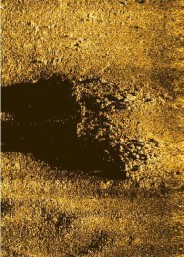
EastBayRI, USA
But for the two hardcore wreck divers and maritime historians, the modest scene was paydirt: They’d found the long-lost Trajan, a 125-foot bark loaded with lime that sank August 17, 1867.
The Trajan, one of thousands of ships that have gone down in Rhode Island waters since the days of the colonists, had been all but forgotten in the 141 years since she was lost.
The men’s discovery that chilly December morning was the culmination of years of research, hard work and more than a bit of luck.
‘As soon as we hit the bottom I knew we’d found it’, said Mr. Munro, an amateur shipwreck hunter who works as a technician at a nuclear power plant in Connecticut. ‘Ultimately, it’s a mystery until you find it and when you close the page on that mystery, it’s just a good feeling.’“
[Full Story]
“Rare Lead Bars Discovered Off The Coast Of Ibiza
May Be Carthaginian Munitions”
December 15, 2008, ScienceDaily, USA
“Dr. Marcus Heinrich Hermanns from the Department of Archaeology at the University of Cologne has recovered three lead bars which may originate from the third century before Christ, 39 meters under the sea off the north coast of Ibiza.
One of the bars has Iberian characters on it. According to the German Mining Museum in Bochum, the lead originates from the mines of Sierra Morena in southern Spain.
Dr. Marcus Heinrich Hermanns from the Department of Archaeology at the University of Cologne has recovered three lead bars which may originate from the third century
before Christ, 39 meters under the sea off the north coast of Ibiza
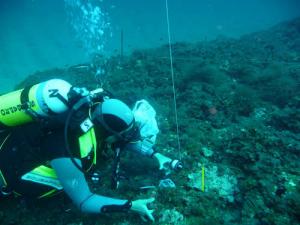
University of cologne/Science Daily
With the help of local volunteer divers, some of whom he also trained in crash courses in underwater archaeology financed by the local government, Dr. Hermanns examined the three lead bars.
A fourth specimen had already been found on an earlier occasion. The characters on the upper surfaces of two of the four known bars are syllabary symbols from the script of Northeastern Iberian.
‘The characters must have been added to the metal before it had set, shortly after it had been cast’, says the underwater archaeologist Dr. Hermanns, ‘in which case, the characters are more likely to be related to production as opposed to commercial information.’
The meaning of the characters has not yet been determined, however, the dating of the objects to the third century B.C., i.e. the period of the Second Punic War, raises further questions.”
[Full Story]
“Divers search for Armada treasure off Mull”
December 07, 2008, The Observer, UK
“More than 400 years after a Spanish galleon loaded with gold and silver slid beneath the waves in the waters surrounding the Isle of Mull, a new mission has been launched to try to recover its hoard of treasure.
Divers will begin to sift through the silt at the bottom of Tobermory Bay in an attempt to recover the valuable cargo, reputed to have been intended to bankroll the ill-fated Spanish invasion of England in 1588. It is the second time that Sir Torquhil Ian Campbell, the 13th Duke of Argyll, has launched such a mission.
The mystery of where the battle-scarred ship lies has puzzled treasure hunters for centuries. According to local folklore, the vessel – laden with gold, jewels and priceless historical artefacts – is at the bottom of Tobermory Bay.
Following the armada’s defeat at the hands of Sir Francis Drake, many Spanish ships fled north to escape the English fleet, but became caught up in violent storms. Exactly how the Almirante di Florencia or the San Juan de Sicilia – the vessel’s exact identity has never been established – foundered is unknown.”
[Full Story]
“The world’s first Illyrian trading post found”
December 07, 2008, Forskingsmagasin, Norway
“A unique archaeological discovery in the Balkans: Archaeologists from the University of Oslo have just found the first Illyrian trading post of all time. So Balkan history must now be rewritten.
The archaeologists found more than 30 Illyrian boats
fully-laden with Roman amphorae
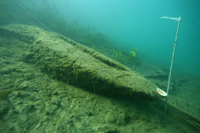
University of Mostar/Forskingsmagasin
There is jubilation at the Museum of Cultural History at the University of Oslo in Norway. Marina Prusac, Associate Professor in the department of archaeology, has just returned home after conducting excavations in the border area between Croatia and Bosnia-Herzegovina.
In the course of several weeks of intense digging this autumn, her archaeological team found the very first traces of an Illyrian trading post that is more han two thousand years old.
The Illyrians were an ancient people who lived by hunting, fishing and agriculture. They were known as warriors and pirates. Not only did they fight Greek colonists and Roman occupants, the various tribes also feuded among themselves.
However, the archaeological finds show that the Illyrians also had peaceful trade connections with the Romans.”
[Full Story]
“Shipwreck clues could clear Blackbeard of sinking his ship
to swindle his crew”
December 06, 2008, The Daily Telegraph, UK
“He was history’s most feared pirate, striking terror into seafarers as he cut a bloodthirsty swathe through the Caribbean and North Atlantic.
Blackbear may be innocent of some of the charges against him
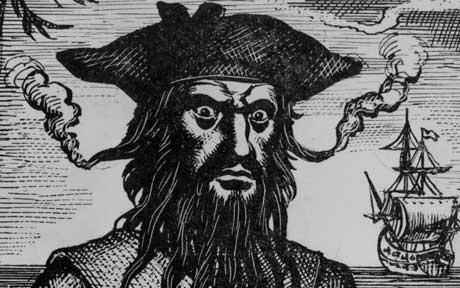
Hulton Archive/The Daily Telegraph
But new research has found that Blackbeard may be innocent of one of the most notorious charges against him.
For almost 300 years, the British pirate captain has stood accused of deliberately sinking his flagship, Queen Anne’s Revenge, so he could swindle his crew out of their share of loot they had plundered.
But marine archaeologists, who are conducting a diving expedition on the vessel’s presumed wreck, now believe it may have run aground by accident. They have even found evidence suggesting that Blackbeard made repeated attempts to rescue the stricken craft.”
[Full Story]
“Shipwreck could have local ties”
December 05, 2008, The Post & Courier, USA
“The slave ship Trouvadore sank off the Turks and Caicos Islands in 1841 on its way to Cuba. Its recent discovery might reveal one more piece of the secret history of the illegal slave trade in the Lowcountry.
A diver records positions and measurements of the hull timbers of a shipwreck off East Caicos that researchers have determined was the slave ship Trouvadore
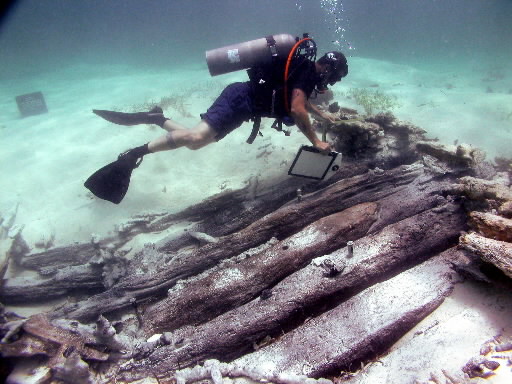
Donald Keith for NOAA
Some of the ship’s captives might have been on their way to slavery in Charleston. People who took in survivors might well have been the former slaves of Lowcountry plantation owners.
The hints of connections to people and events here in the years before the Civil War beguile the archaeologists who just identified the historic wreck.
‘It’s something we’re trying to answer’, said archaeologist Don Keith, president of Ships of Discovery, the company that discovered the wreck under a National Oceanic and Atmospheric Administration grant. ‘It’s an evolving story, and it started with almost no information.’“
[Full Story]
“Saving submerged ruins”
December 02, 2008, Cyber Diver News Network, New Zealand
“Conservation activists who want to protect the submerged cultural resources and marine species diversity of the Gulf of Mannar are campaigning to have it designated as a UNESCO World Heritage Site.
Ecologist Ranil Sennanayake said the Gulf of Mannar encompasses one of the world’s most pristine marine ecosystems as well as the ruins of submerged ancient cities.
Senanayake has logged hundreds of dives in the area and said he and other scientists have found ruins of several ancient cities including Mahabalipuram and Pumpoor.”
[Full Story]
“Prehistoric vessel found in Black Sea”
November 29, 2008, Press TV, Iran
“An intact dugout wooden canoe, datable to prehistoric times, has been found at the bottom of the Black Sea by Bulgarian fishermen.
Archaeologist Dimitar Nedkov, measuring the length of
the ancient vessel found in the Black Sea
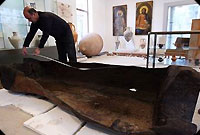
Press TV, Iran
According to head of the Archaeological Museum in the port city of Sozopol, Dimitar Nedkov, the vessel was found some 15 miles off the coast.
‘The dugout is 8.5 feet long and 27.5 inches wide, and it is made most probably of oak’, AP quoted Nedkov as saying.”
[Full Story]
“NOAA-Supported Mission Discovers Historic Shipwreck Off Turks & Caicos Islands”
November 25, 2008, NOAA, USA
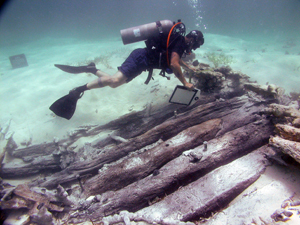
“Maritime archaeologists today announced they have recently identified the wreck of the historic slave ship Trouvadore off the coast of East Caicos in the Turks and Caicos Islands. NOAA’s Office of Ocean Exploration and Research significantly funded several years of archaeological research leading to the discovery by Don Keith and Toni Carrell, from Ships of Discovery, an underwater archaeology research institute.
The hull remains of the so-called ‘Black Rock Wreck’ were measured and compared to
the dimensions of known shipwrecks off East Caicos.
NOAA, USA
The Spanish vessel ‘Trouvadore’ was participating in the slave trade, outlawed in the British Indies, including the Turks and Caicos Islands. In 1841, after the vessel was grounded on a reef, Caicos authorities arrested the crew, and most of the 192 African survivors settled on Grand Turk Island.
Keith and Carrell believe the African survivors of the Trouvadore are the ancestors of a large portion of current residents in the Turks and Caicos Islands. For example, traditions on the Islands have a recognizable African origin. The Turks and Caicos National Museum is recording these traditions through oral histories and is educating the community about their ancestral history.
‘What makes a people different and distinct is their unique history’, said Keith, who has worked in the islands for 30 years.
‘The people of the Turks and Caicos have a direct line to this dramatic, historic event – it’s how so many of them ended up being there. We hope this discovery will encourage the people of the Turks and Caicos to protect and research their local history, especially the history that remains underwater.’“
[Full Story]
“Diver finds priceless ancient jewellery”
November 19, 2008, Drogheda Independent, Ireland
“A local diver has found a priceless piece of ancient silver jewellery whilst taking part in a search for a missing person.
Pat Treanor a member of the Boyne Fishermans Rescue and Recovery Service (BFRRS) found what is believed to be a Viking artefact dating back up to 2,000 years during a search of the River Lee.
It is currently being examined by the National Museum of Ireland but is believed to be at least 1,500 years old.
The piece, which is circular with a bulbous end and is thought to be either a bracelet or brooch, was found on the river bed sitting on top of stones in ten feet of water.”
[Full Story]
“World’s first underwater museum planned for Egypt”
November 17, 2008, The Jerusalem Post, Israel
“World’s first underwater museum planned for Egypt
“Mention underwater archeological treasures and most people will think of shipwrecks full of chests of gold from far corners of the earth.
However, the United Nations Educational Scientific and Cultural Organization (UNESCO), together with the Egyptian government, is now planning to show the world that underwater archeology can be much more, by building the world’s first underwater museum to show the rich cultural and historical heritage that can be found under the Bay of Alexandria in northern Egypt.
The decision by the Egyptian government comes amid growing international awareness of the need to protect archeological sites located underwater. UNESCO has established the Convention on the Protection of the Underwater Cultural Heritage, which is expected to become operational by the end of 2008 after its ratification by 20 states.
The Convention highlights the importance of saving submerged cultural property, which has become increasingly vulnerable to pillaging with the development of more sophisticated and affordable diving equipment.
‘The first underwater discoveries in the Bay of Alexandria were made in 1911, so you see that this is already a long, ongoing issue in one of the most ancient harbors of the world’, Ulrike Koschtial, the representative for the UNESCO Convention, told The Media Line.
‘The whole Bay of Alexandria actually still houses the remains of very important archeological sites. You have the place of the Pharaohs – the ancient lighthouse of Alexandria – which is one of the seven ancient wonders of the world. You have the Polonike Palace, which was the palace of Cleopatra, and there might also be the grave of Alexander the Great’, she said.”
[Full Story]
“Axes at bottom of sea rewrite history”
November 12, 2008, Metro, UK
“A cook was the toast of the archaeological world last night for his discoveries of prehistoric axes that have rewritten the history of Britain.
Jan Meulmeester – who has won the best discovery category at the British Archaeological Awards – took time off from his job at a care home in Holland to indulge his interest in fossil hunting.
But instead of fossils he found the axes – dozens of them, buried in mud dredged from the bottom of the North Sea.
Mr Meulmeester was given permission by the dredging company to search through the gravel, raked from the sea 13km (eight miles) off Great Yarmouth in Norfolk when it was brought into the port of Flushing, near where he lives in Holland.
The axes could be as much as 500,000 years old.”
[Full Story]
“Portal to Maya ‘Hell’ found in Mexico?”
November 11, 2008, KazInform, Kazakhstan
“A labyrinth filled with stone temples and pyramids in 14 caves-some underwater-have been uncovered on Mexico’s Yucatan Peninsula, archaeologists announced recently.
The discovery has experts wondering whether Maya legend inspired the construction of the underground complex-or vice versa.
In one of the recently found caves, researchers discovered a nearly 300-foot (90-meter) concrete road that ends at a column standing in front of a body of water.
‘We have this pattern now of finding temples close to the water-or under the water, in this most recent case’, said Guillermo de Anda, lead investigator at the research sites.
‘Caves are natural portals to other realms, which could have inspired the Mayan myth. They are related to darkness, to fright, and to monsters’, de Anda said, adding that this does not contradict the theory that the myth inspired the temples.
William Saturno, a Maya expert at Boston University, believes the maze of temples was built after the story.
Saturno said the discovery of the temples underwater indicates the significant effort the Maya put into creating these portals.
In addition to plunging deep into the forest to reach the cave openings, Maya builders would have had to hold their breath and dive underwater to build some of the shrines and pyramids.”
[Full Story]
“Historical artifacts unearthed from sunken ship
to be displayed in U.S.”
November 05, 2008, Trading Markets, USA
“Historical artifacts unearthed from a shipwreck in Turkey will be displayed in the United States, the head of a business council said on Tuesday.
Haluk Dincer, the chairman of the Turkish American Business Council, said that 98 artifacts, discovered from a sunken ship named Uluburun, would be exhibited in New York in the second half of November.
‘The artifacts will be on display in the “Beyond Babylon: Arts, Trade and Diplomacy in the Second Millennium B.C.” at the Metropolitan Museum of Art in New York’, Dincer told a press conference in the Turkish city of Istanbul.
Artifacts were recovered from ‘Uluburun’ shipwreck in Kas town of the Mediterranean province of Antalya.
The Uluburun shipwreck is a well-documented late 14th century BC shipwreck of the Late Bronze Age period, discovered off the south coast of Turkey by a Turkish sponge diver in 1982. It was recovered using techniques of underwater excavation in 11 consecutive campaigns of 3-4 months duration each from 1984 to 1994. “
[Full Story]
“Tides reveal ancient port”
November 05, 2008, Turkish Daily News, Turkey
“The remains of an ancient port appeared on a shore in the Aegean town of Burhaniye when the seawater withdrew due to seasonal tides.
An underwater photo reveals the ‘deadeyes’ used to hold ropes on the Riverside, which left Kelleys Island on Friday, Oct. 13, 1893, with a cargo of stone bound for New York
Turkish Daily News
The 2,500-year-old port remains are part of the ancient city of Adramytteion, experts said. Hasan Sezer, a local of Burhaniye, said the remains appear at the same time each year.
‘When you row around, you feel like a part of history’, said Sezer. ‘We must preserve our historical heritage’.
Excavation work has been ongoing in the ancient city of Adramytteion for 20 years.”
[Full Story]
“Shipwreck hunters find 1870 schooner”
November 03, 2008, Toledo Blade, USA
“The images are blurred shapes of dark and light and they have undefined lines and portions shaded out.
But even to the untrained eye the photos that emerged from the sidescan sonar that pierced into the waters of Lake Erie were unmistakably boats. Shipwrecks to be exact.
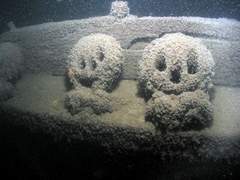
An underwater photo reveals the ‘deadeyes’ used to hold ropes on the Riverside, which left Kelleys Island on Friday, Oct. 13, 1893, with a cargo of stone bound for New York
David Vanzandt/Toledo Blade
More than a year after first glimpsing the boats on sonar and working to discover what they were, shipwreck hunters searching the waters off Cleveland have just recently announced their finds.
The shipwrecks are among many that have been discovered through the collaborative efforts of the Cleveland Underwater Explorers and the Great Lakes Historical Society in Vermilion, Ohio.
There are many more to find.
Thousands of ships litter the floors of the five Great Lakes. In Lake Erie alone, hundreds have been found and hundreds more are waiting to be discovered.”
[Full Story]
“Little object, big find from shipwreck”
October 28, 2008, Havelock News, USA
“One of the smallest artifacts recovered during the latest dive expedition at the shipwreck presumed to be Queen Anne’s Revenge is getting big attention.
The circular, dime-sized piece has been resting on the ocean floor for 300 years, but early examination indicates it may be the first coin to come from the site believed to be the flagship of the pirate Blackbeard.
Shanna Daniel, assistant conservator at the QAR lab in Greenville, said it will likely be one of the first items from the 2008 dive reviewed at the lab because it could reveal important markings used in confirming important information, such as the time period of the shipwreck.
Also among this year’s finds are a guard for a dagger or small sword, pieces of pewter plates, shards of ceramic, grinding stone fragments, cannon ball and hundreds of concretions containing artifacts yet to be uncovered.
Some of the artifacts recovered from this year’s dive, which ends Friday, will be available for the public to view Wednesday from 11 a.m. to 1 p.m. at the N.C. Maritime Museum in Beaufort.”
[Full Story]
“First Underwater Look At New England Shipwreck”
October 24, 2008, WBZ 38 News, USA
“The Steamship Portland went down off the New England coast during a terrible storm back in November 1898.
It became known as the Titanic of New England. Now, over a century later, divers have reached the wreck for the very first time.
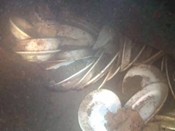
Dinner plates scattered in the wreckage
WBZ 38 News
‘When we came down on the wreck, this was one of the first things we saw, said Bob Foster, pointing out dinner plates in underwater video taken by his dive team.
Foster recently led a team of divers to the wreck of the Portland, the first divers ever to accomplish that.
At a depth of almost 500 feet, the divers could only survey the wreck for 15 minutes before returning to the surface.
They plan to resume their dives in the spring.”
[Full Story & Images]
“Antikythera mechanism exhibition”
October 22, 2008, ANA, Greece
“The first specialized exhibition focusing on the controversial Antikythera Mechanism opens Wednesday at the Ionian Centre for Scientific Studies in Plaka, downtown Athens, in cooperation with the team of scientists studying the device.
The visitors of the exhibition, that will run until December 14, 2008, will learn about unknown applications of the Mechanism in ancient Greek calendars, the study of the movement of the Sun and the Moon, and eclipse prediction.
The exhibition is held under the auspices of the ministry of culture and in cooperation with the National Archaeological Museum of Athens where the Antikythera Mechanism is housed.
The Antikythera mechanism is believed to be an ancient mechanical calculator (also described as a ‘mechanical computer’) designed to calculate astronomical positions.
It was discovered in the Antikythera wreck off the Greek island of Antikythera, between Kythera and Crete, and has been dated to about 150-100 BC. Technological artifacts of similar complexity appeared a thousand years later.”
[Full Story]
“Shipwreck relics of ‘Nanhai 1’ on show”
October 21, 2008, CCTV News, China
“Spectacular porcelains salvaged from an ancient Chinese merchant ship are on display in Hangzhou.
The exhibition is at the museum of the Southern Song Imperial kiln in Hangzhou, the capital of eastern China’s Zhejiang
Province. The exhibition runs until the end of November.
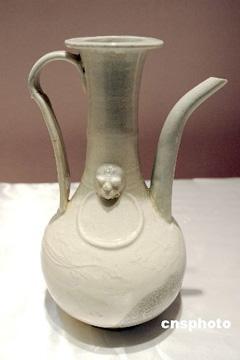
CCTV News, China
‘Nanhai One’, or ‘South China Sea One’ captured the nation’s imagination when it was raised from the depths of the sea in December, 2007.
The ship was laden with fine Chinese porcelain manufactured 800 years ago.
The Southern Song Dynasty marked the first high point of China’s porcelain industry. Products were exported to east, south and west Asia.”
[Full Story & Images]
“Treaty to protect underwater heritage”
October 19, 2008, The Daily Mail, UK
“The crumbling remains of Cleopatra’s palace, the many-gated Indian city of Dwarka and the earthquake-ravaged Caribbean hub of Port Royal are undoubtedly listed among the world’s archaeological treasures – but they have something else in common.
The three sites are all under water, and thanks to a United Nations convention coming into force next year, are set to benefit from greater protection being afforded to mankind’s sub-aquatic legacy.
Divers raise a granite statue of a priest from an Egyptian temple from
the submerged island of Antirhodos in Alexandria harbour.
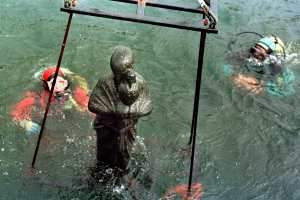
Leila Gorchev/AP
The submerged sites in Alexandria, Gujarat and Jamaica, together with sections of the ancient city of Carthage, in Tunisia, and the temples of Mahabalipuram, in India, fall under the remit of the Convention on the Protection of Underwater Cultural Heritage.
Officials from Unesco, the UN body that helps to conserve mankind’s heritage, are also working to safeguard the more than three million shipwrecks scattered across the planet’s ocean floors.
Experts warn that sunken vessels – such as the Titanic, the Spanish Armada and the junk fleet on which Kublai Khan attempted a Japanese invasion – are increasingly being targeted by scuba-diving relic hunters.”
[Full Story]
“Tang Dynasty relics in Arab dhow – huge 90s find
rewrites history”
October 19, 2008, Digital Journal, Canada
“The Tang Dynasty was one of the world’s great civilizations. Nobody knew, however, that it was trading as far away as the Persian Gulf. So many Tang pieces, of exceptional quality, were found, it’s taken ten years to analyze the find.
This is interesting from a navigational perspective, too. Early navigators, understandably, tended to stick to coastlines, but finding your way to China from Persia isn’t exactly easy. So lugging thousands of pieces of materials from China to Persia is no minor deal.
Even more intriguingly, and not very noticeable from Chinese histories, is any mention of sea trade. The Silk Road was working flat out, and trade through the western nations was well known, but not like this.
Ten years ago, at a spot known locally as ‘Black Rock’, two men diving for sea cucumbers came across a large pile of sand and coral. Digging a hole, they reached in and pulled out a barnacle-encrusted bowl. Then another. And another.
They had stumbled on the oldest, most important, marine archaeological discovery ever made in South East Asia, an Arab dhow – or ship – built of teak, coconut wood and hibiscus fibre, packed with a treasure that Indiana Jones could only dream of.”
[Full Story]
“The treasure trove making waves”
October 18, 2008, BBC Science News, UK
“Since time immemorial, this funnel-shaped passage linking the Java Sea and the Indian Ocean has been one of the two main shipping routes. The Malacca Straits is the other, from China to the West.
The artefacts from the find are nearly 1,200 years old
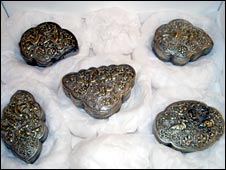
BBC Science News, UK
A British sea captain, shipwrecked here in 1817, called it ‘the most dangerous area between China and London’.
Found packed inside tall, earthenware jars, some experts believe bean sprouts were placed between the bowls as a sort of organic bubble-wrap. These brightly painted tea bowls were the Tang equivalent of plastic food containers.
‘It looks like they were approaching Tanjung Pandang, the main town on Belitung Island, when they hit the reef’, explains Walterfang, the stocky German treasure hunter who salvaged the wreck.
‘They may have come here for water or other supplies. Perhaps there was an emergency. Or even an attack by pirates. But we cannot know. It was nearly 1,200 years ago’.”
[Full Story]
“Pictured: The incredible secret world at the bottom of the sea”
October 18, 2008, The Daily Mail, UK
“In a year-long mission, a BBC team probed a small part of the earth’s amazing undersea world. They completed 1000 dives and explored seven different oceans across the globe. What they found was extraordinary…
Paul Rose explores the wreck of the Paraportiani,
a cargo ship that sank off the coast of East Africa in 1967
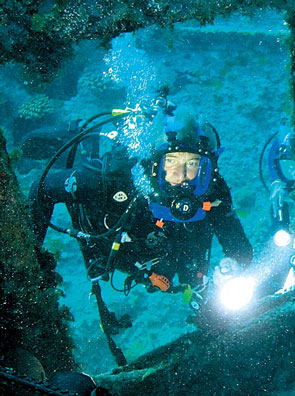
The Daily Mail, UK
To most of us, seas and oceans are featureless expanses. On a good day, the vast surfaces stretching endlessly towards the horizon provide a picturesque foil for a sunset.
Yet these glassy waters hide an extraordinary world.
In fact, we know more about the surface of Mars than we do about the deep ocean floors, which is why a team of experts decided to probe a small part of the planet’s seas, and film it for an eight-part TV series, to be shown on BBC2 next month.
It is no surprise, then, that a new species was discovered by the team during almost every deepsea dive.
But there was more to find, including underwater caves that preserved the remains of lost civilisations and wrecks that spoke of ancient battles.”
[Full Story]
“Oldest cases of human TB found beneath the sea”
October 15, 2008, New Scientist, UK
“The bones of a 9000-year-old woman and child have revealed the world’s oldest cases of human tuberculosis.
DNA sequences of Mycobacterium tuberculosis from the remains closely match those circulating among humans today, suggesting that TB has plagued humans far longer than previously thought.
In separate work, a new genetic analysis of modern strains traces the origins of human TB to the Near East a few thousand years earlier.
The bone discovery contradicts the long-held theory that human TB evolved from cattle strains around the time of animal domestication, says Helen Donoghue, a microbiologist at University College London, who analysed the disease in the woman and child. Rather, high population densities could have made it easier for the disease to spread.
Donoghue’s colleagues working in Israel discovered the remains of a mother and infant at a site several hundred metres offshore in the Mediterranean and about 10 metres underwater. Seawater covered the site not long after humans abandoned it around 9000 years ago.”
[Full Story]
“Convention on the protection of the underwater cultural heritage will enter into force in January 2009”
October 14, 2008, UNESCO Moscow Office, Russia
“Twenty States* have now ratified the Convention on the Protection of the Underwater Cultural Heritage, which therefore will enter into force on 2 January 2009, three months after the deposit of the 20th instrument of acceptance.
‘This is a very important step in the history of the safeguarding of cultural heritage’, declared Koïchiro Matsuura, Director-General of UNESCO. ‘This represents an essential addition to UNESCO’s standard-setting apparatus. From now on, it will be possible to offer legal protection to the historical memory that is in underwater cultural heritage, thus curtailing the growing illicit trade by looters.’
The Convention, adopted in 2001 by UNESCO’s General Conference, aims to ensure more effective safeguarding of submerged shipwrecks and ruins. The international treaty represents the international community’s response to the increased looting and destruction of underwater cultural heritage, which is becoming ever more accessible to treasure hunters.
The 2001 convention is based on four main principles: the obligation to preserve underwater cultural heritage; in situ preservation, i.e. underwater, as a preferred option; no commercial exploitation of this heritage; and cooperation among States to protect this precious legacy, to promote training in underwater archeology, and to raise public awareness of the importance of sunken cultural property.”
[Full Story]
“Archaeologists discover Christ ‘the magician’ reference”
October 03, 2008, CathNews, Australia
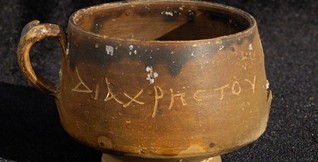
“Marine archaeologists working in Alexandria, Egypt, have discovered what may be the earliest reference to Jesus with a bowl referring to Christ ‘the magician’.
The bowl inscribed with Christos “the magician” discovered underwater
amongst the ruins of Alexandria
CathNews, Australia
A team of scientists led by renowned French marine archaeologist Franck Goddio recently announced that they have found a bowl, dating to between the late 2nd century BC and the early 1st century AD, that is engraved with what they believe could be the world’s first known reference to Christ, Discovery News reports.
If the word ‘Christ’ refers to the Biblical Jesus Christ, as is speculated, then the discovery may provide evidence that Christianity and paganism at times intertwined in the ancient world.
The full engraving on the bowl reads, ‘DIA CHRSTOU O GOISTAIS’, which has been interpreted by the excavation team to mean either, ‘by Christ the magician’ or, ‘the magician by Christ.’“
[Full Story]
“Roman statues found under Aegean Sea”
October 03, 2008, The Daily Telegraph, UK
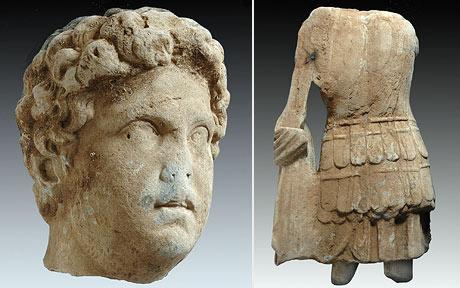
“Underwater archaeologists in the Aegean Sea uncovered more than they were expecting when they found two ancient statues buried in a harbour wall.
In a statement, the ministry said it did not yet know whether the torso and the head were both taken from the same figure, but that the torso stood 4.5ft high.
AFP/Getty/The Daily Telegraph, UK
The Roman-era sculptures were located 8ft under water in a submerged port at Mandraki, on the western side of Kythnos, a Greek island in the Cyclades.
Greece’s culture ministry said the statues consisted of a stone torso of a man in armour as well as another figure – the bearded head of another man.
It is not clear who the statues represented”
[Full Story]
“Traces of Ancient Civilization Discovered
in Chelyabinck Region”
September 29, 2008, Russia-InfoCenter, Russia
“Amazing enormous constructions of stone – megaliths – some of them weighing up to 20 tons, were erected in the Isle of Vera, Lake Turgoyak of Chelyabinsk Region.
‘First divers went underwater around Turgoyak Lake and then we followed them’ – scientist Stanislav Grigoryev says – ‘the greatest sensation was to see a megalith at the depth of about two meters under water surface.’
‘The point is it had been practically impossible to create it underwater. It means that in those times there was a neck of land here and the present day island was a peninsula.’.”
[Full Story]
“Ancient Phoenician harbour discovered off Sardinian coast”
September 29, 2008, Thaindian News, Thailand
“Archaeologists in Sardinia have claimed to have found the port of the Phoenician city of Tharros, held by some to be the ancient peoples most important colony in the Mediterranean after Carthage.
Researchers from the University of Cagliari and Sassari found the submerged port in the Mistras Lagoon, several kilometers from the city ruins.
Excavations have long been going on at the site of the city itself, on a peninsula overlooking the Bay of Oristano in western Sardinia, but this is the first time its waterfront has been located despite almost two centuries of hunting.
As well as an impressive sandstone wall 100 metres in length and four metres in width, the archaeologists discovered a basin carved in the rock, similar to Carthage’s man-made, protected inner harbour.”
[Full Story]
“Namibia: Race against time to save ancient
Portuguese shipwreck”
September 29, 2008, AFP, France
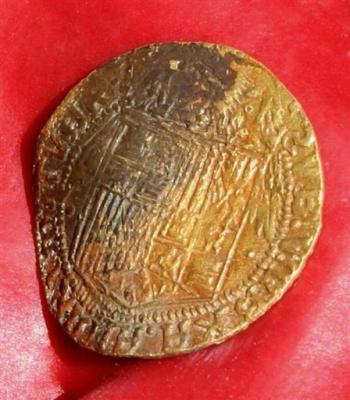
“Archaeologists are racing against the little time left to salvage a fortune in coins and items from a 500-year-old Portuguese shipwreck found recently off Namibia’s rough southern coast. Despite its importance, the project, in a restricted diamond mining area, is itself costing a fortune in sea-walling that cannot be sustained after October 10.
A golden coin recently found on a 500-year-old Portuguese shipwreck
AFP, France
‘The vast amounts of gold coins would possibly make this discovery the largest one in Africa outside Egypt’, said Francisco Alves, a Lisbon-based maritime archaeologist.
Alves is part of a multi-national team combing the seabed where the wreck was discovered six months ago.
The 16th-century ‘Portuguese trade vessel was found by chance this April as mine workers created an artificial sand wall with bulldozers to push back the sea for diamond dredging’, Namibian archaeologist Dieter Noli told reporters invited to view the site.”
[Full Story]
“A world of wonder that lies beneath the waves”
September 25, 2008, Journal Live, UK
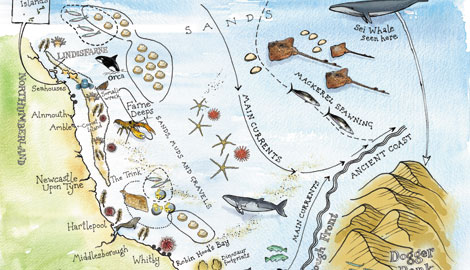
“A new map has been drawn of ancient North East settlements – under the sea. Settlements of neolithic man that eventually came to a fishy end when they were swallowed by the tides of the North Sea are among features on the unique document.
Bone harpoons, axe heads and flint arrows found on the seabed are ample evidence that people once lived on land that is now beneath the waves. And scientists know woolly mammoths also walked the lands.
The vessel’s hull was constructed without iron nails
Journal Live, UK
The map was produced in response to a survey carried out by Natural England which found most people thought the undersea landscape was barren. It also found less than 1% of people questioned could name a feature of a landscape beneath the waves.
So Natural England produced the map to show exactly what can be found off the North’s coast. Regional director Martyn Howat said: ‘There is an incredible variety of landscapes and marine life off the coast of the North East. Our undersea environment has dramatic landscapes with valleys, hills, plains and cliffs and is a source of intrigue and fascination.’“
[Full Story]
“Ruins of Sunken City Discovered”
September 25, 2008, Divemaster News, UK
“Scientists have found two churches lost in Britain’s own underwater Atlantis.
The ruins lie beneath 10 metres of water in the lost city of Dunwich – which sank after being battered by relentless storms 400 years ago. One is St Peter’s and the other possibly St Nicholas’, lost under waves in the 1600s.
The finds off the Suffolk coast – expected to be confirmed today – were being searched by divers yesterday. Prof David Sear, of Southampton University, said: ‘We’re pretty certain we’ve found lost city debris.’
In 1286 a large storm swept much of the town into the sea and the Dunwich River was partly silted up. Residents fought to save the harbour but this too was destroyed by an equally fierce storm in 1328, which also swept away the entire village of Newton, a few miles up the coast.
Another large storm in 1347 swept some 400 houses into the sea. A quarter of the city had been lost and the remainder of Dunwich was lost to the sea over a period of two to three hundred years through a form of coastal erosion known as long-shore drift.
By 1677 the sea had reached the market place and All Saints’ Church collapsed into the sea in about 1920, and now the ancient town lies at the bottom of the water just off the coast. Buildings that sit on the present day cliffs were once a mile inland.”
[Full Story]
“Archaeologists hold out hope of finding lost French fleet”
September 20, 2008, News-Journal, USA
“Four hundred Septembers past, and more, the first recorded hurricane in Northeast Florida raked the coast where we live, leaving violent death and crushed hopes of empires scattered along the sandy beaches where we play.
It’s an old story of a terrible storm that some believed was the hand of God. It scattered and sank a French fleet led by Jean Ribault as it bore down on a handful of Spanish ships sheltering with Pedro Menendez in a harbor at today’s St. Augustine.
Hundreds of Frenchmen, mostly Protestants, died either in the tempest, or of starvation and exposure, or at the hands of Catholic Spaniards who hunted down survivors in a bloody autumn genocide.
Despite the passing of 443 years, archaeologists say the remains of those galleons still lie beneath the sand and water, a cultural holy grail waiting to be found.”
[Full Story]
“Secrets of the Solent”
September 14, 2008, Southern Daily Echo, England
“Picking and prodding at a smelly, mouldy slab of mud and clay taken from the Solent seabed, Garry Momber is in his element. ‘That’s interesting’, he says as he inspects a black flake taken from the chunk. ‘That’s a piece of flint – or maybe it’s organic?’
To the untrained eye it is hard to get -excited over a mystery black speck, but as Mr Momber is quick to remind me, this isn’t just any black speck – it’s an 8,000-year-old black speck.
To put it in context, that is 3,000 years older than Stonehenge and 5,000 years older than the Egyptian pyramids.
It will be analysed, bagged, catalogued and kept in a giant walk-in freezer at the National Oceanography Centre, in Southampton’s Western Docks, along with hundreds of other ancient artefacts retrieved from the Solent.
Whether flint, a splinter from timber or pollen from a plant, the black speck is another vital clue to a forgotten prehistoric settlement.
Since unearthing a Stone Age oven just off Bouldnor on the Isle of Wight almost a decade ago, Mr Momber has remained -convinced his find was ‘just the tip of the iceberg’.”
[Full Story]
“Divers find 100-year-old shipwreck in Lake Baikal”
September 11, 2008, RIA Novosti, Russia
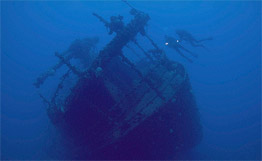
“Divers in Irkutsk have discovered an ancient ship that sank over 100 years ago on the bottom of Siberia’s Lake Baikal, a team member said on Thursday.
The ship, thought to have been built in the late 18th or early 19th century, was found in the southern part of the lake at the depth of around 30 meters.
The vessel’s hull was constructed without iron nails
RIA Novosti
The vessel’s hull, constructed without iron nails, is 16 m (52 feet) long, 5 m (16 feet) wide and 4 m (13 feet) deep. There is a hole in the right side of the hull and divers believe the ship sank during a storm.
The expedition to the depths of the world’s deepest and oldest lake was organized to search for historic artifacts linked with the Krugobaikal Railway, which saw numerous train crashes in the 19th century.”
[Full Story]
“Seabed archaeology goes virtual”
September 09, 2008, BBC Science News, UK
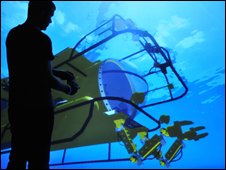
“People will soon be able to operate their own virtual submersibles to explore hidden treasures at deep underwater archaeological sites.
Shipwrecks and their priceless cargoes remain under threat from erosion, deep-sea trawling activity and looting.
The simulator will go on display at the Deep Aquarium in Hull
BBC Science News
The Venus project team has generated 3D digital records of underwater European shipwrecks that can act as a permanent record of these sites.
The simulator is being unveiled at the BA Science Festival in Liverpool.”
[Full Story]
“Oldest Skeleton in Americas Found in Underwater Cave?”
September 03, 2008, National Geographic News, USA
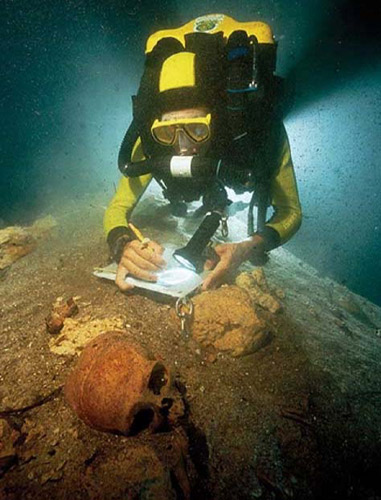
“Deep inside an underwater cave in Mexico, archaeologists may have discovered the oldest human skeleton ever found in the Americas.
Dubbed Eva de Naharon, or Eve of Naharon, the female skeleton has been dated at 13,600 years old.
If that age is accurate, the skeleton – along with three others found in underwater caves along the Caribbean coast of the Yucatán Peninsula – could provide new clues to how the Americas were first populated.
A member of Arturo González’s underwater archaeological team studies a skull in an underwater cave on the coast of the Yucatán Peninsula near Tulum, Mexico
Arturo Gonzáles/National Geographic News
The remains have been excavated over the past four years near the town of Tulum, about 80 miles southwest of Cancún, by a team of scientists led by Arturo González, director of the Desert Museum in Saltillo, Mexico
(see map of Mexico).
‘We don’t now how [the people whose remains were found in the caves] arrived and whether they came from the Atlantic, the jungle, or inside the continent’, González said.
‘But we believe these finds are the oldest yet to be found in the Americas and may influence our theories of how the first people arrived.’“
[Full Story]
“Ice Melt Encourages Lost Arctic Ships Search”
August 31, 2008, Sail World, Australia
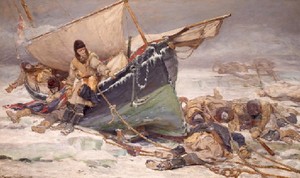
“More than 160 years after they vanished into the northern ice on a doomed mission to find a North West Passage to Asia, an expedition will set off in search of the lost ships of Victorian explorer Sir John Franklin, the HMS Erebus and the HMS Terror.
If the Canadian Coastguard’s sonar manages to locate the remains of HMS Erebus and HMS Terror, they will solve one of the great mysteries of maritime exploration.
Depiction of members of the expedition
Sail World, Australia
The last recorded sighting of the two vessels and their 128 hand-picked officers was on July 26, 1845, two months after they had set sail from Greenhithe in Kent on a mission to chart the North West Passage. Their failure to make to their intended destination of China sparked one of the longest rescue missions in maritime history, in the course of which the passage was finally located after centuries of failed efforts.
Of the Franklin expedition itself, however, only rumours of starvation, madness and cannibalism filtered back to London, based on the reports of Inuit people in the Arctic wastes north of Canada, who reported a group of white men trapped by the ice and slowly dying of hunger. In the 1980s the frozen bodies of two seamen and a petty officer in an ice-filled coffin were found.
The new expedition will be led by Robert Grenier, a senior underwater archaeologist with Parks Canada.”
[Full Story]
“Amazing 3D images of centuries-old shipwrecks
discovered at bottom of Thames”
August 26, 2008, Mail on Sunday, UK
“The largest-ever post-war salvage operation on the Thames has discovered seven shipwrecks up to 350 years old. They include a warship that was blown up in 1665, a yacht converted to a Second World War gunboat, and a mystery wreck in which divers found a personalised gin bottle.
Oldest find: HMS London, which sank in 1665, at the bottom of the Thames Estuary
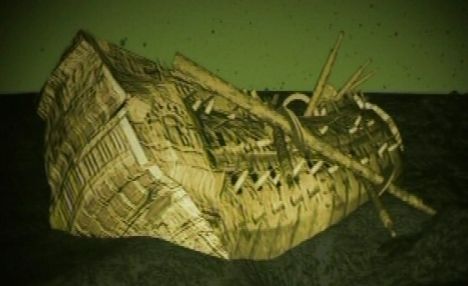
Mail on Sunday, UK
The vessels, in the Thames Estuary, are just some of about 1,100 ships which went down in the whole of the river.
The salvage by Wessex Archaeology and the Port of London Authority, which regulates the river, was both historical and practical. Jagged metal from the wrecks which stick out of the mud, silt, and gravel act as a ‘can-opener’ that can split apart vessels, especially large container ships which can skim within half a metre of the riverbed.
The operation was filmed for the BBC and took four months, using a dozen divers who used 3D survey equipment to locate the wrecks in near-zero visibility.”
[Full Story]
“UK robot sub expects to find new species”
August 22, 2008, Cayman Net News, Cayman Islands
“A state-of-the-art British submarine will be spending most of the next two months prowling the entire length of the Cayman Trough, thought by scientists to be the deepest volcanic ridge in the world.
The Autosub6000, the world’s most advanced robot submarine
Photo: National Oceanography Centre, Southampton, UK
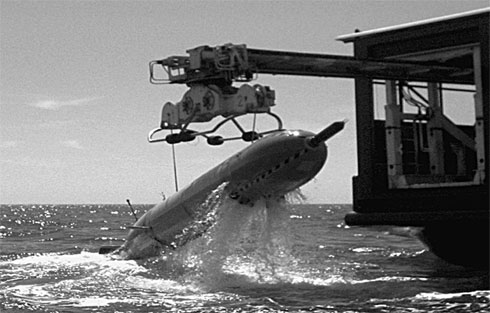
Cayman Net News, Cayman Islands
The specially designed robot sub is only a mere 5.5 meters long, but can dive to a metal-crushing depth of 6,000 meters, half the length of Seven Mile Beach.
The information reported from the depths of the vast trench, which has never before been fully explored, will then be carefully studied by a British scientific team aboard the new research ship, the James Cook.
Scientists say the Cayman Trough, which extends from the Cayman Islands to Jamaica, was created eons ago when the massive Caribbean tectonic plates were pulled away from the American plates, probably due to ancient volcanic eruptions.”
[Full Story]
“Ancient wooden boat to be displayed in Hue”
August 21, 2008, VietNamNet Bridge, Viet Nam
“An ancient wooden boat retrieved from the Huong River in May has been sent to Thua Thien-Hue Province’s Museum of Revolutionary History.
The ancient wooden boat retrieved from the Huong River in May
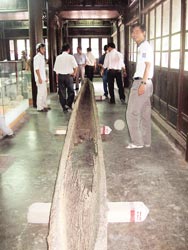
VietNamNet Bridge
The boat, which is 8.5m long and 0.5m wide, is believed to be used during the reign of King Gia Long more than 100 years ago, said researcher Ho Vinh.
Researcher Ho Tan Phan claimed that it was built by the Cham ethnic group 700-800 years ago.”
[Full Story]
“Archaeology students spy on Key Largo shipwreck”
August 17, 2008, Miami Herald, USA
“Archaeology students from across the country have delved into the underwater mystery of a steamship that sank more than a century ago off Key Largo.
For two weeks, archaeology students pieced together an underwater puzzle of weathered artifacts — the metal bands of a paddle wheel, a portion of a smokestack, remnants of boiler plates.
A student archaeologist surveys the Menemon Sanford shipwreck in the Keys
during a two-week field school of the non-profit PAST Foundation
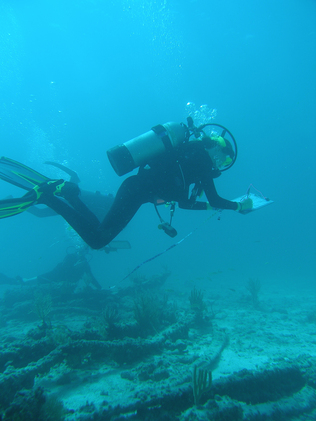
Miami Herald/The PAST Foundation
They mapped and measured these artifacts resting on the ocean’s floor, trying to solve the mystery of the shipwrecked Menemon Sanford, a grand 237-foot side-paddle steamship that sank in 1862 during a secret Civil War mission.
‘At first, all it looks like is a big scattered debris field’, said Scott Tucker of St. Mary’s College of Maryland
As they worked at 25 feet below the surface, the students also hoped to learn more about the little-known moment in history that involved Union troops, a coral reef and a possible act of sabotage.”
[Full Miami Herald Story]
[The PAST Foundation’s Menemon Sanford Project website]
“A swim against tides to find Franklin’s lost ships”
August 15, 2008, The National/Globe & Mail, Canada
“Canadian researchers pieced together funding initiatives to get their project afloat.
Dropped into the waters of the Canadian Arctic Archipelago, automated buoys will record patterns of ice drift, generating data that will be fed into sophisticated mathematical models.
Meanwhile, the nation’s leading underwater archeologist will carry out an underwater survey, thanks to a sidescan sonar towed behind a Canadian Coast Guard vessel.
This high-tech deployment will begin this month as Canadian researchers begin their efforts to find the remains of Sir John Franklin’s catastrophic 1845 expedition, in a project that combines the historical romanticism associated with past explorers and the emerging importance of 21st-century polar science.
Yet the project is happening only as a result of the persistence of the researchers involved. They were initially turned down for funding and say they had to stitch together a patchwork of initiatives to sustain their project.
The project was initially floated in 2006 as an inter-disciplinary idea for the International Polar Year that combined a diverse bunch of Franklin enthusiasts, including a French documentary-maker, an Inuit researcher, polar scientists and archaeological anthropologists.”
[Full Story]
“2,500-Year-Old Greek Ship Raised off Sicilian Coast”
August 11, 2008, National Geographic News, USA
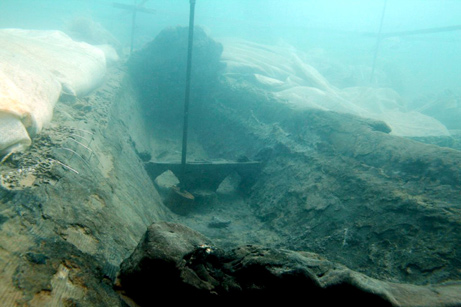
“An ancient Greek ship recently raised off the coast of southern Sicily, Italy, is the biggest and best maintained vessel of its kind ever found, archaeologists say.
At a length of nearly 70 feet (21 meters) and a width of 21 feet (6.5 meters), the 2,500-year-old craft is the largest recovered ship built in a manner first depicted in Homer’s Iliad, which is believed to date back several centuries earlier.
2,500-Year-Old Greek Ship Raised off Sicilian Coast
National Geographic News
The ship’s outer shell was built first, and the inner framework was added later. The wooden planks of the hull were sewn together with ropes, with pitch and resin used as sealant to keep out water.
Carlo Beltrame, professor of marine archaeology at the Università Ca’ Foscari in Venice, said the boat, found near the town of Gela, is among the most important finds in the Mediterranean Sea.
‘Greek sewn boats have been found in Italy, France, Spain, and Turkey. Gela’s wreck is the most recent and the best preserved’, Beltrame said.”
[Full Story]
“Ancient sunken ship near Varna savaged by fishing boats”
August 06, 2008, Sofia Echo, Bulgaria
“An ancient vessel, discovered by US oceanographer Robert Ballard, the discoverer of the wrecks of Titanic and Bismark, in the Black Sea’s waters 30km north of the town of Varna in 2002, has been destroyed by fishing boats.
The news was delivered by Ilia Shtirkov, entrusted with heading the underwater expedition and unveiling the secrets of the 2000-year-old vessel, Bulgarian-language Monitor daily said on August 5 2008.
‘We were so shocked when we saw what the trawls of fishing boats have done to the vessel. We could see the traces they have left’, he was quoted as saying by Monitor.
The small submarine navigated by Shtirkov made two trips to the vessel. He reported that all the vessel’s ancient possessions were scattered on the bottom of the sea.”
[Full Story]
“500 BC Greek ship found”
August 02, 2008, Zee News, India
“A 21-meters long ancient Greek ship, which archaeologists believe sank in a storm some 800 metres off the Gela coast in Greece while transporting goods from the Greek colony in Gela back to Greece in around 500 BC, has been pulled out of the seabed, where it lay for nearly 2500 years.
On Monday coastguards and experts from the Caltanissetta Culture Department salvaged the vessel using a boat equipped with a crane able to lift loads of up to 200 tonnes.
Around 20 other support craft joined the operation, sounding their fog horns when the wreck finally emerged from the water.
The 6.5 metres-wide ancient Greek vessel is said to be the biggest of its kind ever discovered. Earlier, four Greek vessels found off the coasts of Israel, Cyprus and France were at most 15 metres long.
Interestingly, it took two decades before the ship was finally pulled out of the waters, though the bow of the ship, along with an astounding array of amphorae, drinking cups, oil lamps and woven baskets, were brought to the surface in 2003.”
[Full Story]
“Scientists unlock new secrets of Antikythera mechanism”
July 31, 2008, The Australian, Australia
“AN ancient device retrieved from the wreck of a 1st century BC Roman merchant vessel not only predicted astronomical events like the equinox and phases of the moon, it also recorded the time and place of the original Olympic games
The claim comes from British, Greek and US researchers who have uncovered and interpreted previously unknown components of the Antikythera Mechanism, discovered in 1901 by Greek divers collecting sponges in the Mediterranean Sea.
The mechanism is about the size of a wall clock, with bronze gearwheels, dials and inscriptions on both sides. It has long-puzzled experts, keen to determine where it was made and precisely what it did.
‘We knew that this 2100-year-old ancient Greek mechanism calculated complex cycles of mathematical astronomy. It really surprised us to discover that it also showed the four-year cycle of ancient Greek games, including the Olympic Games’, said team member Tony Freeth, a mathematician and filmmaker with Images First in London.
Writing overnight in the journal Nature, Dr Freeth and his international colleagues debunked the previous belief that the intricate device was made in the Eastern Mediterranean, probably Rhodes.
They did so by using 3D X-ray technology to read all the month names on a dial for the 19-year ‘Metonic’ calendar, a system that combined solar and lunar years.”
[Full Story]
“500 BC boat salvaged off Sicily”
July 29, 2008, ABC News, Australia
“The wreck of a Greek boat dating from 500BC has been brought back up to the surface off the coast of southern Sicily, the Italian news agency ANSA reports.
Twenty ships were involved in the operation to salvage the ship, which experts say has remained in a good state of preservation since its discovery in 1988 thanks to the clay soil seabed.
The wooden Greek boat, which measures 21 metres in length and was wrecked 800 metres off the port of Gela, will be desalinated in huge freshwater tanks before being sent to Britain to be restored by archaeologists in the southern port of Portsmouth.”
[Full Story]
“Voyage to the bottom of the deepest lake”
July 27, 2008, Russia Today, Russia
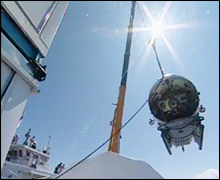
“The two Russian submersibles which dived to the sea-bed beneath the North Pole last year are now attempting to reach the bottom of Lake Baikal in Siberia. Mir One and Mir Two will try to measure the maximum depth of the world’s deepest lake.
In too deep … Mir submersible ready to dive at Lake Baikal
Russia Today
A preliminary dive to test the equipment under water was postponed on Saturday because of bad weather.
Research work on the bottom of the lake is scheduled to begin on July 29. Scientists intend to go as deep as 1,700 metres to study the tectonics of Lake Baikal and to inspect archaeological artefacts.”
[Full Story]
“Israeli diver finds rare artifact”
July 21, 2008, CDNN, New Zealand
“A rare 2,500-year-old marble discus was found last week by an Israeli lifeguard diving in the underwater antiquities site of Yavne-Yam, an ancient port city settled in the middle Bronze Age and inhabited until the Middle Ages. (Today, the beach is named for the nearby kibbutz of Palmahim).
The convex object is believed to have been fixed to the front of ancient ships as a talisman, its shape and painted circles connoting the pupil of a forward-looking and vigilant eye to protect mariners from misfortune.
Kobi Sharvit, director of the Marine Unit of the Israel Antiquities Authority, explained it is known from drawings on pottery vessels, coins and other historic sources from the 5th century BC that this model was very common on the bows of ships and was used to protect them from the evil eye, acting as a pair of eyes to aid navigation and warn of dangers.
Variants of the decoration are still common on modern boats in Portugal, Greece and other coastal countries, and eye-shaped amulets and good luck charms are extremely common throughout the Mediterranean.”
[Full Story]
“Divers explore underwater prehistoric forest”
July 17, 2008, BlueFlipper, England
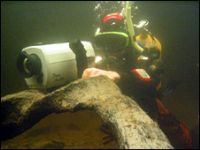
“Underwater archaeologists are taking to Loch Tay to try to uncover more about a submerged prehistoric woodland. The stumps of about 50 trees were discovered in 2005 – some of them are thought to be about 6,000 years old.
underwater exploration
BlueFlipper, England
The experts are now aiming to find their root system and establish the depth to which the trees are buried.
Meanwhile, a campaign has been launched to help restore the reconstructed crannog, an ancient loch dwelling, which attracts thousands of visitors.
The Scottish Trust for Underwater Archaeology will spend the next two weeks inspecting the drowned forest.
They will be focusing on two trees – one dating from 4,270 BC to 4,040 BC and the other dating from 2,350 BC to 2,120 BC.”
[Full Story]
“How to protect the treasures of the deep”
July 16, 2008, New Scientist, UK
“In the cold waters of the English Channel, a yellow submersible owned by Odyssey Marine Exploration, a Florida-based treasure hunting company, is sculling over the rusting cannons and encrusted timbers of two shipwrecks.
Exactly what it has found and where remains a closely guarded secret, but some archaeologists speculate that one of the wrecks may be La Vierge Du Bon Port – possibly the richest French vessel ever lost at sea – which sank after being ambushed by English privateers off the coast of Guernsey in the Channel Islands on 9 July 1666.
The recovery of such a shipwreck could bring big rewards for Odyssey – the cargo of La Vierge Du Bon Port is now estimated to be worth around £200 million.
Many archaeologists, however, would like to see commercial treasure hunting stopped.”
[Full Story]
“Ancient Underwater Relic Found in Israel”
July 15, 2008, Ohmy News, South Korea
“An Israeli lifeguard stubbed his foot during an underwater morning swim in an offshore archaeological site this week on what turned out to a surprising rare find.
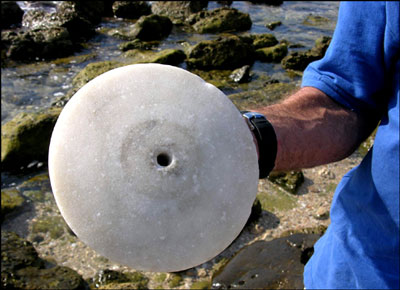
Relic of ancient mariner’s talisman
Israal Antiquities Authority
Instead of treading on one of dozens of slippery giant stingrays which regularly invade Israeli coastal waters during July and August, David Shalom discovered the relic of a 2,500 year-old mariner’s talisman which he presented to the Israel Antiquities Authority (IAA).
Kobi Sharvit, director of the IAA’s Marine Unit identified the 20 centimeter wide marble stone which was flat on one side and convex on the other, as a talisman or ophtalmoi by its Greek name dating to the fifth or fourth century BCE.
It represented the pupil of an eye affixed with a bronze nail by to the bow of a ship to protect ancient mariners from the evil spirits.
But lying hundreds of years on the ocean bed the salt water had washed away the eye painted on the stone and erased its engraved lines.”
[Full Story]
“Peter The Great Russian Battleship Discovered”
July 11, 2008, DiveMaster, UK
“Archaeologists have discovered the wreck of a Russian battleship designed by Peter the Great in Amsterdam and which played a key role in a 1719 victory over Sweden in a war on the Baltic Sea.
A team including professional archeologists, divers, a film-producer and a cameraman located the 54-gun ‘Portsmouth Battleship’ at a 12-meter depth in the waters off Kotlin Island near Kronshtadt last week during final stages of a three-month mission as part of the ‘Secrets of the Sunken Ships’ project.
The team was back on dry land on Tuesday.
The lake’s bottom may have powder kegs and other debris from ships on both sides, said Carrie Sowden, archaeological director for the historical society. The grant was among 32 announced Monday by the American Battlefield Protection Program of the National Park Service.
‘We are currently lobbying for an immediate raising of the wrecks to serve both as a museum and as objects for research’, said Andrei Lukoshkov, head of the research team, adding that the discovery is unique because the ship, which was designed by Peter the Great, disappeared with another ship, the ‘London’, on the way back to the port of Kronshtadt.
However, pending further studies of the wrecks, the archaeologists are yet to establish if wreckage found near the ‘Portsmouth’ also belongs to the ‘London’.”
[Full Story]
“Many of Britain’s shipwrecks in danger of being lost forever, say English Heritage”
July 08, 2008, The Daily Telegraph, UK
“More than 40 per cent of Britain’s historic shipwrecks are in danger of being lost forever through neglect and vandalism, an extensive survey has found.
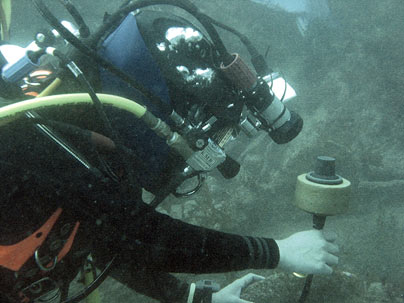
A submarine archaeologist records the Salcombe Cannon site
which was ‘severely vandalised’ last year
The Daily Telegraph, UK
English Heritage has identified 45 wrecks on a new list of important cultural sites that are ‘at risk’, and in urgent need of protection and regeneration.
Many have been damaged by unauthorised divers during clumsy explorations and fishermen as they dredge the seabeds, while others have been allowed to decay.
A 17th century vessel which sank off Salcombe, Devon, carrying the largest collection of Islamic coins ever found in Britain, tops the list of wrecks most in need of attention.
According to English Heritage surveyors the site was ‘severely vandalised’ last year by a fishing boat that had strayed into the restricted area.”
[Full Story]
“Researchers to scan Lake Erie battlefield”
July 04, 2008, Chicago Tribune/AP, USA
“Researchers want to know if the bottom of Lake Erie is littered with cannonballs and other ammunition from a pivotal naval battle that was part of the War of 1812.
With the help of an $18,000 federal grant, the Great Lakes Historical Society will survey the lake floor this summer using sonar and magnetic wave technology.
The U.S. victory over the British in the Battle of Lake Erie, fought in September 1813, helped the Americans secure control of the lake and made a hero of Commodore Oliver Hazard Perry.
The lake’s bottom may have powder kegs and other debris from ships on both sides, said Carrie Sowden, archaeological director for the historical society. The grant was among 32 announced Monday by the American Battlefield Protection Program of the National Park Service.
The money will allow Sowden’s group to document what’s at the bottom and more sharply define the boundaries of the battle.
‘Hopefully we can map out who was where and what happened’, Sowden said.”
[Full Story]
“Jacobean ‘Titanic’ discovered by archaeologists”
July 01, 2008, The Daily Telegraph, UK
“Marine archaeologists who explored the 600-ton vessel off Dorset believe it may have been as luxurious in its day as the Titanic.
Among the treasures they have retrieved is a statue of a merman whose eye sockets would have held precious stones.
The 4.5ft wooden figure was one of a number of statues that would have adorned the stern of the vessel.
At 130ft long, the oak-timbered ship would have been one of the largest of its kind on the seas when it sank in around 1620.
Its identity is not known but it is likely to be British or Dutch.
The wreck was found half a mile from the Sandbanks peninsula during recent dredging work of Poole harbour.”
[Full Story]
“Shipwreck Yields Coins, Barter Items”
July 01, 2008, NumisMaster News, USA
“The Solomon Islands aren’t the only place making numismatic news recently regarding odd and primitive money. A yet to be identified 15th or 16th century shipwreck encountered off the coast of Namibia in Africa was apparently carrying both coins and odd and curious items meant for barter with the local inhabitants.
Archaeologist Dieter Noli is associated with the excavation being undertaken by Namdeb Diamond Corporation, a joint venture of the government of Namibia and the De Beers diamond mining company from South Africa that discovered the wreck by accident.
Noli was quoted in a May 1 Associated Press article as saying, ‘Sending a ship toward Africa in that period [14th to 15th centuries], that was venture capital in the extreme.’
Namdeb Diamond Corporation had been clearing and draining an area of seabed in search of diamonds when they unexpectedly uncovered what was left of the unidentified ship.
At first the team found some partial sphere-shaped ingots that they were unable to identify. This was followed by finding cannons, which were much more easily recognized.
Noli has been advising De Beers for years and anticipated a search along the coast might yield such a find. European ships were a rarity along the African coast at this time. A detailed account of what coins were present at the site wasn’t immediately available, but the coins were described as being a hoard of issues of Spain and Portugal that suggest along with the cannon types and surviving astrolabe navigational equipment that the ship sunk during the late 14th or early 15th century.”
[Full Story]
|