Over the past decade or so there have been numerous discoveries about the ancient world, many of which cannot be explained by the traditional views of prehistory as interpreted by mainstream archæologists. It would be impossible to keep abreast of them all, but many have major implications for our greater understanding of the cataclysmic events of antiquity which are remembered in the stories of Atlantis, the Deucalian flood, and the flood of Noah that have been passed down from generation to generation in both oral and written traditions since time immemorial …
Of course, there are so many ancient tales of flooded kingdoms, cataclysmic inundations and sunken lands from more or less every corner of the world, that it is difficult to avoid the basic question of whether or not they all refer to the same cataclysm, or a series of cataclysms that happened over several millennia from around 15,000 BC to around 1,500 BC? Many scientists now believe that there were a series of rapid sea-level changes which marked the abrupt end of the last Ice Age, especially at the time of Plato’s original date of 9,600 BC where he placed the supposed destruction of Atlantis.
The melting ice-sheets, it is believed by ‘uniformitarians’, were sufficient to account for these sea-level rises, but other scientists are looking at the possibility that supermassive quantities of water-ice were rudely delivered to the Earth by a giant comet which passed close to the Earth and the Moon at the end of the Pleistocene era – again at around 11,500 years ago. This ‘event’ was coeval with the world’s major mountain ranges – such as the Alps, the Andes, and the Himalayas – attaining their present elevations, whilst many of the world’s low-lying basin areas collapsed in an abrupt series of crustal deformations caused by the gravitational effects of a celestial body in such close proximity to Earth.
Many of the world’s ‘deluge traditions’ refer to a celestial agency as having been the cause of the global floods, as well as the major rifting of Earth’s crust in numerous locations, and possibly also causing a tilt in the Earth’s rotational axis which brought about the seasons and the frigid polar regions as we now know them. The mass extinctions which marked the end of the Pleistocene and the start of the present Holocene era are also dated to between 10,000 and 12,000 years ago, as are the unconsolidated jumbles of now extinct land animals, marine lifeforms, and Pleistocene flora which comprise the many types of ‘drift deposits’ found jammed with extreme force into caves and rock fissures worldwide.
Many species from widely differing climatic zones and habitats lie side-by-side in bits and pieces evidencing the violent nature of their common demise, and careful analysis of these suggest the cause as being not the Ice Age of the uniformitarians, but the tumultuous swirling waters of mega-tsunami. Either way, the major question which cannot any longer be reasonably avoided by serious prehistorical researchers must be:
”
What more evidence of ancient civilisations, and of the sea-faring peoples of world-wide
mythology, remains to be discovered beneath the waves on the
continental shelves all around our planet?”
…
December 28, 2009, Think Spain, Spain:
“A GALLEON ship from Spain that sunk off the coast of the Dominican Republic at the end of the 17th century has been recovered by divers.
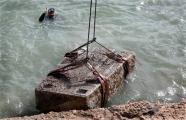
A sunken red granite tower, part of a pylon of the Isis temple is lifted out of the Mediterranean Sea off the archaeological eastern harbor of Alexandria
Think Spain, Spain
The unknown vessel, which bears the words Soli Deo Gloria (Latin for ‘only God the Glory’) was found by underwater investigators a few miles out to sea in Nagua, to the north-east of the island.
In addition to the galleon, the divers have also discovered navigation compasses and tools used for measuring the water’s depth, together with silver coins, a pistol, sword-sheaths and other wartime implements.
They also found ornaments and jewellery, including a ring with eight diamonds embedded into it.” [Full Story]
December 25, 2009, China Daily, China:
“A major underwater museum housing an 800-year-old merchant ship opened to the public in this coastal city in western Guangdong province yesterday.
The 30-m wooden vessel, named Nanhai No 1, or South China Sea No 1, lies in a ‘crystal palace’ made of glass inside the Maritime Silk Road Museum.
‘Today marks a new journey for the ancient merchant ship’, said Shan Jixiang, director of the State Administration of Cultural Heritage.
It was discovered early in 1987 off Hailing island of Yangjiang.” [Full Story]
December 18, 2009, The Associated Press, USA:
“Egyptian archaeologists have lifted out of the Mediterranean Sea an ancient granite temple pylon from the palace complex of Cleopatra, submerged in the waters of Alexandria’s harbor.
Divers and underwater archaeologists used a giant crane and ropes to lift the 9-ton, 7.4-foot-tall pylon from the murky waters Thursday
A sunken red granite tower, part of a pylon of the Isis temple is lifted out of the Mediterranean Sea off the archaeological eastern harbor of Alexandria
Nasser Nasser for AP
The tower was originally part of the entrance to a temple of Isis, a pharaonic goddess of fertility and magic.
The temple is believed to have been near the palace that belonged to the 1st century B.C. Queen Cleopatra in the ancient city of Alexandria, submerged in the sea centuries ago.” [Full Story]
December 17, 2009, BBC News, UK:
“OK, so there’s these so-called ‘undersea archaeologists’ who claim they’ve found what they call the ruins of the lost city of Atlantis and have released grainy images of their discovery, in the video below.
Here’s how the Huffington Post reported it:
‘Undersea archaeologists have found the ruins of an ancient city on the bottom of the Caribbean Sea, and researchers claim that it is the fabled and lost city of Atlantis. The satellite photos do show something that could be a city, and the researchers believe that what they’ve found would predate the pyramids of Egypt. Indeed they claim to be able to make out a pyramid and other city-like structures from the satellite photos.’
‘The archaeologists have so far refused to divulge their identities or the location in the Caribbean. They say they are raising money for an expedition to confirm their findings.’
So, for the gullible, here are a few red flags that this is yet another ‘we’ve discovered the remains of Bigfoot’ style hoax.
* They don’t say who they are.
* They won’t say where the ruins are.
* They’re trying to raise money.
Of course, we skeptics could be wrong and this could indeed be one of the archaeological discoveries of the centuries.” [Full Story]
December 17, 2009, BBC News, UK:
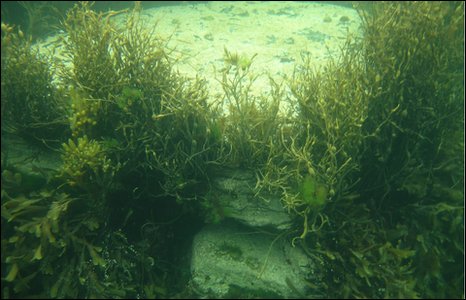
“A unique discovery of submerged man-made structures on the seabed off Orkney could help find solutions to rising sea levels, experts have said.
They said the well preserved stone pieces near the island of Damsay are the only such examples around the UK.
Among the many structures found submerged was this apparent table with four supports
BBC News
It is thought some of the structures may date back thousands of years.
Geomorphologist Sue Dawson said that people have survived and adapted in the past and it is that adaption to climate change that needs to be learned from.
In general Scotland’s mainland has been getting higher – but the surrounding islands have been sinking.” [Full Story]
December 16, 2009, Herald de Paris, France:
“New, un-filtered images were revealed, today, from the team claiming to have discovered a previously unknown and submerged ancient city on the sea floor, in the Caribbean.
This series of images were released, they say, to focus attention more on the discovered ruins, and less on the anomalous blocks misinterpreted by the satellite imagery.
These images appear to show stone foundations and construction rubble fields. Some of the features show verticality and shadow, which researchers claim pixelated distortion would not.
The team cautioned that the puffy-looking white areas in photo #4 are not clouds, but instead the reflection of the ocean’s surface with the sun high in the sky.” [Full Story]
December 16, 2009, ANSAmed, Italy:
“A rare artifact, dating to the Ptolemy era will be recovered from the seabed tomorrow, off Alexandria’s Eastern Port, which commands a major historical importance.
A project was initiated in 1992 by the Supreme Council of Antiquities, in cooperation with the European Institute of Submerged Antiquities, to make a topographic survey of the area of royal facilities at the submerged parts, specifically the Eastern Port of Alexandria, north Egypt.” [Full Story]
December 10, 2009, BBC News, UK:
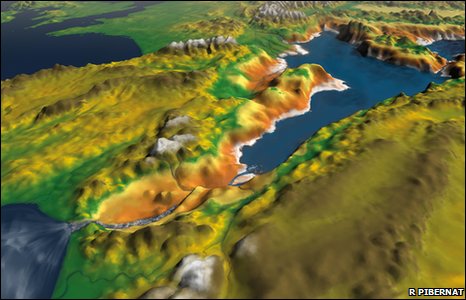
“Research has revealed details of the catastrophic Zanclean flood that refilled the Mediterranean Sea more than five million years ago.
The team made a reconstruction of the Mediterranean during the ‘megaflood’
R. Pibernat for BBC News
The flood occurred when Atlantic waters found their way into the cut-off and desiccated Mediterranean basin.
The researchers say that a 200km channel across the Gibraltar strait was carved out by the floodwaters.
Their findings, published in Nature, show that the resulting flood could have filled the basin within two years.” [Full Story]
December 05, 2009, The Star, Malaysia:
“For the past five years Horst H. Liebner has been uncovering the mystery behind 1,000-year-old artifacts recovered from two sunken treasures in the Java Sea.
Since1987, the German scholar has been researching maritime culture and the history of the Malay Archipelago.
As scientific advisor, Liebner, 49, who is based in Makassar, Sulawesi, has painstakingly pieced together information gathered from diverse sources to identify the two 10th century cargo ships that went down, now codenamed the ‘Cirebon/Nan-Han’ and the ‘Karawang’.
Besides 10th century coins as well as white and green-glazed ceramics from China, Liebner also documented gold artifacts including a dagger handle, glass bottles and bronze mirror. He has set up a database to register, measure, describe and evaluate underwater finds.” [Full Story]
December 04, 2009, ADNkronos, Italy:
“Italian archaeologists have discovered the remains of an ancient Roman city submerged off the coast of Libya.
The remains of the city date back to the 2nd century A.D. and were found by archaeologists and experts from Sicily and the University Suor Orsola Benincasa of Naples, involved in the ArCoLibia archaeology project.
The discovery took place on the Cape of Ras Eteen on the western side of Libya’s Gulf of Bumbah, as archaeologists were searching the area for shipwrecks and the remains of ancient ports.
Archaeologists instead found walls, streets, and the remains of buildings and ancient tombs.” [Full Story]
December 01, 2009, Cambridge News, England:
“RESEARCHERS from Cambridge have solved the mystery of how Britain split off from the Continent.
Long before the English Channel there was the ‘Fleuve Manche’ – a prehistoric ‘super-river’ which ran south from the area of the North Sea.
At different times the river ebbed sufficiently to let people and animals cross from the continent into England.
Then melting ice filled up the valley and the ‘Fleuve Manche’ became ‘La Manche’ – the French word for ‘sleeve’ that describes the English Channel.
Scientists have now pieced together the geological jigsaw behind these events after studying samples of sediment carried by the ancient river and deposited in the Bay of Biscay.
Earlier studies had suggested the river existed during a sequence of ice ages that began 450,000 years ago.” [Full Story]
November 30, 2009, The Sydney Morning Herald, Australia:
“DID American whalers discover the east coast of Australia before Captain Cook? That is the intriguing question a crack team of maritime archaeologists, divers and marine scientists hope to answer when they sail tomorrow for a remote reef 450 kilometres off the coast of Queensland.
The expedition leader, Kieran Hosty, describes the 200-year-old mystery of Wreck Reef as one of the great untold sagas of our maritime history.
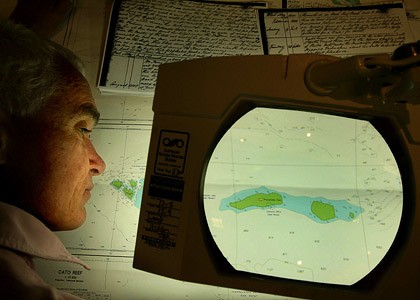
Wreck hunter… Kieran Hosty with a map of the reef
Steven Siewert for The Sydney Morning Herald
The story began in 1803, after Matthew Flinders had completed his epic circumnavigation of Australia and was returning to England.
He was a passenger on HMS Porpoise, a 10-gun sloop under the command of Lieutenant Robert Fowler. The ship was travelling in convoy, accompanied by Cato, an armed cargo ship, and Bridgewater, a cargo ship owned by the East India Company.
But disaster struck close to midnight on August 17 when Porpoise hit an uncharted reef in the dark. Fowler ordered a cannon to be fired to warn the other ships.
In the confusion Cato and Bridgewater were heading for a catastrophic collision until Captain Park, on the Cato, changed course, even though that meant hitting the reef about 400 metres from the Porpoise.” [Full Story]
November 27, 2009, Taiwan Today, Taiwan:
“Readers might be surprised to learn that Taiwan has underwater archaeological treasures to rival the remains of the ‘Titantic’, wrecks of Spanish treasure galleons in the Caribbean and even the lost city of Atlantis, said by Plato to have sunk into the ocean ‘in a single day and night of misfortune’.
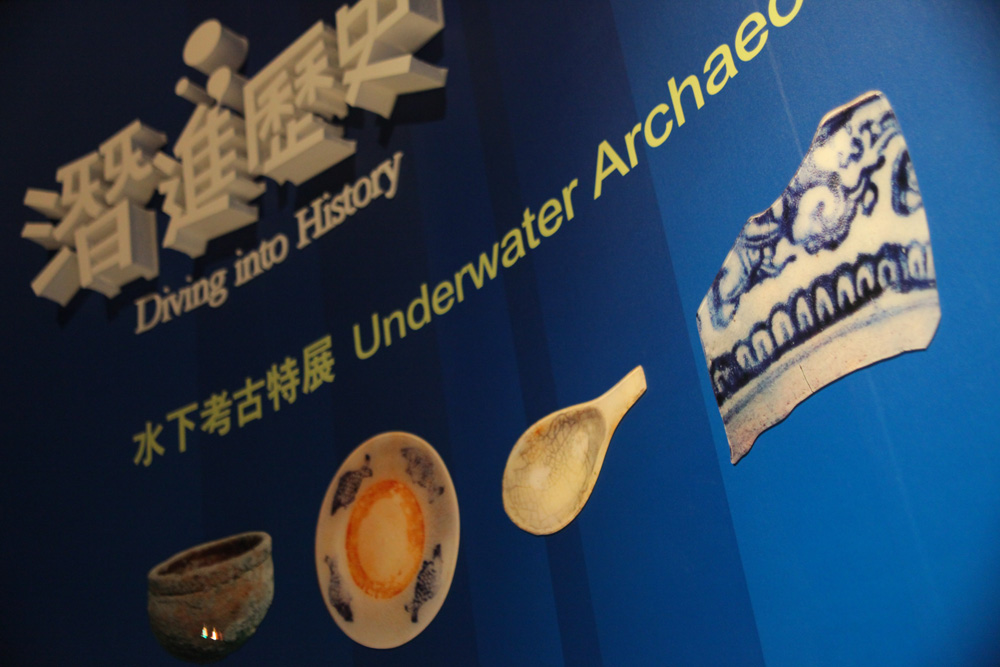
The place to go to find out about these treasures is ‘Diving into History’, the island’s first-ever underwater archaeology exhibition, put together by the Executive Yuan’s Council for Cultural Affairs, now at Bali Township’s Shihsanhang Museum of Archaeology in Taipei County until Dec. 13.
“Diving into History,” Taiwan’s first-ever underwater archaeology exhibition, now at Bali Township’s Shihsanhang Musuem of Archaeology in Taipei County through Dec. 13
CNA for Taiwan Today
As defined by the United Nations’ Educational, Scientific and Cultural Organization, underwater archaeology studies sites, artifacts and human remains which have been submerged in the ocean, lakes or rivers for at least 100 years.
UNESCO regards ‘archaeological sites located under water as important sources of historic information’ because these locations, ‘due to the lack of oxygen, contain material that is lost on comparable sites on dry land.’
Large-scale underwater exploration was not feasible until six decades ago when the development of an efficient free-diving apparatus made the task safer and easier.
‘Aqua-Lung’, a self-contained, underwater breathing device, was introduced by Jacques-Yves Cousteau and Emile Gagnon in 1943. It was important in allowing divers to operate underwater for long periods of time.” [Full Story]
November 23, 2009, Bangkok Post, Thailand:
“About 18 metres below the sea off Rayong province, 15 divers from seven countries are exploring a wooden shipwreck.
The exploration is part of Unesco’s six-week training on underwater cultural heritage preservation.
A participant in the six-week training on underwater cultural heritage preservation shows a piece of ancient artifact found at an underwater archaeological site in Rayong
Bangkok Post
The divers are from Cambodia, Indonesia, Laos, Malaysia, the Philippines, Sri Lanka and Thailand.
They have been picked for an underwater heritage protection programme organised by the United Nations Education, Scientific, and Cultural Organisation (Unesco) and the Fine Arts Department’s Underwater Archaeology Division (UAD) which runs from Oct 26 to Dec 6.
Division head Erbprem Vatcharangkul said Thailand has 64 underwater archaeological sites. He said all of them, especially those in shallow water, were under threat from treasure hunters.”
[Full Story]
November 05, 2009, The Local, Germany:
“Archaeologists have finished recovering a 600-year-old ship from Lake Constance discovered near a mediaeval Benedictine abbey, the state of Baden-Württemberg announced on Thursday
An ice skater reported the shallow wreck off the lake’s Reichenau Island in the winter of 2006 and subsequent dives and carbon testing by archaeologists revealed it was from the 14th century.
The Local, Germany
‘We believe it could be the oldest shipwreck ever found in the lake’, spokesperson for the Stuttgart regional commission Dr. Peter Zaar told The Local.
‘There is one other boat we know is also from the 14th century, but we need more testing to know for sure.’
Thursday marked the end of a four-day diving operation to recover the exposed parts of the boat, which will now be taken to a Hemmenhof laboratory where specialist Dr. Dietrich Hakelberg from the Seemuseum Kreuzlingen will lead examinations.”
[Full Story]
November 05, 2009, Dominican Today, Dominican Republic:
“The treasure hunters Marine Exploration, Inc. has updated its website to include pictures it said it recovered sunken treasure including gold and pearl jewelry, silver fittings, and dynasty china, as a possible conflict with Dominican Republic’s authorities surfaces.
Marine Exploration CEO Mark Goldberg comments, ‘The pictures uploaded to our website are preliminary photos of a few pieces of sunken treasure that we just found. They have not yet been inventoried or cataloged according to our Host Country Contract. ‘
‘We have secured the treasure wreck site and are bringing the R/V Hispaniola into port on the north shore for two days of provisioning and to bring aboard additional treasure holding tanks. Burt Webber will then take the team back to the wreck site to resume treasure recovery.’
The Company shall continue to issue near-term updates to its investors and the public as the recovery process continues.
Marine Exploration, Inc. and joint venture partner Hispaniola Ventures, LLC headed by Burt Webber, plan to continue the shipwreck site survey and salvage.”
[Full Story]
November 01, 2009, Herald Sun, Australia:
“Plato was in the news last week. Like most blokes born 2500 years ago, he doesn’t make headlines all that often these days.
But on the south coast of Greece an Anglo-Greek team of archaeologists and marine geologists has started investigating a submerged ruined settlement discovered by a British oceanographer in 1969.
It is a complete planned city with its own town hall, suggesting it was inhabited by an educated and advanced people. Ceramics recovered from it indicate someone was living there perhaps 5000 years ago.
Plato was believed to have been indulging in fiction ‘when he wrote of Atlantis’, although there has always been conjecture that such a place may have existed or at least inspired the tale.
Some were suggesting last week that perhaps Pavlopetri is it. For some reason the sea levels changed there dramatically and the city slid beneath the surface, hidden but untouched for millennia.
Who knows what secrets it might hold, and what we might learn from the remarkable Greeks of that era?
One of the reasons they are paying close attention to the site is because it is not far from the spot at which the so-called ‘Antikythera Mechanism’ was found.”.
[Full Story]
October 31, 2009, Reuters India, India:
“Scuba divers are exploring the depths of a volcanic lake in Guatemala to find clues about an ancient sacred island where Mayan pilgrims flocked to worship before it was submerged by rising waters.
Samabaj, the first underwater archaeological ruins excavated in Guatemala, were discovered accidentally 12 years ago by a diver exploring picturesque Lake Atitlan, ringed by Mayan villages and popular with foreign tourists.
‘No one believed me, even when I told them all about it. They just said ‘he’s mad”, said Roberto Samayoa, a businessman and recreational diver who grew up near the lake where his grandmother told him legends of a sunken church.
Samayoa dived for years at the lake, often stumbling across pieces of pottery from the Mayan pre-classic period. In 1996, he found the site, with parts of buildings and huge ceremonial stones, known as stelae, clearly visible.”.
October 28, 2009, The Daily Telegraph, UK:
“A British holidaymaker has uncovered what is believed to be a lost, ancient temple while snorkelling in the Mediterranean.
Michael Le Quesne, 16, was swimming off a popular beach in Montenegro with his parents and his ten-year-old sister Teodora when he spotted an odd looking ‘stone’ at a depth of around two metres.
The Montenegrin coast is dotted with ancient ruins yet to be documented
The Daily Telegraph, UK
It turned out to be a large, submerged building which may have been the centrepiece of an important Greek or Roman trading post, swallowed up by the sea during a massive earthquake.
A British team of experts led by Dr Lucy Blue, presenter of BBC Two show Oceans, is to investigate the significant find in this largely unexplored corner of south east Europe.
Dr Blue said that if the discovery is confirmed to be an underwater temple it would ‘put Montenegro on the map’.
She added: ‘Montenegro is largely an undiscovered underwater world.’“.
October 22, 2009, Powys County Times, Cymru:
“A walk along the promenade at Aberdyfi can be a fantastic way to spend an afternoon. This pretty town on the coast of the Irish Sea looks like it was lifted straight from a postcard.
However, ancient folklore claims that under the depths of the sea lies Wales’ equivalent to the lost city of Atlantis – Cantre’r Gwaelod, or Lowland Hundred.
Its value was immense to the people who inhabited it, due to its high fertility. Indeed, one acre of land on Cantre’r Gwaelod was said to be worth four acres on any other land.
It was protected from the seas by a series of sluice gates, which allowed the water to be released back to the sea following high tides.
These sluice gates were protected by two princes, however one of these princes,
Seithenyn, was notoriously famous for being rather fond of a drink or 200
The legend claims that it was his negligence while out gallivanting that allowed the sea to rise and claim the city, ruining the once-fertile land forever.”
October 21, 2009, Jacksonville Daily News, USA:
“An anchor from the shipwreck believed to be Blackbeard’s flagship, the Queen Anne’s Revenge, has been raised and can be viewed by the public Thursday before conservation of the artifact begins.
An anchor from the shipwreck believed to be Blackbeard’s flagship the Queen Anne’s Revenge, is expected to be raised Wednesday due to its unstable position.
Jacksonville Daily News
The four-and-a half-foot grapnel, a small four-pronged anchor, has been resting loosely in the sand on the ocean’s bottom and was considered too vulnerable to leave exposed to possible storms until the full-scale expedition, state officials said.
A team of N.C. Department of Cultural Resources archaeologists and conservators raised the grapnel Wednesday from the QAR site off Beaufort and the public will have two opportunities Thursday to see it.”
[Full Story]
October 17, 2009, The Guardian, UK:
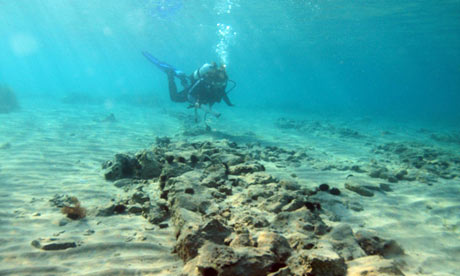
“The secrets of a lost city that may have inspired one of the world’s most enduring myths – the fable of Atlantis – have been brought to light from beneath the waters off southern Greece.
Explored by an Anglo-Greek team of archaeologists and marine geologists and known as Pavlopetri, the sunken settlement dates back some 5,000 years to the time of Homer’s heroes and in terms of size and wealth of detail is unprecedented, experts say.
A diver explores the sunken settlement beneath the waters off southern Greece
The Guardian
‘There is now no doubt that this is the oldest submerged town in the world’, said Dr Jon Henderson, associate professor of underwater archaeology at the University of Nottingham.
‘It has remains dating from 2800 to 1200 BC, long before the glory days of classical Greece. There are older sunken sites in the world but none can be considered to be planned towns such as this, which is why it is unique.’
The site, which straddles 30,000 square meters of ocean floor off the southern Peloponnese, is believed to have been consumed by the sea around 1000 BC.”
[Full Story]
October 16, 2009, AlphaGalileo, Belgium:
“Archaeologists surveying the world’s oldest submerged town have found ceramics dating back to the Final Neolithic.
Their discovery suggests that Pavlopetri, off the southern Laconia coast of Greece, was occupied some 5,000 years ago — at least 1,200 years earlier than originally thought.
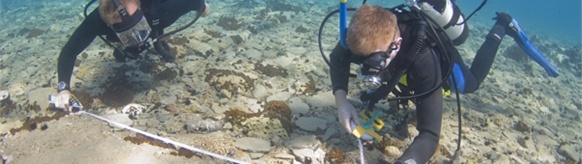
archaeological divers surveying the world’s oldest submerged town off the southern Laconia coast of Greece
University of Nottingham / AlphaGalileo
These remarkable findings have been made public by the Greek government after the start of a five year collaborative project involving the Ephorate of Underwater Antiquities of the Hellenic Ministry of Culture and The University of Nottingham.
As a Mycenaean town the site offers potential new insights into the workings of Mycenaean society.
Pavlopetri has added importance as it was a maritime settlement from which the inhabitants coordinated local and long distance trade.
The Pavlopetri Underwater Archaeology Project aims to establish exactly when the site was occupied, what it was used for and through a systematic study of the geomorphology of the area, how the town became submerged.”
[Full Story]
October 13, 2009, The Chronicle Herald, Canada:
“A large rock juts out of the dark, choppy waters off Prospect.
Inscribed on it is the date Nov. 24, 1814, and the name Fantome, the British warship that hit a rocky reef and sank there.
This spot, about 30 kilometres southwest of Halifax, has become the flashpoint for a turf war that reaches to the depths of the ocean floor.
The crew of the 18-gun naval brig survived, and for nearly 200 years, so has the mystique about what the sloop may have been carrying.
Because of that, archeologists and the treasure hunters who hire them to document Nova Scotia’s marine heritage are at loggerheads over how wrecks like the Fantome should be treated.
Nova Scotia is the only province to allow treasure hunting. Critics say the Treasure Trove Act should be abolished.
The province estimates there are about 10,000 shipwrecks around Nova Scotia, giving it one of the richest maritime histories in the world.”
[Full Story]
October 13, 2009, The Wall Street Journal, USA:
“The New Forest National Park Authority (NFNPA) in the UK is using detailed marine mapping from local company SeaZone to undertake an archaeological assessment of its coastline in response to changing sea levels.
As part of a nationwide programme of Rapid Coastal Zone Assessment Surveys supported by English Heritage, the study will help with the development of long term coastal management plans by identifying archaeological and historic sites and protecting them where possible or making provision for their recording where this may not be possible.
In this area, there is a need to protect archaeological sites and artefacts from rising sea level and flooding as well as increasing pressures from industrial, residential and leisure developments.
Using SeaZone HydroSpatial together with additional historic records such as aerial photographs, many dating back over 90 years, the study aims to identify and record previously undiscovered archaeological sites and artifacts along the 86km of New Forest National Park coastline.”
[Full Story]
October 09, 2009, The Wall Street Journal, USA:
“Marine archaeologists have discovered a 17th-century shipwreck in recent months with a cargo that includes the world’s earliest pocket calculator – a wooden carpenter’s rule – while exploring the seabed of the English Channel.
It offers a tantalizing taster of treasures that may lie within nearly 270 wrecks that have been identified, but whose survival is under serious threat from 21st-century trawlers working the busy channel between the Continent and Britain.
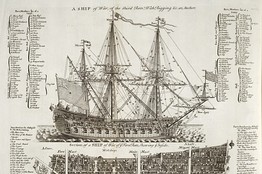
Diagram of a warship from the 1728 Cyclopaedia
Wikipedia / The Wall Street Journal
Some historic vessels that fell victim to the sea or cannon fire centuries ago could disappear within five years, according to a leading British marine archaeologist, Sean Kingsley, who is an adviser on the most extensive archaeological deep-sea survey of the Channel ever undertaken.
‘Incalculable wreck destruction has already occurred’, says Dr. Kingsley, who heads Wreck Watch International, a specialist consultancy.
‘Sites of major archaeological significance have been or are being completely destroyed. Without a swift resolution, future generations may judge us as having signed the death warrant for some of the world’s most important archaeological sites.’“
[Full Story]
October 08, 2009, Archaeology Magazine, USA:
“Since archaeologists first began to suit up in scuba gear in the 1960s, the excavation of underwater sites has transformed how we understand our past.
With thousands of sites to choose from, we no doubt missed a favorite of yours, but for our doubloons, these 12 are the most exciting and surprising discoveries made during the age of underwater archaeology.
Underwater archaeology isn’t just about shipwrecks; some of the most spectacular finds have been ancient villages, cemeteries, and even entire cities.
The most exciting discoveries ever made in the Mediterranean were two vessels that gave archaeologists a complete picture of how mariners plied the seas during the Bronze Age.”
[Full Story]
October 06, 2009, ThinkSpain, Spain:
“The remains of a sunken 17th or 18th century galleon have been found by a fisherman in Fornells, on the north coast of the island of Menorca.
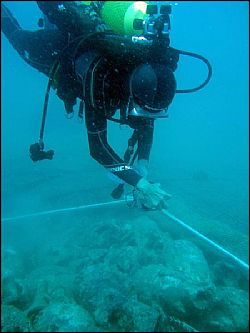
A diver inspecting the remains of a galleon off the coast of Menorca
ThinkSpain
According to information provided by the Argo Maris foundation investigating the find, an initial inspection of the site by remote controlled vehicles has revealed a sunken shipwreck approximately 60 metres down and covering a radius of about 40 metres.
Several huge anchors, iron cannons and wooden parts of the ship’s structure have been identified, suggesting either a frigate or a war galleon from the 17th or 18th centuries.
The initial archaeological survey was carried out by a team of archaeologists from the Ecomuseo Cap de Cavalleria with the support of the Argo Maris foundation, and their report has now been presented to the Culture & Heritage Department of the Council of Menorca.”
[Full Story]
October 04, 2009, Cyprus Mail, Cyprus:
“The Department of Antiquities has just released the findings of its survey of a Roman shipwreck near Cape Greco on the Island’s southeast coast.
The shipwreck dates from the 2nd century AD and contains over 130 ceramic jars, likely to have been carrying wine or oil.
‘Its location in shallow waters, suggest that either the vessel was nearing an intended port-of-call, or else was engaged in a coasting trade, moving products to market over short distances up and down the coast’, said a press release from the Department of Antiquities.”
[Full Story]
September 27, 2009, CCTV, China:
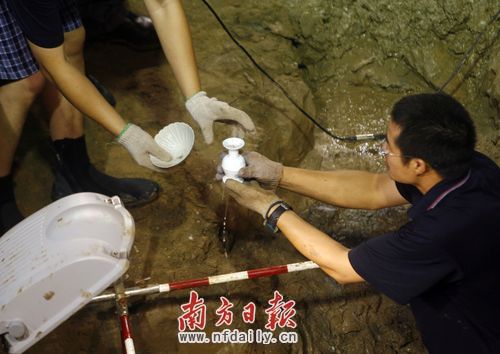
“Chinese archaeologists have discovered more than 200 precious porcelain artifacts on an 800-year-old merchant ship in the southern province of Guangdong
The 40-day trial excavation ended Saturday and a massive excavation would start next year, said Wei Jun, an archaeologist leading the excavation.
Chinese archaeologists with some of the 200 porcelain artifacts found on an 800-year-old merchant ship in the southern province of Guangdong
China.org
The Nanhai (South China Sea) No. 1 ship from the Song Dynasty (960-1279) was loaded with an estimated 60,000 to 80,000 pieces of relics.
Archaeologists have also found well-preserved cabin, board and deck in the trial excavation.
They had recovered more than 4,000 artifacts of gold, silver and porcelain, and about 6,000 copper coins on the merchant ship while it was still on the seabed.”
[Full Story]
September 27, 2009, This is Hampshire, England:
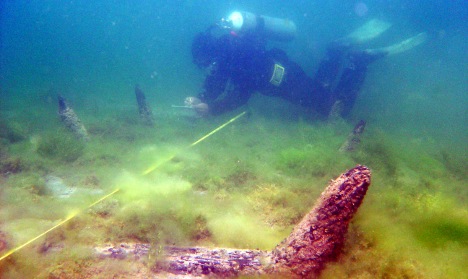
“Diving almost blind in the Solent’s murky waters, the team of maritime detectives could just make out the shape of a wooden plank protruding from the muddy seabed.
While it might have been dismissed as underwater junk by the untrained eye, the archaeologists soon realised they had discovered a vital clue to a lost civilisation.
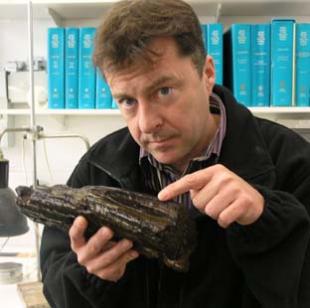
Garry Momber holding one of the pieces of wood that marine archaeologists have found in the Solent
This is Hampshire
The timber was not isolated. In fact they found another 23 pieces of all shapes and sizes intersecting throughout the underwater cliff off Bouldnor, on the north coast of the Isle of Wight.
They are now convinced the timber is evidence of a huge wooden structure built about 8,000 years ago by our Mesolithic ancestors.”
[Full Story]
September 23, 2009, Post-Gazette, USA:
“Onerous searches often are compared with finding needles in haystacks. But two Mercyhurst College archeologists are involved in a search dramatically more challenging.
That’s because they’ve had to find the proverbial haystacks long before even thinking about finding the proverbial needles.
From the summer Mercyhurst trip to the Gulf of Mexico off Florida with James Adovasio and C. Andrew Hemmings, searching for signs of early human activity: Researchers head for a dive site
Mercyhurst Archaeological Institute
James Adovasio, director of the Mercyhurst Archaeological Institute, and C. Andrew Hemmings, a Mercyhurst research associate, plan next summer to dig for evidence of prehistoric humans about 130 feet underwater in the Gulf of Mexico sea bed.
It might sound odd, at least initially, that clues to human habitation of North America are submerged in the Gulf of Mexico. But as far back as 22,000 years ago, a substantial portion of Earth’s water was in the form of glacial ice atop the continents.
Ice two miles thick, for example, covered current-day Erie, Dr. Adovasio said.
Much shallower oceans meant coastlines extended hundreds of miles onto the continental shelves. So what once was dry coastline now is 130 to 160 feet underwater.”
[Full Story]
September 19, 2009, NineMSN News, Australia:
“US deep-sea treasure hunters have reached an agreement with the British government to end a court fight and cooperate in salvaging artifacts from a sunken warship.
Florida-based Odyssey Marine Exploration discovered last year the remains of the HMS Victory, a 100-gun vessel that sank in the English Channel in 1744.
The company’s chief executive said the lawsuit filed in US District Court in Tampa was dismissed after London agreed to provide Odyssey a salvage award of about 160,000 dollars after obtaining two bronze cannons recovered from the site.
‘We’re thrilled that we’ve been able to return two cannon from (Admiral John) Balchin’s Victory to the citizens of the United Kingdom, but these are just a small portion of the irreplaceable cultural artifacts that remain at the site’, Greg Stemm said in a statement.”
[Full Story]
September 18, 2009, San Antonio Express, USA:
“Archaeologists have found five well-preserved Roman shipwrecks deep under the sea off a small Mediterranean island, with their cargo of vases, pots and other objects largely intact, officials said Friday.
The ships are submerged between 330 to 490 feet off Ventotene, a tiny island that is part of an archipelago off Italy’s west coast between Rome and Naples.
The ships, which date from between the 1st century B.C. and the 4th century, carried amphorae – vases used for holding wine, olive oil and other products – as well as kitchen tools and metal and glass objects that have yet to be identified, Italy’s Culture Ministry said.
The spot was highly trafficked, and hit by frequent storms and dangerous sea currents.
The discovery is part of a new drive by archaeological officials to scan deeper levels of the sea and prevent looting of submerged treasures.
Discoveries of shipwrecks are not unusual in the Mediterranean, but these ships are far better preserved than most, which are often found scattered in fragments, said Annalisa Zarattini, the head of the ministry’s office for underwater archaeology.”
[Full Story]
September 17, 2009, Daily News, Sri Lanka:
“Submerged archaeologists have found 12 Mayan pre-Hispanic skulls, two rifles from the Colony time and about 50 vessels in the sinkholes in southwestern Mexico, Mexican culture officials said on Tuesday.
Daily News, Sri Lanka
The Mexican National Institute of Anthropology and History (INAH) announced that those relics were found in Mexico’s Yucatan state during researches aimed at completing the Underwater Archeological Atlas of Yucatan Peninsula.
According to INAH archaeologist, Lisseth Pedroza, some 50 domestic and ritual vessels from the Late Pre-classic period (400-250 A.C.) were found in Kan Kab Che’en sinkholes.”
[Full Story]
August 31, 2009, Siemens R & D Mag, USA:
“In one of the more dramatic moments of an underwater archaeological survey co-led by Mercyhurst College archaeologist James Adovasio along Florida’s Gulf Coast this summer, Andy Hemmings stood on an inundated river’s edge where man hasn’t set foot in more than 13,000 years.
Donning full scuba gear, Hemmings stood in 130 feet of water on a peninsula at the intersection of two ancient rivers nearly 100 miles offshore from Tampa. The last time humans could have stood in that spot, mammoth and mastodon roamed the terrain.
‘The successful tracking of the St. Marks-Aucilla River and the Suwannee River, between 50 and 150 kilometers respectively, represents what we believe to be the most extensive delineation of submerged prehistoric river systems ever done anywhere in the world’, Adovasio said.
Another pivotal find is the identification of chert at three dive sites along the river systems; chert is a superior quality fine-grained stone used by prehistoric peoples to make tools.
‘There is no doubt’, Adovasio said, ‘that we have found the haystacks and are one step closer to uncovering the archaeological needles;” in effect, narrowing the search for evidence of early Americans in the now submerged Inner Continental Shelf in the Gulf of Mexico off the Florida coast.’
Hemmings, one of the leading Paleoindian underwater archaeologists in North America, agreed.‘My feeling is, given a little time to probe the sediments with a dredge, we will quickly find human artifacts.’.”
[Full Story]
August 26, 2009, Florida Today, USA:
“Though Indialantic’s Robert Marx has explored ancient shipwrecks all over the world, there’s one hotspot that has eluded him until now: The waters off Cape Canaveral.
After he clears the last hurdles to his search during a trip to Spain this week, Marx will probe the depths for the Spanish treasure ships he knows wrecked here.
From the 1500s onward, the waters off Florida’s east coast were a major lane for fleets laden with gold and jewels.
The sailors looked for a hill and clump of trees that marked the Cape and set upon a relatively safe route east to Europe from there. Unfortunately, many read the geography badly, took a wrong turn and wrecked in the shallows.
It was so shallow in some areas that old maps actually show islands off Cape Canaveral. And hurricanes didn’t help.
‘In the area we’re interested in, there’s a minimum 50 to 60 treasure wrecks out there,’, Marx said. You’ve got galleons on the way home, but there’s a lot of other ones that we don’t know about, and we don’t know about it because the document would just say ‘lost off the Cape.”“
[Full Story]
August 18, 2009, IU Newsroom, USA:
“A prehistoric water-filled cave in the Dominican Republic has become a ‘treasure trove’ with the announcement by Indiana University archaeologists of the discovery of stone tools, a small primate skull in remarkable condition, and the claws, jawbone and other bones of several species of sloths.
The discoveries extend by thousands of years the scope of investigations led Charles Beeker, director of Academic Diving and Underwater Science Programs at IU Bloomington’s School of Health, Physical Education and Recreation, and his interdisciplinary team of collaborators.
Jessica Keller holds the primate skull found in the Padre Nuestro Cavern
Indiana University
The researchers’ focus has been on the era a mere 500 years ago when the Old World and New World first met after Christopher Columbus stepped ashore in the Caribbean — and on scintillating pirate lore.
This rare find is expected to give insights into the earliest inhabitants of the Greater Antilles and the animals they encountered.
‘To be honest, I couldn’t believe my eyes as I viewed each of these astonishing discoveries underwater’, Beeker said.
‘The virtually intact extinct faunal skeletons really amazed me, but what may prove to be a fire pit from the first human occupation of the island just seems too good to be true. But now that the lithics (stone tools) are authenticated, I can’t wait to direct another underwater expedition into what may prove to become one of the most important prehistoric sites in all the Caribbean.’“
[Full Story]
August 09, 2009, Los Angeles Times, USA:
“The fire began in the galley, where the crew had kept a stove burning while they visited a tavern ashore. As the flames devoured her stern, the Anna Maria sank through the ice in the Stockholm archipelago.
Three hundred years later, the Dutch merchant ship rests amid seaweed and algae about 60 feet (18 meters) below the surface. Marine archaeologist Niklas Eriksson relives the blaze.
‘Now I’m swimming towards the stern where the galley was located and it was here that they had dinner, it was here that the fire started’, Eriksson says, his voice transmitted through a cable to a research boat on the surface.
‘I think it’s quite fascinating to be aboard the same ship as those fellows.’
The Anna Maria is part of a vast graveyard of ill-fated ships hidden in the murky waters of the Baltic Sea, protected from the shipworm that destroys wooden wrecks in saltier oceans.
Some 20,000 shipwrecks have been found — half of them in Swedish waters — dating back to as far as the Viking age. Researchers believe as many as 80,000 more could still be waiting to be discovered.”
[Full Story]
August 08, 2009, Taipei Times, Taiwan:
“Over 1,100 years ago, an international crew of men set sail on a perilous journey. They are returning home from Tang Dynasty China with rare ceramics and gold, created by ninth-century Chinese craftsmen, desired by the rest of the world.
But on their return voyage, they made a fateful decision. Here, off the coast of Indonesia, the reef-filled waters are so deadly that ancient sailors called the area the Treacherous Bay.
Tilman Walterfang was lured here in the late 1990s, in search of undersea treasure. An engineer by trade in his native Germany, Walterfang maintains a lifelong passion for ancient art.
He comes to Indonesia on a quest for big discoveries. Local fishermen find a mound of ceramics on the seabed.
Based on the designs, they appear to have been created between 600 and 900AD, in Tang China.
The whole vessel was buried. It had 1,100 years of sediment accumulated on top of that.”
[Full Story]
August 06, 2009, YLE Uutiset, Finland:
“An underwater archeological investigation of the wreck of a 13th century ship in Finnish waters is providing new insights into Baltic maritime trade during the Middle Ages.
Divers this summer have been bringing up unusually well-preserved ceramic and bronze artifacts.
Ceramic fragments recovered from the Engelskär wreck.
YLE Uutiset, Finland
An exceptionally large number of artifacts have been discovered in the wreck of a ship that went down in the Finnish archipelago sometime in the late 1200s or early 1300s.
The Engelskär wreck, as it’s called, was first discovered in 1996 by marine biologists working in the area.
This summer, the site is the most important field operation for archeologists from the National Board of Antiquities.”
[Full Story]
August 06, 2009, The Epoch Times, USA:
“Swedish divers were surprised to discover a well-kept shipwreck from the 17th century outside the Värmdö municipality, in the archipelago of Stockholm.
‘We were actually searching for a cargo ship that had sank in the 1940s, but then we found this instead’, Markus Hårde, one of the wreck divers told Svenska Dagbladet, a Swedish paper.
The shipwreck is probably a Dutch trading ship from early 17th century. Marcus Hårde discovered the wreck together with Anders Backström and Jonas Rydin in May.
The divers saw a lion figurine on the rudder and nicknamed the it ‘The Lion Wreck.’
The ship with three masts seems to be well kept, and has been under 141 feet (43 meters) of water for 400 years.”
[Full Story]
August 06, 2009, Ethiopian Review, Ethiopia:
“Dunwich, England, is one of several underwater sites where divers are uncovering new information about historic cultures.
Beneath the slate-gray surface of the North Sea, about a half-mile off England’s east coast, lies the underwater town of Dunwich. Crabs and lobsters skitter along the streets where some 3,000 people walked during the town’s heyday in the Middle Ages. Fish dart through the sea sponge-ridden ruins of its churches, now partially buried in the seabed some 30 feet down.
Erosion—caused by the North Sea’s relentless pounding of England’s east coast—had all but consumed Dunwich (pronounced DUN-ich) by 1750. And the sea’s silty, cold waters made visibility almost nonexistent for the intrepid few who wanted to explore the medieval ruins.
Until now. Thanks to advances in acoustic technology, a group of divers and a geomorphologist are surveying the sunken town this summer using multibeam and sidescan sonars that can detect objects on the seafloor. During a survey last year, the group mapped two churches and found evidence of a third.
‘This is absolutely opening the seas up’, said David Sear, the Dunwich project’s geomorphologist who teaches at the University of Southampton. And, he added, the North Sea has plenty to reveal; in addition to Dunwich, Sear would like to use the undersea technology to explore the submerged towns of Old Kilnsea and Eccles that lie farther north.
The English sunken sites join a list of others that span the globe. According to UNESCO, submerged settlements have been found in Egypt, India, Jamaica, Argentina, Denmark, Sweden, Italy, and the Black Sea.
‘Under the sea is probably the world’s biggest museum’, said James P. Delgado, president of the Institute of Nautical Archaeology based in Texas. ‘There’s not a lot of work going on in this area right now, however. The issues are time, money, interest, and research. Just to do a single shipwreck can take years…. Underwater archaeology costs 10 times more to dig.’“
August 02, 2009, The Epoch Times, USA:
“Approximately 9,000 to 5,000 years ago in the northern Turkish province of Sinop, an event of spectacular historic magnitude took place.
So spectacular, in fact, that some believe it represents proof that the ‘Great Flood’ recounted in the Bible may have been an actual (though somewhat exaggerated) representation of real events.
In September of 2004, an expedition in the Black Sea by a team of scientists from various institutions (including the National Geographic Society) determined that the sea in question was not always as we know it today.
They concluded that it had originated from an immense lake of black water that at one point in history began to widen in an unusually rapid way.
The change was so great, in fact, that inhabitants of the surrounding area were immediately obliged to search for more secure land, hastily leaving behind housing, tools, and other traces of their former lives.”
[Full Story]
July 30, 2009, Pittsburgh Tribune-Review, USA:
“Andrew Hemmings walked Wednesday on a Florida beach that man hasn’t set foot on in more than 13,000 years.
Not because it isn’t a popular stretch of real estate — it’s just that few people are able to don full scuba gear and dive 40 feet under water in the Gulf of Mexico for a stroll in the sand.
The University of Texas archaeologist is part of an elite team of scientists led by James Adovasio of Mercyhurst College in Erie.
Adovasio, former chairman of the University of Pittsburgh’s anthropology department, is looking for evidence of the earliest North American settlements along the coast of Florida that were submerged thousands of years ago by glacial ice melting.”
[Full Story]
July 30, 2009, The Daily Telegraph:
“The wreck of a 19th century English ship loaded with gold and silver worth millions of pounds has been found by German adventurers in seas off Indonesia.
More than 1.5 tonnes of silver coins, gold jewellery, crystal, Chinese porcelain, cannon, muskets and 400 bottles of wine were recovered by the treasure hunters from the Forbes, a ship that ran aground between Borneo and Sumatra in 1806.
The team believes the value of the find to be at least 7 million euros (£6m)
EPA / The Daily Telegraph
Martin Wenzel, one of the hunters, told The Daily Telegraph that the discovery had come like ‘a shot of adrenalin in the blood’.
‘I found the first things during a survey and everything just looked encrusted but when I saw there was treasure like this I just couldn’t believe my eyes’, he said.
The Forbes was a prolific trading and buccaneering ship that had King George III’s approval to attack and plunder foreign vessels.”
[Full Story]
July 27, 2009, Top News, India:
“A team of archaeologists has discovered a trove of five Roman-era shipwrecks deep under the sea off a small Mediterranean island near Italy.
According to a report in Discovery News, the find of well-preserved ships, made possible by sonar technology and the use of remotely operated vehicles, includes cargo of largely intact clay vases and pots transporting wine, olive oil, fish sauce and other goods.
Resting untouched between 330 to 490 feet underwater near the small island of Ventotene, which lies 30 miles off the Italian coast halfway between Rome and Naples, the ships date from the 1st century B. C. to the 5th century A. D.
The oldest ship – approximately 18 meters (59 feet) long, 5 meters (16.4 feet) wide and perhaps 2,100 years old – was carrying clay amphorae (a type of ceramic vase with two handles and a long neck narrower than the body) filled with wine from the southern Italian region of Campania.”
[Full Story]
July 26, 2009, Times of Malta, Malta:
“The murky water in Dock No.1 in Cospicua has witnessed much history over the years. Nobody ever imagined, however, that lying underneath could be the remains of an ancient Turkish wonder – the Mausoleum of Halicarnassus.
No one, that is, but oncologist Stephen Brincat, who came across this precious piece of information while reading an article about the excavations of the site by the British in the 19th century in the Turkish magazine Cornucopia.
‘There was one sentence which said that the wall of the mausoleum was dismantled to build a dock in Malta’ Dr Brincat said.
The discovery is part of a new drive by archaeological officials to scan deeper levels of the sea and prevent looting of submerged treasures.
Blocks of marble that made up a wall of the mausoleum, built more than 300 years BC, are believed to be submerged in the dock, which is expected to be soon embellished in a €10 to €12 million project.
The mystery remains hidden under water which is so murky that it is impossible to see the bottom.”
[Full Story]
July 24, 2009, The Associated Press, USA:
“Archaeologists have found five well-preserved Roman shipwrecks deep under the sea off a small Mediterranean island, with their cargo of vases, pots and other objects largely intact, official said Friday.
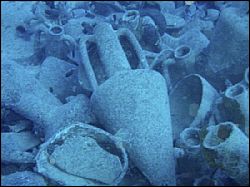
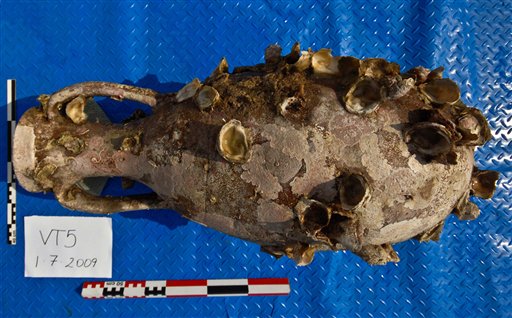
An encrusted amphorae, believed to be of Spanish origin and dating back to the 1st century A.D., after it was found with other objects off the coast of Ventotene
Italian Culture Ministry / The Aurora Trust
The ships are submerged between 100 and 150 meters (about 330 to 490 feet) off Ventotene, a tiny island that is part of an archipelago off Italy’s west coast between Rome and Naples.
The ships, which date from between the 1st century B.C. and the 4th century, carried amphorae — vases used for holding wine, olive oil and other products — as well as kitchen tools and metal and glass objects that have yet to be identified, Italy’s Culture Ministry said. The spot was highly trafficked, and hit by frequent storms and dangerous sea currents.
The discovery is part of a new drive by archaeological officials to scan deeper levels of the sea and prevent looting of submerged treasures.
Discoveries of shipwrecks are not unusual in the Mediterranean, but these ships are far better preserved than most, which are often found scattered in fragments, said Annalisa Zarattini, the head of the ministry’s office for underwater archaeology.
Because the ships sank at a deeper lever than most known wrecks, they were not exposed to destructive underwater currents, she said.”
[Full Story]
July 24, 2009, ANSA, Italy:
“An amateur scuba diver has discovered what may be the ruins of an ancient city off the coast of Calabria, a local town council said Friday.
Stone blocks may come from Scylletium
ANSA, Italy
Alessandro Ciliberto, an architect with a passion for scuba diving, discovered a group of stone blocks around 3-4 metres under water while he was diving 15 metres from the shore near the town of Squillace on Calabria’s east coast.
‘Standing out against the sandy seabed there’s a dark-coloured form of around two metres in length and a metre and a half wide which seems to be man-made’, Ciliberto said.”
[Full Story]
July 23, 2009, Reuters, UK:
“A team of archaeologists using sonar technology to scan the seabed have discovered a ‘graveyard’ of five pristine ancient Roman shipwrecks off the small Italian island of Ventotene.
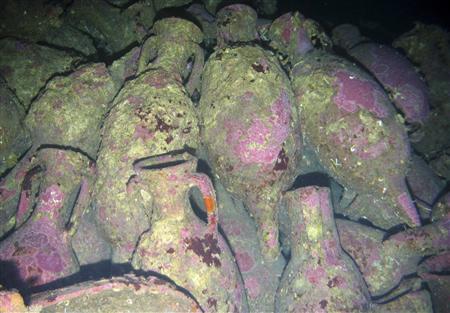
Amphorae from a Roman shipwreck are seen on the seabed near the island of Ventotene in a June 19, 2009 file photo.
Timmy Gambin / Aurora Trust / Reuters
The trading vessels, dating from the first century BC to the fifth century AD, lie more than 100 meters underwater and are amongst the deepest wrecks discovered in the Mediterranean in recent years, the researchers said on Thursday.
Part of an archipelago situated halfway between Rome and Naples on Italy’s west coast, Ventotene historically served as a place of shelter during rough weather in the Tyrrhenian Sea.
‘The ships appear to have been heading for safe anchorage, but they never made it’, said Timmy Gambin, head of archaeology for the Aurora Trust. ‘So in a relatively small area we have five wrecks…a graveyard of ships.’“
July 23, 2009, Targeted News Service, USA:
“The U.S. Commerce Department’s National Oceanic & Atmospheric Administration has four cooperative agreement opportunities for exploration and discovery of important maritime heritage sites.
The estimated total program funding available was cited as $400,000, although no specific amount for this award was indicated by the agency.
This funding opportunity is open to state, county, city, town, and Native American tribal governments; public, state and private institutions of higher education; nonprofits; for-profits; eligible agencies of the federal government; and non-domestic entities.”
[Full Story]
July 22, 2009, The News Tribune, USA:
“South Sound’s premiere archaeological site was a busy place Tuesday as 27 students and supervisors from all over the country worked with painstaking care to uncover treasures from a 700-year-old fishing and seafood-processing camp once inhabited by ancestors of the Squaxin Island tribe.
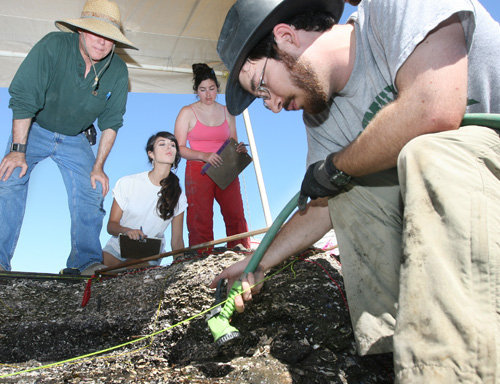
Squatting in a 1-square-meter cell, Dartmouth College graduate Mark Williams used a water nozzle set at a fine mist to slowly expose a piece of cedar basketry or mat in an area of the dig that is only accessible at low tide.
Dale Croes, South Puget Sound Community College archaeology professor, and several summerquarter students observe as Mark Williams, a site supervisor and former student, carefully uncovers a section of material Tuesday at the Squaxin Island tribal archaeology site on Mud Bay
STEVE BLOOM, The Olympian
‘We first discovered it on the last day of last summer’s dig’, Williams said. ‘One of our priorities is to get it out this year.’
Now in its 11th year, the excavation along the lower Eld Inlet shoreline is a cooperative venture among South Puget Sound Community College, the tribe and property owners Ralph and Karen Munro.
Over the years, the fish camp and food-processing plant has produced amazing artifacts, often well-preserved in the shoreline mud where they have escaped decay.
Items include a toy war club, portions of a cedar bark gillnet used to catch salmon, ornamental baskets, arrows, spears and shell jewelry.”
[Full Story]
July 20, 2009, Big Blue Tech, USA:
“Machete chops echo and leaves rustle underfoot when the vines clear, revealing cobalt-blue water in a cliff-sided pool.
Hidden beneath the dry-season forest, these waters, the blue cenotes (cen-NO-tays) of Cara Blanca, represent a mystery for scholars, one left by the ancient Maya. What lies within these sacred wells?
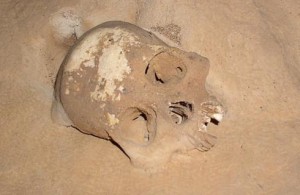
an image of a Maya skyll found underwater in a cenote
Big Blue Tech, USA
‘Cenotes were portals to the underworld, Xibalba, for the Maya’, says archaeologist Lisa Lucero of the University of Illinois at Urbana-Champaign on a tour of the pools in May. ‘Offerings, artifacts — they would have left something there for the gods. We would expect to find something.’
The secrets of the ancient Maya, whose Central American population centers were mysteriously abandoned more than a millennium ago, have long intrigued scientists. Why did such a complex culture disappear?
Lucero and her colleagues are among those trying to understand this lost world. They have been searching the 6-mile-long Cara Blanca site for ruins since 1998, working each year primarily in May and June, before the rainy season.”
[Full Story]
July 20, 2009, Big Blue Tech, USA:
“Where the first Americans came from, when they arrived and how they got here is as lively a debate as ever, only most of the research to date has focused on dry land excavations.
But, last summer’s pivotal underwater exploration in the Gulf of Mexico led by Mercyhurst College archaeologist Dr. James Adovasio yielded evidence of inundated terrestrial sites that may well have supported human occupation more than 12,000 years ago, and paved the way for another expedition this July.
Inundated terrestrial sites that may well have supported human occupation more than 12,000 years ago
Big Blue Tech, USA
As part of their 2008 findings, the researchers located and mapped buried stream and river channels and identified in-filled sinkholes that could potentially help document the late Pleistocene landscape and contain artifacts and associated animal remains from early human occupations.
Continued exploration, Adovasio said, will be geared toward assessing a human presence on the now submerged beaches and intersecting river channels.
‘There’s no doubt that early North American occupations are underwater, but it’s like looking for a needle in a haystack’, he said. ‘We have found the haystack; now we’ve got to find the needles.’“
[Full Story]
“A book that completetly changes the established and conventional view of prehistory by relocating the Lost Eden – the world’s 1st civilization – to SouthEast Asia. At the end of the Ice Age, SouthEast Asia formed a continent twice the size of India, which included Indochina, Malaysia, Indonesia and Borneo.
The South China Sea, the Gulf of Thailand and the Java sea, which were all dry, formed the connecting parts of the continent. Geologically, this half sunken continent is the Shunda shelf or Sundaland.
He produces evidence from ethnography, archaeology, oceanography, from creation stories, myths and sagas and from linguistics and DNA analysis, to argue that this founder civilization was destroyed by a catastrophic flood, caused by a rapid rise in the sea level at the end of the last ice age.”
… exclusive …
October 2002
Morien Institute
illustrated interview with
Professor Masaaki Kimura
of the University of the Ruykyus,
Okinawa, Japan, regarding
the discovery of:
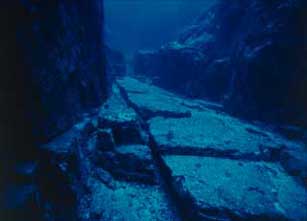
“Do undersea relics near Okinawa offer proof of a sophisticated civilization during the last ice age? Archeologists have long believed that civilization as we define it — intelligent, tool-making, monument building, social humans — began about 5,000 years ago. But submerged beneath the waves near the Japanese island of Yonaguni is evidence that may well overturn that long-held theory.
A small but persuasive number of scholars and scientists have long thought that “advanced” societies may have existed as long as 10,000 years ago. Their theories, however well reasoned and defended, have been hamstrung by a lack of evidence. But recent discoveries of man-made artifacts on the Pacific seafloor may well prove to be the smoking gun that will propel this alternative view of civilization to prominence”.
see the evidence with ‘unique underwater footage’ of the Yonaguni structures in the NEW DVD of the ‘History Channel’ television programme