|
links about
– tsunami –
DigitalGlobe is making more high-resolution satellite images available to media for free; this set is from the Banda Aceh shore in Indonesia:
Tsunami Satellite Photos
A study of the danger to coastal settlements in Australia from the threat of tsunami is available at:
The Tsunami Papers
Other interesting links for more information about tsunami are listed below:
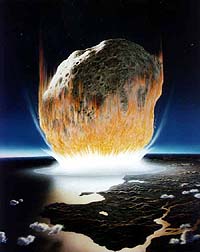
Tsunami from Asteroid/Comet Impacts
Science of Tsunami
Hazards
Two Decades of Global Tsunamis
1982 – 2002
Simulation of
Impact Tsunami
Washington University
Tsunami page
Pacific Tsunami Museum, Hawaii
Asteroid Tsunami
National Oceanic
& Atmospheric Administation
Tsunami page
A Selection of Books About:
Tsunami
Tidal Waves
Earthquakes
Volcanoes

“Tsunamis in the
Mediterranean Sea
2000 BC-2000AD”
Sergei Leonidovich
Solovev (Editor)
Olga N. Solovieva
Chan N. Go
Khen S. Kim
Nikolay A. Shchetnikov
Sergey L. Soloviev
EU English Edition
“The founder and recognized leader of the Russian scientific school of tsunami researchers Sergey (1930-94) and his collaborators describe in detail the waves generated by earthquakes and accompanying phenomena in a region prone to earthquakes and where the written record allows a study of four millennia. Most of the material is quantitative information, including coordinates of the observation sites, dates, heights of tsunami run-ups, main parameters of the earthquakes, and tide gauge records. That is augmented by the electronic database created in the Tsumani Laboratory, Institute of Computational Mathematics and Mathematical Geophysics in Novosibirsk. Only geographical names are indexed.
“Tsunami: Monster Waves (American Disasters)”
Mary Dodson Wade
Janet Hamilton
EU English Edition
“Grade 4-7-Tsunamis, although not common, hold a fascination for both shore dwellers and inland inhabitants. The idea of a huge wave coming suddenly with little warning and capable of major devastation is both awesome and horrifying. This pedestrian book capitalizes on the destructive nature of these great waves.”
“Tidal Waves Wash Away Cities”
Kate Petty
EU English Edition
“Kids in grades 1-3 will enjoy this set of simple yet entertaining facts about tidal waves: from underwater volcanic action to tidal action and ocean problems, this packs in details about tidal waves and their effects on human habitation with over 30 pages including a glossary and bright photos set against black pages.”
“Landslides and Tsunamis”
Barbara Keating, Christopher Waythomas &
Alastair Dawson
EU English Edition
“The study of tsunamis has been shifting away from theoretical modeling of tsunami source, wave propagation and runup toward multidisciplinary investigations, with an emphasis on field studies. This collection of papers highlights the many approaches being utilized to study landslides and tsunamis.”
“Caribbean Tsunamis:
A 500-year History from 1498 – 1998″
Karen Fay O`Loughlin, James F. Lander (Editor)
EU English Edition
“In the past 500 years, the Caribbean region has had devastating tsunamis causing incalculable damage. It is an area of relatively high seismicity, and although tsunamis are not the chief natural hazard, they have the potential to produce catastrophic regional disasters.
“Today the necessity for awareness is of paramount importance. Tectonic forces continually build stress – until the inevitable release of strain that may trigger a tsunamigenic earthquake. The lack of a major tsunami in the past 57 years is due to a relative lack of relief of built-up energy, and the potential extent of the stress release grows as time elapses. The long period without relief of seismic stress buildup only increases the ominous threat of a devastating tsunami that could result from a sudden seafloor cataclysm.
Caribbean Tsunamis – A 500-Year History from 1498–1998 broadly characterizes the nature of tsunamis in the Caribbean Sea, while bearing in mind both scientific aspects as well as potential interest by the many governments and populations likely to be affected by the hazard. Comprehension of the nature of tsunamis and past effects is crucial for the awareness and education of populations at risk. Audience: This book provides a thorough, yet highly accessible review of tsunamis in the Caribbean. It is of interest not only to tsunami and natural hazards specialists at academia and governmental institutes, but also to policy makers and to the general public.”
“The Mechanics of Earthquakes and Faulting”
Christopher H. Scholz
EU English Edition
“Our understanding of earthquakes and faulting processes has developed significantly since publication of the successful first edition of this book in 1990. This revised edition has therefore been thoroughly up-dated whilst maintaining and developing the two major themes of the first edition. The first of these themes is the connection between fault and earthquake mechanics, including fault scaling laws, the nature of fault populations, and how these result from the processes of fault growth and interaction.
The second major theme is the central role of the rate-state friction laws in earthquake mechanics, which provide a unifying framework within which a wide range of faulting phenomena can be interpreted. With the inclusion of two chapters explaining brittle fracture and rock friction from first principles, this book is written at a level which will appeal to graduate students and research scientists in the fields of seismology, physics, geology, geodesy and rock mechanics.”
“Tsunami Man: Learning About Killer Waves With Walter Dudley”
Anthony D. Fredericks
EU English Edition
“For Dr. Walter Dudley tsunamis are “not just about devastation and destruction, they are about men, women, and children.” Dr. Dudley’s work has expanded our knowledge of these waves and has helped us to better understand and prepare for these unpredictable, yet ever present, dangers.
In Tsunami Man young readers are given an inside look at the life of a working scientist who uses his knowledge for the common good and serves as an exciting role model for future scientists. Filled with dramatic photographs and accounts of tsunami survivors, the book also addresses the “how” and “why” of tsunamis, their impact on human lives, and the ways in which information about these “killer waves” is shared throughout the world.”
“Tsunami: The Newfoundland Tidal Wave Disaster”
Maura Hanrahan
US Edition Only
but available
worldwide
“Twenty-seven dead. Staggering property losses. Triggered by an offshore earthquake on the Grand Banks, a tsunami unleashed its fury on the coastline of the Burin Peninsula, Newfoundland, killing 27 people and destroying homes and fishing premises in 50 outports.
Here is the dramatic, incredible story of the South Coast Disaster of 1929, the superhuman efforts of Nurse Dorothy Cherry to save the sick and dying, and Magistrate Malcolm Hollett’s tireless campaign to rebuild shattered lives and devastated communities.”
“Fire in the Sea: The Santorini Volcano: Natural History and the Legend of Atlantis”
Walter L. Friedrich & Alexander R. McBirney (Translator)

EU English Edition
“It used to be thought that, around 3,600 years ago, the flourishing Bronze Age (Minoan) civilisation and culture of the eastern Mediterranean was wiped out by the volcanic eruption of the island of Santorini. The eruption also became linked with the Old Testament story of the darkness that beset Egypt as one of the seven plagues and with Plato’s description of the fabled island of Atlantis.
Walter Friedrich, the author of Fire in the Sea, is a German professor and geologist, now based in Denmark, who has researched and published many details of the Santorini eruption. In this superbly illustrated account for the general reader, he tells how around 1600 B.C., the Minoan inhabitants of Santorini witnessed their paradisal island home of Thera blow up in their faces.
Like a vigorously shaken giant champagne bottle, the Santorini volcano suddenly erupted, producing one of the largest explosions ever witnessed by humans. So much volcanic ash and pulverised rock was thrown into the atmosphere that it circulated the Earth for several years and changed global climates.
Amazingly, the Minoan civilisation was not wiped out. Detailed dating has shown that the eruption happened well before the Minoan civilisation declined. Friedrich sets the detailed story in the wider geological evolution of the whole region. As the continental plate of Africa pushes north, the whole of the eastern Mediterranean has become dangerously active. Today, tourists blithely sail into the bay of Thera, the 5km wide crater left by the eruption, before wandering around the still gently active volcano.”
“Active Tectonics: Earthquakes, Uplift, and Landscape”
Edward Keller & Nicholas Pinter

EU English Edition
“Active Tectonics is a carefully organized, easily understandable book. Extremely current throughout, this book thoroughly explores the effects of earthquakes and active tectonic systems on humans, geomorphic systems, and Earth’s topography. Complete with numerous case studies in a variety of regions, the very latest advances in the field, separate quantitative techniques boxed sections, and a host of pedagogical aids.
This comprehensive book focuses on new advances in the technology and new applications to geology and tectonics. Increased material on Quaternary chronology, including lichen chronology and micro stratigraphy of desert varnish. New studies, including research in the Olympic Mountains, Nepal, Australia, Taiwan, the Himalaya, and the New Madrid seismic zone of the central United States.
New techniques such as cosmogenic surface-exposure dating, argon and helium geobarometry and geothermometry, regional hyposometric analysis using digital elevation models, geodetic positioning, and coupled geodynamical computer simulations of topographic evolution are covered. Covers a number of regions with case studies including: Alaska; Pacific Northwest; California; The basin and range; Midwest; and East Coast. Ideal for beginning readers in active tectonics, geomorphology and natural hazards.”
“Earthquakes and Animals: From Folk Legends to Science”
Motoji Ikeya
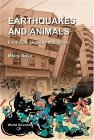
EU English Edition
“Those who survive major earthquakes often report the occurrence of mysterious phenomena beforehand — unusual animal and plant behavior, lightning, strange clouds and malfunctioning electrical appliances. In fact these stories are legendary the world over. But are they merely legends? Are the many people who report them just superstitious or suffering from over-active imaginations?
Earthquakes and Animals brings objective science to bear on these old legends. But this is not the suspect science associated with recent attempts to validate UFO sightings. The book places in front of the reader the simple laboratory evidence for the behaviour of animals, plants and objects when they are subjected to intense electromagnetic pulses. In many cases they behave in ways that have been recorded for centuries — and are still reported today — as earthquake-related.
Written for both the general public and scientists, Earthquakes and Animals demonstrates experimentally a physical basis for the old earthquake legends. It also adds tantalisingly to the science of earthquake prediction and cautiously suggests a legitimate new field of study — electromagnetic seismology.”
DVDs & VHS:
|
|
The links below are to pages that will give you more information on tsunami – the giant tidal waves that can be caused by undersea earthquakes, volcanoes, landslides, and, as it has recently been realised, by the impacts of asteroids, comets and meteorites in the oceans. Their incredible destructive power has been responsible for the sweeping away of many coastal towns, villages, and inundating huge landmasses throughout history and prehistory.
Following tsunami there is often very little evidence left for future archæologists to discover, and it is highly probable that much of the evidence of civilisation near coastal areas in prehistoric times has simply been wiped away by these incredible forces of nature.
One recent study has discovered that, according to radiocarbon dating of sediments from the area, a ‘giant tsunami’ hit the eastern coast of Scotland in 5,800 BC. Stone tools found in the sand off Inverness showed that the waves hit the area without warning following a landslide off Storegga in north-west Norway.
Professor Smith, of the Department of Geography at Coventry University, told
BBC News Online:
“It looks as if those people were happily sitting in their camp when this wave from the sea hit the camp. Professor Smith of the department of Geography at Coventry University told BBC News Online. We’re talking about two, three or four large waves followed by little ones, that would have been 5-10 metres high. These waves do strike with such force that they are very destructive. It’s like being hit by an express train’.”
A little further south, on Moel Tryfan in North Wales, the mashed and mangled remains of marine molluscs (sea-shells) have been found in so-called ‘Ice-Age drift deposits’ supposedly left there when the ice-sheets melted and retreated back towards the North Pole. But the composition of the supposed ice-sheet deposits told another story.
In their book “Cataclysm: Compelling Evidence of a Cosmic Catastrophe in 9,500 BB”, an academic study of the evidence suggesting that the flood myths of ancient times were based on archaic memories of a ‘real global tsunami’, or ‘deluge’, and which challenges the orthodox interpretation of geological history descending from the notions of a Pleistocene Ice Age theorised by Louis Agassiz in the 1820s, authors D. S. Allan and J. B. state:
“Eroded and fragmentary shells occur within the ‘drift’ deposits on Moel Tryfaen, a mountain in North Wales rising 1,300ft (400m) above sea level. Perplexingly the species represented include not only northern but also temperate and southern forms adapted to very varied habitats. Some required deep and others shallow water, some sandy and others muddy water, and some were peculiar to shingly and others to a bare rocky environment.
In stating that ice could never have brought together so varied a molluscan assemblage as this, it is hardly necessary to add that water could have – in which case the enveloping drift’ deposits must have been similarly water-borne.”
In fact many of the ‘peculiarities’ conventionally attributed to an Ice Age simply could not have been created by the supposed advance and retreat of ice-sheets. Yet, if the many and various ‘flood-myths’ of antiquity, which have been passed down through millennia in the oral traditions of peoples worldwide, are based on true recollections of an ‘archaic deluge’, a catastrophic mega-tsunami could well have produced ALL of the phenomena now attributed to an Ice Age.
These would include:
-
the global distribution of ‘erratic boulders’ – especially in the latitudes which even the die-hard glaciologists admit were not covered with ice-sheets …
-
the multi-zone distribution of flora, fauna and marine life-forms in the composition of so-called ‘glacial drift’ in areas where no ice-sheets are even claimed to have existed …
-
and also in the pitiful conglomerations of broken and twisted remains of animals, birds, fish, trees and plants, pebbles, dirts and clays which can be found in caves and rock crevices in many areas around the world – not to mention the remains of whales and other sea creatures found on mountaintops – irrespective of theorised Pleistocene ice-sheet coverage …
NONE of these supposed ‘Ice Age Peculiarities’ could have been achieved solely by the action of Ice moving horizontally across hilly terrains. The nature of Ice is such that it cannot move uphill, and, as recent scientific surveys have concluded that there were never any huge mountains at the North Pole for ice-sheets to have slid down, ONLY the turbulent waters of mega-tsunami could have brought together such jumbles of life-forms, and forcibly jammed them into the small, tight places we find them today …
Was there really an Ice Age?
Or are the Deluge Traditions and Flood Myths of antiquity based on a sounder ancient science:
Tsunami
One of the best resources for understanding the
December 2004 Tsunami tragedy is the
Sydney Morning Herald’s
Interactive Tsunami Map
below are some details from a selection of recent stories in
our news headlines archive in latest date order
…
“Traces of tsunami in ancient city of Patara”
Turkish Daily News, Turkey – December 27, 2005
“Archaeologists claim that an ancient lighthouse located in the ancient city of Patara on Antalya’s Mediterranean coast might have been destroyed by a tsunami that hit the region in ancient times.”
[Full Story Requires Registration]
“Tsunami uncovers archaeological mystery”
ABC TV News, Australia – December 26, 2005
“The destructive capacity of last year’s tsunami wiped life from Earth in numbers that defy comprehension. Each one gone dramatically altering other lives – friends and families in a chain wrapped countless times around the world.
Towns and villages and possessions obliterated. In many parts, the very presence of human beings simply erased, as if they were never there.
The tsunamis took a great deal away, but in one tiny corner, they actually gave something back. And it has archaeologists and historians arguing about precisely what it is.
It is evidence of a long-lost ancient community? Is there a mystical temple covered by time, or perhaps even an entire city buried beneath the sand and the sea around Mahabalipuram in southern India.
Anne Maria Nicholson travelled to India to piece together a picture from the fleeting glimpses snatched between the tsunamis and the more structured exploration now under way.”
[Full Story]
“Ancient legends give an early warning
of modern disasters”
The Observer, UK – December 04, 2005
“On the banks of Siletz Bay in Lincoln City, Oregon, officials dedicated a memorial last week to one of America’s worst calamities: a huge earthquake and tsunami that killed thousands of Native Americans 300 years ago. But the memorial’s main job is not to commemorate the disaster, which has only just come to light, but to warn local people that similar devastation could strike at any time.
The area sits over massive fault lines whose dangers have been highlighted by a startling new scientific discipline that combines Earth science studies and analysis of ancient legends. This is geomythology, and it is transforming our knowledge of earthquakes, volcanoes and tsunamis, says the journal Science.
Apart from the ‘lost’ Seattle earthquake, geomythology has recently revealed that a volcano in Fiji, thought to be dormant, is active, a discovery that followed geologists’ decision to follow up legends of a mountain appearing overnight.
Geologists have found that Middle Eastern flooding myths, including the story of Noah, could be traced to the sudden inundation of the Black Sea 7,600 years ago. The Oracle at Delphi has been found to lie over a geological fault through which seeped hallucinogenic gases. These could account for the trances and utterances of the oracle’s mystics.”
[Full Story]
“India: 5 Killed in Tsunami From Rare Tribe”
Gadsden Times/AP, USA – November 17, 2005
“Last year’s Indian Ocean tsunami killed five members of the wandering Shompen tribe in India’s remote Nicobar islands, an official said Thursday in the first confirmation of casualties among a prehistoric tribe that is nearing extinction.
Indian officials had until now reported only that some members of Shompen went missing after the Dec. 26 tsunami. However, a district official, Vivek Porwal, told The Associated Press that five people are confirmed to have died.
Many of the survivors among the ancient tribes say they relied on the old wisdom handed down by their ancestors to run away from the shore when the sea retreated just before the tsunami came.”
[Full Story]
“Tsunami reveals ancient temple sites”
BBC News Online, UK – October 27, 2005
|
BBC News Online
|
|
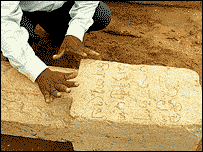
“Archaeologists say they have discovered the site of an ancient temple in the southern Indian state of Tamil Nadu.
It is the latest in a series of archaeological discoveries in the area struck by December’s tsunami, which desilted large areas of the coastline.
|
The brick temple dates back more than 2,000 years to the late Tamil Sangam period and was discovered on the beachfront near Saluvankuppam, just north of a famous World Heritage site at Mahabalipuram.
The discovery lends more weight to growing evidence that a huge tsunami hit the east coast of India during this period, obliterating large habitations along the coastline.”
[Full Story]
“Did an ancient tsunami ruin temple?”
Taipei Times, Taiwan – September 23, 2005
“The ruins of an ancient temple built by a long-vanished kingdom in southern India are being excavated by archaeologists who say the sanctum may have been destroyed centuries ago by a tsunami.
The temple was found in the region affected by the Dec. 26 Asian tsunami, and the ‘discovery now poses very interesting questions … about the history of tsunamis,’ the archaeologist leading the excavation, Thyagarajan Satyamurthy said Wednesday.
The temple appears to have been built between the second century BC and the first century AD It was excavated this month just north of Mahabalipuram, a port town 50km south of Madras, in the southern state of Tamil Nadu, by a team from the government Archaeological Survey of India, Satyamurthy said.
‘This is the earliest temple discovered in this region so far,’ Satyamurthy said.”
[Full Story]
“Temple ruins found in India show signs
of ancient tsunami”
Pravda, Russia – September 21, 2005
|
Pravda
|
|
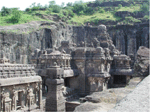
“Indian archaeologists have discovered the ruins of an ancient Hindu temple that may have been destroyed centuries ago by a tsunami, an official said Wednesday.
|
The temple appears to have been built between second century B.C. and first century A.D and was excavated this month just north of Mahabalipuram, a port town in the southern state of Tamil Nadu, by a team from the government Archaeological Survey of India, said the group’s chief, Thyagarajan Satyamurthy.
‘This is the earliest temple discovered in this region so far,’ Satyamurthy added. The archaeologists are trying to determine the date of the tsunami from sand and sea shells found at the brick temple, dedicated to Lord Muruga, a Hindu god, Satyamurthy told The Associated Press.”
[Full Story]
“Huge tide expected in Qiantang this month”
People’s Daily, China – September 19, 2005
“A powerful, massive tide is expected to sweep over the Qiantang River in Hangzhou, capital city of East China’s Zhejiang Province, later this month, posing a potential danger to people outside the designated tide-watching areas, experts said yesterday.
The tidal waves are likely to reach a height of 2.5 metres much higher than that of past years on Wednesday, the 18th day of the eighth month of the lunar calendar year, the traditional tide-watching day, said Bao Yuepeng, director of the Hangzhou Water Resource Monitoring Station.
‘Thanks to the strong rainfall, which swept away much of the sediment, the tide this year will be as tall and grand as it was said to be before,’ Bao told China Daily.
The tradition for people living by the mouth of the Qiantang River to watch the tide has a history of 2,000 years, with many ancient literati leaving a rich legacy of poems and writings.”
[Full Story]
“‘Small tsunami’ recorded after PNG earthquake”
The Jakarta Post, Indonesia – September 11, 2005
“Officials said on Saturday a ‘small tsunami’ was recorded after a strong earthquake struck off the east coast of Papua New Guinea the previous day, but no casualties or damage had been reported.
‘We had information on a small tsunami, and that is the concern we have at the moment,’ Col. Eric Ani, director of the National Disaster Management Office in Port Moresby, told AFP.
Communication with some remote areas was difficult, but there had been no reports of damage or injuries and ‘we are hopeful that is it’, Ani said.
A spokesman for the Volcano Observatory in Rabaul on the island of New Britain told AFP that tide gauges in Rabaul harbor had recorded ‘a small tsunami after the earthquake, with a maximum of 40 to 50 centimeters in height.’“
[Full Story]
“Tsunami clue to ‘Atlantis’ found”
BBC News Online, UK – August 15, 2005
|
BBC Science News
|
|
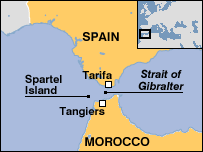
“A submerged island that could be the source of the Atlantis myth was hit by a large earthquake and tsunami 12,000 years ago, a geologist has discovered.
Spartel Island now lies 60m under the sea in the Straits of Gibraltar, but some think it once lay above water.
|
The finding adds weight to a hypothesis that the island could have inspired the legend recounted by the philosopher Plato more than 2,000 years ago. Evidence comes from a seafloor survey published in the journal Geology.
Marc-André Gutscher of the University of Western Brittany in Plouzané, France, found a coarse-grained sedimentary deposit that is 50-120cm thick and could have been left behind after a tsunami.”
[Full Story]
“Hurricane caused ‘tallest wave'”
BBC Science News, UK – August 05, 2005
“Hurricane Ivan generated a wave more than 90 feet (27 metres) high – thought to be the tallest and most intense ever measured – scientists have revealed.
It would have dwarfed a 10-storey building and had the power to snap a ship in half – but never reached land.
The wave was recorded by sensors on the ocean floor as Hurricane Ivan passed over the Gulf of Mexico last September.
The observations suggest prior estimates for extreme waves are too low, researchers warn in Science. “
[Full Story]
“Tsunami risk from volcano belt: experts”
Sydney Morning Herald, Australia – July 28, 2005
“Australian researchers have helped identify a volcanic area between New Zealand and Tonga which could trigger a devastating tsunami at any time.
The volcanic area on the seabed contains 75 previously unknown volcanoes and is one of the most active in the world, Australian National University geologist Richard Arculus said.
‘While relatively little money is available for ocean research, submerged volcanoes pose a significant threat to communities across the Pacific,’ he said in a statement.”
[Full Story]
“Tsunami warning for Indian Ocean”
TamilNet, Sri Lanka – July 24, 2005
“An earthquake of initially estimated magnitude of 7.3 Richter scale near Nicobar Islands was reported by Japanese Meteorological agency Sunday 16.02 GMT, CNN reported Sunday.
The earthquake has potential to generate tsunami in littoral areas in Indian Ocean, the report cautioned.
‘There is a possibility of a destructive local tsunami in the Indian Ocean,’ the agency said in a written statement about the earthquake, the report added.”
[Full Story]
“US admits detecting Indian Ocean tsunami
and failing to issue warning”
PressEsc, USA – June 24, 2005
“United States State Department officials today acknowledged that US scientists predicted a tsunami could form after the December 26 earthquake, but claimed that they failed to issue a warning because such waves are rare in the Indian Ocean.
Scientists Indonesia, Sri Lanka and India, the worst affected countries, often alleged that the scientists in the US Geographic Survey were aware of the impending tsunami, and deliberately withheld information of the disaster, but this is the first time the US officials have ever admitted to it.
Andrew Natsios, US Agency for International Development Administrator made the startling admission answering questions posed by journalists at press conference organized to update media on the progress maid by the US authorities in reconstructing the badly affected areas during the six months following the tsunami.
‘Any earthquake that takes place of any magnitude in the world, our National Geographic Survey can tell you where it took place and the amount – the level of the earthquake fairly quickly,’ Natsios said. ‘And that’s what they use — there is an early warning system for tsunamis in the U.S. along our coast.’“
[Full Story]
“Ancient sands reveal traces of huge tsunamis: Layers
in soil cores could help predict future disasters”
San Francisco Chronicle, USA – June 13, 2005
“Six months after the mega-tsunami that killed more than a quarter of a million people in lands around the Indian Ocean, scientists are literally digging for answers to the question: ‘How can we anticipate such cataclysms in the future?’
They’re excavating the soil along the world’s coastlines, seeking geological evidence of past tsunamis, some of which struck during epochs before the Roman Empire.
Typical evidence is a sheet of beach sand sandwiched between younger and older layers of ordinary soil, like a slice of ham between two slabs of sourdough.
That sandy layer is all that remains of a horrific moment long ago, when the sea surged skyward and slammed into the beach and scoured it clean of trees, underbrush, animals and, perhaps, villages.”
[Full Story]
“Paradise Lost: Tsunami Crushes Age-Old Indian Tribe”
Planet Ark, USA – May 31, 2005
“For thousands of years India’s gentle Nicobarese tended their coconut plantations and reared pigs on the sandy shores of their island paradise.
Today, the tribespeople have turned their backs on the sea, and may be turning their backs on their ancient way of life.
The tsunami that struck their shores five months ago not only killed thousands of Nicobarese, it cracked the very foundations of their economy and their society.
‘People have not come out of their shock and trauma,’ said Samuel Stephen, a 35-year-old government worker from the flattened village of Mus on the northern tip of Car Nicobar.
‘People are scared by the sound of the waves at night. Even the noise of buses and trucks at odd hours gets them up,’ he said. ‘But the worst change is in their behaviour. They have started drinking too much.’“
[Full Story]
“Earthquake pushes up cluster of 10 new islands
near Sumatra”
Asahi Shimbun, Japan – May 28, 2005
“The March earthquake that struck near Nias island off Sumatra was so powerful that it created about 10 new islands, Japan’s Geographical Survey Institute said.
Researchers, led by Mikio Tobita, spotted the new islets on images taken by the European Space Agency’s Envisat satellite, GSI officials said earlier this month.
The March 28 temblor had a magnitude of 8.7, but unlike the Dec. 26 quake off Sumatra, it did not trigger killer tsunami.
GSI researchers said they compared images taken in February with those from April. They found the seabed near the northwestern coast of Nias island upheaved about 2 meters due to crustal movements caused by the quake.”
[Full Story]
“15,000 flee as freak tide hits”
Herald Sun Sunday, Australia – May 22, 2005
“At least 15,000 villagers were evacuated after a freak tide caused a surge of seawater in the southern Indian state of Kerala, triggering memories of December’s devastating tsunami, officials said today.
Seawater crashed into fishing hamlets in Trivandrum, Ernakulam, Alappuzha, Thrissur and Kannur districts, state revenue minister K.M Mani said.
Meteorologists did not say what caused the tide.”
[Full Story]
“Interpol slams waning tsunami support”
Herald Sun, Australia – May 21, 2005
“Waning government support and shrinking resources could delay the identification of thousands of victims of the Indian Ocean tsunami indefinitely, Interpol chief Ronald Noble said today.
‘I’m not pointing the finger at any one country, I’m pointing the finger at all countries. We as a world community should be embarrassed,’ he told Reuters Television.
Mr Noble, whose international law enforcement agency is overseeing the identification of tsunami victims, said diminishing funds and a shortage of Disaster Victim Identification experts were huge problems.
‘It’s outrageous that we’re in a situation where DVI experts who should be spending their full time identifying bodies are required to raise money for their work so that families who have lost loved ones can get some closure,’ he said.”
[Full Story]
“Tsunami rebuilding ‘slow'”
Herald Sun, Australia – May 13, 2005
“Rebuilding tsunami-ravaged Asia is going extremely slowly the United Nations warned, as global business leaders met today for the first time since the December 26 tragedy to devise swift reconstruction plans with governments.
‘The reconstruction effort is still too slow,’ Jan Egeland, the UN coordinator of massive international relief said at the one-day ‘private sector summit on post-tsunami rehabilitation and reconstruction’ in Washington.
‘I am concerned with people in the displacement camps that it (reconstruction) is going slower than they had expected to get back to their homes, their livelihood,’ he told reporters at the conference.”
[Full Story]
“Tsunami changed Tamil Nadu shoreline”
WebIndia123.com, India – April 25, 2005
“Nearly four months after devastating tidal waves struck the east coast of India, a study has revealed that the Dec 26 tsunami considerably changed Tamil Nadu’s shoreline.
The study conducted by the Suganthi Devadason Marine Research Institute, a Tuticorin-based NGO, says marine fauna and flora were more or less unaffected by the tsunami.
But all along Tamil Nadu’s 1,076-km coast, the shoreline, or the area where the sea meets the land, has been changed considerably, it said.”
[Full Story]
“Voice of Reason: The Myth of Tsunami
Survivors’ Sixth Sense”
LiveScience, USA – April 21, 2005
“Shortly after the Dec. 26, 2004 tsunami tragedy, stories and news reports appeared making claims that animals and aboriginal tribes had escaped the danger because they possessed a mysterious ‘sixth sense’ that somehow warned them in time.
For example: ‘no dead animals have been found as a result of the tsunami, confiming animals’ sixth sense’ and ‘no one has found dead animals in the aftermath of the earthquake and tsunami’.
These reports are simply incorrect. Many news and eyewitness accounts described dead animals among the debris and carnage. The Washington Post, for example, reported, ‘In the coastal town of Velanganni…volunteers wearing face masks drove around in trucks Tuesday, picking up cattle carcasses …’ “
[Full Story]
“Planetary alignment caused tsunami, says a scientist”
Deccan Herald, India April 16, 2005
The deadly tsunami on 26 December, 2004 was the result of Saturn, Moon, Earth and the Sun falling in a straight line, claims a retired scientist of Department of Atomic Energy.
Paramahamsa Tewari, who supervised construction of Narora and Kaiga atomic plants and authored controversial ‘space vortex theory’, says his conclusion about the cause of tsunami stems from his theory that all spinning cosmic objects including the Sun develop electrical fields that repel each other.
On the fateful day, Saturn, Moon, Earth and the Sun were perfectly aligned. As a result, Earth was subjected to the repulsive electrical force of the Sun on one side.
But the balancing force on the other side due to Saturn was very much reduced as it was shielded by the Moon which does not spin and therefore has no electrical repulsive force on its own, he claims.”
[Full Story]
“Kill sheep to ward off tsunamis?”
Hindustan Times, India – April 12, 2005
“Indonesia’s president said on Tuesday he had been told to slaughter 1,000 sheep to prevent a repeat of the disastrous quakes that have hit his country, but he rejected the advice as superstitious nonsense.
Susilo Bambang Yudhoyono said he had been bombarded with telephone text messages, or SMS, saying sacrificial lambs could calm the seismic forces that have claimed thousands of lives.
‘I have received many SMSs which say: “Mr. President, please slaughter 1,000 sheep”,’ Yudhoyono was quoted as saying by the state news agency Antara.”
[Full Story]
“Tsunami theory of flood disaster”
BBC News Online, UK – April 1, 2005
“A tsunami in the Bristol Channel could have caused the deaths of up to 2,000 people in one of Britain’s greatest natural disasters, experts have said.
For centuries, it has been thought that the great flood of January 1607 was caused by high tides and severe storms. It is estimated that 200 square miles of land in south Wales and south west England were covered by water.
Eyewitness accounts of the disaster, published in six different pamphlets of the time, told of ‘huge and mighty hills of water’ advancing at a speed ‘faster than a greyhound can run’ and only receding 10 days later.”
[Full Story]
“Tsunami: Anatomy of a disaster”
BBC Science News, UK – March 25, 2005
“At two minutes to eight in the morning on Boxing Day 2004, a magnitude 9.3 earthquake ripped apart the seafloor off the coast of northwest Sumatra.
Over 100 years of accumulated stress was released in the second biggest earthquake in recorded history.
It unleashed a devastating tsunami that travelled thousands of kilometres across the Indian Ocean, taking the lives of nearly 300,000 people in countries as far apart as Indonesia, the Maldives, Sri Lanka and Somalia.
A new BBC One programme, featuring the harrowing stories of survivors, gives a scientific account of the disaster.”
[Full Story]
“Tsunami reclaims sea treasures”
iAfrica, South Africa – March 21, 2005
“Marine archaeologists spent nine years trawling the seabed of Sri Lanka’s Galle port to collect thousands of centuries-old treasures buried underwater in shipwrecks.
But it took just a few seconds for them to be reclaimed by the ocean when a tsunami battered the shores of this island nation on December 26 and swept away everything in its path, including hopes of opening the country’s first maritime museum.
The collection of priceless artefacts — including spoons, jars, jugs, bottles, cannons and leather belts — were to be exhibited to showcase the maritime heritage Sri Lanka shared with European invaders and Arab traders.
But only 20 percent of 3,600 objects salvaged from shipwrecks within the waters of Galle port from about 1996 appeared to have survived the tsunami, said S. M. Nandadasa, the officer in charge of the project.”
[Full Story]
“Tsunami fuels talk of Indian Atlantis”
The Globe & Mail, Canada – March 18, 2005
“For a few minutes, after the water had receded far from shore and before it came raging back as a tsunami, the fishermen stood along the beach and stared at the reality of generations of legends.
Or so they say. Spread across a kilometre, the site was encrusted with barnacles and covered in mud. But the fishermen insist they saw the remains of ancient temples and hundreds of refrigerator-sized blocks, all briefly exposed before the sea swallowed them up again.
‘You could see the destroyed walls covered in coral, and the broken-down temple in the middle,’ said Durai, a sinewy fisherman who uses only one name, like many south Indians. ‘My grandfathers said there was a port here once and a temple, but suddenly we could see it was real. We could see that something was out there.’“
[Full Story]
“Tsunami quake shifted seven Indian islands”
Hindustan Times, India – March 16, 2005
“Three popular beach resorts were among seven islands on India’s Andamans archipelago that shifted southwestwards when a giant earthquake hit on December 26, geologists said on Wednesday.
The state-run Centre for Earth Science Studies (CESS) found six inhabited islands and one that boasts a volcano moved ‘a few metres’ after the undersea quake that measured 9.3 on the Richter Scale triggered deadly tsunamis.
‘Preliminary estimates from the GPS (global positioning satellite systems) survey around Andaman and Nicobar suggest the islands have shifted southwestward by a few metres,’ CESS seismologist CP Rajendran told reporters.”
[Full Story]
“Earthquakes and Tsunamis are triggered
by Star-quakes”
IndiaDaily, India – March 07, 2005
“Computer models are showing an interesting relationship between star-quakes and earthquakes. Supernova, star-quakes and similar burst of energy in the Universe triggers earthquakes and tsunamis.
According to researchers, most of the large earthquakes and Tsunamis happened when there was a burst of energy somewhere in the cosmos. According to BBC, Astronomers say they have been stunned by the amount of energy released in a star explosion on the far side of our galaxy, 50,000 light-years away.
The flash of radiation on 27 December was so powerful that it bounced off the Moon and lit up the Earth’s atmosphere.”
[Full Story]
“‘Island of the dead’ battles to come to life
in tsunami-hit Andamans”
ReliefWeb, Switzerland – March 03, 2005
“‘Hush, don’t say the word ‘sea,’ it terrifies them,’ whispered schoolteacher Belinda Studel in a makeshift school in this tsunami-hit Indian Ocean island paradise where waves washed away most of the population.
The students Studel and fellow teachers were instructing in the thatched hut included many of the 44 children orphaned in Katchal which bore the brunt of the tidal waves triggered by a giant undersea earthquake off Indonesia.
‘Even the handful of adults who survived are afraid to go near the sea,’ added Henna Sondil, a housewife who has pitched in to tutor the children in the absence of scores of school teachers swallowed by the waves two months ago.”
[Full Story]
“Tsunami, earthquake reshapes, tilts Andaman islands”
Reuters India, India – February 28, 2005
“The earthquake that triggered Asia’s tsunami has moved, twisted and tilted the Andaman and Nicobar islands, raising some out of sea and sinking large parts of others.
Shifts in tectonic plates have submerged India’s southernmost point, split one island in two, destroyed beaches and villages, fuelled social pressures and even threatened the habitat of an ancient and isolated tribe of hunter-gatherers.
The earthquake, at 9.0 on the Richter scale the world’s biggest in decades, came after the India tectonic plate collided with and was forced underneath the Burma plate.”
[Full Story]
“India finds more ‘tsunami gifts'”
BBC News Online, UK – February 27, 2005
|
Copyright © February 2005
–
BBC/AFP
–
|
|
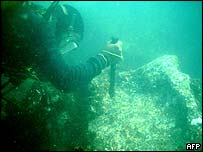
“The deadly tsunami could have uncovered the remains of an ancient port city off the coast in southern India. Archaeologists say they have discovered some stone remains from the coast close to India’s famous beachfront Mahabalipuram temple in Tamil Nadu state following the 26 December tsunami.
|
They believe that the “structures” could be the remains of an ancient and once-flourishing port city in the area housing the famous 1200-year-old rock-hewn temple.
Three pieces of remains, which include a granite lion, were found buried in the sand after the coastline receded in the area after the tsunami struck.”
[Full Story]
“Natural barriers reduced tsunami devastation”
New Scientist, UK – February 22, 2005
“The first major assessment of the environmental damage caused by the Asian tsunami paints a picture of polluted water supplies, smashed livelihoods and damaged wildlife.
But in areas where natural barriers – such as mangrove swamps and coral reefs – had not been degraded by human activity, there was less devastation, according to the United Nations Environmental Programme (UNEP) report.
UNEP’s executive director Klaus Toepfer said: ‘The report indicates that the environment was a victim of the tsunami but also that it often played its part in reducing the impact. Where healthy and relatively intact features like coral reefs, mangroves and coastal vegetation were in place there is evidence that the damage was reduced.’“
[Full Story]
“Tsunami throws up India relics”
BBC South Asia News, UK – February 11, 2005
“Indian divers have found more evidence of an ancient port city, apparently revealed by December’s tsunami.
|
Copyright © February 2005
–
BBC/AFP
–
|
|
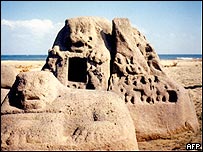
Stone structures that are ‘clearly man-made’ were seen on the seabed off the south coast, archaeologists say. They could be part of the mythical city of Mahabalipuram, which legend says was so beautiful that the gods sent a flood that engulfed six of its seven temples.
|
Other relics were revealed when the powerful waves washed away sand as they smashed into the Tamil Nadu coast.
The Archaeological Survey of India launched the diving expedition after residents reported seeing a temple and other structures as the sea pulled back just before the tsunami hit.”
[Full Story]
“Navy releases tsunami images”
BBC Science News, UK – February 09, 2005
“UK scientists have released images of the ocean floor near the epicentre of December’s giant Asian earthquake. They were obtained by the Royal Navy’s hydrographic survey ship HMS Scott.
The three-dimensional pictures detail the deformed seabed 150km (94 miles) off the Sumatran coast, and reveal huge underwater landslides.
Researchers involved in the project believe the images may help in the design of the tsunami early warning system to be built in the region.”
[Full Story]
“Nine tsunami survivors rescued from Great Nicobar”
NDTV News, India – February 06, 2005
“Thirty-eight days after the tsunami shook South Asia, nine people were rescued from the Great Nicobar Island. They managed to survive with a little help from the island’s aboriginal tribe, the Shompens, after the tsunami swept away their village Pilobhabi, located on the islands west coast.
The group, comprising two young girls, two women, a 65-year-old man and four youth, struggled eastwards through thick jungles and were found 39 km from Campbell Bay, the island’s headquarter town.
Some Shompens taught them how to light a fire using the ancient practice of rubbing wood. The group used the technique to roast wild boar for food.”
[Full Story]
“Bright Idea: Ancient monster tsunami mixed fossils”
The Albuquerque Tribune, USA – February 01, 2005
“A 65 million year old tsunami is still wreaking havoc in the scientific community, a New Mexico State University professor says.
The 300-foot-tall tsunami – an aftereffect of the giant meteor impact that some scientists think killed off the dinosaurs – scrambled fossils and rock and has made the event very hard to date, said Timothy Lawton, head of NMSU’s geology department.
‘This tsunami caused one of the biggest recycling systems the world has ever known,” Lawton said. ‘Fossil assemblages we found from rocks related to that event in northern Mexico were a very odd mix of things that don’t belong together. The fossils don’t match the environment they’re in, making it look like the tsunami mixed them up and dragged others back into deep water from the shore.’“
[Full Story]
“Science: Moon May Be Cause of Asia Tsunami”
Novinite Sophia News Agency, Bulgaria – January 28, 2005
“Full moon and other cosmic processes may have influenced the Earth to such extent that caused the mighty earthquakes and mammouth tsunami in South East Asia a month ago.
This revolutionary theory was developed by a Russian astronomer and quoted in Russian daily Nezavisimaia Gazeta.
The December 27 natural disaster, which devastated an enormous area and claimed the lives of more than 280,000 people from 60 countries has even caused the remove of Earth’s axis.”
[Full Story]
“Tsunami survivors risk deadly fungal infections”
New Scientist, UK – January 27, 2005
“Doctors have warned that survivors of the Asian tsunami are at risk of a fungal infection which is frequently fatal, but hard to diagnose. The warning came after the infection was identified in an Australian man who had returned home after being injured in Sri Lanka during the catastrophe.
Given the difficulties faced by health services in the countries devastated by the tsunami, the doctors suggest that travellers returning to other nations could be a good predictor of diseases present in the most affected regions.
The fungus responsible is found in soil and rotting vegetation and causes mucormycosis – an infection that is quite rare but kills between 20% and 80% of its victims.”
[Full Story]
“Researcher: Global Warming Not To Blame
For Tsunami”
ScienceDaily, USA – January 26, 2005
“The shock and awe resulting from the massive tsunami that hit Indian Ocean nations Dec. 26 has left many wondering what could have caused such a disaster and if there is anything humans can do to control or mitigate future events.
Some quickly suggested that an increase in the frequency of natural disasters like the tsunami were a harbinger of what we have in store due to the increase of Earth’s greenhouse gases resulting from the burning of fossil fuels.
Nothing could be further from the truth, said Daniel Sarewitz, a professor of science and society and director of the Consortium for Science, Policy and Outcomes at Arizona State University.”
[Full Story]
“B.C. natives fear tsunami, seek to move”
The Globe & Mail, Canada – January 26, 2005
“More than three centuries after a series of massive waves crashed onto the west coast of Vancouver Island, destroying villages and sweeping people out to sea, 14 native communities are asking to be moved to higher ground.
‘I think after Asia we do feel threatened,’ Robert Dennis, Chief of the Huu-ay-aht First Nation, said yesterday. Today is the 305th anniversary of the Jan. 26, 1700, tsunami.
Chief Dennis said that when the Huu-ay-aht, who number about 500 in a village near Bamfield, built a new community centre a few years ago, they abandoned the original building site near the ocean and moved it higher up the slope after an elder reminded them of the tsunami threat outlined in old stories.
The tsunami was triggered by an earthquake that ruptured the sea floor from California all the way north to mid-Vancouver Island. The devastation it caused had such an impact on native cultures that the story was largely mythologized, becoming a giant thunderbird battling a whale the size of a mountain. That became a motif of Pacific Northwest art, reflected in fearsome totem poles, longhouse paintings and haunting ceremonial masks.
Many historians ascribed the story to fanciful legend, but the Huu-ay-aht and other bands along the coast never doubted the authenticity of the tales. In recent years scientists have unearthed geological proof of the tsunami, reviving fears that another one is overdue.”
[Full Story]
the above story illustrates clearly the need to re-evaluate the worldwide ‘flood myths’ and ‘deluge traditions’ of antiquity that are still to be found in the ‘oral traditions’ of many peoples
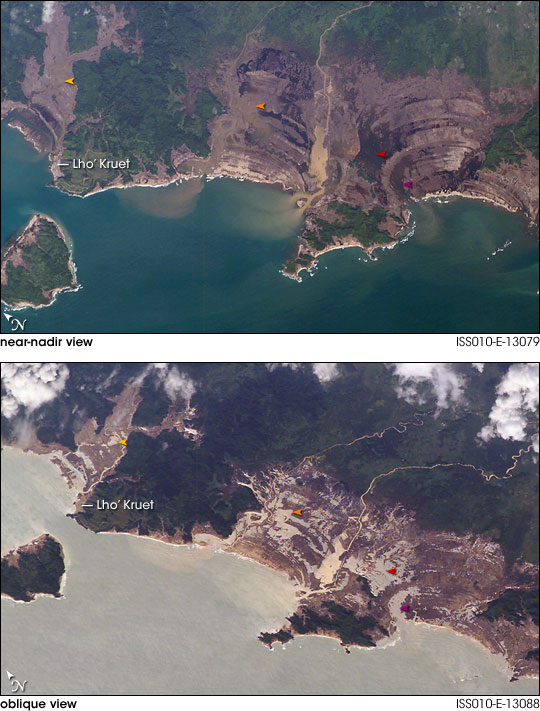
“Tsunami Damage, Northwestern Sumatra, Indonesia”
NASA Earth Observatory – Earth Orbit, January 25, 2005
Copyright © January 15, 2005
–
NASA Earth Observatory
–
click on the images above to access more satellite images of the recent tsunami damage
“Indonesian death toll from earthquake,
tsunami hits 173,981″
Channel NewsAsia, Singapore – January 23, 2005
“The Indonesian death toll from last month’s earthquake and tsunami disaster has risen more than 7,000 to 173,981, the health ministry said Sunday. It said 173,741 people had died in Aceh, with another 240 in the neighbouring province of North Sumatra. Another 7,249 people are classified as missing.
Confusion has surrounded the number of Indonesians who died in the December 26 disaster with three government departments giving out markedly different figures.”
[Full Story]
“Maritime museum damaged by tsunami”
The Sunday Observer, Sri Lanka – January 23, 2005
“Caught up in the destruction of the tsunami was the Maritime Museum in Galle which suffered partial damage to property and irreparable damage to 75 per cent of valuable artefacts.
“The waves had entered the museum breaking down the front entrance. As the museum adjoins the Galle Fort wall, which was strong enough to withstand the force of the waves, nothing was washed away. Instead all the objects that were on display were seen floating in the water and remained inside the building,” says Mayuri Munasinghe, Assistant Director (Botany) National Museum Department.”
[Full Story]
“Humanity still unable to forecast tsunami”
Pravda, Russia – January 19, 2005
“Over 170 thousand people were killed in the mammoth earthquake and the giant tsunami in the Indian Ocean. Despite the continuing technical progress, the mankind is still defenseless in front of the power of nature.
Numerous respectable institutes in a lot of countries of the globe study oceans and the Earth’s depth, but it seems that they are unable to protect the world from the natural rage.
The phenomenon of tsunami is known from ancient times. According to manuscripts, a giant wave destroyed the town of Amnisos on Crete in the year 1400 A.C.. The tsunami generated from the eruption of the Volcano of Santorini in the Bronze Age washed away the vast sea-based Minoan civilization.
The tragedy was reflected in the legend about the death of Atlantis.”
[Full Story]
“Tsunami scare stampede in Chile kills one”
Merco Press, Falklands-Malvinas – January 18, 2005
“A false alarm about an imminent tsunami approaching the southern coast of Chile which developed into an early Monday morning panic causing the death of a woman and several injured was described by the country’s Interior Minister Jose Miguel Insulza as a ‘macabre joke’.
Mr. Insulza who is acting Chilean president since Mr. Ricardo Lagos is in an overseas visit of Africa and Asia, said the authorities haven’t so far established the origin of the rumour and its tragic consequences.
The false alarm at 02:00 hours Monday morning in Chile’s second city Concepción and neighbouring towns panicked 12,000 people who fled their homes in whatever vehicle they could catch for higher ground.
Apparently the tsunami warning began when a group of unidentified fishermen reported seeing uncommon sea and tidal movements which sparked into a general panic and chaotic situation.”
[Full Story]
“Tsunami expert had tough case to prove”
Seattle Post-Intelligencer, USA – January 17, 2005
COLOMBO, Sri Lanka — “All the tsunami detectives over here keep referring to a guy in Seattle named Brian Atwater.
Most Pacific Northwest residents likely have heard that a massive magnitude 9 earthquake, much like the Sumatran quake on Dec. 26, spawned a killer tsunami off the Washington and Oregon coast more than 300 years ago.
What might not be as well known is why we know this, and how recently it was that we didn’t and were at risk of a similar deadly surprise.
‘It really wasn’t until Kenji Satake’s paper in 1996 that they all finally shut up about it,’ Atwater, a U.S. Geological Survey geologist and ‘paleoseismologist’ at the University of Washington, said in an interview about his work in Seattle.
The normally mild-mannered Atwater still gets irked thinking about what he had to go through to get his ideas accepted.
‘They’ were the quake and tsunami experts who in the 1990s said that Atwater was just flat wrong about the risk from the Cascadia Subduction Zone.” [Full Story]
“Animals’ behavior provides warning
of earthquake”
Anchorage Daily News, Alaska – January 14, 2005
The elk seemed to know, Mike Miller said.
Moments before a light earthquake struck beneath western Prince William Sound on Thursday morning, Miller’s small band of elk at the Alaska Wildlife Conservation Center near Portage gathered in a group and began running — to no place in particular, he said.
‘These guys were just trotting along like they were migrating,’ said Miller, the center’s director. ‘They knew they should be scared and stressed’.
He initially thought a wolf or other predator was in the area. But as Miller watched the suddenly restless animals from his window, he said, the quake struck with a jolt.
He looked over at the black bears’ den, and the two 3-year-olds scampered out and climbed a cottonwood tree, according to Miller. [Full Story]
“Was ancient Indian town swallowed by tsunami?”
CNN Science & Space, USA – January 14, 2005
POOMPUHAR, India (AP) — For generations, the people of Poompuhar have spoken of the days when their sleepy fishing town was the capital of a powerful kingdom, and traders came from Rome, Greece and Egypt to deal in pearls and silk.
Then, more than 1,500 years ago, it was gone. The thriving town, according to ancient Tamil-language texts, was ‘kodalkol’ — ‘swallowed by the sea’.
Perhaps, archaeologists and historians thought, the sea water had gradually risen. Or, some think now, perhaps it was something else.
‘Nobody knew what had happened,’ said Murugaiyan, a 38-year-old fisherman whose family has long talked of a long-gone kingdom. On December 26, though, it all became clear to him, when the tsunami slammed into coastlines across Asia and Africa.
‘Now I know,’ he said. ‘It must have been another tsunami’. [Full Story]
“La Palma Tsunami: The mega-hyped
tidal wave story”
LaPalmaTsunami.com, Canary Islands – January 13, 2005
How the story started:
1. Scientific research was published about a fault line on La Palma and the possibility of a landslide being caused by future volcanic activity.
2. Theoretical projections were made as to the circumstances under which the fault could cause a major landslide.
3. A computer model was made which showed that under specific circumstances a landslide could cause a tidal wave which might reach the Atlantic Coast of the USA, the Caribbean, the northern and western coasts of the South American continent, West Africa and the Western coasts of Europe.
4. A television program was made based on the research and the speculations and a vary large helping of dramatic effects.
5. The general public believed it. The media keeps repeating the speculation as if it is fact.
6. Other well respected scientists have destroyed the La Palma Tsunami theory by using factual evidence. The media has FAILED to present this contra-expertise.”
[Full Story]
“‘Tsunami Conspiracies Disrespect against
Disaster Victims'”
Zaman Online, Turkey – January 9, 2005
“The South Asian tsunami disaster has spawned many conspiracy theories including prior knowledge by governments and an underwater nuclear explosion by superpowers in order to seize control of the region.
There is even speculation that the disaster was caused by aliens from space who wanted to realign the world’s rotation. Responses to these theories differ from scientists, but they are united in condemning them as disrespectful of the victims.
Dr. Bart Bautisda from the Philippine Institute of Volkanology and Seismology Institute said of the nuclear explosion speculations: “It is impossible to produce so much energy. Even if a billion tons of explosive could not produce such destruction.” According to Bautisda nuclear tests could cause waves but never on the scale of those produced by the shift in tectonic plates around Sumatra.” [Full Story]
“Well warning in tsunami zone”
Ireland Online, Ireland – January 9, 2005
“The South Asian earthquake that spawned deadly tsunami waves also shifted water levels by at least three feet in a geologically sensitive Virginia well some 9,600 miles away from the epicentre, researchers say.
The well, near Christiansburg, which started oscillating about an hour after the magnitude 9 quake near Sumatra on December 26, is particularly sensitive to movements in the Earth and is monitored by the US Geological Survey.
David Nelms, a groundwater specialist with the USGS in Richmond, saw the changes from his computer.” [Full Story]
“Tsunami didn’t redraw Asian coastlines”
ABS-CBN News, Philippines – January 8, 2005
“Aerial images of tsunami-battered coastlines suggest the world map may be changed forever, with chunks of land sinking into the sea. But did the quake and the killer wave it spawned really significantly reshape the Indian Ocean’s outline? Scientists say probably not.
Almost all the apparent land fragmentation is likely due to temporary flooding, experts say. However, there are signs — still too early to verify — that a handful of isolated Indian islands near the center of the quake or its aftershocks may indeed have changed.
Cecep Subarya, of Indonesia’s National Coordination Agency for Surveys and Mapping, says no new islands have been spotted, and no existing islands have been seen to vanish or split up off the northwest coast of Indonesia’s Sumatra Island, the earthquake’s epicenter.” [Full Story]
“Catastrophes of the past: poetic exaggeration
or scientific facts?”
TamilNet, Sri Lanka – January 7, 2005
“To the ancient Tamil world natural calamities like the tsunami that hit the east coast on 26 December 2004 is not unknown,” says professor A.Shanmugathas, head of the department of Tamil, Jaffna University.
The Sangam Literature, which is more than 2000 years old, makes reference to similar natural catastrophes (perooly) that have affected the Tamil speaking world – spreading from Cape Comarin in the South to the Vindian ranges in the North.
“The history records it that tidal destruction (Kadatkol) has occurred from time to time and these facts are established by the archeological excavations. They are not imaginary accounts,” he adds. This is supported by modern scientific theories. [Full Story]
“Tsunami’s salt threat to islands”
BBC Science News, UK – January 6, 2005
“Water supplies on some Indian Ocean islands may have been ruined for years or decades by the salt water that flooded them during the Asian tsunami.
It means communities may be reliant on outside aid for the foreseeable future. Reports from across the stricken region suggest salt water filled wells and invaded porous rocks which communities depend on for their water supply.
Atolls in the Maldives may be worst affected; islanders may have to wait for rains to flush out water systems.”
[Full Story]
“Scale of tsunami tragedy complicates
DNA matching”
New Scientist, UK – January 6, 2005
“DNA testing is crucial to identifying many of the victims of the Asian tsunami, but the sheer numbers of dead make the task extremely difficult and risks false matches, say experts.
At least 150,000 people were killed after a magnitude 9.0 earthquake shook south east Asia on Sunday 26 December and spawned a huge tsunami. The enormous wave pounded coastal regions in 12 countries, with Indonesia, Sri Lanka, India and Thailand the worst affected.
With many thousands of people still missing, and many bodies decomposed beyond recognition, DNA analysis will be critical in returning the victims’ bodies to their families.”
[Full Story]
“Tsunami’s salt water may leave islands uninhabitable”
New Scientist, UK – January 5, 2005
“Some Indian Ocean islands could have been made permanently uninhabitable by the salt water that flooded them during the devastating Asian tsunami of 26 December.
Water experts are now warning that, in the long run, the salt invasion may prove almost as destructive to the land as the tsunami itself. It could leave some communities dependent on outside aid for food and water for months or years to come.
There are widespread reports from across the stricken region that seawater has filled wells, invaded the porous rocks on which communities depend for water, and poisoned soils. Even as far away as Somalia in east Africa, hundreds of wells used by coastal villages are now poisoned with salt or have been buried by sand washed inland by the giant waves.
Dozens of coral atolls in the Maldive Islands south of India were completely overwhelmed by the waves, which poisoned all of their underground water reserves with salt.”
[Full Story]
“Reading nature may have saved ancient tribes
on remote Indian islands”
The SunLink, USA – January 4, 2005
PORT BLAIR, India (AP) — “Two days after a tsunami thrashed the island where his ancestors have lived for tens of thousands of years, a lone tribesman stood naked on the beach and looked up at a hovering coast guard helicopter.
He then took out his bow and shot an arrow toward the rescue chopper. It was a signal the Sentinelese have sent out to the world for millennia: They want to be left alone. Isolated from the rest of the world, the tribesmen needed to learn nature’s sights, sounds and smells to survive.
Government officials and anthropologists believe that ancient knowledge of the movement of wind, sea and birds may have saved the five indigenous tribes on the Indian archipelago of Andaman and Nicobar islands from the tsunami that hit the Asian coastline Dec. 26.
“They can smell the wind. They can gauge the depth of the sea with the sound of their oars. They have a sixth sense which we don’t possess,” said Ashish Roy, a local environmentalist and lawyer who has called on the courts to protect the tribes by preventing their contact with the outside world.”
[Full Story]
“Age old early warning systems saved
Andaman tribes: ASI”
Central Chronicle, India – January 4, 2005
“The five aboriginal tribes inhabiting the Andaman and Nicobar Islands, our last missing link with early civilisation, have emerged unscathed from the tsunamis because of their age old ‘warning systems’.
“The tribals get wind of impending danger from biological warning signals like the cry of birds and change in the behavioural patterns of marine animals. They must have run to the forests for safety. No casualties have been reported among these five tribes,” ASI Director Dr V R Rao told newsmen today.
This has promted the Anthropological Survey of India (ASI) to propose its immediate documentation to save coastal populations from similar disasters in future. His team in the badly-hit islands reported the well being of all five aborigines tribes — Jarwas, Onges, Shompens, Sentenelese and Great Andamanese.
Early warning systems developed by their forefathers and adapted successfully by the tribals must have sent the first alarm signals and given them time to run for safety, he said. These tribes could be traced down to the mesolithic and upper paleolithic era (from 20000 to 60000 years ago), he said. They had inherited a wealth of indigenous knowledge that had not yet been recorded.”
[Full Story]
“History has it. Dwarka inundated by tsunami!”
The Times of India, India – January 3, 2005
“Could a tsunami have struck the coast of Gujarat in 1,500 BC to drown the ancient city of Dwarka? Experts and others closely associated with the discovery of the lost city off the coast of Saurashtra don’t discount this possibility. They speak of the Mahabharata talking about the sea suddenly engulfing the city after Lord Krishna’s death and Arjuna taking Krishna’s grandsons to Hastinapur.
Well known marine archaeologist SR Rao worked on Dwarka for 14 years with the National Institute of Oceanography, Goa. Talking to TOI from Bangalore, Rao says, “We can’t rule out the possibility of a tsunami drowning ancient Dwarka as the town was inundated by some sea activity. There are shlokas which talk of the suddenness of the incident and the gravity of the calamity.”
The Bhagvat Purana mentions “Ete ghora mahotpata Dwarvatyam yamaketavaha. Muhoorthamapi na atra no yadu pungava”.
The literal translation is “This calamity itself became a symbol of death. The Yadavas should not stay here even for a moment’. The suddenness of the present tsunami has caused similar devastation to what seems to have happened at ancient Dwarka and its inhabitants.”
[Full Story]
“Massive tectonic forces cited in fatal tsunamis”
Honolulu Star-Bulletin, Hawaii – January 3, 2005
“Instruments at the Hawaiian Volcano Observatory showed waves of vibrations pulsing through the earth for six hours following Dec. 26’s massive earthquake off the coast of Indonesia.
“The earth was ringing like a bell,” said observatory head Jim Kauahikaua.
Geologists are using a relatively new term for the phenomenon that caused such massive vibrations. They call it a ‘megathrust earthquake’.
It is a new name for an old danger that has caused death and destruction in Hawaii. A magnitude-9.5 megathrust earthquake off the coast of Chile in 1960, the largest quake ever recorded, created a tsunami that killed 61 people on the Big Island and caused $23 million in damage.”
[Full Story]
“A Virginia tsunami? It already happened”
Richmond Times-Dispatch, USA – January 2, 2005
“What happened in South Asia a week ago when walls of water crashed ashore, killing thousands, has happened here in Virginia. Thirty-five million years ago. In testament to nature’s destructive power, a mile-high tsunami that swept across Virginia was part of a prehistoric disaster that still has residents coping with the aftermath.
No one was around to see the waves, debris and sediment that engulfed the shoreline (about where Interstate 95 now sits) and plowed across to the Blue Ridge Mountains. Scientists today are learning more about its cause and lingering effects.
Geologists think the Virginia tsunami resulted from a fiery space ball that exploded 35 million years ago over the shallow ocean near what’s now Cape Charles.”
[Full Story]
“Was Nagapattinam hit by a tsunami in 900 AD?”
The Times of India, India – January 2, 2005
“When high tidal waves hit India the last time before Sunday, they were not called “tsunami” waves as they are now known. Ancient scriptures and literature have evidence that waves from the Indian Ocean did hit the Nagapattinam in 900 AD and destroyed a Buddhist monastery.
According to literature available in the library of the Thondaiman kingdom in Pudukottai, Tamil Nadu, it was during the reign of Raja Raja Chozha (read Chola) that waves had washed away the monastery and several temples and killed hundreds of people. There is evidence of this even in Kalki Krishnamurthy’s novel “Ponniyin Selvan — The Pinnacle of Sacrifice”.
In the chapter “The Sea Rises”, the author explains how the sea had risen so high it seemed to be touching the mass of dark clouds suspended in the sky.”
[Full Story]
“Russians confirm planetary angular momentum theory to warn of another major tsunami
even more devastating”
India Daily, India – January 1, 2005
“The earth has entered a seismically active period when weakness in earth’s crusts start breaking apart, volcanoes erupt, plate collisions cause major earthquakes, mud volcanoes erupt and geysers come out in different parts of the world with much higher frequency. This results in volcanic eruption, mudslides, Tsunamis, mega earthquakes and more.
According to the Russian scientists, the number of earthquakes in the earth has increased exponentially over the past few years, a phenomenon not seen in modern human history.
According thousands of years old Mayan civilization, this kind of period come after thousands of years. The ancient civilization warned that around 2012 the world would face major calamities from natural disasters and other factors. They used planetary positions and interferences as well as sun signs.”
[Full Story]
|
|
Ancient Mysteries
Bookshoppe
for a wide selection of
books that challenge
orthodox views of
prehistory on
our planet :
“Eden in the East: The Drowned Continent of Southeast Asia”
Stephen Oppenheimer
EU English Edition
“A book that completetly changes the established and conventional view of prehistory by relocating the Lost Eden – the world’s 1st civilization – to SouthEast Asia. At the end of the Ice Age, SouthEast Asia formed a continent twice the size of India, which included Indochina, Malaysia, Indonesia and Borneo.
The South China Sea, the Gulf of Thailand and the Java sea, which were all dry, formed the connecting parts of the continent. Geologically, this half sunken continent is the Shunda shelf or Sundaland.
He produces evidence from ethnography, archaeology, oceanography, from creation stories, myths and sagas and from linguistics and DNA analysis, to argue that this founder civilization was destroyed by a catastrophic flood, caused by a rapid rise in the sea level at the end of the last ice age.”
“Red, Earth, White Lies: Native Americans & the Myth of Scientific Fact”
Vine Deloria

EU English Edition
“Leading Native American scholar and author of the best-selling books God Is Red and Custer Died for Your Sins, Vine Deloria, Jr., addresses the conflict between mainstream scientific theory about the world and the ancestral worldview of Native Americans. Claiming that science has created a largely fictional scenario for American Indians in prehistoric North America, Deloria offers an alternative view of the continent’s history as seen through the eyes and memories of Native Americans.
“The World Almanac and Book of Facts”
Ken Park (Editor)

EU English Edition
extracts from pages
in the book:
“… systems can drive ocean water inland and cause significant flooding. Coastal floods can also be produced by sea waves called tsunamis, sometimes referred to as tidal waves: these waves are produced by earthquakes or volcanic activity
“… of the volcano collapsed to 1,000 ft below sea level, sinking most of the island and killing over 3,000. A tsunami (tidal wave) generated by the collapse killed more than 31,000 people in Java and Sumatra, and eventually reached England.”
“Furious Earth: The Science and Nature of Earthquakes, Volcanoes, and Tsunamis”
Ellen J. Prager
EU English Edition
from the back cover:
“The Science Behind the Earth’s Most Catastrophic Phenomena. If our planet is a sleeping giant, it slumbers fitfully and awakens in powerful starts. Our familiar landscape bears the scars f hidden forces at work deep beneath it. Furious Earth contains the latest science on these forces and the cataclysmic phenomena they produce – earthquakes, volcanoes, and tsunamis.
Now, hard-won knowledge of these phenomena, gained often in the aftermath of disaster or through dangerous research efforts, is presented here by scientist Ellen Prager with the following experts: Stanley Willaims, Ph.D. Professor of Volcanology, Arizona State University, on volcanoes; Kate Hutton, Ph.D., Seismologist, California State Institute of Technology, on earthquakes; Costas Synolakis, Ph.D., Professor of Civil Engineering, University of Southern California, on tsunamis.”
Japan’s Mysterious Pyramids: YONAGUNI

Do undersea relics near Okinawa offer proof of a sophisticated civilization during the last ice age?
www.historychannel.com
“Earthshaking Science : What We Know (and Don’t Know) about Earthquake”
Susan Elizabeth Hough
EU English Edition
“Earthshaking Science is the first book to really make sense of the dizzying array of information that has emerged in recent decades about earthquakes. Susan Hough, a research seismologist in one of North America’s most active earthquake zones and an expert at communicating this complex science to the public, separates fact from fiction. She fills in many of the blanks that remained after plate tectonics theory, in the 1960s, first gave us a rough idea of just what earthquakes are about. How do earthquakes start? How do they stop? Do earthquakes occur at regular intervals on faults? If not, why not? Are earthquakes predictable? How hard will the ground shake following an earthquake of a given magnitude? How does one quantify future seismic hazard?
“As Hough recounts in brisk, jargon-free prose, improvements in earthquake recording capability in the 1960s and 1970s set the stage for a period of rapid development in earthquake science. Although some formidable enigmas have remained, much has been learned on critical issues such as earthquake prediction, seismic hazard assessment, and ground motion prediction. This book addresses those issues. Because earthquake science is so new, it has rarely been presented outside of technical journals that are all but opaque to nonspecialists. Earthshaking Science changes all this. It tackles the issues at the forefront of modern seismology in a way most readers can understand.”
“Cataclysm: Compelling Evidence of a
Cosmic Catastrophe
in 9500 BC”
D. S. Allan & J. B. Delair

EU English Edition
“Previously titled – When the Earth Nearly Died & republished by Bear & Co. under this title. This is an excellent, well-documented book that basically disproves the ice age as it has been believed in the last 200 years. Methodically explores mythology, biology, geology, botony, astronomy and so much more to show there is no scientific proof for a long ice age or series of ice ages and that most of what is blamed on an ice-age and moving glaciers is in error.
Shows the probable explanation is that an extraordinary event occured involving some type of body entering our solar system and effecting each planet and ultimately the earth causing major axis shifts, global earthquakes, land upheavals, hurricanes, floods, tidal waves, fires, and so on.”
“Nature on the Rampage: Tsunamis”
Christy Steele
EU English Edition
“One of a series that examines natural disasters and extreme weather, detailing the science behind them and the negative and positive effects on people and the environment. The book includes research into predicting natural disasters, safety tips on surviving them, and information on notable disasters in history as well as myths created to explain their origin.”
“Awesome Facts About Tidal Waves”
Clare Oliver
EU English Edition
“A new series of information books for the younger reader. The text is carefully written for the age group and certain words are in italics and appear in a comprehensive glossary at the back. Each spread focuses on a different subject introduced in the main paragraph and supported by many smaller snippets of information or awesome facts. These can take the form of Project/True or False questions and answer / Search and Find.”
“Krakatoa : The Day the World Exploded:
August 27, 1883″
Simon Winchester

EU English Edition
“The legendary annihilation in 1883 of the volcano-island of Krakatoa — the name has since become a byword for a cataclysmic disaster — was followed by an immense tsunami that killed nearly forty thousand people. Beyond the purely physical horrors of an event that has only very recently been properly understood, the eruption changed the world in more ways than could possibly be imagined.
Dust swirled round die planet for years, causing temperatures to plummet and sunsets to turn vivid with lurid and unsettling displays of light. The effects of the immense waves were felt as far away as France. Barometers in BogotÁ and Washington, D.C., went haywire. Bodies were washed up in Zanzibar. The sound of the island’s destruction was heard in Australia and India and on islands thousands of miles away. Most significant of all — in view of today’s new political climate — the eruption helped to trigger in Java a wave of murderous anti-Western militancy among fundamentalist Muslims: one of the first outbreaks of Islamic-inspired killings anywhere.”
“Raging Planet: Earthquakes, Volcanoes, and the Tectonic Threat to
Life on Earth”
Bill McGuire
EU English Edition
“Volcanoes, earthquakes, and giant killer tidal waves called tsunamis . . . We think of these events as disasters, but for Earth they are merely business as usual. This dramatically illustrated book describes some of the more than 3,000 active volcanoes scattered around the planet, and chronicles many of history’s most devastating volcanic eruptions, earthquakes, and tidal waves.
The author explains that volcanoes and earthquakes both result from movement of the Earth’s vast tectonic plates, and are most likely to occur at or near places where two or more plates come together. Such movement has been going on since the Earth’s origins, creating mountain ranges and dividing the landmass into separate continents. Described in these pages are volcanic blasts from the past: Vesuvius, Italy in 79 A.D. … Laki, Iceland in 1783 … Tambora, Indonesia in 1815 … Krakatoa, Indonesia in 1883 … Mount St. Helens, Washington State in 1980 … Pinatubo, the Philippines in 1991, and others.
Also chronicled are earthquakes that have struck large population centers, producing disasters in Lisbon, Portugal, in 1755, San Francisco in 1906, Tokyo-Yokohama, Japan, in 1923, and Kobe, Japan, in 1995. The Earth’s major trouble spots and likely targets for future earthquakes are described. Urban areas in greatest danger continue to be those along the Pacific Rim, which encompasses North America’s West Coast and most of Japan’s cities. Here is an intensely readable summary of natural disasters that have struck the earth, along with informed speculation on how and when similar events will recur in the future. More than 200 color illustrations.”
“Vesuvius A.D. 79: The Destruction of Pompeii and Herculaneum”
Ernesto De Carolis & Giovanni Patricelli

EU English Edition
“Mount Vesuvius, in what is now southern Italy, erupted in AD 79, spewing volcanic rock, clouds of fine ash, and deadly gases over surrounding towns and farms, burying every trace of their existence. In nearby Pompeii, nearly 2000 people died. Rain falling with the ash formed a kind of cement that encased everything and everyone in an airtight seal.
This is an account of the seismic and volcanic activity leading up to the eruption of Vesuvius, as well as a detailed description of the event itself and its aftermath. The authors rely on a wide range of scientific, artistic and literary sources, including the gripping eyewitness account of Pliny the Younger, whose eminent uncle died from exposure to toxic gases while trying to help victims evacuate.
The authors close with stories and legends of this ancient catastrophe, which continues to fascinate scholars and non-experts to this day.”
“The Raging Sea: The Powerful Account of the Worst Tsunami in U.S. History”
Dennis M. Powers

EU English Edition
“Perspectives on Tsunami Hazard Reduction: Observations, Theory and Planning”
Gerald T. Hebenstreit (Editor)
EU English Edition
“Tsunamis remain an ever-present threat to lives and property along the coasts of most of the world’s oceans. This volume, comprising papers presented at the 17th International Tsunami Symposium, highlights critical advances in key areas of tsunami hazard reduction. One group of papers describes observational aspects of tsunami research, including reconstruction of events during specific tsunamis, and advanced techniques for measurements and for improving our overall knowledge of tsunami events.
Another section applies numerical and observational methods to understanding tsunami generation and propagation and the prediction of tsunami effects in coastal zones. A final part examines the evolving efforts to provide rapid, accurate, and comprehensive warnings to coastal populations. This emphasises the interdisciplinary nature of tsunami research and its ultimate focus: reducing coastal hazards.
Audience: This book will be of interest to researchers and graduate students involved in natural hazards research, physical oceanography, seismology, environmental impact assessment and risk assessment.”
“21st Century Earthquake and Tsunami Textbook: Critical Geologic and Public Safety Information”
Tsunami Information Center
No EU English Edition
“This comprehensive and well-illustrated textbook, designed for high school usage, was developed by the International Tsunami Information Center. It provides a good, readable overview of the geologic and public safety aspects of earthquakes and tsunamis. The following topics are covered in this textbook:
Outside and Inside the Earth * Characteristics of the Earth Internal Structure * Oceans and Continents Water Depth Measurement; Pacific Ocean dimensions Seismic Waves, Faults – Reverse, Normal, Strike-Slip Layers of the Earth * Ocean Floor Features * Crust on the Move Wegener and Continental Drift * Ridges, Sea-Floor Spreading.
Plate Tectonics * Plumes in the Mantle * Hot Spots Earthquakes and Volcanoes Worldwide * Intensity Scale – Modified Mercalli Intensity Scale * Magnitude Scale – Richter Aftershocks * Seismographs * Activity – Locating an Earthquake Magma and Lava * Volcanic Activity * Eruptions and their Products.
Tsunami – Causes – Volcanoes, Earthquakes, Landslides Wave Diffraction, Distantly Generated Tsunamis Coastal Effects * Runup on a Shoreline Wave Height * Protection from Tsunamis * Warning System Seismicity of the Country – Example, Chile Earthquake and Tsunami Protection Measures and Survival Kit.”
Proceedings & Reports:
“Tsunami: The Underrated Hazard”
Edward Bryant
“Tsunami: A Document Of Devastation”
Gary Knight, Joachim Ladefoged, Jim Natchwehy & John Stanmeyer
“Seismic Sea Waves (Bulletin of the Fisheries Research Board of Canada ; 198)”
T. S Murty
“United States Tsunamis 1690-1988
Report 41-2″
James F. Lander
“Cruel Dichotomy – Assessing the Impact of the 2004 Tsunami on IT Spending in Southeast Asia [DOWNLOAD: PDF]”
IDC, Anna Toncheva & David Emberley
“Tsunamis affecting the west coast of the United States, 1806-1992 (SuDoc C 55.219/2:29)”
James F. Lander
“Tsunamis: Their Science and Engineering: Proceedings of the International Tsunami Symposium, 1981”
Miyagi-Ken et al
“Catalog of Tsunamis in the Pacific 1969-1982”
C. Go & K. Kim S.L. Soloviev
“Geological Hazards: Earthquakes, Tsunamis, Volcanoes, Avalanches, Landslides, Floods”
Bruce A. Bolt et al
A Further Selection Of Books About:
Tsunami
Tidal Waves
Earthquakes
Volcanoes
|