|
“Nation Hurries to Salvage Undersea Cultural Relics”
July 02, 2004, China.org, China: “Bending his back low and hunching his shoulders, archaeologist Zhang Wei tried four times to light a cigarette in the harsh wind sweeping the shore of the South China Sea.
Since 2001 Zhang has led a team of about 12 underwater archaeologists, including one woman, to salvage relics from a millennium-old shipwreck. The site is called ‘Shipwreck No 1 in the South China Sea’ by Chinese authorities and dubbed the ‘Titanic of China’ by the media.
The team has deliberately shunned the limelight, and has released little information about its work.
However, speculation about its achievements have hit news headlines, since the public is curious about the wreckage of the merchant ship from the Song Dynasty (960-1279).”
[Full Story]
“Artefacts believed Ming dynasty recovered
from shipwreck off Malaysia”
July 04, 2004, Channel NewsAsia, Singapore: “Marine archaeologists have recovered thousands of artefacts believed to date back to the Ming dynasty from a 400-year-old shipwreck in Malaysian waters, local media said Sunday.
More than 6,000 pieces of porcelain estimated to be worth between 700 ringgit (184 dollars) and 1,400 ringgit each were salvaged from the wreck off the eastern Terengganu state.
‘Unfortunately hundreds of years of immersion destroyed most of the cargo,’ Museums and Antiquities department director-general Adi Taha said. ‘We believe the 21-metre vessel sank after an explosion or was blown up by a rival ship.’“
[Full Story]
“Centuries-old sunken Chinese artifacts recovered
from shipwreck in Malaysian waters”
July 04, 2004, The China Post, Taiwan: “Marine archaeologists have salvaged thousands of pieces of Chinese porcelain from a 17th-century Portuguese colonial merchant ship that sank after being bombarded by cannon fire in Malaysian waters, an official said Sunday.
Many of the blue-and-white porcelain bowls, plates, jars and other crockery – similar to those used by ancient Chinese emperors – were in pristine condition, but the rest were badly chipped, decayed or completely in shards, Adi told The Associated Press.
Adi said early estimates indicated each artifact could be worth up to 1,400 ringgit (US$350) _ but he stressed the two-month-old salvage expedition was not launched for financial profits.
‘It’s not a matter of dollars and cents to us,’ Adi said. ‘This is a rare discovery that will help us learn more about our region’s heritage and history.’“
[Full Story]
“Network of divers will help uncover Georgia’s
submerged treasures”
July 18, 2004, AccessNorthGeorgia/AP, USA: “Archaeologists have been digging up pottery, stone tools and other artifacts in Georgia for years, but until recently there was no coordinated effort to locate the historic treasures submerged along the coast and in rivers and streams.
Georgia has joined at least eight other states, including Florida, North Carolina and South Carolina, in launching a state-funded underwater archaeology program.
As the state’s first official underwater archaeologist, Jason Burns is organizing a network of divers and historians to identify the state’s submerged relics, including 2,000 shipwrecks.
‘When you think of underwater archaeology, it’s not just shipwrecks,’ Burns said. ‘We’re interested in everything from submerged prehistoric sites, to docks, piers and wharves.’“
[Full Story]
“Pre-Harappan bricks found in Gulf of Cambay”
July 18, 2004, The Times of India, India: “In an underwater exploration in the Gulf of Cambay, National Institute of Ocean Technology (NIOT) scientists discovered almost 9,500-year-old bricks made of clay and straw.
Archaeological experts of the MS University who, too, are involved in a part of the exploration near Surat and the coast of Gulf of Cambay, however, feel that a further insight into the size of the bricks can confirm its age and its period.
The bricks, believed to be pre-Harappan, have been identified to be of the Holocene age. In the NIOT surveys in the 17 sq km area, stone artefacts like blade scraper, perforated stones and beads were found. The bricks, according to NIOT scientists, were used for construction.
It indicates that the people of that age led an advanced form of life. The artefacts found on the seabed, 20 to 40 ft below the present sea level, consisted of housing material.”
[Full Story]
“Plankton Planet”
August 2004 Edition, Discover Magazine, USA: “When 19th-century British biologist Thomas Henry Huxley first put seafloor mud under a microscope, he found tiny round and oval particles in abundance. Not knowing what they were, he dubbed them coccoliths, based on the Greek words for ‘seed’ and ‘stone.’
Only later would scientists learn that coccoliths are calcite plates that surround some species of phytoplankton like armor.
Today, more than 100 years after Huxley, teams of researchers are still unraveling the role phytoplankton play in creating the air we breathe, the food we eat, the fuel we burn, even the ground we walk on.”
[Full Story]
“New ocean species uncovered”
August 06, 2004, BBC Science News, UK: “Scientists exploring the depths of the mid-Atlantic ridge were excited to uncover a wealth of new species, including a bright red squid.
The two-month long, Norwegian-led expedition is part of the international Census of Marine Life (CoML). The 10-year census, which began in 2000, aims to record all known marine life, in an aquatic ‘Doomsday Book’.
The latest study used deep-sea probes to explore the undersea mountain ridge, running between Iceland and the Azores.”
[Full Story]
“Atlantic ridge reveals underwater wonders”
August 06, 2004, New Scientist, UK: “Scientists studying the submerged peak of the mid-Atlantic ridge believe they have found several new species of fish and squid.
The first extensive scientific expedition to collect specimens and analyse the depths along the ridge, the MAR-ECO study, has also revealed the first evidence of spinning plankton blooms as well as a set of mysterious oceanic tracks.
The mid-Atlantic ridge is the world’s tallest mountain range, which zigzags across the bottom of the Atlantic Ocean from Iceland to the Azores where the ridge rises above sea level”
[Full Story]
“Controversy erupts over ‘sterile’ Antarctic lake”
August 07, 2004, New Scientist, UK: “Controversy has erupted over Lake Vostok, one of Earth’s last unexplored frontiers, which lies deep under the Antarctic ice.
Last week a team of Russian and French scientists claimed the lake is sterile. But American scientists insist that it is a potential source of undiscovered life forms, and are worried that Russian plans to drill right through the ice will contaminate it.
At the heart of the dispute is a small but diverse group of microbes found in the single core that has been drilled from the ice above the lake. The Russians and French say these are contaminants from the drilling and testing of samples in the labs. They also argue that the lake itself is too toxic to sustain life because of its extremely high levels of oxygen.”
[Full Story]
“Ireland is Plato’s Atlantis, claims geographer”
August 07, 2004, ABC News Online, Australia: “The mythical lost island of Atlantis was actually Ireland, according to a new theory by a Swedish scientist.
The Greek philosopher, Plato, wrote in 360 BC that Atlantis was an island in the Atlantic Ocean, where an advanced civilisation developed some 11,500 years ago until it was hit by a cataclysmic natural disaster and sank beneath the waves.
Geographer Ulf Erlingsson, whose book explaining his theory will be published next month, says the measurements, geography, and landscape of Atlantis as described by Plato match Ireland almost exactly.”
[Full Story]
“Divers tackle Mary Rose jigsaw”
August 11, 2004, BBC News Online, UK: “It is an underwater jigsaw puzzle – complicated by the fact that the picture on the box bears little resemblance to reality.
|
BBC News Online
|
|
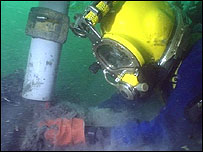
A team of marine archaeologists has been working for weeks to find and recover the lost front section of the Mary Rose from beneath metres of silt in the Solent.
Every new find on the dive site has the potential to change our understanding of Henry VIII’s sunken flagship. The only contemporary drawing of the Mary Rose has already been found to owe more to artistic licence than historical fact.
|
Only when all the wreckage has been traced, recovered and measured will the team begin to know for sure what the pride of the Tudor king’s navy looked like. When the first sign of the bow of the ship was first found last May, it was described as ‘the most important maritime archaeology find in England in the last 20 years.’“
[Full Story]
“Fossils Show How Whales Evolved to Hear Underwater”
August 11, 2004, National Geographic News, USA: “Starting 50 million years ago, modern-looking whales began to evolve from terrestrial wolflike ancestors.
Their transition to fully fledged aquatic behemoths took 15 million years. It is one of the best-recorded examples of an evolutionary transition in the fossil record.
A well-preserved series of fossils from India and Pakistan have already helped scientists understand how whales rapidly evolved limbs, teeth, kidneys, and other organs to cope with the pressures of the marine environment.”
[Full Story]
“Unknown underwater animal found in Atlantic Ocean”
August 11, 2004, Pravda, Russia: “Norwegian scientists from the Bergen-based Institute of Marine Research returned from a two-month expedition to study the underwater mountain chain in the center of the Atlantic Ocean. Scientists reported the discovery of an unknown creature, which was found living at the depth of two kilometers.
Researchers say it was a crawling bright-colored animal, about 30 centimeters long. The creature had a forefoot and a tail. The amazing creature was not reminiscent of any other sea animals. It was not possible to retrieve the animal from the ocean floor, although scientists managed to take pictures of it.
The unknown animal was definitely a sensation in the scientific world. Researchers, however, say there were over 80,000 rare species found during the international expedition, which united specialists from 16 countries.”
[Full Story]
“Relic linked to Seahenge”
August 13, 2004, EDP24, England: “A simple carved wooden figure could hold the key to an amazing new theory about the true meaning of Norfolk’s Seahenge site.
Scientists have carbon-dated the relic, found in the Thames Estuary in 1912, and discovered that it dates back to the same period as the older of Norfolk’s two timber circles.
Archaeologists now believe instead of being composed of plain wooden posts, parts of a Bronze Age timber circle found close to the site of Seahenge could have been decorated with carvings resembling native American totem poles.”
[Full Story]
“Sea serpents, beach giants, boiling seas –
ancient mariners feared them all”
August 16, 2004, US News & World Report, USA: “For the adventurers who first explored the ocean, known hazards were abundant enough. There was thirst, for one thing, along with hunger and scurvy, and hurricanes, mutinies, and shipwrecks. But before the Age of Discovery could even begin, mariners had to conquer the greatest obstacle of all: their dread of the unknown.
Henry the Navigator, the 15th-century Portuguese prince who launched the era of exploration, called it ‘the shadow of fear’ – the assortment of groundless qualms that kept ordinary Europeans securely on shore.
Medieval minds envisioned sea serpents bigger than whales, an ocean that constantly boiled, and giants on the beach ready to wade in and grab a ship with one hand. ‘I marvel,’ Henry complained, ‘at the imaginings that have possessed you all.’“
[Full Story]
“Ancient Rome’s fish pens confirm sea-level fears”
August 16, 2004, New Scientist, UK: “Coastal fish pens built by the Romans have unexpectedly provided the most accurate record so far of changes in sea level over the past 2000 years. It appears that nearly all the rise in sea level since Roman times has happened in the past 100 years, and is most likely the result of human activity.
Sea-level change is a measure of the relative movement between land and sea surfaces. Tide-gauge records show that the sea level has been rising 1 to 2 millimetres a year since widespread measurements began around 1900, but do not pinpoint when the trend started.
Earlier sea levels can be estimated from geological data, but the accuracy is limited to about half a metre, which is not enough to precisely chart the history of sea-level rise.”
[Full Story]
“Anfeh’s salt, from ancient times a gift of the sea”
August 16, 2004, TerraNet, Lebanon: “Fruits of the earth come in many shapes, sizes, and colors, and some are even colorless. Sea salt, in its naturally occurring form, is transparent, almost simple in its outward appearance.
Nonetheless, Sodium chloride (NaCl), salt’ s chemical name, is absolutely essential to human life. Indeed, during the increasingly hot summer months in Lebanon it is advisable for people to add a little more salt to their diet, in order to compensate for its loss.
Perhaps equally as important though, and to gain a better sense of Lebanon’ s own history, it is also advisable to understand the role that the country’ s coast played in the history of salt.
Since the earliest Phoenician records, salt ponds existed on the rocky shores of Anfeh, an ancient port just south of Tripoli.”
[Full Story]
“Diggers find town on former sea bottom”
August 17, 2004, The Washington Times, USA: “Kazakh archaeologists have found a medieval town on the dried bottom of the Aral Sea, local media reported Tuesday.
The town, in the northeastern part of Aral, is covered with sand and bottom sediment. It could be Robat-Togan, a prosperous town that existed about 1,000 years ago, the Kazakh Nomad Web site said.
Archaeologists have discovered the remains of a levee surrounding the town that fits a description of Robat-Togan.
The diggers also found the ruins of buildings, pottery, iron lamps and coins. Remains of people and domestic animals also were chaotically scattered around the town, as though a catastrophe caught people unawares.”
[Full Story]
“Atlantis ‘Evidence’ Found in Spain and Ireland”
August 19, 2004, National Geographic News, USA: “An empire filled with riches, it was an awe-inspiring civilization west of the Strait of Gibraltar’s Pillars of Hercules cliffs – until it was defeated by ancient Athens and consumed by a cataclysmic natural disaster.
‘In a single day and night … the island … disappeared into the depths of the sea.’
So wrote the Greek philosopher Plato in 360 B.C. about the island he called Atlantis. The story is one of the more mysterious and enduring tales in history.
Whether or not Atlantis actually existed has been a great topic of debate for thousands of years. Now new evidence claims that Atlantis was based on a real place – or places.”
[Full Story]
“Two Ancient Greek Ship Wrecks Discovered In The Aegean”
August 23, 2004, Turkish Press, Turkey: “Archeologists have discovered the remains of two ancient Greek ships in the eastern part of the Aegean Sea near the islands of Chios and Samos, the Greek ministry of culture said Monday.
The wreck near Chios, 65 meters (215 feet) underwater, dates from the Classic period (5th and 4th centuries BC), while the other, 30 meters (100 feet) under, is from the Hellenistic period that came immediately after.
Amphoras – large, two-handled earthen jars used to store wine or oil – were found on both wrecks. Samples were removed for analysis.”
[Full Story]
“Expedition to shed light on ‘undiscovered’ reefs”
August 23, 2004, ABC News Online, Australia: “Geoscience Australia says there is evidence suggesting there could be undiscovered coral reefs in the Gulf of Carpentaria.
Three submerged living coral reefs, covering 80 square kilometres, were found in the Gulf last year, which was a significant find for the region.
Marine Geologist Dr Peter Harris says another expedition in February 2005 may shed more light on other reefs.”
[Full Story]
“Explorers find three ancient wrecks off Capri”
August 23, 2004, CTV News, Canada: “Archeologists exploring the bottom of the sea off the island of Capri have found the wrecks of three ancient ships that once plied the Mediterranean between Rome and northern African colonies.
Culture Minister Giuliano Urbani took a mini-submarine tour Thursday to see the latest additions to Italy’s rich archaeological heritage, which were found earlier this month.
The wrecks were found off the island in the Gulf of Naples at a depth of 130 metres, said private TV Canale 5, showing underwater footage of the finds Friday.”
[Full Story]
“Archaeology students get their feet wet”
August 23, 2004, The News & Observer, USA: “It was tough digging for archaeology students Erin Head and Matt Napolitano. Cold seeped through their wet suits. Dislodged river muck swirled through the water like cream being stirred into a cup of coffee. Visibility was only a few inches.
‘Some days you can’t see your hand in front of your face,’ said Head, standing waist-deep in a Hudson River bay.
So it goes in the submerged world of underwater archaeology. Instead of wearing khakis, diggers this summer at Croton Point Park donned wet suits and scuba gear as they dug up discoveries beyond the reach of landlocked archaeologists.”
[Full Story]
“CTO gains in publicity, but loses rights over
Atlantis documentary”
August 25, 2004, Cyprus Mail, Cyprus: “The government has lost the rights to a documentary of an Atlantis expedition to the island by an American scientist, but the Cyprus Tourism Organisation (CTO) is a clear winner having received hundreds of thousands of pounds worth of publicity worldwide for a £10,000 investment in the project.
The CTO yesterday denied reports that it had offered Robert Sarmast a total of £50,000. But the American told the Cyprus Mail that this amount had been promised and that it would have given Cyprus the rights to the documentary of the expedition he hopes to launch late next month.
‘This money was going to give Cyprus the rights to the film,’ said Sarmast, who admitted he had been banking on the investment to help with the expedition. He said he was ‘not really co-operating’ with the CTO now, although it did hand over £10,000 initially.”
[Full Story]
“Mary Rose artefacts to go on show”
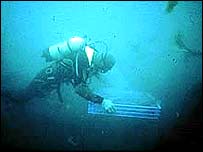
August 27, 2004, BBC News Online, UK: “Items recovered during a recent dive at the historic wreck site of the Mary Rose are on public display over the August bank holiday weekend.
|
BBC News Online
|
|
Visitors to the Mary Rose Museum in Portsmouth, Hampshire, will even get a chance to touch the artefacts, which include a Tudor comb and knife.
Most of Henry VIII’s flagship was raised from the Solent in 1982 after 437 years under the sea. Investigations over the last year have resulted in many new discoveries.
|
During the most recent expedition marine archaeologists found large pieces of the vessel’s missing front section, which had broken off from the rest of the ship.”
[Full Story]
“Underwater excavation of ancient warships under way”
August 29, 2004, China Daily, China: “Chinese archaeologists are excavating sunken warships used by Zheng Chenggong and his followers to reclaim Taiwan from Dutch occupiers more than three centuries ago.
The ruins of Zheng’s fleet were found near Dongshan Island in east China’s Fujian Province in 2000. But as long as ten years before, local people had found bowls, plates and other porcelain wares with the seals of Zheng Chenggong. Local fishermen said they can see rusty cannons at ebb tide.
The excavation began on June 6 and is scheduled to finish by the end of September. It may last longer, though, if the sunken ships are found to be still intact, said Chen Liqun, a cultural official in Dongshan County.”
[Full Story]
“Protecting Champlain’s underwater history”
August 30, 2004, Rutland Herald, USA: “Many of the bricks the canal schooner O.J. Walker was carrying when it sank a century ago in a Lake Champlain gale are still on deck today, stacked in recognizable, if falling over, piles.
Some are scattered off to the side of the boat in about 60 feet of water. The handcarts used to move the bricks and other cargo lay undisturbed on the muck alongside the boat.
The boat itself sits upright, providing an underwater look into the 19th century commercial history of Lake Champlain. It’s accessible to certified divers as part of a Lake Champlain underwater historic preserve, run by the states of Vermont and New York.
The wreck site is marked on the surface with a yellow buoy. The anchor chain leads to a concrete pad and from there another chain leads to the wreck itself, where divers are greeted by a sign that warns them to stay out of the wreck and that it’s illegal to take artifacts off the wreck.”
[Full Story]
“Dive recovers Cromwell’s sailor”
September 13, 2004, BBC News Online, UK: “A sailor from a sunken ship belonging to Oliver Cromwell’s navy had the upper body of a trapeze artist but bowed legs, his recovered skeleton shows.
The able seaman, who was in his early 20s, stood 157cm (5ft 2in) tall and suffered from rickets as a child.
About 80% of the man’s skeleton was recovered from the wreck of the Swan, a warship that sank off the Isle of Mull in Scotland on 13 September 1653.”
[Full Story]
“Scientist makes the case for Aegean underwater museum”
September 22, 2004, Kathimerini, Greece: “Robert Ballard, the scientist who investigated the wreck of the Titanic, has called for a long-term research program to follow the Aegean’s ancient trade routes and hopes the underwater exploration can be broadcast live.
|
Kathimerini
|
|
The one-day conference organized last week by the Ephorate of Marine Antiquities, in cooperation with the Hellenic Center of Marine Research, proved to be extremely challenging as well as interesting, as it discussed the use of new technologies in marine archaeological research.
|
Among the guests, including mostly scientists and representatives from a variety of international foundations and institutions, was Dr Robert Ballard, the scientist who investigated the sinking of the Titanic.”
[Full Story]
“Scientists To Probe Seabed Treasures”
September 22, 2004, Scoop, New Zealand: “New Zealand and American scientists set off this week on a three-week voyage on the deepwater research vessel Tangaroa to investigate submarine volcanoes in the Kermadec Arc, northeast of New Zealand.
They will map and probe a 550km stretch of seafloor between Giggenbach volcano and just south of Tonga. The first 450km of the survey area lies within New Zealand’s Exclusive Economic Zone. The balance is in international waters.
The project is the third in a series of voyages, which started in 1999, aimed at mapping and investigating submarine volcanoes and seafloor hotsprings along the 2500km of volcanic arc between New Zealand and Tonga.”
[Full Story]
“Ancient Sea Reptile Explains Long Neck”
September 23, 2004, Discovery Channel News, USA: “The fossil of a sea reptile with a neck twice as long as its body is solving the mystery of how some ancient reptiles used their long appendages.
|
Discovery Channel
|
|
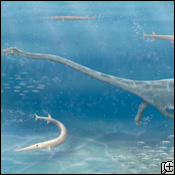
According to a report in the current issue of Science, the protorosaur, called Dinocephalosaurus orientalis, swam in a shallow sea in southeast China more than 230 million years ago during the Triassic Period.
Its stiff, 1.7-meter-long neck (about 5.5 feet), topped by a small head with short fangs, may have allowed the creature to sneak up on prey in murky water without being seen.
|
‘To a fish in murky water, Dinocephalosaurus’ head would have initially looked like another animal its own size, but by the time the fish was able to see Dinocephalosaurus’ body, it would already have been lunch,’ said Michael LaBarbera, professor of organismal biology and anatomy at the University of Chicago, in a press release.”
[Full Story]
“Ancient sea creature sucked in prey”
September 23, 2004, New Scientist, UK: “A bizarre marine reptile used a neck nearly twice the length of its body to capture its prey, 230 million years ago. Fish saw only its small head in murky waters and, when they came too close, the animal quickly expanded its formidable throat to suck in its dinner.
The astonishing length of the neck of Dinocephalosaurus was revealed when a near complete skeleton was unearthed in China by Chun Li of the Institute of Vertebrate Paleontology and Paleoanthropology, in Beijing. The length took researchers by surprise, since the reptile had previously been known from only a fossil skull.
Dinocephalosaurus belongs to a little-known group called protorosaurs which first appeared at least 250 million years ago and were probably related to the ancestors of dinosaurs.”
[Full Story]
“Mystery from the deep creates puzzle”
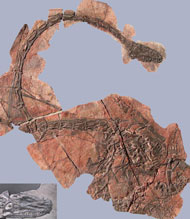
September 25, 2004, China Daily, China: “Protorosaurs are a group of carnivorous (meat-eating) reptiles who lived in the Triassic Period about 206-248 million years ago.
|
China Daily
|
|
Science magazine, the leading international weekly journal of science, published on Friday an article about the discovery of the Triassic marine protorosaur which has an extremely long neck in Southwest China’s Guizhou Province.
It is the first time a protorosaur has been discovered in China, says Li Chun, the lead author of the article. The strange long-necked fossil creature, named Dinocephalosaurus orientalis, has not been found anywhere else in the world, says the researcher with the Institute of Vertebrate Paleontology and Paleoanthropology of the Chinese Academy of Sciences.
|
Two fossil specimens of the protorosaur were found in a marine limestone formation dating back to the Middle Triassic Period (230 million years ago) near Xinmin of Guizhou Province in 2002 and collected by the institute. One is the reptile’s skull and neck fossil and another is its trunk.”
[Full Story]
“The Myth Is the Message: Yet another discovery of
the lost continent of Atlantis”
October 2004 Edition, Scientific American, USA: “Myths are stories that express meaning, morality or motivation. Whether they are true or not is irrelevant. But because we live in an age of science, we have a preoccupation with corroborating our myths.
Consider the so-called Lost Continent of Atlantis, a mythic place that has been ‘found’ in so many places around the planet that one wouldn’t think there was anywhere left to look.
Think again. On June 6 the BBC released a story about satellite images locating Atlantis in, of all places, the south of Spain. The story quoted Rainer Kühne of the University of Dortmund in Germany as saying, ‘Plato wrote of an island of five stades (925 m) diameter that was surrounded by several circular structures–concentric rings–some consisting of Earth and the others of water. We have in the photos concentric rings just as Plato described.’“
[Full Story]
“Prehistorical record of cultural eutrophication
from Crawford Lake, Canada”
October 2004 Edition, Geology Magazine, USA: “Cultural eutrophication — the process by which human activities increase nutrient input rates to aquatic ecosystems and thereby cause undesirable changes in surface-water quality — is generally thought to have begun with the start of the industrial era.
The prehistoric dimension of human impacts on aquatic ecosystems remains relatively undescribed, particularly in North America. Here we present fossil plankton data (diatoms and rotifers), organic and inorganic carbon accumulations, and carbon isotope ratios from a 1000 yr sediment core record from Crawford Lake, Ontario, Canada.
The data document increased nutrient input to Crawford Lake caused by Iroquoian horticultural activity from A.D. 1268 to 1486 and show how this increased nutrient input elevated lake productivity, caused bottom-water anoxia, and irreversibly altered diatom community structure within just a few years. Iroquoian settlement in the region declined in the fifteenth century, yet diatom communities and lake circulation never recovered to the predisturbance state.”
[Abstract]
“Iranian and Australian marine archeologists
to explore Persian Gulf”
October 2, 2004, Payvand, Iran: “Iranian and Australian marine archeologists intend to embark on a 5-year plan to discover possible ships wrecked in Iran’s territorial waters of the Persian Gulf, though their plan awaits the go-ahead from heritage authorities, Iranian Cultural Heritage News Agency reported.
In recent years Iranian marine archeologists have managed to discover some artifacts and relics that indicate some ancient ships and military armada are lying on the sea floor.
‘Now after some negotiations with experts of marine archeology at Sydney University, a team is set up and plans to start its excursions in the Persian Gulf as soon as receiving a green light from Iranian Cultural Heritage and Tourism Organization (CHTO),’ said Mahmood Mir-Eskandari, head of the team.”
[Full Story]
“Divers to return to Blackbeard vessel this week”
October 3, 2004, The Jacksonville Daily News, USA: “For the first time in four years, state underwater archaeologists plan to dig on the site believed to be the wreckage of the Pirate Blackbeard’s flagship.
Researchers with the Queen Anne’s Revenge Project have scheduled an exploratory dive this week, during which they hope to uncover buried artifacts on the northwest side of the shipwreck.
‘We’re not really planning to do any artifact recovery other than what is absolutely necessary,’ said QAR Project Archaeologist Chris Southerly.”
[Full Story]
“Time team race to save history from the waves”
October 3, 2004, Scotland on Sunday, Scotland: “The sea has shaped Scotland’s coastline and given her people an abundance of food, wealth and play. But it is also rapidly erasing the nation’s history.
Coastal erosion – made worse by global warming – threatens to destroy an estimated 12,000 of Scotland’s 35,000 sites of archaeological importance, some of them in months and years rather than decades and centuries.
Experts say that 500 of the sites are of national and even international importance and they are in a race against time to salvage what artefacts they can before the seas claim them forever.”
[Full Story]
“Hermaphrodite fish found near waste plants”
October 4, 2004, IOL, South Africa: “Fish with both male and female sex tissue have been discovered near Colorado wastewater treatment plants on the South Platte River and Boulder Creek.
Scientists are trying to determine if chemicals that disrupt hormones, such as oestrogen, are responsible for the gender-bending phenomenon.
Colorado biologist John Woodling discovered the deformed white suckers about two years ago near two wastewater discharge pipes. Female fish also far outnumber the male fish near the plants.”
[Full Story]
“Underwater archaeologists to dig on believed site of flagship”
October 4, 2004, Sun-Journal, USA: “For the first time in four years, state underwater archaeologists plan to dig on the site believed to be the wreckage of the Pirate Blackbeard’s flagship.
Researchers with the Queen Anne’s Revenge Project have scheduled an exploratory dive this week during which they hope to uncover buried artifacts on the northwest side of the shipwreck.
‘We’re not really planning to do any artifact recovery other than what is absolutely necessary,’ said QAR Project Archaeologist Chris Southerly.”
[Full Story]
“Archaeologists excited about another Blackbeard cannon”
October 8, 2004, The Jacksonville Daily News, USA: “Historical records indicate that when the pirate Blackbeard took a French frigate in 1717 and renamed it Queen Anne’s Revenge, he increased the ship’s firepower from 14 to 40 guns.
Since 1996, when the wreckage believed to be the remains of the pirate’s flagship was discovered in Beaufort Inlet, underwater archaeologists found 22 on the site. This week, they added one more to the list.
‘”We’re pretty positive that we have cannon number 23,’ said QAR Project Archaeologist Chris Southerly.”
[Full Story]
“7-Foot Robot Used in Black Sea Expedition”
October 11, 2004, PhillyBurbs/AP, USA: “Four years ago, scientists thought they had found the perfect place to settle the Noah flood debate: A farmer’s house on a bluff overlooking the Black Sea built about 7,500 years ago – just before tidal waves inundated the homestead, submerged miles of coastline and turned the freshwater lake into a salty sea.
Some believed the rectangular site of stones and wood could help solve the age-old question of whether the Black Sea’s flooding was the event recounted in the Biblical story of Noah.
That story told of a calamitous flood occurring over 40 days and nights. Scientists had largely dismissed it, believing the Black Sea filled up gradually with gently rising waters. That wisdom was rocked, however, when two scholars claimed several years ago that the Black Sea’s flooding was more recent – and so rapid and widespread that it forced people to move as far away as mainland Europe.”
[Full Story]
“Black Sea slowly gives up ancient secrets:
Expedition delves into theories about biblical flood”
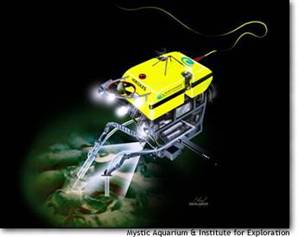
October 11, 2004, MSNBC News, USA: “Four years ago, scientists thought they had found the perfect place to settle the Noah flood debate: A farmer’s house on a bluff overlooking the Black Sea, built about 7,500 years ago — just before tidal waves inundated the homestead, submerged miles of coastline and turned the freshwater lake into a salty sea.
|
MSNBC News
|
|
Some believed the rectangular site of stones and wood could help solve the age-old question of whether the Black Sea’s flooding was the event recounted in the Biblical story of Noah.
That story told of a calamitous flood occurring over 40 days and nights. Scientists had largely dismissed it, believing the Black Sea filled up gradually with gently rising waters.
|
That wisdom was rocked, however, when two scholars claimed several years ago that the Black Sea’s flooding was more recent — and so rapid and widespread that it forced people to move as far away as mainland Europe.”
[Full Story]
“Searching for the ‘Mayan Atlantis'”
October 12, 2004, IOL, South Africa: “A team of international archaeologists have set sail from Mexico to seek a sunken city that has been dubbed the ‘Mayan Atlantis’, press reports said on Monday.
Quoted by the Mexican newspaper Milenio, team leader Paulina Zelintzky, a Russian archaeologist, said sonar equipment had given indications there could be ancient structures on the ocean floor between Mexico’s Yucatan peninsula and Cuba.
According to Milenio, resonances showed geometric images similar to pyramids and round structures. The archaeologists will search the area using a mini-submarine known as ‘Deep Worker’.”
[Full Story]
“Ancient Clams Lived 120 Years”
October 14, 2004, Discovery Channel News, USA: “Researchers have found fossil clams from Antarctica that lived for more than 120 years and defy conventional wisdom about longevity in nature.
Cold climates, coupled with short growing seasons, are usually called on to explain how some critters live for decades or centuries.
But the Antarctic waters where the clam Cucullaea raea lived some 45 million years ago weren’t any colder than those off of North Carolina, said Syracuse University geologist Linda Ivany.”
[Full Story]
“Old towns emerge as lakes shrink”
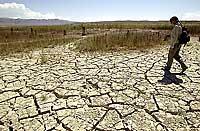
October 22, 2004, The Seattle Times, USA: “Early last year, fishermen searching for bass and bluegill on a northern finger of Lake Mead saw a curious cluster of concrete blocks jutting out of the water. It turned out to be the chimney of what had been, 65 years earlier, an ice-cream parlor.
|
L.A. Times
|
|
Within months, other ruins began to emerge: The steps of a nearby schoolhouse. The foundation of the old Gentry Hotel, where former President Hoover once bunked for the night.
Today, the water line of Lake Mead, once six miles to the northwest, is one-half mile to the southeast.
|
Now, there is a sun-soaked valley, along with the ruins of St. Thomas, a town that was, until recently, under 64 feet of water.”
[Full Story]
“Sea damaging Roman burial site”
October 26, 2004, BBC News Online, UK: “There are concerns for part of Cumbria’s Roman heritage, which is being damaged by erosion.
Roman invaders buried and cremated their dead at Beckfoot, which lies north of Maryport. Now the site is being badly damaged by the sea and work is being done to try to save its relics.
Local volunteers have been gathering artefacts which are being found on the beach and an underground survey of the site has now started.”
[Full Story]
“Strange life-forms 1800m down in smoking deep-sea volcano”
November 01, 2004, New Zealand Herald, New Zealand: “Scientists may have discovered new deep-sea creatures 1800m down in the crater of a seafloor volcano northeast of the Bay of Plenty.
The scientists, from New Zealand and Japan, recovered a variety of creatures while diving into the Brothers volcano in the world’s deepest-diving submersible research vessel, Shinkai 6500.
The 26-tonne vessel can take a crew of three to the bottom of the ocean for eight hours. Scientists scan the sea floor with the sub’s powerful light.
They discovered numerous long-neck barnacles, shrimps, limpets, tubeworms, crabs and ‘black smoker chimneys’.”
[Full Story]
“Underwater Archeology in Iran”
November 01, 2004, Persian Journal, Iran: “As evidenced by archeological documents, the ancient city of Kish, the wall of the ancient city of Gorgan, Takht-e Suleiman and part of the Portuguese Castle are submerged in Iran’s coastal waters.
Although Iran’s underwater archeological activities are over half a century old, this topic is yet to be treated in a suitable manner.
Two centuries have passed and archeology has yet to achieve its rightful position in Iran. This science needs full revision, as Iran has special importance in human civilization and its role in establishing other cultures inspired by its civilization is undisputed.
For this reason, Iran Cultural Heritage Organization (ICHO) is not able to take charge of many historical grounds. Dissemination of information is so poor that many in our society still consider archaeologists as treasure hunters!”
[Full Story]
“Traces of an ancient settlement found on the
dry bottom of the Aral”
November 05, 2004, Kazinform, Kazakhstan: “The scientists of the Institute of Archeology named after Alkey Margulan found some traces of an ancient town on the dry bottom of the Aral Sea.
The area of the town amounts to about 6 ha and goes back to the 13-14 centuries, i.e. the epoch of the Golden Horde.”
[Full Story]
“Submerged Himachal temples to be relocated”
November 05, 2004, OnlyPunjab, India: “The 15th century Nagara style temples in Bilaspur town, 90 km from here, have been lying submerged under the Gobind Sagar Lake, the backwards of the Bhakra hydro project built nearly four decades ago.
The tops of some of these stone temples are visible when the water level drops in summer.
‘We have approached the ASI to transplant these temples as the water is damaging them,’ said an official of the department of language, art and culture.”
[Full Story]
“Ancient marine invasion sheds light on diversity”
November 09, 2004, Innovations-Report, Germany: “Fossils from the sea floor illuminate the relationship between local and global diversity, and these relationships may help us understand the effects of global climate change on species diversity.
‘Looking at fossils can tell you something about the controls on global diversity, but so much of the investigation of the fossil record has looked only at global compilations of fossil species,’ says Dr. Mark E. Patzkowsky, associate professor of geosciences. ‘Recently, a few studies have shown that if you look at diversity locally, it is not necessarily mimicking global diversity at that time.’
Patzkowsky and Steven M. Holland, professor of geology, University of Georgia, looked at fossils similar to modern corals, clams, snails and brachiopods from 450 million-year-old fossil beds in the area around Cincinnati, Ohio. These Ordovician fossils show great diversity of sea floor invertebrates.”
[Full Story]
“Sea change: Skeletons of ancient corals different from today’s”
November 09, 2004, EurekAlert, USA: “A Johns Hopkins University graduate student may have solved a problem that has been baffling marine biologists and paleontologists for years: Why do coral reefs disappear from the fossil record during the beginning of the Cretaceous period – 120 million years ago – only to reappear after its end 35 million years ago?
The possible answer: Ancient seawater’s low magnesium-to-calcium ratio during this interval made it difficult for the marine animals – which build their skeletons from a mineral called aragonite calcium carbonate – to grow and flourish into vast reefs.
That left few to end up in the fossil record, posits doctoral candidate Justin Ries and his advisor Steven Stanley, professor in the Morton K. Blaustein Department of Earth and Planetary Sciences at the university’s Zanvyl Krieger School of Arts and Sciences.”
[Full Story]
“Underwater Treasure Discovered Off Coast of La Paz, Mexico”
November 10, 2004, eMediaWire, USA: “In the aptly named Sea of Cortez a rich booty of treasure has recently been discovered, mind you not in pieces of eight but rather an ecological treasure of enormous wealth.
Located in varying depths between 65 and 130 feet of water, 032 degrees, and 8.2 miles from northernmost tip of Isla Partida off the coast of La Paz, Mexico scuba divers have found an underwater El Dorado.
This underwater volcano, known as a seamount, is described in stunning detail in the new bestselling novel “Diving The Seamount”. El Bajo, as it is known by the locals, is a magnificent dive spot rated one of the top ten in the world.”
[Full Story]
“Divers find mystery Napoleonic-era wreck off Wales”
November 12, 2004, DiverNet, UK: “Divers from Fishguard Subaqua Club have found the remains of an ancient wreck, possibly Napoleonic – causing speculation that the wreck may be have been part of the 1797 French invasion of Fishguard, Wales.
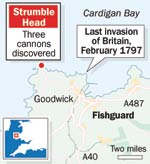
A little-known chapter of British history has been re-opened after the divers recovered artefacts from a wreck site they had discovered in 30m off Strumble head, Pembrokeshire. .
The site and finds have been reported to the Receiver of Wrecks, Sophia Exelby. She has made the Fishguard Subaqua Club licensed custodians of the site.”
[Full Story]
“Rogue divers raid war grave wreck”
November 13, 2004, The Daily Telegraph, UK: “The wreck of a German ship sunk by Soviet torpedoes in the Baltic Sea 60 years ago, with the loss of 9,000 lives, is being systematically plundered by rogue divers.
The Wilhelm Gustloff, which was packed with refugees when it sank on the night of Jan 10, 1945, in what experts say is the worst maritime disaster in history, has been stripped of everything from its portholes to wash basins.
Many of the divers are encouraged by rumours that items such as ashtrays and bed linen from the ship are regularly snapped up by German collectors
‘for the price of a Mercedes’.”
[Full Story]
“Divers find mystery Napoleonic warship”
November 13, 2004, The Western Mail, Cymru: “Divers off the Welsh coast may have found the wreck of a ship from the last foreign invasion of mainland Britain, over 200 years ago.
The discovery by a husband-and-wife diving team off the Pembrokeshire coast could rewrite history, once it is formally identified.
Until now it was widely believed no ships were lost when the French landed at Carregwasted near Fishguard, in 1797.
But items found off Strumble Head by Pembrokeshire Scuba Diving Club appear to be from a large warship dating back to the Napoleonic era.”
[Full Story]
“Cyprus ‘just the tip of Atlantis'”
November 14, 2004, ABC News Online, Australia: “An expedition on the trail of the lost city of Atlantis says it has discovered evidence of man-made structures submerged in the sea between Cyprus and Syria.
Robert Sarmast, who is convinced the fabled city lurks in the watery depths off Cyprus, will give details of his findings this week.
‘Something has been found to indicate very strongly that there are man-made structures somewhere between Cyprus and Syria,’ a spokesperson for the mission told Reuters.
The mystery of Atlantis – both whether it existed and if so, why it disappeared – has fired the imagination of explorers for decades.”
[Full Story]
“‘It’s definitely Atlantis’”
November 14, 2004, Cyprus Mail, Cyprus: “THE TEAM led by American researcher Robert Sarmast, who believes Cyprus is Atlantis, said yesterday they had found man-made structures in the area they had earmarked as the site of the underwater lost continent.
‘It’s definitely Atlantis, Sarmast was quoted as saying through his spokeswoman Angela Henderson. ‘It’s going to be impossible for the sceptics to prove me wrong.
Henderson said that Sarmast, the author of “Discovery of Atlantis: The Startling Case for the Island of Cyprus”, launched a secret expedition last Monday and was due back at Limassol port last night. He is to reveal his findings at a news conference today, accompanied with visual data.
‘All we can say right now is that we have found compelling new evidence from side-scan sonar that there are unnatural formations, i.e. man-made objects the details of which will be released on Sunday,’ Henderson told the Sunday Mail.”
[Full Story]
“Nation gods found too decadent and plunged under the sea”
November 15, 2004, The Scotsman, Scotland: “THE first accounts of Atlantis appear in Timaeus and Critias, two dialogues by the ancient Greek philosopher Plato. According to these, the island was described to the Athenian statesman Solon by an Egyptian priest, who claimed that Atlantis was larger than Asia Minor and Libya combined.
He maintained that the nation had conquered all the Mediterranean peoples except the Athenians. According to Plato, Atlantis had ‘soil the best in the world, an abundance of water, and in the heaven above an excellently attempered climate’.
Its people were so blessed that few were compelled to do physical work. But they also became so decadent that the gods decided to destroy them and a great catastrophe plunged Atlantis under the waves.
Plato described a series of worldwide floods culminating in the deluge of the Deucalion, dated by Greek historians to the end of the last Ice Age, about 10,000 BC.”
[Full Story]
“US team claims Atlantis discovery”
November 15, 2004, Aljazeera, Qatar: “A US researcher says he has found the lost civilisation of Atlantis in the waters off Cyprus – adding his theory to a mystery that has baffled explorers for centuries.
|
Aljazeera, Qatar
|
|
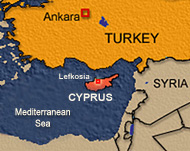
Robert Sarmast said a Mediterranean basin was flooded in a deluge around 9000 BCE which submerged a rectangular land mass he believes was Atlantis, lying 1.5km beneath sea level between Cyprus and Syria.
‘We have definitely found it,’ said Sarmast, who led a team of explorers 80km off the south-east coast of Cyprus earlier this month, on Sunday.
|
Deep water sonar scanning had indicated man-made structures on a submerged hill, including a 3km-long wall, a walled hill summit and deep trenches, he said. But further explorations were needed, he said.”
[Full Story]
“New claim on location of Atlantis”
November 15, 2004, BBC News Online, UK: “American researchers claim to have found convincing evidence that locates the site of the lost kingdom of Atlantis off the coast of Cyprus.
|
BBC News Online
|
|
The team spent six days scanning the Mediterranean sea bed between Cyprus and Syria using sonar technology.
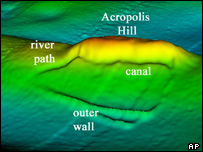
They believe they found evidence of massive, manmade structures beneath the ocean floor, including two straight, 2-km (1.25 mile) long walls on a hill. They say their discoveries match accounts of the city written by Plato.
|
Team leader Robert Sarmast said the walls appear to be sited on a flat-topped hill where the temples of Atlantis once stood.
He intends to use the sonar data to make a three-dimensional computer image of the site, 1.5km below sea level, before returning for further research.”
[Full Story]
“The Great Atlantis Hoax: Another Media Fiasco”
November 15, 2004, CCNet 148/2004, England:
“In recent years, radical environmentalists have called upon the media to abandon all balanced science reporting because impartial journalism would give sceptics too much credibility. The media’s Atlantis debacle is a clear and disturbing indication where uninhibited science journalism could end once the shackles of even-handedness and scepticism are shaken off for good.”
– Benny Peiser, 15 November 2004
“An American researcher claimed yesterday to have discovered the remains of the legendary lost city of Atlantis on the bottom of the east Mediterranean Sea. Robert Sarmast says that sonar scanning of the seabed between east Cyprus and Syria revealed man-made walls, one as long as two miles, and trenches at a depth of 1,500 meters. “We have definitely found the Acropolis of Atlantis,” he affirmed, adding the site was 50 miles south-east of Cyprus.”
– Press Association, 15 November 2004
“It is a miracle we found these walls as their location and lengths match exactly the description of the acropolis of Atlantis provided by Plato in his writings.”
– Robert Sarmast, Associated Press, 15 November 2004
“People who dismiss this have not really done their homework, sceptics don’t really understand. To understand the enigma of Atlantis you have to have good knowledge of ancient history, Biblical references, the Sumerian culture and their tablets and so on.”
– Robert Sarmast, Reuters, 14 November 2004
“Serious archaeologists tend to place the search for Atlantis within the realm of fantasy. This latest theory should be taken with a very large pinch of salt. Archaeologists only work with hard evidence. There is no evidence whatsoever to give credence to this hypothesis and we have no intention of investigating it.”
– Despo Pilides, Department of Antiquities, Cyprus, 28 September 2003
[Sour Grapes or Sound Science? Decide for yourself]
“Cyprus Atlantis Expedition Press Release”
November 15, 2004, Cyprus Atlantis Expedition Press Office, Cyprus: “A triumphant Robert Sarmast, American author and expedition co-ordinator of the first Cyprus Atlantis Expedition, is today celebrating at his base in Limassol, Cyprus, following the completion of the first expedition to prove that Plato’s lost city of Atlantis lies 1.5km down on the sea bed 80km off the S.E. coast of Cyprus.
The 6 day long, privately-funded $200,000 expedition has confounded or at least confused sceptics by bringing back scientific side-scan sonar data which supports evidence from previous scans of the Eastern Mediterranean revealing man-made structures (including a 3km long wall, a walled hill summit and deep trenches) – plus old river beds – in exactly the formation and proportions that Plato himself described for the Acropolis Hill of Atlantis City in his works of 2,400 years ago.
‘We cannot yet provide tangible proof in the form of bricks and mortar, as the artefacts are still buried under several metres of sediment, but the circumstantial and other evidence is now irrefutable – and we hope that future expeditions will be able to uncover the sediment and bring back physical proof’ said Robert, whose book, “The Discovery of Atlantis – the startling case for the island of Cyprus” has become something of a best-seller in Cyprus – where the tourist industry will certainly be set to gain from this latest discovery.”
[Full Story]
“New Atlantis Location Pictures”
November 15, 2004, Cyprus Atlantis Expedition Press Office, Cyprus: “Additional images using data from a recent French survey and additional data of the expedition.
You can now freely access theAssorted Early Data Images as well as the Aquatec Team Picture Gallery”
“Titanic threatened by tourists, says explorer”
November 15, 2004, ABC News Online, Australia: “Undersea tourists and souvenir hunters are hastening the decay of the Titanic, says United States explorer Bob Ballard, the man who discovered the world’s most famous shipwreck nearly 20 years ago.
In a visit to the site of the Titanic last June, his first since 1985, Dr Ballard was shocked at how fast the wreckage had deteriorated and he wants the US Congress to pass legislation giving greater protection to the sunken vessel.
Most alarming, he said, was damage caused by submersibles landing on the deck of the Titanic, which hit an iceberg and sank in the North Atlantic on April 14, 1912, on its maiden voyage from Southampton, England to New York.
‘It’s sort of like going into the Louvre [Museum in Paris] with a bulldozer,’ Dr Ballard said of the submersibles landing on the deck of the once-luxury liner.”
[Full Story]
“Atlantis discovered! This time it’s under the sea off Cyprus”
November 16, 2004, The Times, UK: “In the child’s imagination or in the whimsical plots of the cult 1970s television series, Atlantis exists, variously, on the tip of a Bolivian volcano, beneath the sands of the Arabian desert or in the Fourth Dimension somewhere off the coast of Bermuda.
|
The Times
|
|
Now the Utopian civilisation described in 400BC by Plato and supposedly submerged in a deluge 11,600 years ago, has been ‘definitively located’, for the 47th time in recent years.
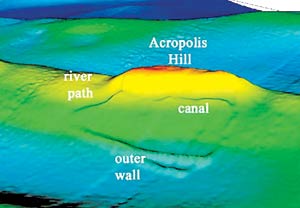
Robert Sarmast, an American researcher, is ‘absolutely convinced’ that he has discovered the lost city after finding what he claims is evidence of man-made structures submerged in the sea between Cyprus and Syria.
|
Mr Sarmast, who has nurtured an obsession with Atlantis since he was a young boy, said that the dimensions and configuration of straight walls and a canal on a hillside above a rectangular plain on the sea-bed ‘perfectly’ matched Plato’s description of the fabled city consigned to the deep by earthquakes and flooding. ‘We have proven this is a match that cannot be coincidental,’ he said.”
[Full Story]
“Acropolis of lost Atlantis ‘found’ in eastern Med”
November 16, 2004, The Western Mail, Cymru: “An American architect’s claim to have discovered Atlantis at the bottom of the east Mediterranean Sea was yesterday greeted with scepticism.
Robert Sarmast, 38, from Los Angeles, said, ‘We have definitely found the Acropolis of Atlantis.’
Dr Louis Rawlings, lecturer in Ancient History at Cardiff University, believes the Atlantis Plato described was an invention of his imagination.
‘In the context of trying to work out what would be an ideal constitution and state he invented this place called Atlantis and set a number of stories there. Somehow, some people have taken this literally, which I find quite fascinating.’
Now that satellite technology has allowed the world to be mapped in minutes, Dr Rawlings believes there is a human hunger to discover lost civilisations.”
[Full Story]
“Welsh shipwreck linked to French folly”
November 16, 2004, The Times, UK: “The discovery of a Napoleonic wreck off the windswept coast of West Wales is expected to rewrite the history of the last invasion of Britain.
|
The Times
|
|
Divers who found the previously undocumented warship off Strumble Head in Pembrokeshire believe that it carried part of a rag-tag French force that advanced on Fishguard 207 years ago.
The warship, which is still awaiting official identification, lies beneath 30 metres (98ft) of water in an area notorious for wrecks. It was discovered by the Pembrokeshire Scuba Diving Club last year.
|
Two amateur divers, Richard and Rebecca Hughes, found it by chance but because of strong currents and poor weather were unable to return to explore further until this summer.”
[Full Story]
“How Often Is Atlantis Discovered?
The lost city that’s always being found”
November 16, 2004, The Slate, USA: “American architect-turned-archaeologist Robert Sarmast claims to have discovered the lost city of Atlantis, off the southeast coast of Cyprus. Sarmast says his latest sonar readings reveal submerged walls that closely resemble those described by Plato, the first person to ever mention Atlantis in print.
In Timaeus, written around 360 B.C., the renowned philosopher portrayed Atlantis as ‘a great and wonderful empire’ that was destroyed by earthquakes and floods in a 24-hour span. How many times have researchers previously claimed to have discovered the vanished island-state?
Oodles—and that’s not even counting the numerous psychics and crackpot ‘Atlantologists’ who’ve placed the city everywhere from Nicaragua to Ceylon.
The hunt began in earnest in the early 19th century, when Guatemalan Dr. Paul Felix Cabrera proposed that Hispaniola — the island where Haiti and the Dominican Republic are now found — was the site of Atlantis”
[Full Story]
“Atlantis ‘just a volcano'”
November 17, 2004, Herald Sun, Australia: “The remains of the lost city of Atlantis, which a United States researcher claims to have found off the Mediterranean island of Cyprus, are in fact submarine volcanoes, according to a German physicist.
US researcher Robert Sarmast claimed on Monday to have found proof that the mythical lost city of Atlantis actually existed and is located under the Mediterranean seabed between Cyprus and Syria.
But German physicist Christian Huebscher said he had identified the phenomenon as 100,000 year-old volcanoes that spewed mud.
Mr Huebscher, of the Hamburg Centre for Marine and Atmospheric Sciences, is quoted in tomorrow’s edition of the newspaper Frankfurter Allgemeine Zeitung as saying he and two Dutch colleagues had sailed in a boat to the same area at which Mr Sarmast claimed to have located Atlantis and made their findings.”
[Full Story]
“Ancient sea reptiles gave birth to live young”
November 17, 2004, Saudi Press Agency, Saudi Arabia: “Fossils of ancient marine reptiles that lived 230 million years ago show the prehistoric creatures gave birth to live young, scientists said on Wednesday.
Although thousands of specimens of a large group of ancient reptiles called sauropterygians have been found, scientists were not sure whether they laid eggs on land, like sea turtles, or delivered their offspring live in the water.
But the remains of two pregnant reptiles known as Keichousaurus hui have answered the question. The fossils from the National Museum of Natural Science in Taiwan revealed they had a moveable pelvis, which could make birth easier, and both contained several embryos.”
[Full Story]
“Media Debacle Complete As Researchers Expose Atlantis Hoax”
November 17, 2004, CCNet 149/2004, England:
“Less than 48 hours after the world’s news agencies and major news outlets announced the discovery of the mythical island of Atlantis, the rug has been pulled out under the latest, bizarre media hype. German geophysicists who have studied the Mediterranean ocean bottom for many years, have exposed the sensational ‘discovery’ of Atlantis for what it really is: meager delusions based on the misinterpretation of geological features that are more than 100,000 years old.
As I pointed out in yesterday’s editorial, every journalist and science writer who trustingly covered this pseudo-scientific ‘discovery’ would have been capable to recognize immediately that they were the victims of a stupid little hoax – simply by consulting the internet (not to mention calling a expert).
After all, that’s how I established quickly that the bottom of the Mediterranean wasn’t exposed to the air for the last 6 million years.
That none of the numerous stories and reports provided any scientific context, any serious reservations or consulted experts in the field about the outlandish claim is a sad reflection on the disturbing decline of ‘science’ reporting.
Not surprisingly, yesterday’s headlines about the confirmation of Atlantis’s demise have been replaced today by headlines that proclaim ‘Human extinction within 100 years warns scientist’. Given current conditions, I doubt whether the news media that were duped by a shrewd con artist will retract yesterday’s fairy tales or today’s doomsday prophecies that are just as baloney.”
– Benny Peiser, 15 November 2004
[Sour Grapes or Sound Science? Decide for yourself]
“Ancient marine invasion sheds light on diversity”
November 18, 2004, The Hindu, India: “The relationship between local and global diversity is illuminated by fossils from the sea floor and this relationship may help us understand better the effects of global climate change on species diversity.
‘Looking at fossils can tell you something about the controls on global diversity, but so much of the investigation of the fossil record has looked only at global compilations of fossil species,’ says Mark E. Patzkowsky, Associate Professor of Geosciences.
Researchers look at three types of diversity: local or alpha diversity, which is diversity at a specific location; regional or gamma diversity, which is diversity in a large area up to continent size; and beta diversity which is the diversity gained as one moves from one area to another.”
[Full Story]
“Slate’s Explainer: The Myth of Atlantis”
November 18, 2004, National Public Radio, USA: “Slate senior editor Andy Bowers explains the myths surrounding the ancient lost city of Atlantis, a metropolis mentioned in ancient texts.
An explorer recently claimed to have found an undersea plateau in the Mediterranean where the city once stood.”
[Listen to the radio broadcast via Real PLayer or Windows Media Player]
“Argument breaks out over sunken treasure”
November 19, 2004, ABC News Online, Australia: “In the blue waters of the Java Sea, a drama is unfolding around an ancient cargo of sunken treasure. But with corruption and bureaucracy never far from the surface in Indonesia, the tale owes more to Franz Kafka than Indiana Jones.
A team of divers – among them two Australians, two Britons, two French, a Belgian and a German – has been working for months to excavate a vessel laden with rare ceramics which sank more than 1,000 years ago off Indonesia’s shores.
Their finds, including artefacts from China’s Five Dynasties period from 907 to 960 AD and ancient Egypt, are already causing a stir among archaeologists who say the cargo sheds new light on how ancient merchant routes were forged.”
[Full Story]
“Another scientist casts doubt on Atlantis theory”
November 20, 2004, Cyprus Mail, Cyprus: “Another scientist has come forward to challenge American researcher Robert Sarmast’s theory that a rise on the seabed off Cyprus is part of the lost continent of Atlantis.
Earlier this week, a French geologist living in Cyprus called Sarmast to a public debate on the issue. A day later, a German physicist said what had been found by Sarmast’s expedition was a merely a 100,000 year-old underwater mud volcano. He and two other scientists said they had surveyed the same area last year.
In an email to the Cyprus Mail yesterday, physical geographer and marine geologist Dr Ulf Erlingsson from Florida joined the fray.
Erlingsson is the author of ‘Atlantis from a Geographer’s Perspective: Mapping the Fairy Land’, which pinpoints Ireland as the likely location, based, like Sarmast, on Plato’s writings.
However, Erlingsson argues that with over 20 years of experience of mapping the sea floor with sonar, and having studied the Atlantis dialogues in detail, Sarmast’s Cyprus hypothesis ‘does not hold up to scrutiny’.
Erlingsson says the Cyprus hypothesis appears implausible to begin with, for several reasons. ‘Because the island of Atlantis does not fit in the Eastern Mediterranean with the measures that Plato gave (3000×2000 stadia), and also because it is assumes an extremely low sea level very recently.’“
[Full Story]
“Atlantis, the fabled lost continent chronicled by Plato
has been found — again and again”
November 21, 2004, Time Magazine, USA: “The utopian civilization that sank beneath the waves more than 11,000 years ago (or so the legend goes) has spawned hundreds of books, placing it everywhere from Bolivia to Sweden to the Sahara. Here are five theories that have surfaced this year:
NOVEMBER
American architect turned mythologist Robert Sarmast announced last week that Atlantis lies off the southeast coast of Cyprus. Sarmast says sonar scans taken earlier this month show man-made structures on the seabed, and that the area matches many of the details of the site given by Plato.
OCTOBER
Maverick Russian astrophysicist Alexander Chechelnitsky asserted that the lost continent was situated in Alaska’s Yukon River valley, and that the change in the earth’s axis — and the repositioning of the North Pole — brought about its cataclysmic end. Refreshingly undogmatic for an Atlantis hunter, he is quoted as saying: ‘I don’t have any concrete scientific proof for my theory. But I believe in it.’
JUNE
German physicist Rainer Kühne argued — based on satellite images that he says show ancient ruins — that Atlantis lies under what are now salt marshes near the southern Spanish city of Cádiz.
SEPTEMBER
Swedish geographer Ulf Erlingsson argued in a new book that Atlantis is in fact Ireland, and the legend was inspired by the fate of the Dogger Bank, which sank into the North Sea in 6,100 B.C.
SPRING 2005
A diving expedition led by French archaeologist Jacques Collina-Girard will try to prove that Atlantis lies just west of the Straits of Gibraltar. His team believes Plato exaggerated the city’s splendors, and will look for signs of prehistoric civilization rather than temples of gold.”
[Full Story]
“Researchers study history by pulling up ocean plugs”
November 21, 2004, Anchorage Daily News, Alaska: “Bruce Finney just returned from a 34-day cruise through Southeast Alaska, up to Glacier Bay and continuing on to Prince William Sound.
Along the way, he punched 30 holes into the ocean floor. From those 30 holes, Finney pulled up cores of sediment that together add up to more than one-third of a mile.
Now in cold storage in Corvallis, Ore., that long cylinder of ocean bottom holds the history of the Gulf of Alaska.”
[Full Story]
“Science taps into ocean secrets”
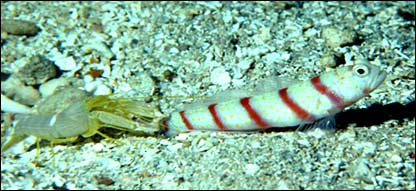
November 22, 2004, BBC Science News, UK: “Some 13,000 new marine species have been discovered in the past year, according to information released by an international alliance of scientists.
The Census of Marine Life (COML) has also uncovered previously unknown migration routes used by fish such as tuna and shark.
BBC Science News
The $1bn 10-year project, which is building a huge database, involves researchers in more than 70 countries. The new knowledge will inform future conservation and fisheries policies.
‘We’re just skimming the surface,’ said Dr Ron O’Dor, Chief Census Scientist, based in Washington DC, US.
We know something about the first 100m at this point but we know almost nothing about what lies down in the deep. Our analysis shows that if you catch a fish below 2,000m it is 50 times more likely to be new to science,’ he told the BBC News website.”
[Full Story]
“Prehistoric site found in underwater cave”
November 22, 2004, IOL/Cape Argus, South Africa: “A team of international scuba divers have located an underwater cave which reveals ‘promising signs’ of prehistoric human activity.
Maritime archaeologist Dr Bruno Werz described the site in False Bay on the Cape coast as ‘worthy of international exploration and excavation’.
He said: ‘The cave has the correct overhang and orientation for prehistoric cave dwellers. It would have been raised above the landscape allowing the inhabitants to spot game and command a strategic view. There is evidence around the cave of the type of vegetation that prehistoric man would have eaten. These are all promising signs that we may discover traces of human activity in the cave.’“
[Full Story]
“Moniz: Divers selling historic artefacts on Internet”
November 23, 2004, The Royal Gazette, Bermuda: “Divers are stealing historic artefacts from Bermuda’s shipwrecks and selling them on Internet auction site eBay, Shadow Attorney General Trevor Moniz said in the House of Assembly on Friday.
However Director of Conservation Services Jack Ward said Mr. Moniz’s assertion was ‘urban myth’, and that while it could happen, his department has received no evidence of such a thing.
In fact, Mr. Ward added, Mr. Moniz was ‘completely incorrect’ to say that humans present a greater threat to Bermuda’s wrecks than hurricanes.”
[Full Story]
“Letters to the Editor – The legend of Atlantis”
November 23, 2004, The Times, UK: “Sir, You report (November 16) yet another ‘discovery’ of Atlantis. I believe Atlantis is a myth inspired by the partial flooding of a desert island in the year of Plato’s birth.
Plato was born in 427BC, some five years into the Peloponnesian War. In The History of the Peloponnesian War Thucydides records that this year was characterised by frequent earthquakes which were accompanied by huge waves at sea.
He writes that a small Athenian island called Atalanta was struck by such a wave, which swept away fortifications. At Orobiac in Euboea a more powerful flood drowned many and left parts of the settlement submerged.
Far more probable than any drowned kingdom is that Plato was told of these floods as a child, and subsequently drew on them as inspiration for his noble fantasy.”
[Letter Source]
“Dive South Africa Is Proud To Be Part of Operation Zembe”
November 23, 2004, Only Punjab, India: “In 1995 leading South African marine archaeologist Bruno Werz found a hand axe whilst surveying a shipwreck in False Bay off Cape Town.
This was identified as an Acheulean tool dating back 300 000 to a million years, the oldest under sea find ever recorded, an archaeological oddity that raised a series of fascinating questions.
Further brief explorations of this site over the next few years revealed another hand axe and some pieces of animal bone.
Realizing that this site has international significance, through SAIMA (South African Institute of Maritime Archaeology) Bruno has requested the assistance of the Dorset based Scientific Exploration Society to be the first group to truly investigate this and other sites.”
[Letter Source]
“Stone age relics found off coast”
November 25, 2004, BBC News Online, UK: “The site of a stone age settlement, preserved under layers of silt, has been discovered off the coast of the Isle of Wight.
|
BBC News Online
|
|
Included in the find is a fire pit, presumed to be an oven, which was first used about 9,000 years ago.
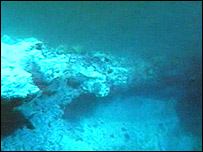
The settlement, now thirty feet beneath the sea and 500 yards off the coast of Bouldnor, was found by divers.
The Hampshire and Wight Trust for Maritime Archaeology hope to gather funds for a full investigation.
|
A small flint tool was also found embedded in a piece of wood near the oven.”
[Full Story]
“Atlantis in Ireland Theory Gaining Strength;
Invitation to Debate”
December 03, 2004, PRWeb, USA: “Based on similarity in geographic extent, Dr Erlingsson formulated the hypothesis that Plato based the description of the Atlantean Empire on the Megalithic Culture of Europe. He further reasoned that Atlantis then must have been Ireland.
This inference he evaluated scientifically using statistical significance testing on the null hypothesis. The probability that ‘Plato based the geographic description of Atlantis on Ireland’ was found to be 99.98%, leaving only a 0.02% possibility that the similarity is coincidental.
The rest of the book deals with archaeology and mythology. Both those fields reveal intriguing similarities between Ireland and Atlantis. For instance, archaeological textbooks confirm that Ireland features the choicest monuments of Megalithic Europe.
The finest monument, Newgrange, is called Brugh na Boinne in Ireland, which means the ‘Palace of Boann’ – the river goddess of the Boyne. Plato called Atlantis’ finest temple the ‘Palace of Poseidon’, Poseidon being the Greek river god. Moreover, both temples are 85 m across, and decorated with stones of different colors.”
[Full Story]
“China launches archeological sub”
December 06, 2004, XinhuaNet, China: “Chinese scientists say they have produced a submarine for underwater archeological research, as well as for underwater photography, seabed maps drawing and sea rescue.
The Beijing Morning Post reports the sub is 1.23 meter, or about 4 feet long, operates at a speed of up to 1.5 meter per second and can work for two to three hours.
Earlier this year, the submarine successfully helped archeologists study an ancient warship in south-east Fujian province.”
[Full Story]
“Robot developed for underwater archeological research”
December 07, 2004, XinhuaNet, China: “China has successfully developed afish-shaped robot for underwater archaeological studies.
With a black body, the 1.23-meter-long robot is much like a real fish in shape and movement. Through a palm-size remote control pad, technicians gave different instructions, making it swim supplely up and down, said Tan Min, deputy director of the Automation Research Institute under the Chinese Academy of Sciences (CAS).
‘The robot is able to work for two to three hours under water with the maximum speed of 1.5 meters per second,’ said Wang Tianmiao, director of the Research Institute of Robotics at Beijing University of Aeronautics and Astronautics, which developed the robot.”
[Full Story]
“The National Museum of Ireland Leaves Possibility Open
for Island Having Been Atlantis”
December 08, 2004, PRWeb, USA: “In early August the news broke that the island Atlantis, as described by Plato, was modeled on Ireland. Dr Ulf Erlingsson reported that the geographic similarity was statistically significant to 99.98% confidence level. The findings are presented in
“Atlantis from a Geographer’s Perspective: Mapping the Fairy Land”.
Later a number of newspapers printed articles claiming that the National Museum of Ireland had dismissed the theory. However, the written statement from the institution says the opposite, clearly showing that they did not reject it:
‘This theory seems to be based on geological information which we, as archaeologists, are not in a position to assess. However, we can say that we know of no archaeological evidence which would support Mr Erlingsson’s theory.’
Thus, the museum does not express any opinion about the validity of the arguments. They left it on the table that Atlantis could have been modeled on the geography of Ireland. They neither dismissed it, nor did they endorse it—exactly what one would expect from a serious scholar who does not have all the facts.”
[Full Story]
“They contributed to ice-age deep freeze”
December 09, 2004, Innovations-Report, Germany: “Labrador Sea ocean tides dislodged huge Arctic icebergs thousands of years ago, carrying gigantic ice-rafted debris across the ocean and contributing to the ice age’s deep freeze, say an international team of university researchers.
The study, published in the November issue of Nature, is the first to suggest that ocean tides contributed to enigmatic Heinrich events, a phenomenon where colossal discharges of icebergs periodically flowed into the North Atlantic from about 60,000 to 10,000 years ago.
The events occurred during the deep throes of the ice age and the new study shows that tides added to the chill by breaking gigantic icebergs from the ice sheet covering northern Canada. ‘These findings provide a link between ocean tides, ice sheets and ocean circulation and a measure of the sensitivity of climate during the last ice age,’ says University of Toronto physics professor Jerry Mitrovica, a co-author of the study. ‘This sensitivity is important to understand, because the connection between changes in ocean circulation and future climate remains a matter of great interest.’“
[Full Story]
“Diving for Life under Antarctic Ice”
December 15, 2004, Astrobiology Magazine, USA: “Life manages to hang on pretty much anywhere on Earth where there’s liquid water. Ice-covered lakes in Antarctica are no exception. But to study the microbes that hang out down under the ice, researchers have to do some risky diving. Dale Andersen is a pioneer of the technique.
Dale Andersen is a biologist at McGill University, the SETI Institute and NASA Ames. His research focuses on Mars analogs, locations on Earth that resemble Mars in one or more ways.
By studying these analog sites, Andersen hopes to learn about how life might have begun – or might still survive – on Mars.”
[Full Story]
“Catastrophic Flooding from Ancient Lake
May Have Triggered Cold Period”
December 17, 2004, ScienceBlog, USA: “Imagine a lake three times the size of the present-day Lake Ontario breaking through a dam and flooding down the Hudson River Valley past New York City and into the North Atlantic.
The results would be catastrophic if it happened today, but it did happen some 13,400 years ago during the retreat of glaciers over North America and may have triggered a brief cooling known as the Intra-Allerod Cold Period.
Assistant Scientist Jeffrey Donnelly of the Woods Hole Oceanographic Institution presented the findings at the American Geophysical Union’s fall meeting in San Francisco today. Donnelly and colleagues analyzed data from sediment cores, walrus fossils and pollen to precisely date the discharge from Glacial Lake Iroquois down the Hudson River Valley at 13,350 years ago.
The flood waters broke through a spot of land where the Verazanno Narrows Bridge now stands to reach the North Atlantic.”
[Full Story]
“Study shows whales suffer from the ‘bends'”
December 24, 2004, The Scotsman, Scotland: “Sperm whales appear to be vulnerable to the ‘bends’ just like deep-sea divers, scientists have revealed.
Researchers found evidence of bone damage in the giant animals similar to that suffered by divers.
The pitting and erosion of ribs, vertebrae and other bones was characteristic of a condition called osteonecrosis associated with decompression sickness, or the ‘bends’.
It used to be thought that whales were immune to the disorder, which occurs when a too-rapid return to the surface causes body tissues to ‘fizz’ with nitrogen bubbles.”
[Full Story]
“Historic Himalayan Ice Dams Created
Huge Lakes, Mammoth Floods”
December 27, 2004, ScienceDaily, USA: “ce dams across the deepest gorge on Earth created some of the highest-elevation lakes in history. New research shows the most recent of these lakes, in the Himalaya Mountains of Tibet, broke through its ice barrier somewhere between 600 and 900 AD, causing massive torrents of water to pour through the Himalayas into India.
Geological evidence points to the existence of at least three lakes, and probably four, at various times in history when glacial ice from the Himalayas blocked the flow of the Tsangpo River in Tibet, said University of Washington geologist David Montgomery, a professor of Earth and space sciences.
Carbon dating shows the most recent lake, about 780 feet deep, burst through the ice dam between 1,100 and 1,400 years ago, rapidly draining some 50 cubic miles of water.
The second lake, more than 2,200 feet deep, dates from about 10,000 years ago, and likely held more than 500 cubic miles of water. When that ice dam broke, it caused one of the greatest floods on Earth since the last ice age.”
[Full Story]
|
|
To understand why this News Page is sometimes late here is some information about Fibromyalgia
if you would like to support our marine archaeology research
The Morien Institute
Research Projects
please send us a book

from our Wish List
…
exclusive
…
October 2002
Morien Institute
illustrated interview with
Professor Masaaki Kimura
of the University of the Ruykyus,
Okinawa, Japan, regarding
the discovery of:
“Megalithic structures found underwater off the coast of
Yonaguni-jima, Japan”
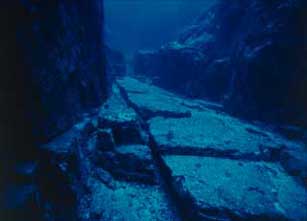
…
exclusive
…
June 2002
Morien Institute
illustrated interview with
Dr Paul Weinzweig
of Advanced Digital Communications,
Havana, Cuba, regarding
the discovery of:
“Megalithic urban ruins discovered off the coast of Cuba”
SeaLife
SL560 ReefMaster PRO
Set 35mm Camera
FEATURES:
Waterproof to 164 feet
35mm wide-angle lens
Triple-element lens construction
Push-button operation
Comes with SeaLife macro 3x close-up lens/underwater filter, SeaLife care kit, and external flash
“Atlantis of the West: The Case For Britain’s Drowned Megalithic Civilization”
by Paul Dunbavin

EU English Edition
“Do Welsh legends of lost cities beneath the sea match Plato’s descriptions of the island civilization of Atlantis? Do Irish myths of a golden age when the eastern Irish Sea was a flowery plain describe the same place Herodotus said disappeared beneath the waves during a single day and night of geological upheaval millennia before Ancient Greece?
Author and researcher Paul Dunbavin has embarked on a multidisciplinary investigation into how science could explain such a catastrophe and how modern archaeological findings point to a possible location for lost Atlantis. This book theorizes that the Middle Neolithic period around 5,000 years ago was a time of dramatic climate and sea-level changes all around the world.
From an up-to-date scientific perspective, Dunbavin distills an array of significant geological theories and then examines the archaeological and mythological record-which together leads to a lost land thousands of years ago in the Irish Sea that was still mentioned in ancient Welsh histories recorded in the 6th century.”
“Eden in the East: The Drowned Continent of Southeast Asia”
by Stephen Oppenheimer

EU English Edition
“A book that completetly changes the established and conventional view of prehistory by relocating the Lost Eden – the world’s 1st civilization – to SouthEast Asia. At the end of the Ice Age, SouthEast Asia formed a continent twice the size of India, which included Indochina, Malaysia, Indonesia and Borneo.
The South China Sea, the Gulf of Thailand and the Java sea, which were all dry, formed the connecting parts of the continent. Geologically, this half sunken continent is the Shunda shelf or Sundaland.
He produces evidence from ethnography, archaeology, oceanography, from creation stories, myths and sagas and from linguistics and DNA analysis, to argue that this founder civilization was destroyed by a catastrophic flood, caused by a rapid rise in the sea level at the end of the last ice age.”
“Discovery of Atlantis: Startling New Evidence and the Case for Cyprus”
by Robert Sarmast
EU English Edition
“Plato provided 53 physical clues in his famous dialogue Critias–the original account of the story of Atlantis that is the sole basis of all Atlantis research.
Discovery of Atlantis proves that the island of Cyprus and the underwater landscape just south of Cyprus is a perfect match with 51 of these clues. Exclusive 3D bathymetric maps based on new scientific data show for the first time a stretch of sunken land off of Cyprus.
The general layout of the landscape of Atlantis as described by Plato is easily discernible on this underwater landmass, as well as the precise location of its capital–Atlantis City. This robust empirical data is joined with other original findings based on mythological analysis and historical research, making the case for Cyprus increasingly obvious.”
“Underworld: The Mysterious Origins of Civilization”
by Graham Hancock
&
Santha Faiia
(Photographer)
EU English Edition
“From Graham Hancock, bestselling author of Fingerprints of the Gods, comes a mesmerizing book that takes us on a captivating underwater voyage to find the ruins of a lost civilization that’s been hidden for thousands of years beneath the world’s oceans.
While Graham Hancock is no stranger to stirring up heated controversy among scientific experts, his books and television documentaries have intrigued millions of people around the world and influenced many to rethink their views about the origins of human civilization. Now he returns with an explosive new work of archaeological detection.
In Underworld, Hancock continues his remarkable quest underwater, where, according to almost a thousand ancient myths from every part of the globe, the ruins of a lost civilization, obliterated in a universal flood, are to be found.”
“Atlantis and Earth’s
Shifting Crust”

VHS NTSC version
(USA and Canada)
“Searching for Lost Worlds: Atlantis”
VHS NTSC version
(USA and Canada)
“Quest for the Lost Civilisation: Boxed Set”
VHS NTSC version
(USA and Canada)
VHS UK PAL version
(UK and Europe)
“SeaLife ReefMaster DC310 Digital MAXX 3.3MP Digital Dive Camera”
“The Atlantis Blueprint: Unlocking the Ancient Mysteries of a Long-Lost Civilization”
by Colin Wilson & Rand Flem-Ath

EU English Edition
“The Great Pyramid. Stonehenge. Machu Picchu. For centuries, these and other sacred sites have inspired wonder among those who ponder their origins.
Conventional science tells us they were constructed by local peoples working with the primitive tools of a fledgling civilization. Who could have built these elaborate monuments? How did they do it? And what were their incomprehensible efforts and sacrifices designed to accomplish? Now comes a revolutionary theory that connects these mysteries to reveal a hidden global pattern–the ancient work of an advanced civilization whose warnings of planetary cataclysm now reverberate across one hundred millennia.
International bestselling author Colin Wilson and Canadian researcher Rand Flem-Ath join forces to share startling evidence of a fiercely intelligent society dating back as much as 100,000 years–one that sailed the oceans of the world, building monuments to preserve and communicate its remarkable wisdom.”
“Atlantis: Mother
of Empires”
by Robert B.Stacey- Judd

EU English Edition
“Stacy-Judd’s 1939 classic is the best book ever on the subject of Atlantis. Stacy-Judd was a Los Angeles architect who was fascinated by the Maya and their connections to Atlantis.
Long out-of-print, this popular of all Atlantis books is again available. Stacy-Judd’s training as an architect and draftsman put him in a unique position to evaluate and express in drawing his theories and evidence for Atlantis.
This is the book that has the original photo of the famous Mayan frieze of a pyramid being destroyed in a volcanic explosion and people escaping in a boat. Packed with Stacy-Judd’s photos and illustrations, this book belongs in every Atlantis library!”
“The Round Towers
of Atlantis”
by Henry O’Brien

EU English Edition
“First published in 1834 as “The Round Towers of Ireland” or the “Mysteries of Freemasonry, of Sabaism, and of Budhism”, this book was an instant sensation as one of the first modern studies of Atlantis, round towers, pre-Christian megalithic architecture and secret societies.
In addition to being a sourcebook on Atlantis Research, Druidic Culture and origins of modern Celtic Christianity, the book is a treasure-trove of ancient esoteric lore and arcane knowledge of the past, including:
The History of the Tuath-de-Danaans, The Round Towers and Megalithic Crosses of Ireland are pre-Christian, Ireland’s strange connections with ancient India, Persia and China, Ancient Secret Societies and Ireland, Ancient Egyptians and Ireland, Pre-Christian Messiahs, Mithraism, and Ireland, The Connections Between Atlantis and Ireland.”
“Submerged: Adventures
of America’s Most Elite Underwater Archeology Team”
by Daniel F. Lenihan
EU English Edition
“One of the world’s leading underwater archeologists recounts experiences from his 24 years as founder and head of the elite, award-winning Submerged Cultural Resources Unit (SCRU) team of the U.S. National Park Service-adventure writing at its best.
In Submerged, Lenihan (the co-author with Gene Hackman of the novel Wake of the Perdido Star) takes the reader on a kaleidoscope of underwater experiences-to ancient ruins covered by reservoirs in the desert southwest, to the lower rings of hell to retrieve the bodies of drowned divers, to gripping accounts of personal survival in underwater caves, ships, and submerged buildings. Among the astonishing, often harrowing assignments he recalls:
• The Isle Royale shipwrecks: Surveying ten large ships sunk from the mid-19th to mid-20th centuries in the middle of the frigid and deep Lake Superior. • The USS Arizona in Pearl Harbor: Executing the largest mapping project ever conducted underwater, and his personal impressions as, the leader of the first expedition to explore and video the entire ship in 1983.”
“Basic Decompression Theory and Application, Second Edition”
by Bruce R. Wienke

EU English Edition
“The new 2nd Edition of Basic Decompression Theory And Application has been extended, updated, with new material added. It takes all rudiments of decompression theory and phase mechanics to considerable depth, while focusing on diving applications in an historical perspective.
Topics span many disciplines, and the targeted audience is the commercial diver, hyperbaric scientist, doctor, physical scientist, technical diver, and instructor. Recent developments in diving tables, decompression meters, and decompression management software are presented, and broad model underpinnings are detailed and contrasted.
Testing and validation of modern dual phase approaches to staging for decompression, extended range, altitude, and mixed gas diving are a focus of discussion. Deep stops, optimal gas switches, and helium mixes are underscored from diver experience, data, and coarse grain principles. References and numerical examples (with solutions) are included for more detail and extended diver analysis.”
“Successful Underwater Photography”
by Brian Skerry & Howard Hall
EU English Edition
“From fundamental principles of photographing marine life to making a living selling underwater photographs, Successful Underwater Photography provides an unlimited wealth of practical advice, surefire strategies, and tested tips for taking extraordinary photos of elusive underwater subjects.
Written by two top photographers who specialize in marine photography, this solid, lavishly illustrated field guide provides no-nonsense information on such topics as taking available-light photographs, silhouettes, marine wildlife portraits, close-focus wide angle photographs, and extension tube photographs to name just a few. Readers will also find proven guidance for purchasing underwater photographic equipment, taking photos of shipwrecks, and repairing and maintaining field equipment.
Plus, 150 stunning, full-color photos demonstrate the authors’ successful techniques in action. For all aspiring underwater photographers who want to unlock the secrets of how top names in the field achieve spectacular results, Successful Underwater Photography is your definitive one-stop guide.”
“Digital Imaging for the Underwater Photographer”
by Jack Drafhal & Sue Drafhal
EU English Edition
“How to Solve Common Problems, Repair Images and Create Dazzling Presentations; Focusing on the aspects of digital imaging that are most important to underwater photographers, this book is a step-by-step guide for the professional and amateur alike to improve their images and presentations. Designed to help the underwater photographer make a smooth transition to digital imaging, this book discusses how to digitally refine, correct, and enhance underwater photographs. Detailing the equipment necessary, it also includes a discussion on the essentials of scanning. There is also extensive information on Adobe Photoshop, and how it can be used to edit underwater pictures.
Designed to help the underwater photographer make a smooth transition to digital imaging, this book discusses how to digitally refine, correct, and enhance underwater photographs. Detailing the equipment necessary, it also includes a discussion on the essentials of scanning. There is also extensive information on Adobe Photoshop, and how it can be used to edit underwater pictures.
Designed to help the underwater photographer make a smooth transition to digital imaging, this book discusses how to digitally refine, correct, and enhance underwater photographs. It details the equipment necessary for digital imaging for underwater photography, and includes a discussion on the essentials of scanning. There is extensive information on Adobe Photoshop, and how it can be used to edit underwater pictures. This book also investigates the ethics of photo manipulation and discusses the future of underwater photography.”
SeaLife
DC310 3.3MP
Underwater Digital Camera
FEATURES:
Land Mode, Sea Mode and External Flash Mode
Instant delete option after each picture in both Sea and External Flash Modes
One-button operation
Expandable with all ReefMaster lenses, flashes and accessories
Depth tested to 200 ft / 60 m
“When the Sky Fell:
In Search of Atlantis”
by Rose & Rand Flem-Ath
EU English Edition
“Did Atlantis really exsist? If so,where was it,and what happened to it?
Inspired by the theory that at various stages in prehistory the earths crust shifted dramatically,causing violent earthquakes, tidal waves,devastating climatic changes,the authors examine the clues as to the location of Atlantis entrusted to Plato by Egyptian priests,the extraordinary similarities between myths from around the world,and ancient and amazingly accurate maps of South America and ice free Antarctica that date long before the first European explorers ever reached those shores.
They conclude that a civilization of highly intelligent seafarers did exists some twelve thousand years ago, but was destroy ed,by a geological disaster,leaving only a few survivors to safeguard its relicsand legends for posterity.”
“Atlantis, the Antediluvian World”
by Ignatius Donnelly
EU English Edition
“The most important book of its time (1882) on the subject of Atlantis.
The author claims there once existed in the Atlantic Ocean, opposite the mouth of the Mediterranean Sea, a large island, which was the remnant of an Atlantic continent, and known to the ancient world as Atlantis, that Atlantis was the region where man first rose from a state of barbarism to civilization, that the gods and goddesses of the ancient Greeks, the Phoenicians, the Hindus, and the Scandinavians were simply the kings, queens, and heroes of Atlantis, that the mythologies of Egypt and Peru represented the original religion of Atlantis, which was sun-worship, etc., etc. Illustrated with photographs.”
“The Round Towers
of Atlantis”
by Henry O’Brien
EU English Edition
“First published in 1834 as “The Round Towers of Ireland” or the “Mysteries of Freemasonry, of Sabaism, and of Budhism”, this book was an instant sensation as one of the first modern studies of Atlantis, round towers, pre-Christian megalithic architecture and secret societies.
In addition to being a sourcebook on Atlantis Research, Druidic Culture and origins of modern Celtic Christianity, the book is a treasure-trove of ancient esoteric lore and arcane knowledge of the past, including:
The History of the Tuath-de-Danaans, The Round Towers and Megalithic Crosses of Ireland are pre-Christian, Ireland’s strange connections with ancient India, Persia and China, Ancient Secret Societies and Ireland, Ancient Egyptians and Ireland, Pre-Christian Messiahs, Mithraism, and Ireland, The Connections Between Atlantis and Ireland.”
“Basic Decompression Theory and Application, Second Edition”
by Bruce R. Wienke
EU English Edition
“The new 2nd Edition of Basic Decompression Theory And Application has been extended, updated, with new material added. It takes all rudiments of decompression theory and phase mechanics to considerable depth, while focusing on diving applications in an historical perspective.
Topics span many disciplines, and the targeted audience is the commercial diver, hyperbaric scientist, doctor, physical scientist, technical diver, and instructor. Recent developments in diving tables, decompression meters, and decompression management software are presented, and broad model underpinnings are detailed and contrasted.
Testing and validation of modern dual phase approaches to staging for decompression, extended range, altitude, and mixed gas diving are a focus of discussion. Deep stops, optimal gas switches, and helium mixes are underscored from diver experience, data, and coarse grain principles. References and numerical examples (with solutions) are included for more detail and extended diver analysis.”
“Plato’s Timaeus”
by Peter Kalkavage (Translator)
EU English Edition
“A new translation in the Focus Philosophical Library series, with notes and introductory material, glossary and appendix.
Especially noteworthy are the extensive discussions in appendices on astronomy, geometry and music. Modern Students can now appreciate the wisdom of the world’s greatest thinkers.
Through clear, faithful translations, renowned scholars have made classical philosophical texts accessible and inspirational.”
“The Atlantis Dialogue: Plato’s Original Story of the Lost City, Continent, Empire”
by Plato, Aaron Shepard (Editor), B. Jowett (Translator)

EU English Edition
“Atlantis was first introduced to world literature by the Greek philosopher Plato in two “dialogues” he wrote in the fourth century B.C.
His tale of a great empire that sank beneath the waves has sparked thousands of years of debate over whether Atlantis really existed. But did Plato mean his tale as history, or just as a parable to help illustrate his philosophy?
In this book, you’ll find everything Plato said about Atlantis, in the context he intended. Now you can read and judge for yourself!”
“The New View over Atlantis”
by John F. Michell

EU English Edition
“The View Over Atlantis, John Michell’s unrivaled introduction to megalithic science, earth mysteries, and the inner meaning of number and measure, was described by Colin Wilson as ‘one of the great seminal books of our generation—a book which will be argued about for decades to come.’
Across much of the globe are ancient earthworks and stone monuments built for an unknown purpose. Their shared features suggest that they were originally part of a worldwide system, and John Michell argues that they served the elemental science of the archaic civilization that Plato referred to as Atlantis.
In this connection the most significant modern discovery is that of ‘leys’, the mysterious network of straight lines that link the ancient places of Britain and have their counterparts in China, Australia, South America, and elsewhere.”
“Successful Underwater Photography”
by Brian Skerry & Howard Hall
EU English Edition
“From fundamental principles of photographing marine life to making a living selling underwater photographs, Successful Underwater Photography provides an unlimited wealth of practical advice, surefire strategies, and tested tips for taking extraordinary photos of elusive underwater subjects.
Written by two top photographers who specialize in marine photography, this solid, lavishly illustrated field guide provides no-nonsense information on such topics as taking available-light photographs, silhouettes, marine wildlife portraits, close-focus wide angle photographs, and extension tube photographs to name just a few. Readers will also find proven guidance for purchasing underwater photographic equipment, taking photos of shipwrecks, and repairing and maintaining field equipment.
“Digital Imaging for the Underwater Photographer”
by Jack Drafhal & Sue Drafhal
EU English Edition
“How to Solve Common Problems, Repair Images and Create Dazzling Presentations; Focusing on the aspects of digital imaging that are most important to underwater photographers, this book is a step-by-step guide for the professional and amateur alike to improve their images and presentations. Designed to help the underwater photographer make a smooth transition to digital imaging, this book discusses how to digitally refine, correct, and enhance underwater photographs. Detailing the equipment necessary, it also includes a discussion on the essentials of scanning. There is also extensive information on Adobe Photoshop, and how it can be used to edit underwater pictures.
Designed to help the underwater photographer make a smooth transition to digital imaging, this book discusses how to digitally refine, correct, and enhance underwater photographs. Detailing the equipment necessary, it also includes a discussion on the essentials of scanning. There is also extensive information on Adobe Photoshop, and how it can be used to edit underwater pictures.
SeaLife
DC310 3.3MP
Underwater Digital Camera
FEATURES:
Land Mode, Sea Mode and External Flash Mode
Instant delete option after each picture in both Sea and External Flash Modes
One-button operation
Expandable with all ReefMaster lenses, flashes and accessories
Depth tested to 200 ft / 60 m
“Maritime Archaeology: A Technical Handbook”
Jeremy Green
EU English Edition
“Jeremy Green’s systematic overview of maritime archaeology offers a step-by-step description of this fast-growing field. With new information about the use of computers and Global Positioning Systems, the second edition of this handbook shows how to extract as much information as possible from a site, how to record and document the data, and how to act ethically and responsibly wth the artifacts.
Treating underwater archaeology as a discipline, the book demonstrates how archaeologists, “looters,” academics, and governments interact and how the market for archaeological artifacts creates obstacles and opportunities for these groups. Well illustrated and comprehensive in its approach to the subject, this book provides an essential foundation for everybody interested in underwater environments, submerged land structures, and conditions created by sea level changes.
* Covers five broad areas: searching for sites, recording sites, excavation, management of collections, and study, research and publication.
* Describes a variety of techniques and procedures in considerable detail, accessible to both professional and amateur archaeologists.
* More than 250 photographs, charts, and diagrams explain everything from how to operate a sextant and a hand-held GPS to how a swim line should be laid out by the dive team before excavation begins.”
“Maritime Archaeology: A Technical Handbook”
Jeremy Green
EU English Edition
“Jeremy Green’s systematic overview of maritime archaeology offers a step-by-step description of this fast-growing field. With new information about the use of computers and Global Positioning Systems, the second edition of this handbook shows how to extract as much information as possible from a site, how to record and document the data, and how to act ethically and responsibly wth the artifacts.
Treating underwater archaeology as a discipline, the book demonstrates how archaeologists, “looters,” academics, and governments interact and how the market for archaeological artifacts creates obstacles and opportunities for these groups. Well illustrated and comprehensive in its approach to the subject, this book provides an essential foundation for everybody interested in underwater environments, submerged land structures, and conditions created by sea level changes.
* Covers five broad areas: searching for sites, recording sites, excavation, management of collections, and study, research and publication.
* Describes a variety of techniques and procedures in considerable detail, accessible to both professional and amateur archaeologists.
* More than 250 photographs, charts, and diagrams explain everything from how to operate a sextant and a hand-held GPS to how a swim line should be laid out by the dive team before excavation begins.”
|
