|
“Tsunami uncovers archaeological mystery”
December 26, 2005, ABC TV News, Australia: “The destructive capacity of last year’s tsunami wiped life from Earth in numbers that defy comprehension. Each one gone dramatically altering other lives – friends and families in a chain wrapped countless times around the world.
Towns and villages and possessions obliterated. In many parts, the very presence of human beings simply erased, as if they were never there.
The tsunamis took a great deal away, but in one tiny corner, they actually gave something back. And it has archaeologists and historians arguing about precisely what it is.
It is evidence of a long-lost ancient community? Is there a mystical temple covered by time, or perhaps even an entire city buried beneath the sand and the sea around Mahabalipuram in southern India.
Anne Maria Nicholson travelled to India to piece together a picture from the fleeting glimpses snatched between the tsunamis and the more structured exploration now under way.”
[Full Story]
“More treasure off Elba, divers say”
December 23, 2005, ANSA, Italy: “A group of diving enthusiasts who found sunken treasure in the sea off the island of Elba this year are convinced there is more and are preparing for a new expedition in 2006.
In the meantime, what they found in the wreck of the steamship Polluce, which sank in 1841, will go on display in an exhibition opening in January in Portoferraio, one of Elba’s two ports.
The haul includes 12,000 gold and silver coins, an array of gold jewelry and piles of personal objects belonging to the rich passengers who were travelling on the Polluce.
But Enrico Cappelletti, a writer and diving enthusiast who spearheaded the initiative after extensive research, said he was convinced that under the mud around the wreck there is much more gold and silver.”
[Full Story]
“Divers hope to set example by turning in lake’s artifacts”
December 22, 2005, NBC3 News, USA: “Two men who have spent countless hours scouring the bottom of Lake Champlain for artifacts are turning their collections over to the state – and hoping other divers will follow their example.
Greg Brunet and Tony Tyrell say it wasn’t uncommon for many amateur divers to keep items they found on the lake’s murky bottom.
Some of those items – such as cannon balls or parts of boats and ships – hold historic significance from the battles fought on the lake.
But artifacts lying on the bottom of a body of water belong to the state or to the military branch or even the nation from which they came.”
[Full Story]
“Dead Sea anchors were carefully designed”
December 16, 2005, The Jerusalem Post, Israel: “Two remarkably well-preserved wooden anchors more than two millennia old, discovered recently on the shores of the Dead Sea, are now on view opposite the book shop at the Israel Museum, on loan from the Israel Antiquities Authority.
Over the last few decades, Israel’s diversion of water from Lake Kinneret into the national water carrier has caused the progressive drop in the level of the Dead Sea, reducing its size by nearly half.
The receding waters uncovered the two wooden anchors, which were spotted by archaeologist Dr. Gideon Hadas during a stroll along the shore.
The first anchor, approximately 2,500 years old, was found where the Ein Gedi harbor was once located, and may have been used by the Jews of biblical Ein Gedi.
The later anchor, some 2,000 years old, was constructed according to the best Roman technology and probably belonged to a large craft used by one of the rulers of Judea. As the sea recedes further, we may yet get to see the ship to which this anchor belonged.”
[Full Story]
“Greece’s seas: the looters’ next destination”
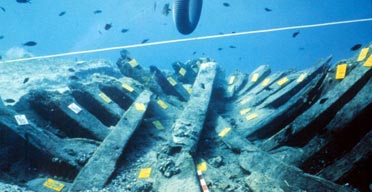
December 06, 2005, The Guardian, UK: “When it was first proposed, it seemed like a good idea: open up the Greek seas to divers and create a paradise for tourists underwater. Those who backed the law never thought of it as a windfall for looters, nor did it occur to them that it might put the acquisition policies of museums under further scrutiny.
|
The Guardian, UK
|
|
But the Greek parliament’s unprecedented step last month to allow divers access to the once forbidden coastline has raised fears that archaeological riches preserved in an untouched world will be taken by ruthless thieves.
‘There are treasures in our seas,’ says Dimitris Athanasoulis, president of the Archaeologists’ Association.
|
‘This will open the floodgates to smugglers. It’ll serve to encourage them at a time when evidence shows the trafficking of antiquities is on the rise.’
Last month, as Athens announced legal action against California’s Getty Museum to reclaim an array of antiquities whose rightful owners, according to authorities, died at least 2,000 years ago, the row reached a new pitch.
At issue are thousands of shipwrecks believed to be buried in the Mediterranean. Greece is thought to host most of these submerged gems, with an undisclosed number, say experts, dating to the golden age of the 5th century BC. And, like later vessels from the Roman, Byzantine and early modern periods, those ships sank with priceless cargoes intact.”
[Full story]
“Skeleton under ship is Iron age”
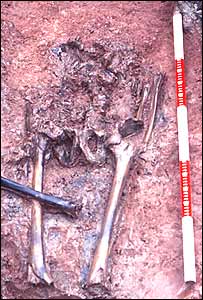
December 05, 2005, BBC Science News, UK: “The remains of a skeleton found underneath a medieval ship discovered buried in the banks of the River Usk in Newport are that of an Iron age man.
|
BBC Science News
|
|
Tests carried out on the bones which were found in December 2002, have shown that they date back to 170BC. It makes the skeleton about 1,500 years older than the 15th century ship.
The man is thought to have been about 5ft 9in tall and very muscular. He was probably in his late 20s or early 30s when he died.
Experts carried out radio carbon dating on the bones which were found underneath wooden struts supporting the ship as workers carried out an excavation of the orchestra pit of the city’s Riverfront Theatre and Arts Centre on 11 December 2002.
|
The bones were examined by Dr Ros Coard and Alison Bennett from the University of Lampeter. At the time of the find, it was thought that the man may have died in an industrial accident as he was salvaging the boat.
Archaeologists have concluded that the man’s body may have deliberately placed in the channel or he was a victim of drowning whose body was washed into the channel and buried under sediment.”
[Full story]
“Ancient underwater forest off of Nantucket
may yield prehistoric clues”
December 04, 2005, WHDH-TV News/AP, USA: “Scientists who have found evidence of an ancient forest buried under six feet of mud in Nantucket Sound say the discovery could help answer questions about early people in North America.
The findings, made two years ago while scientists were mapping a proposed wind farm, include a piece of birch wood, yellowish green grass, soil and insect parts, and appear to make up a forest floor that lined the coastline 5,500 years ago, reported The Boston Sunday Globe.
‘We’ve been arguing for years whether there are remnant prehistoric landscapes out there and now we know they can exist,’ said Victor Mastone, director and chief archaeologist of the Massachusetts Board of Underwater Archaeological Resources.
Mastone said this means there is the potential of going after ‘the big theory of how did people get here and how they lived.’ Archaeologists have long believed that the first humans came to North America about 12,000 years ago by way of a land bridge from Siberia to Alaska.
But some scientists believe people may have migrated on a coastal route to get from Russia to the Pacific Coast or from Europe to North America. There’s little evidence to support this hypothesis, however, because most of the prehistoric shoreline is under water. The discovery of an intact cultural site could provide evidence of tools or food gathering and help settle the debate.”
[Full Story]
“Cornish Divers arrested on treasure hunt suspicion”
December 04, 2005, Deeper Blue, UK: “A team of Cornish commercial divers could be facing extradition accused of plundering shipwrecks of the Spanish coast.
It was originally claimed that the team was illegally diving for gold and diamonds on a wreck off Galicia on the north west coast of Spain.
Now they face charges of theft and damaging Spanish heritage and up to six years in jail.”
[Full Story]
“Sunken treasure: Scientists find evidence of ancient forest buried under the seabed of Nantucket Sound”
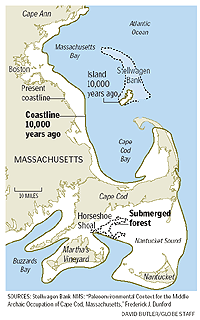
December 04, 2005, The Boston Globe, USA: “Scientists mapping the seabed under a proposed wind farm in Nantucket Sound were stunned by their find: evidence of a submerged forest under 6 feet of mud.
|
The Boston Globe
|
|
It’s hardly the lost city of Atlantis, but the piece of birch wood, the yellowish-green grass, soil, and insect parts appear to be part of a forest floor that lined the coastline 5,500 years ago, before being swallowed by the sea that rose after the last ice age.
Nearby is evidence of a drowned kettle pond and marsh.
The find has scientists abuzz because if a preserved forest rests below the sea, maybe artifacts from ancient cultures do, too – items that could help answer some of the most vexing questions about early people in North America.
|
As more energy projects are proposed off New England, archaeologists say, there will be more opportunity for even bigger finds.
‘We’ve been arguing for years whether there are remnant prehistoric landscapes out there and now we know they can exist,’ said Victor Mastone, director and chief archaeologist of the Massachusetts Board of Underwater Archaeological Resources. ‘This means there is the potential to go after the big theory of how did people get here and how they lived.’“
[Full story]
“Grant helps historians search for shipwrecks off Atlantic coast”
December 04, 2005, Sun-Sentinel, USA: ” With a state grant stowed away, Martin County historians have begun researching the waters off the coast for historic shipwrecks, like the wreck of the ship that brought Jonathan Dickinson, the Quaker pioneer whose journal constitutes the area’s earliest written history.
Volunteers with the Historical Society of Martin County are researching ways to identify pieces of wrecks and underwater artifacts, which someday could be part of a new exhibit at the Elliott Museum on Hutchinson Island.
Using the expertise of a nonprofit salvage operation and volunteer archaeologists, local historians said the 7-square-mile survey, which will take place early next year, will likely uncover many historically significant wrecks.”
[Full Story]
“Divers face prison over claims they pillaged
wreck of Spanish galleon”
December 02, 2005, The Independent, UK: “Three British divers arrested three years ago for allegedly trying to pillage a Spanish galleon have been told they will face charges punishable by up to six years in prison.
The men, commercial divers based in Cornwall, learnt this week that they are to face charges of theft and damaging Spain’s historic heritage after a three-year inquiry.
The group were arrested in Galicia, north-western Spain, after winning a contract from the Spanish authorities to salvage 220 tons of tin worth up to £650,000 from the Friesland, a Dutch cargo vessel which sank in 1877.
Prosecutors allege that as well as diving on the Friesland, the Britons were exploring the remains of an adjacent vessel, the Dom Pedro, a 17th-century galleon laden with gold and diamonds.
Investigators found the wrecks had been minimally disturbed and no valuables taken.”
[Full Story]
“Episkopi Bay may be strewn with ancient shipwrecks”
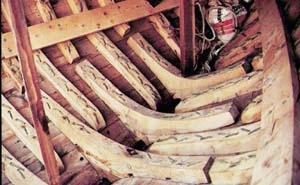
November 29, 2005, The Cyprus Weekly, Cyprus: “There are no immediate plans to salvage ancient shipwrecks possibly lying on the bottom of the Episkopi Bay on the island’s southern coast, Director of Antiquities Pavlos Flourentzos said this week.
|
The Cyprus Weekly
|
|
Asked by The Cyprus Weekly to comment on a continuing underwater survey in the area, which revealed potential shipwreck sites, he said that unless something was important and at least older than the famous 4th century Kyrenia wreck, the Department would leave it alone for the time being.
|
He explained that excavating and bringing up a submerged ancient wreck involved considerable expenses and efforts, especially as it would then have to be restored and preserved. ‘If they are Roman or more recent they would just have to wait,’ Flourentzos said.
The only definite sightings so far concern the scattered debris of a 5th or 6th century merchantman in the small inlet of Avdimou Bay. But the use of more sophisticated equipment this year showed anomalies on the seabed of Episkopi Bay probably hiding shipwrecks underneath.”
[Full story]
“Ancient Harbor Complex Confirmed at Bimini, Bahamas
— Uncovering the Bimini Hoax – “
November 09, 2005, I-NewsWire, USA: “An American archaeological team has discovered definitive evidence of underwater ancient harbor remains at two separate locations at Bimini. A hoax begun in 1978 by skeptics has also been uncovered.
Archaeologist William Donato and a team of researchers have confirmed a complex of ancient harbor works in shallow water off Bimini, 50 miles from Miami. In May 2005, the team investigated a little-known line of underwater stones located a mile from a controversial site known as the ‘Bimini Road’. The new mile-long line of stones was found and videotaped from the air.
Subsequent dives revealed several large stone circles on the bottom, formed from large blocks of limestone arranged into circular patterns. The circles were spaced at regular intervals.
Stone anchors, identical to ancient Phoenician, Greek, and Roman anchors, were also found. ‘These finds took us by surprise,’ stated Dr. Greg Little, who organized the expedition. ‘The circles may be similar to ancient Mediterranean harbor “mooring circles.”‘
Near the new site is the Bimini Road, a misnamed J-shaped underwater formation of stone blocks. A careful search there yielded two stone anchors in the 1800-foot long stone formation. ‘One of these is identical to unusual ancient Greek anchors found at Thera,’ Little related. Several other artifacts were found, ‘but the most important finds directly contradict skeptical claims.’“
[Full Story] –
Download Dr Little’s Full (6.5Mb) Report in .pdf
“Archaeologists discover base of ancient lighthouse”
November 07, 2005, RIA Novosti, Russia: “French diving archeologists have discovered the foundation of the ancient lighthouse of Pharos in Alexandria, the seventh wonder of the world.
The director of the Alexandria national museum, Ibrahim Darwish, said Sunday that the lighthouse, which was destroyed by two earthquakes in the 11th and 14th centuries, had occupied an area of 800 sq m north of the city’s eastern harbor.
The lighthouse consisted of three towers stacked one on top of the other largest to smallest and reached 120-137 meters (390-450 feet) in height. On top of the lighthouse, there was a bronze chalice holding smoldering coal. A complicated system of mirrors made it possible for travelers to see the smoldering coal from a distance of tens of kilometers (up to 60 miles).”
[Full Story]
“Timbers from Two Ancient Shipwrecks Excavated
by Maritime Studies Institute”
November 06, 2005, IMRA, Israel: “The annual underwater archaeological excavation season at the Dor/Tantura lagoon has just ended.
Two shipwrecks were excavated: one from the Byzantine period – about the end of the 5th century CE, and the other from the early Islamic period – the beginning of the 8th century CE.
The Byzantine wreck is the remains of a ship which carried building stones, 80 of which were found stacked neatly in its hold. In previous seasons, the stones were removed layer by layer, exposing the ship’s internal planking which was protected by matting.
In the 2005 season, the fourth, the divers dismantled the planking and studied the interior of the hull. The last step was the sawing out of a section of the ship’s hull for detailed study.
The timbers from this section were retrieved from the seabed and transferred to the recently-installed conservation laboratory at the University of Haifa.”
[Full Story]
“Fighting over the salvage of ancient wrecks”
November 03, 2005, Kathimerini, Greece: “A new Merchant Marine Ministry law on recreational diving has provoked protests, particularly by archaeological authorities.
The new law, aimed at developing diving tourism, was passed by both major parties. Its provisions introduce radical changes to the rules governing diving in Greece, including virtually abolishing the ban on diving in areas of major archaeological interest.
According to the Merchant Marine Ministry, the new law will turn the country into an underwater paradise for amateurs and professional divers alike, bringing in more tourism revenue.
Officials involved in drafting the law have accused the Ephorate of Underwater Antiquities of idleness, as a result of which recreational divers have at their disposal just 120 ‘free’ areas out of a total of 16,000. As they are all close to ports, they are not of great interest.
Sources in the ephorate, which belongs to the Culture Ministry, say the law is a scandal since it does not take into consideration an archaeology law that is enshrined in the constitution and therefore has greater force. They also note that soon Greece will no longer be of any interest to divers since its underwater treasures will be easy game for antiquities smugglers.”
[Full Story]
“Archaeologists search in Charlotte Harbor”
November 01, 2005, The News-Press, USA: “Slowly, very slowly Monday, the 24-foot twin-engine Parker bumped through the choppy green water in Charlotte Harbor.
Three archaeologists intently watched two screens — one hooked to a side-scan sonar ‘tow fish’ trailing behind the boat, the other hooked to a magnetometer tow fish — seeking the harbor’s maritime history.
‘This is really exciting work; going 3 to 4 knots, looking at the bay floor,’ said J. Coz Cozzi, Mote Marine Laboratory’s nautical archaeologist. ‘This is as exciting as it gets.’
With the help of scientists and equipment from Panamerican Consultants Inc. of Memphis, Cozzi has started the first systematic search for sunken and abandoned vessels and the remains of historic structures in Charlotte Harbor.”
[Full Story]
“Marine hopes for archaeologists”
October 28, 2005, ANSA, Italy: “Archaeologists in this western Sicilian city are hoping that a modern sailing event could help them unlock some of the underwater secrets of the island’s maritime past.
The highly publicized pre-America’s Cup Louis Vuitton series, the final chapters of which were staged off the coast here prior to the winter break, helped spotlight an area that is home to numerous wrecks of archaeological value.
Dozens of ancient vessels are still lying unsalvaged on the seabed, in part, due to a lack of funds.
Among the wrecks are a group that sank over 2,200 years ago during the Punic Wars, in a landmark battle between the Romans and the Carthaginians that shaped history.
The wild weather sunk 70 Carthaginian vessels and 30 Roman ones and despite some archaeological plundering in the 1970s, numerous finds are still waiting to be rescued from their resting place.”
[Full Story]
“Tsunami reveals ancient temple sites”
August 27, 2005, BBC News Online, UK: “Archaeologists say they have discovered the site of an ancient temple in the southern Indian state of Tamil Nadu.
|
BBC News Online
|
|
The fragments of Henry VIII’s flagship, which sank in 1545, were found in 2003 in the Solent.
It is the latest in a series of archaeological discoveries in the area struck by December’s tsunami, which desilted large areas of the coastline.
|
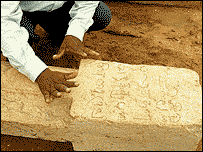
The brick temple dates back more than 2,000 years to the late Tamil Sangam period and was discovered on the beachfront near Saluvankuppam, just north of a famous World Heritage site at Mahabalipuram.
The discovery lends more weight to growing evidence that a huge tsunami hit the east coast of India during this period, obliterating large habitations along the coastline.”
[Full story]
“Divers unveil exquisite treasure pulled
from depths of Java Sea”
October 26, 2005, Yahoo News/AFP, USA: “In a nondescript warehouse in Jakarta, treasure-hunter Luc Heymans dips into plastic boxes and pulls out jewels and ornaments that lay hidden at the bottom of the Java Sea for 1,000 years.
An ornately sculpted mirror of polished bronze is one masterpiece among the 250,000 artefacts recovered over the last 18 months from a boat that sank off Indonesia’s shores in the 10th century.
On a small mould is written the word ‘Allah’ in beautiful Arabic script, on top of a lid sits a delicately chiseled doe.
Tiny perfume flasks accompany jars made of baked clay, while slender-necked vases fill the shelves of the hangar along with brightly colored glassware from the Fatimides dynasty that once ruled ancient Egypt.
A team of divers, among them three Australians, two Britons, three French, three Belgians and two Germans, excavated the vessel laden with rare ceramics which sank more than 1,000 years ago some 130 nautical miles from Jakarta.”
[Full Story]
“Protection of heritage all at sea”
October 24, 2005, China Daily, China: “Cultural treasures hidden beneath the waves of the South China Sea are being threatened by illegal plunderers and the operations of the modern fishing industry, experts have warned.
Speaking at the 15th General Assembly of the International Council on Monuments and Sites (ICOMOS) which concluded on Friday in Xi’an, capital of Shaanxi Province, Zhang Wei, director of the China National Museum’s Submarine Archaeology Research Centre, said unscrupulous fishermen are targeting the country’s underwater treasures.
Historically, the South China Sea has been a popular trade route. Dubbed the ancient marine Silk Road, many vessels sank in the sea’s waters taking their valuable cargo with them to the bottom.
In the latest case, local fishermen discovered a Qing Dynasty (1644-1911) wreck in the South China Sea in June. Attempts to hook booty from the boat caused serious damage to the archaeologically important wreck.”
[Full Story]
“Greek and American scientists to continue successful
joint deep-sea exploration project”
October 22, 2005, Kathimerini, Greece: “The United States and Greece will continue their successful deep-sea exploration program in the summer of 2006.
The project, part of a long-term partnership between Greek and American scientists and engineers, explores the deep-sea basins of Greece to locate, map and interpret ancient shipwrecks and geological and chemical features in three areas. American Ambassador to Athens Charles Ries is holding a dinner on Tuesday in honor of the team as well as to present the results of the partnership’s 2005 project.
The program is jointly supported by the Greek Culture Ministry, the Ephorate of Underwater Activities, the Hellenic Center for Marine Research (HCMR), the Woods Hole Oceanographic Institution (WHOI) and the Massachusetts Institute of Technology (MIT).
The precision surveys are carried out by the SeaBED (Autonomous Underwater Vehicle, or AUV) developed by WHOI. The next mission, in summer 2006, will investigate a Byzantine-era shipwreck (c. 10th century AD) 110 meters below the surface, a Classical/Hellenistic wreck (c. fourth century BC) at a depth of 500 meters, an active submarine volcano and unexplored sea floor.”
[Full Story]
“Ophelia hoists artifact from Blackbeard’s ship”
October 22, 2005, Myrtle Beach Online, USA: “Researchers excavating the site of the pirate Blackbeard’s wrecked ship got an unexpected assist from Hurricane Ophelia, which unearthed an apothecary mortar from the remains of the Queen Anne’s Revenge.
The item – familiar to modern eyes in pharmacy logos, where it’s shown with a pestle – was among several items revealed among the wreckage when the storm churned up the N.C. coastline last month, said Chris Southerly, project archaeologist for the Queen Anne’s Revenge Shipwreck Project.
Two cannons, an anchor and other debris were also exposed when Ophelia scoured sand to the south and southwest of the main ballast pile.
Project workers believe that’s the stern of the vessel, where the officers’ quarters would have been and where divers are most likely to find Blackbeard’s personal items, Southerly said.”
[Full Story]
“Underwater archaeology impossible at Bolaghi”
October 19, 2005, IranMania, Iran: “Underwater archaeological works will be impossible at Tang-e Bolaghi after the Sivand Dam devours the ancient site, the Iranian director of the joint Iranian and Italian team working at the site said, MNA reported.
‘Underwater archaeology is only practical in oceans and seas in which the water is stagnant in the deep area. The reservoir of the Sivand Dam will be filled by the Polvar River, thus causing a constant flow of water into the dam. The river will then deposit mud behind the dam and the archaeological sites will be buried under sediment,’ Alireza Asgari added.
‘The large extent of the silt will entirely cover Tang-e Bolghi, so that there will be no trace of the site after 100 or 150 years when the dam expires. The layers of sediment will also gradually spoil the dam by raising the level of water to the crest of the dam,’ he explained.
Teams of Italian, Polish, Japanese, French, German, and Australian archaeologists have been assigned to save 129 ancient sites in Tang-e Bolaghi.
‘The officials of the dam as well as the teams of archaeologists know that Tang-e Bolaghi will meet its death when the ancient sites are submerged and also know that underwater archaeology would be a futile effort in this case. Thus, they have decided to arrange the filling time (of the reservoir) in such a way that more excavations can be carried out,’ Asgari said.”
[Full Story]
“Satellite images hint at ancient river course
through Gulf of Cambay”
October 17, 2005, Express India, India: “The study of satellite images post 2001’s Bhuj earthquake reveal a paleo channel in the Gulf of Cambay ending with obscure features resembling human settlements. A joint paper presented by M S University geologists and Space Application Centre (SAC) scientists at the recently-concluded marine archaeology conference in Panjim reported these findings.
The existence of a paleo channel, which hints at an ancient river course extending upto 250 km in the Gulf of Cambay with its mouth veered towards Saurashtra, hints at new possibilities. However, researchers are hesistant to link it with the mythical river Sarswati right now.
‘It is too early to say what it is, we need more scientific studies. But it does indicate the likelihood of a river course which could have supported a human settlement in the region,’ said R V Karanth, MSU geologist.
At the seventh Indian Conference of Marine Archaeology of Indian Ocean Countries hosted by the National Institute of Oceanography, R V Karanth, P S Thakker, M S Gadhavi, D A Sant and J G Negi jointly presented a paper on ‘Vedic Sarswati and The Arabian Sea’. Traditionally, it is believed that the river Saraswati drained into the Arabian Sea its course ran via the Rann of Kachchh.
The mouth of the paleo channel, which indicates a likely settlement, is located some 200 km away from Mumbai and around 150 km from the Saurashtra coast and would be around 40 metres below sea level.”
[Full Story]
“Mary Rose yields more relics”
October 12, 2005, The Guardian, UK: “A question which must have anguished Henry VIII on July 19 1545, as he watched his flagship sink barely a mile out to sea, may have been answered yesterday.
A 10-metre length of curved Tudor elm, prised from the deep silt on the bed of the Solent, may finally explain the disaster which overwhelmed the Mary Rose, and the 700 men and boys who sailed in her.
The Mary Rose was the pride of his navy. In 1545 it had just undergone a major refit which may have sealed its fate. It put to sea to fight the French carrying almost twice the normal crew, and heavy new guns. It sank so fast, apparently from taking in water, that all but a handful of men went down with it.
A massive iron anchor from the ship was also lifted yesterday, but the timber is regarded as one of the most important finds since most of the hull of the ship was located, and lifted 23 years ago, on October 11 1982.”
[Full Story]
“Mary Rose anchor comes to surface”
October 11, 2005, BBC News Online, UK: “The anchor and a section of the bow from Henry VIII’s flagship Mary Rose are being raised on the anniversary of the recovery of its hull.
Divers have been examining the wreck in the Solent, off Portsmouth, Hampshire, since 23 September in preparation.
The operation coincides with the anniversary of the raising of the main section of the hull in 1982.
The anchor was raised to the surface just after 1030 BST on Tuesday – 460 years after the warship sank.”
[Full Story]
“Renowned archaeologist Dr S R Rao felicitated by society”
October 06, 2005, WebIndia123, India: “Octogenarian Dr S R Rao, the world renowned archaeologist who claimed to have discovered now submerged the mythological city of Dwaraka built by Lord Krishna, was felicitated by the Society of Marine Archaeology here today.
Dr N P S Varde, Director, Department of Science, Technology and Environment, presented him a memento in presence of Deputy Director of the National Institute of Oceanography Dr N B Bhosle and Secretary of the society Dr K V Vora besides top archaeologists across the country.
It was under the initiative of Dr Rao that the NIO opened a marine archaeology research centre in 1981, under the stewardship of then director Dr S Z Quazim, which grew into a world recognised body.
More than 100 archaeologists are participating in the national conference on marine archaeology of the Indian Ocean countries being organised under the aegis of the society.”
[Full Story]
“Mary Rose figurehead found”
October 04, 2005, The Guardian, UK: “Archaeologists believe they have found the Tudor rose figurehead of the Mary Rose, flagship of Henry VIII’s fleet, which has been buried deep in the silt of the Solent since 1545, when the ship sank within sight of the shore during a battle with the French.
Excavation director Alex Hildred said yesterday: ‘It’s clearly not functional … I believe this may well be decorative carving, and you have to wonder where that might have come from. Sometimes, even as an archaeologist, you have to let your imagination go.’
The paddle-shaped piece of oak was brought up by divers on Sunday afternoon, covered in muck. The carving was a wholly unexpected discovery during survey work before a planned attempt next week to raise a five metre long iron anchor.”
[Full Story]
“Beijing to show porcelain wares salvaged from sea”
September 23, 2005, XinhuaNet, China: “A total of 165 porcelain relics, lying at the bottom of sea for 260 years, are scheduled to be shown at the Palace Museum in Beijing next Monday.
The relics were stored at a Chinese merchant ship which wrecked near a Swedish seaport 260 years ago, Beijing Daily reports Friday.
After the exhibition, the newspaper said, 18 items will be keptat the Palace Museum for permanent storage.”
[Full Story]
“Divers to raise bow and anchor of Mary Rose”
September 22, 2005, Dive Magazine, England: “Archaeologists plan to raise an anchor and bow section of Tudor warship Mary Rose, which sank in the Solent off Portsmouth in 1545.
The hull of Henry VIII’s flagship was raised in 1982, but the bow section remained undiscovered until 2003.
The salvage operation has been organised by the Ministry of Defence together with English Heritage. Diving will begin next week on 24 September and will continue until 14 October, weather permitting.”
[Full Story]
“Mary Rose fragments to be raised”
August 21, 2005, BBC News Online, UK: “Sections of the bow and anchor of the Tudor warship Mary Rose are to be raised to the surface next month, it was announced on Wednesday.
|
BBC News Online
|
|
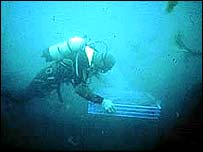
The fragments of Henry VIII’s flagship, which sank in 1545, were found in 2003 in the Solent.
The vast majority of the hull was raised in 1982 but the bow section remained in the silt off Portsmouth. The raising of the bow and the anchor will improve the understanding of the main part of the ship.
|
It is hoped the sections will be raised by divers on 11 October, the anniversary of the recovery of the hull 23 years ago.”
[Full Story]
“Treasures from oldest sunken ship on show”
September 18, 2005, Daily Express, Malaysia: “Sabah’s historical treasures recently salvaged from the seabed, some 400 metres off Simpang Mengayau at the Tip of Borneo, are now on display at the Sabah Museum until Sept 27.
The treasures were recovered from a sunken Chinese junk that went down more than 800 years ago, believed to be from the Sung Dynasty of 960 to 1127AD.
The Chinese vessel was believed to have sunk near the Tip between 878 and 1045 AD, and a group of fishermen stumbled upon the shipwreck and its remains in March 2003.
It is believed that the sunken ship hit the sandbank between the Tanjung Simpang Mengayau and Kalampunian Island in stormy weather. It is said that it is the oldest sunken ship ever found in the country and possibly in South East Asia to date.”
[Full Story]
“Deep-sea archaeologists look for secrets in ‘Shipwreck 7’”
September 17, 2005, Kathimerini, Greece: “It all began about 30 years ago, when archaeologist Nikos Tsouchlos was fishing under the western waters of the Pagasitic Gulf near Volos in northeastern Greece.
That’s when Tsouchlos, director of the Institute of Underwater Archaeological Research (IENAE), discovered an old shipwreck.
|
Kathimerini, Greece
|
|
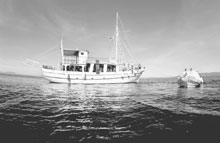
In 2000, the institute had undertaken an initial research trip into the waters, but didn’t find the specific shipwreck they had in mind. They did, however, find another eight. That’s how interest stirred in “Shipwreck 7,” a project close to Telegraphos Bay some five nautical miles south of the village of Amaliapolis.
|
The shipwrecks and their treasures are dated to the end of the fourth century AD, in the later Roman period.
The IENAE research team arrived at the Pagasitic Gulf in September 2003. Initially, underwater research was focused on the topographical location of the shipwreck and the hoisting up of four amphorae from submerged ships.”
[Full Story]
“Sunken forest in loch adds to tree of knowledge”
September 12, 2005, The Herald, Scotland: “One of the earliest remains of Scotland’s natural native woodland has been found under six feet of water.
Archaeologists working in Loch Tay, Perthshire, have discovered the remains of a drowned forest and say it dates from the neolithic period, about 5000 years ago.
A spokesman for the trust said: ‘This is an exciting discovery for scientists of all disciplines as these trees represent possibly the earliest surviving remains of part of Scotland’s natural native woodland.
An appropriate find for what is known as Perthshire’s Big Tree Country, more work needs to be carried out to determine the extent of the woodland, and to examine what might prove to be the best-preserved natural woodland floor in the country.’“
[Full Story]
“Ancient drowned forest discovery”
September 12, 2005, The Courier, Scotland: “Underwater archaeologists in Perthshire have made the incredible discovery of a drowned forest, thought to date from the neolithic period some 5000 years ago.
Stunned divers spotted the ancient wooded area as they worked in Loch Tay. The eerie find is sure to excite scientists of all disciplines as it could represent the earliest surviving remains of Scotland’s native woodland.
Preliminary surveys in the 14 mile long loch—carried out by the Scottish Trust for Underwater Archaeology (STUA) over the weekend—have identified well preserved fallen oak and elm trees as well as a series of oak upright trunks embedded in layers of gravel and silt.
Many of the fallen trees have survived in odd shapes, creating a spooky landscape protruding from the loch bed. Timber samples taken by the STUA dive team yesterday produced radiocarbon dates of 3200BC and 2500BC.”
[Full Story]
“In Greece, high-tech looters target artifacts buried in the sea”
September 11, 2005, The Boston Globe, USA: “On congested, dusty Alexandras Avenue, the secrets of the sea seem a world away. But in Room 625, on the sixth floor of Greece’s gargantuan police headquarters, the watery world of ancient shipwrecks and other archeological riches occupies the attention of Giorgos Gligoris.
The veteran officer oversees the Hellenic Police Force’s antitrafficking unit, battling smugglers bent on snatching treasures from the seabed.
Traffickers have caught on to the fact that there are more than 12,000 shipwrecks in Greek waters. Many of the submerged gems date back to the Golden Age of the fifth century BC.
Armed with archeological service maps acquired on the black market, burgeoning numbers of international smugglers have made it their mission to locate the wrecks, authorities say.”
[Full Story]
“Sunken treasure sheds new light”
September 09, 2005, Baku Sun, Azerbaijan: “Italian archaeologists believe they are on the verge of finding the ancient ships downed in the battle of the Aegates Islands more than 2,000 years ago thanks to modern technology and a police tip-off.
Wooden ships laden with ceramic pots, golden necklaces and valuable spices have for centuries navigated Indonesian waters, a key trade route linking Asia with Europe and the Middle East. And for just as many years, they have been sinking.
No one knows that better than Adi Agung, who later this month will wrap up salvage operations on a Chinese ship that went down in the crystal blue Java Sea more than 1,000 years ago.
So far, 422,000 artifacts have been recovered from the wreckage 54 meters (178 feet) below the surface in what could be the largest cargo of ceramics ever found. Christie’s is expected to auction the items in 2006 and 2007, says it’s worth millions of dollars (euros).
Most of the goods are fine white or green wares from northern and southern China dating back to the early 10th century. But the vessel also contains Egyptian artifacts and Lebanese glassware, and experts say the rarity and variety of the items could shed new light on inter-Asian trade.”
[Full Story]
“Boats from Taksin reign recovered: Divers find antiques
in river by Wat Thaphut”
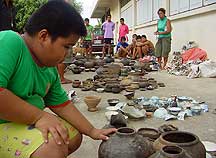
September 04, 2005, Bangkok Post, Thailand: “Two ancient boats, many pieces of chinaware and antiques believed to be from the era of King Taksin the Great have been recovered from the bed of the Thachin river in Sam Phran district. The recovery was made yesterday by a team of divers, led by Suchart Saengprasert, from Ayutthaya province.
|
Bangkok Post
|
|
The items were recovered from the river in front of Wat Thaphut in tambon Rai Khing.
The team was hired by the committee of Wat Thaphut to look for ancient objects, some of which had earlier been recovered from the river in front of the temple.
|
Yesterday morning, the team managed to fish out many pieces of chinaware, ancient money and utensils and a boat from a depth of 14m.”
[Full Story]
“Investigator vindicates to the Plato’s Atlantis
like an para-historical story”
August 28, 2005, PressBox, UK: “‘The narration on the Atlantis written in the dialogues of the Platós Timaeus and the Critias, belongs to a type of literary sort much more next to the history that to mythology’, Hispanic-Cuban investigator affirms.
News – laAtlantida.info/ The scriptologist Georgeos Díaz-Montexano has been able to advance in scientific atlantology until points that nobody before had arrived. Georgeos Díaz has made the most solid and scientific contributions, because they are always based on data, documents, codices, manuscripts, archaeological and geological evidences; that most of the Díaz-Montexano’s contributions they are absolutely original and novel.
Points obtained by Georgeos Díaz and that they widely appear developed in his theory:
1. A series of serious errors of translation and interpretation on the Atlantis, perpetuated during many centuries and presents in all previous works, are rectified for the first time.
2. In the history of the atlantology and classic archaeology and philology it is for the first time made a paleographical and lexicographical study and medieval revision of texts of Plato through the trascripciones of manuscripts and codices written in Greek and Latin. For the first time, the oldest translations of the Timaeus like the one of Chalcidio (Century IV) and the translations to Latin of books of the Timeo and the Critias to the Latin of famous medieval philosophers Marsilio Ficino (s. XV) and Iano Cornarius study and consult in a study on Atlantis (s. XVI).
3. The original names of the atlanteans kings and the own Atlantis like the country or island of which are reconstructed for the first time as ‘to Support, to Bear, to Endure’; identifying also the names of Elasippo with the one of and/or Elisippo Olisippo (name of the old city of Lisbon)
4. It is argued for the first time that Plato affirms that Gadeira is a name atlantean, since nobody before had been noticed of this fact.”
[Full Story]
“Tsunami clue to ‘Atlantis’ found”
August 15, 2005, BBC Science News, UK: “A submerged island that could be the source of the Atlantis myth was hit by a large earthquake and tsunami 12,000 years ago, a geologist has discovered.
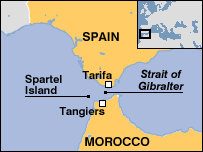
Spartel Island now lies 60m under the sea in the Straits of Gibraltar, but some think it once lay above water.
|
BBC Science News
|
|
The wreck was discovered by chance last summer by two divers who uncovered several cannon and an anchor. The bronze cannon could be Portugese. dating from the 17th Century, but the wreck’s origin is still unknown. Evidence comes from a seafloor survey published in the journal Geology.
|
Marc-André Gutscher of the University of Western Brittany in Plouzané, France, found a coarse-grained sedimentary deposit that is 50-120cm thick and could have been left behind after a tsunami.”
[Full Story]
“Italian archaelogists on trail of ancient warships”
August 12, 2005, Reuters, UK: “Italian archaeologists believe they are on the verge of finding the ancient ships downed in the battle of the Aegates Islands more than 2,000 years ago thanks to modern technology and a police tip-off.
‘This project has an enormous historical value, but perhaps more important is the relevance for archaeology,’ Sebastiano Tusa, Sicily’s chief of marine culture, told Reuters on Friday.
‘What we find will help us understand how wars were waged at that time and how battleships were built.’
After two years of underwater searches around the islands, which lie west of Sicily in the Mediterranean Sea, experts last year found a bronze helmet and some amphorae from about 241 BC, the date of the decisive Roman victory over the Carthage fleet.
At around the same time, a team of Italy’s famed art police busted a collector who had a ship’s bronze battering ram from the same period on display in his home. It turned out the relic had been illegally looted using nets from the same area.”
[Full Story]
“Rocks add weight to Atlantis debate”
August 10, 2005, ABC News in Science, Australia: “Plato’s account of how the fabled city of Atlantis sank below the surface of the ocean has scientific grounding, according to a seafloor survey of an island west of the Straits of Gibraltar.
Dr Marc-André Gutscher of the University of Western Brittany in France performed a detailed mapping of the seafloor on Spartel Island, already proposed as a candidate for the origin of the Atlantis legend in 2001 by French geologist Professor Jacques Collina-Girard.
Lying 60 metres beneath the surface in the Gulf of Cadiz, the island is right ‘in front of the Pillars of Hercules’, or the Straits of Gibraltar, as stated by Plato.
Analysis of sedimentary deposits reveals a large earthquake and a tsunami hit the island about 12,000 years ago.”
[Full Story]
“Underwater archaeologists look for 500-year-old wreck”
August 10, 2005, The State/AP, USA: “Archaeologists are searching the bottom of Winyah Bay for a Spanish galleon believed to have sunk in about 25 feet of water almost 500 years ago.
The Capitana was part of an expedition by Lucas Vazquez de Ayllon, a Spanish lawyer and explorer who sailed along the southeastern coast of North America in the early 1500s.
De Ayllon led an expedition of men, women and children who briefly attempted to settle a colony in the Georgetown area.
Chris Amer, state underwater archaeologist for the maritime division of the Department of Archaeology and Anthropology, said the search for the Capitana and its artifacts are part of a long-term project to map about 11,000 miles of inland water and more than 187 miles of South Carolina coastline to look for other shipwrecks.”
[Full Story]
“They discover symbol of the Atlantis city in a Iberian ceramics”
August 09, 2005, PressBox, UK: “A fragment of ceramics found near the city of Seville, Spain, presents the symbol of the concentric city of Atlantis, it affirms studious investigator of the Plato’s Atlantis.
The finding of this ceramics took place in the decade of the Fifties of the last century, nevertheless, was unnoticed pass until scriptologist Hispanic-Cuban Georgeos Diaz-Montexano was noticed of the representation of a center circle, that appears surrounded by five ring, and from whose center it leaves a straight outline – like a channel – that extends towards the outside of the ring.
This design, evokes – according to Diaz-Montexano – the scheme of the main city of Atlantis, according to the description that offers Plato in the dialogue of the Critias.
The ceramics was exactly in the most emblematic site of the Tartessian civilization ‘El Carambolo’, located to few kilometers of the city of Seville, and where it appeared the most famous treasure of gold jewels of this civilization.”
[Full Story]
“Atlantis images unveiled”
August 06, 2005, Edmonton Sun, Canada: “An Iranian-American architect who claims to have discovered the site of Atlantis says he now has additional evidence that the legendary city existed between Cyprus and Syria.
Robert Sarmast, who first said he had found Atlantis in November, told reporters that enhanced side-scan sonar images of the east Mediterranean seabed showed the ‘unmistakable remains of man-made structures at a depth of 1.5 kilometres, 80 kilometres from the southeastern corner of Cyprus.’
On Thursday Sarmast showed a news conference colour slides of what he said were the ruins of the Atlantis acropolis, surrounded by the remains of a defensive wall that runs for three kilometres before turning a right angle and continuing for an equal distance.
‘The new images will silence any remaining skepticism that modern Cyprus is what remains of a much larger and now partly sunken land mass, a land mass that fits Plato’s description of Atlantis perfectly,’ said Sarmast, referring to the ancient Greek philosopher.”
[Full Story]
“Archaeologists explore mystery ship”
August 05, 2005, MSNBC News, USA: “The ocean is often reluctant to reveal its mysteries, but archaeologists from both sides of the Atlantic are busy trying to unravel the secrets of an unknown wooden ship.
The ship once measured 25 meters long by 10 meters wide and, although it was a merchant ship, possibly a British packet boat, it was fully armed with a cannon.
Between 1740 and 1760, the ship crashed on the reef and foundered about two miles southwest of where Carysfort Light Tower sits today. Like many of the 1,000 or so shipwrecks off the Florida Keys, the name, nation and the details of its final moments are lost. It no longer sports cannon. In fact, just about everything that could identify this ship has been looted or washed away by time and tide.
But the Anglo-Danish Maritime Archaeological Team, headed by co-founder and director Simon Q. Spooner, has laid out a grid along the wreck site where students of underwater archaeology have been surveying the bottom in an attempt to identify the ship.
They hope to solve the riddle of the ‘Button Wreck’, so named because a number of silver and pewter uniform buttons have been found amid the wreck debris. ‘It’s like trying to piece together a giant, underwater, three-dimensional jigsaw puzzle without a picture of the finished product,’ Spooner said Wednesday morning, just before holding his dive mask and dropping backwards off a boat to dive the warm waters of the Atlantic Ocean, offering 150 feet of horizontal visibility.”
[Full Story]
“New mission to prove Atlantis claims”
August 05, 2005, Cyprus Mail, Cyprus: “American Atlantis hunter Robert Sarmast yesterday presented images showing what appears to be a right-angled wall one mile under the sea between Cyprus and Syria, which he claims is part of the legendary lost city.
Sarmast, author of
“Discovery of Atlantis: Startling New Evidence and the Case for Cyprus”, believes he located the remains of the lost civilisation based on the writings of Plato. He also said he believed Atlantis and the Garden of Eden were one and the same.
‘We pinpointed one mountain because it was such a perfect match with the Acropolis Hill as well as with the rectangular valley, the mountain and so forth. We went there, did a survey there and that’s exactly where it was and nowhere else. This can not be a coincidence,’ Sarmast told a news conference in Nicosia, during which he revealed the results of sonar scans from last November’s expedition 80km off the south-east coast.
Sarmast also announced his plans for a second expedition next spring, with the full support of the Cyprus government, to take a closer look with the use of remote viewing robots and submersibles.
The government, lukewarm over the expeditions until now, rushed to sponsor Sarmast when it heard the Turkish Cypriot side had offered to do so. ‘This is something that will benefit Cyprus for years to come,’ said Sarmast. ‘This is something that will continue for decades.’
The second expedition will cost between $500,000 and $1 million. Sarmast hopes it will be financed through sponsors such as the Cyprus Tourism Organisation plus a lucrative contract for a documentary about the expedition.”
[Full Story]
“Expert in new mission to find Atlantis”
August 04, 2005, 7 News/Reuters, Australia: “An American researcher on the trail of long-lost Atlantis says he will lead an expedition next year to prove the mythological civilisation lies in the watery deep between Cyprus and Syria.
Robert Sarmast believes Atlantis did exist and that his quest is not a wild goose chase inspired by the ramblings of an ancient Greek philosopher thousands of years ago.
‘All the evidence points here. This is where civilisation started,’ he said in Cyprus. Sarmast lives in Los Angeles.
Plato suggested that the civilisation of Atlantis was destroyed in a deluge around 11,500 years ago. The Mediterranean island of Cyprus is its pinnacle, says Sarmast.
Sarmast, an architect, says he has found evidence suggesting man-made structures on an initial expedition some 80 km off the south-east coast of Cyprus in November 2004.”
[Full Story]
“CTO back on board for Atlantis mission”
August 04, 2005, Cyprus Mail, Cyprus: “The Cyprus Tourism Organisation (CTO) has jumped back on the Atlantis bandwagon by again becoming one of the sponsors for the second expedition to search for the lost city by American Robert Sarmast.
It is not known how much the CTO has given for the new expedition, but the tourism organisation donated £10,000 for the first expedition in 2004.
The Cyprus Mail has learned that rumours the Turkish Cypriot authorities were willing to invest in the expedition were what prompted the government and the CTO to beat them to it, lest the north benefit by supporting Sarmast.
On May 3, Sarmast’s website announced he would be attending Atlantis festivities at the Eastern Mediterranean University in the north.
A week later it announced that ‘due to the political situation in Cyprus, Robert has cancelled his participation in the Atlantis Festival’.
Sarmast, author of
“Discovery of Atlantis: Startling New Evidence and the Case for Cyprus”, said this week that he would be today revealing the results of last year’s expedition to the world for the first time, showing the sonar scans of what he believes are manmade structures one mile below water.”
[Full Story]
“Arctic depths teem with life”
July 30, 2005, ABC News Online, Australia: “The remotest depths of the Arctic ocean are surprisingly full of life, including previously unknown species of jellyfish and worms, according to a scientific team that just finished exploring the area.
The scientists, led by the University of Alaska, used robot submarines and sonar to probe an isolated 3,800-metre basin off Canada’s Arctic coast where they fear species could be at risk from global warming.
‘We were surprised by the abundance and the diversity of life in this environment,’ said Rolf Gradinger of the University of Alaska, the chief scientist on the voyage.
‘Even at a depth of 3,000 metres we found animals on the sea floor, we found sea cucumbers … and all kinds of jellyfish and crustaceans. Some of the species that we saw are completely new to science. They have not been described in any area of the earth so far.’“
[Full Story]
“Atlantis scientific discoveries
The Atlantis between Spain and Morocco”
July 28, 2005, Pressbox.co.uk, UK: “A Scientific Expedition has started off at the end of this summer for the area of the Straits of Gibraltar in search of possible ruins of the well-known civilization like Atlantis by Plato.
According to the ‘Atlantis Ibero-Moroccan project’, between the coasts of southwest of the Iberian Peninsula and the northwest of Africa evidences of cities or submerged coastal villages of the Bronze Age would have to be that could belong to the Island or Peninsula of Atlantis.
The expedition is directed by specialist the investigating outstanding and in languages and writings of the antiquity, Spanish-Cuban Georgeos Diaz-Montexano(1), President Founded Emeritus of the rising ‘Scientific Atlantology International Society (S.A.I.S.), and creator of the Proto-genesis project. Between his objectives it is the confirmation of revealers and enigmatic data found in several texts of the antiquity.
The Spanish-Cuban investigator and scriptologist Georgeos Diaz-Montexano has made very revealing discoveries that they allow to guarantee his thesis on the possible existence of an historical substrate in the story of Plato on the Island or Atlantis Peninsula or Atlantis, the one that would be according to Georgeos Diaz, in some point between the Straits of Gibraltar, the Gulf of Cádiz, the coasts of Morocco, and the Madeira Islands like possible more remote point.”
[Full Story with References]
“Researchers debate existence of Atlantis”
July 28, 2005, PhysOrg/UPI, USA: “Researchers are no closer to finding the location of the lost city of Atlantis, saying they are confused by Plato’s account of its disappearance.
Plato, more than 2,300 years ago, wrote Atlantis disappeared into the ocean in just one day after violent earthquakes and floods.
During a conference of Atlantis researchers held earlier this month in Malta, Marc-Andre Gutscher of the European Institute for Marine Studies, noted Egyptians who told Plato the Atlantis story may have used a different definition of ‘years,’ meaning the destruction of Atlantis occurred more recently than thought.
The conference reached no firm conclusions. But researchers did agree on 24 criteria a geographical area must satisfy to qualify as a site where Atlantis could have existed.”
[Full Story]
“Scientists for first time lead deep sea expedition from land”
July 26, 2005, The Standard-Times, USA: “The ship with all the gadgets and underwater rovers is in the middle of the Atlantic Ocean, but for the first time, the team of scientists directing the expedition is not on board.
They’re sitting inside a room thousands of miles away.
The scientists and technicians are at universities in Rhode Island, Washington and New Hampshire, watching 52-inch plasma television screens as an unmanned submersible pokes around the Lost City hydrothermal vents — a forest of limestone chimneys on the ocean floor.
Wearing headsets, the expedition’s leaders stationed at the University of Washington tell engineers on the ship where to send the robotic vehicle and its high-definition video cameras, and what to explore next.”
[Full Story]
“Wreck discovery wins protection”
July 24, 2005, BBC News Online, UK: “An important wreck site found off the Dorset coast has won vital protection to keep treasure-hunters away.
Unlicensed diving and excavation of the site off West Bay has been made illegal under a government designation order granted last week.
|
BBC News Online
|
|
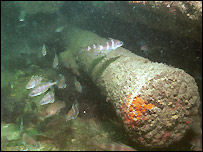
The wreck was discovered by chance last summer by two divers who uncovered several cannon and an anchor. The bronze cannon could be Portugese. dating from the 17th Century, but the wreck’s origin is still unknown.
Further site assessments are needed to identify the type and origin of the ship.
|
Photographs of the cannon have already been examined by the Royal Armoury. A spokesman said: ‘The nature of the decoration means that it is certainly not English.’“
[Full Story]
“Ocean expedition to ‘Lost City’ links land, sea”
July 23, 2005, YubaNet, USA: “A precedent-setting ocean expedition will use ‘telepresence’ to connect Dr. Robert Ballard at sea with Chief Scientist Dr. Debbie Kelley ashore as they explore the unique Lost City hydrothermal vents.
The July 23 through August 1 mission is financially supported and coordinated by NOAA, the National Oceanic and Atmospheric Administration.
|
YubaNet, USA
|
|
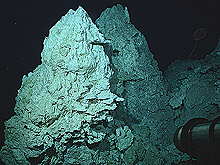
‘Lost City is a remarkable, unique field of tall chimneys that spiral up from the ocean floor, and we are telling its story in real time through a precedent-setting ocean expedition that raises the bar on use of communications technology,’ said Ballard, University of Rhode Island oceanography professor and the expedition’s principal investigator.
|
‘Normally, on a deep-ocean expedition, I talk with the mission’s chief scientist across a table on the research vessel,’ he said. ‘In this case, we talk across the planet.’
‘Only now has our nation, led by NOAA, created a major program to explore the vast uncharted regions of our planet that lie beneath the sea,’ said Ballard. ‘Stay tuned for new discoveries!’“
[Full Story]
“Seafloor survey buoys Atlantis claim”
July 22, 2005, Nature, UK: “‘There occurred violent earthquakes and floods. And in a single day and night of misfortune… the island of Atlantis disappeared in the depths of the sea.’
This account, written by Plato more than 2,300 years ago, set scientists on the trail of the lost city of Atlantis. Did it ever exist? And if so, where was it located, and when did it disappear?
In a recent paper in Geology, Marc-Andre Gutscher of the European Institute for Marine Studies in Plouzané gives details of one candidate for the lost city: the submerged island of Spartel, west of the Straits of Gibraltar.
The top of this isle lies some 60 metres beneath the surface in the Gulf of Cadiz, having plunged beneath the waves at the end of the most recent ice age as melting glaciers caused the sea level to rise.”
[Full Story]
“Geologist mapping unseen regions of underseas terrain”
July 22, 2005, The Worcester Telegram/AP, USA: “When geologist Page Valentine steams out for a trip off the state’s picturesque coastline, he’s far more interested in what he can’t see.
Valentine has been using sophisticated sonar to map 1,400 square miles of ocean floor off the Massachusetts coast for 11 years.
He’s discovered networks of underwater ridges and valleys, the remains of long-forgotten shipwrecks and underwater gouges left by ancient icebergs.
Valentine sees the maps as a basic tool for government regulators who must manage the miles of hidden land. The maps can also point fishermen toward productive areas, direct more efficient placement of underwater cables and give researchers the location of vulnerable or changing ocean habitats.”
[Full Story]
“Ancient temples emerging
around Tamil Nadu’s Mamallapuram coast”
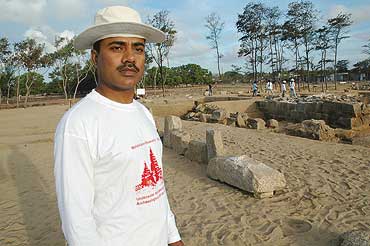
July 18, 2005 Edition, Outlook India, India: “In the post-tsunami excitement of the discovery of ‘new’ ancient temples emerging around Tamil Nadu’s Mamallapuram coast, at least one person looked completely calm: Dr Alok Tripathi, who heads the ASI’s Underwater Archaeology Wing.
|
Outlook India
|
|
‘We began work in the area in ’01 and these findings were slowly unfolding’, he says.Otherwise, Tripathi is full of excitement about work. ‘I wanted to be an archaeologist since I was in Class IV’, he says.
Today, Tripathi is a professional diver with a passion for working on shipwrecks.
|
He has directed excavations on the Princess Royal shipwreck off Bangaram Island in Lakshadweep, and dreams of working on a Bronze Age ship some day. India’s seawaters are rich with archaeological remains and Tripathi believes there is much to be unearthed.
His work with other archaeologists and the Indian navy in TN’s Mamallapuram and Arikamedu, Gujarat’s Dwaraka, Maharashtra’s Elephanta and several other sites provide exciting insights into ancient sea-based commerce, sea-faring activities in our seas and changes over time in these coastal regions.”
[Full Story]
“Divers recover main cannon from wreck of CSS Alabama”
July 13, 2005, Montgomery Advertiser/AP, USA: “The 7,000-pound main battery pivot gun of the Confederate sea raider CSS Alabama has been recovered from the bottom of the English Channel, where the vessel was sunk 141 years ago by a Union warship, a project spokesman said.
The cannon was brought to the surface by the French naval vessel Elan, which had a special A-frame winch on the stern able to bring up such a heavy object, said Gordon Watts, an underwater archaeologist from North Carolina who is overseeing the project.
Watts said French divers and American archaeologists recovered the cannon Saturday about seven miles off the coast of Cherbourg, France in some 200 feet of water.
He said the cannon will be placed in a specially constructed container and shipped back to the United States for conservation. A project supporter in Mobile said it will be taken to the underwater archaeology lab at Texas A&M University.”
[Full Story]
“After flood, Shetrunji throws up a civilisation”
July 13, 2005, The Times of India, India: “Remnants of an ancient civilisation have emerged in Amreli district as the waters of the Shetrunji river receded after the recent floods.
The fury of the Shetrunji — believed to be an ancient river of the pleistocene period — washed away nearly six feet of soil cover seven km from Amreli town, revealing plinths in regular shapes.
Excavation by local residents has revealed earthenware bits that could have been pots and pans. Eyewitnesses say they have also recovered some stones which appear to be embossed.
They claim, ‘Four houses constructed up to the plinth level were seen. Also, there were some stone ornaments found from the site.’ Archaeologists who have yet to reach the site, are not surprised and say relics from the late Harappan civilisation had been found earlier in this region.”
[Full Story]
“‘Blackbeard’s Ship’ Yields New Clues to Pirate Mystery”
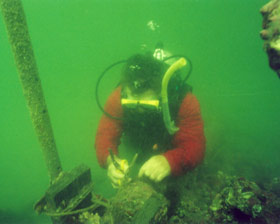
July 12, 2005, San Luis Obispo Tribune, USA: “The pirate Blackbeard’s flagship may finally be yielding its identity after nearly 300 years on the ocean floor. Though researchers have yet to find definitive proof, evidence continues to surface off the coast of North Carolina that wreckage there was once the vessel known as ‘Queen Anne’s Revenge’.
|
National Geographic
|
|
The wreck has generated attention ever since its 1996 discovery in Beaufort Inlet, North Carolina.
The wreckage includes a dozen cannon and large anchors rated for a 350-ton (355-metric-ton) ship, found amid a mound of debris where records indicate Blackbeard’s flagship ran aground in 1718.
|
‘We have extensive historical records, and there is no evidence of any [other] vessel of this kind of armament sinking anywhere during the 18th century on this coast,’ said Mark Wilde-Ramsing, director of the Queen Anne’s Revenge Shipwreck Project, a consortium of researchers investigating the wreck.
Shipwreck records in the region are surprisingly complete. They include accounts of ships lost decades before the QAR and in more remote areas”
[Full Story]
“The Atlantis Hypothesis: Searching for a Lost Land”
July 11-13, 2005, Atlantis Conference 2005, Greece:
“This Conference aims to serve as a forum for the presentation and constructive discussion of all the issues related to the hypothesis of the lost land of Atlantis.
Greece is the most appropriate location for hosting this conference, as the ancient Greek great mind Plato formulated the Atlantis hypothesis.
A full list of the Atlantis 2005 Conference Topics and also the Submitted Abstracts are available on the conference website
While the Full Abstracts are also available, along with biographical details of the Authors from around the world who have submitted them.”
[Full Conference Programme – .pdf file]
“Underwater excavations: This Santa Fe team protects and collects treasures from the waters of our national parks”
July 10, 2005, Santa Fe New Mexican, USA: “In a city full of surprises, one of the more unusual in Santa Fe is on the second floor of a Rodeo Road office building: a room full of high-tech scuba gear, including robotic vehicles and tanks of oxygen, nitrogen and helium.
It all belongs to the National Park Service’s Submerged Resources Center, where five permanent and three part-time members bring decades of diving and archaeology experience to projects around the world. If it’s underwater and in a national park, the Submerged Resources Center usually gets the call.
The team also works with other state and federal agencies, as well as with groups in countries from France to the Federated States of Micronesia. Their work combines the details of archaeology with the complexity, time constraints and risks of diving.
‘You have to be comfortable enough with the diving so that you can get down and get back safely’, said archaeologist Dave Conlin, who describes wanting to become an underwater archaeologist since seeing his first Jacques Cousteau movie as a boy. ‘You can’t afford to space out.’“
[Full Story]
“Archaeologists make major discovery – underwater”
July 07, 2005, Channel 5 News, Belize: “When most people think about Mayan archaeology they imagine excavations in royal tombs or trenches cut into tree covered mounds.
Few of us would expect that a significant find could be made underwater … particularly in a swamp. But Belizean archaeology is a many-faceted field, as the presentations at this year’s Archaeology Symposium, now underway in San Ignacio, amply reveal.
Among the updates to last year’s reports is a startling discovery made by a team from Louisiana State University. It is a find unlike any in all of the Meso-American world, and it was made right here in Belize.”
[Full Story]
“Possible Submerged Road and Ruins off Cornwall Coast”
July 04, 2005, Satellite Discoveries, USA: “Lyonesse is believed to be a land that was suddenly inundated by the ocean at the time of King Arthur. St Michael’s Mount, off the Cornish coast is said to be part of this legendary kingdom which supposedly extended as far as the Isles of Scilly. (The Isles of Scilly are an archipelago of small islands off the southwestern coast of England near the entrance to the English Channel). Lyonese is also said to have been a hilly country and is sometimes associated with Avalon.
|
Satellite Discoveries
|
|
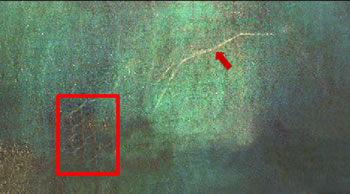
The red arrow in the image to the left is pointing to the road-like feature. The sun has illuminated this area underwater and sub-surface anomalies are visibly apparent. Also notice the cell like features in the red rectangle to the left. Possibly a submerged structure of some kind.
|
According to Arthurian legend, one of the signs of King Arthur’s return will be that Lyonesse will rise from the depths again.
According to legend Lyonesse was flooded by Merlin to drown Mordred’s knights when they followed Arthur’s army after the battle of Camlann. The battle of Camlan is believed to have taken place at Camelford which lies about 20 kilometres from where the submerged road is located.”
[Full Story]
“NASA Releases Pictures of A Manmade Bridge
Between India And Sri Lanka”
July 02, 2005, SouthAsiaNet, India: “NASA has released satellite pictures which which indicate a 30 km long bridge made of a chain of shoals between India and Sri Lanka. The bridge has been named Adam’s Bridge.
This information is a crucial aspect for an insight into Ramayana, which was supposed to have taken place in tretha yuga (more than 17,00,000 years ago).
In this epic, there is a mentioning about a bridge, which was built between Rameshwaram (India) and Srilankan coast under the supervision of a dynamic and invincible figure ‘Rama’ who is supposed to be the incarnation of the supreme. “
[Full Story]
“Police warning following underwater find”
July 01, 2005, Dive Magazine, UK: “Police in Scotland have warned divers not to endanger their lives by treasure hunting underwater, after ancient coins and gold were found off the northeast coast.
Four divers discovered a stash of ancient coins and gold, thought to be worth millions of pounds, in a submerged cave near the wrecks of two old wooden boats.
But police and coastguards have warned other divers not to risk their safety searching the site, which is believed to be in the Cullykhan Bay area. ‘Given the dangers of reaching some parts of that coastline from land and sea, we’d advise people not to rush out there,’ a spokesman for Grampian Police said. ‘There are some dangerous and isolated areas and it should be treated with respect.’“
[Full Story]
“Ancient bridge found between India, Lanka”
July 01, 2005, NDTV News, India: “Every child who’s read or been told of the Ramayana has heard the story of the bridge that was built during Ram’s quest to rescue his wife Sita from Lanka.
According to legend, Rama’s army of Hanuman and his followers built this bridge, rock by rock, across what is now Palk Straits.
Till now this has been part of popular folklore. But now NASA has released satellite pictures, which indicate that such a bridge known as Adams bridge does exist in the Palk Straits.”
[Full Story]
|
|
To understand why this News Page is sometimes late here is some information about Fibromyalgia
if you would like to support our marine archaeology research
The Morien Institute
Research Projects
please send us a book

from our Wish List
“Under Ancient Skies: Ancient Astronomy and Terrestrial Catastrophism”
Paul Dunbavin

EU English Edition Only
but avialable
worldwide
“In all of the world’s myths and religions we find traditions of a Great Flood. There are stories too of a Golden Age: the antediluvian paradise that it destroyed. Might these be real memories of the ancient world? And how can we analyse the subject scientifically? The key to unlock these ancient myths lies in astronomy. “Under Ancient Skies” will examine the astronomical evidence for an ancient cataclysm and in the process will explore a number of related anomalies in prehistory, including: Was there a single great flood in human prehistory, or have there been many?
Could the workings of ancient calendars and the records of ancient eclipses give us clues about the Flood and the antediluvian world? Did the Celtic Druids use a calendar based on the orbit of Saturn; and is this the same antediluvian calendar as is described in Plato’s myth of Atlantis? Do Hindu, Chinese and Mayan cosmology myths recall the years after the Flood when our world wobbled on its axis?
Geologists have recently found the crater in Yucatan, where an asteroid impact destroyed the world of the dinosaurs. Scientists and astronomers have stopped dismissing the theory that a comet could have struck the Earth during prehistory – but any suggestion that a comet impact just a few thousand years ago might have caused the Biblical Flood, remains the last taboo. It is time for this barrier too to be washed away. If you read this book and you understand it then be warned – it may scare you!”
“Atlantis of the West:
The Case For Britain’s Drowned Megalithic Civilization”
Paul Dunbavin

EU English Edition
“Do Welsh legends of lost cities beneath the sea match Plato’s descriptions of the island civilization of Atlantis? Do Irish myths of a golden age when the eastern Irish Sea was a flowery plain describe the same place Herodotus said disappeared beneath the waves during a single day and night of geological upheaval millennia before Ancient Greece?
Author and researcher Paul Dunbavin has embarked on a multidisciplinary investigation into how science could explain such a catastrophe and how modern archaeological findings point to a possible location for lost Atlantis. This book theorizes that the Middle Neolithic period around 5,000 years ago was a time of dramatic climate and sea-level changes all around the world.
From an up-to-date scientific perspective, Dunbavin distills an array of significant geological theories and then examines the archaeological and mythological record-which together leads to a lost land thousands of years ago in the Irish Sea that was still mentioned in ancient Welsh histories recorded in the 6th century.”
“Eden in the East: The Drowned Continent of Southeast Asia”
Stephen Oppenheimer

EU English Edition
“A book that completetly changes the established and conventional view of prehistory by relocating the Lost Eden – the world’s 1st civilization – to SouthEast Asia. At the end of the Ice Age, SouthEast Asia formed a continent twice the size of India, which included Indochina, Malaysia, Indonesia and Borneo.
The South China Sea, the Gulf of Thailand and the Java sea, which were all dry, formed the connecting parts of the continent. Geologically, this half sunken continent is the Shunda shelf or Sundaland.
He produces evidence from ethnography, archaeology, oceanography, from creation stories, myths and sagas and from linguistics and DNA analysis, to argue that this founder civilization was destroyed by a catastrophic flood, caused by a rapid rise in the sea level at the end of the last ice age.”
“Discovery of Atlantis:
Startling New Evidence
and the Case for Cyprus”
Robert Sarmast
EU English Edition
“Plato provided 53 physical clues in his famous dialogue Critias–the original account of the story of Atlantis that is the sole basis of all Atlantis research.
Discovery of Atlantis proves that the island of Cyprus and the underwater landscape just south of Cyprus is a perfect match with 51 of these clues. Exclusive 3D bathymetric maps based on new scientific data show for the first time a stretch of sunken land off of Cyprus.
The general layout of the landscape of Atlantis as described by Plato is easily discernible on this underwater landmass, as well as the precise location of its capital–Atlantis City. This robust empirical data is joined with other original findings based on mythological analysis and historical research, making the case for Cyprus increasingly obvious.”
“Underworld: The Mysterious Origins
of Civilization”
Graham Hancock
&
Santha Faiia
(Photographer)
EU English Edition
“From Graham Hancock, bestselling author of Fingerprints of the Gods, comes a mesmerizing book that takes us on a captivating underwater voyage to find the ruins of a lost civilization that’s been hidden for thousands of years beneath the world’s oceans.
While Graham Hancock is no stranger to stirring up heated controversy among scientific experts, his books and television documentaries have intrigued millions of people around the world and influenced many to rethink their views about the origins of human civilization. Now he returns with an explosive new work of archaeological detection.
In Underworld, Hancock continues his remarkable quest underwater, where, according to almost a thousand ancient myths from every part of the globe, the ruins of a lost civilization, obliterated in a universal flood, are to be found.”
“Basic Decompression Theory and Application, Second Edition”
Bruce R. Wienke

EU English Edition
“The new 2nd Edition of Basic Decompression Theory And Application has been extended, updated, with new material added. It takes all rudiments of decompression theory and phase mechanics to considerable depth, while focusing on diving applications in an historical perspective.
Topics span many disciplines, and the targeted audience is the commercial diver, hyperbaric scientist, doctor, physical scientist, technical diver, and instructor. Recent developments in diving tables, decompression meters, and decompression management software are presented, and broad model underpinnings are detailed and contrasted.
Testing and validation of modern dual phase approaches to staging for decompression, extended range, altitude, and mixed gas diving are a focus of discussion. Deep stops, optimal gas switches, and helium mixes are underscored from diver experience, data, and coarse grain principles. References and numerical examples (with solutions) are included for more detail and extended diver analysis.”
“Maritime Archaeology:
A Technical Handbook”
Jeremy Green
EU English Edition
“Jeremy Green’s systematic overview of maritime archaeology offers a step-by-step description of this fast-growing field. With new information about the use of computers and Global Positioning Systems, the second edition of this handbook shows how to extract as much information as possible from a site, how to record and document the data, and how to act ethically and responsibly with the artifacts.
Treating underwater archaeology as a discipline, the book demonstrates how archaeologists, “looters,” academics, and governments interact and how the market for archaeological artifacts creates obstacles and opportunities for these groups.
Well illustrated and comprehensive in its approach to the subject, this book provides an essential foundation for everybody interested in underwater environments, submerged land structures, and conditions created by sea level changes.”
“Atlantis and Earth’s Shifting Crust”

VHS NTSC version
(USA and Canada)
“Searching for Lost Worlds: Atlantis”
VHS NTSC version
(USA and Canada)
“Quest for the Lost Civilisation: Boxed Set”
VHS NTSC version
(USA and Canada)
VHS UK PAL version
(UK and Europe)
“The Atlantis Blueprint:
Unlocking the Ancient Mysteries
of a Long-Lost Civilization”
Colin Wilson & Rand Flem-Ath

EU English Edition
“The Great Pyramid. Stonehenge. Machu Picchu. For centuries, these and other sacred sites have inspired wonder among those who ponder their origins.
Conventional science tells us they were constructed by local peoples working with the primitive tools of a fledgling civilization. Who could have built these elaborate monuments? How did they do it? And what were their incomprehensible efforts and sacrifices designed to accomplish? Now comes a revolutionary theory that connects these mysteries to reveal a hidden global pattern–the ancient work of an advanced civilization whose warnings of planetary cataclysm now reverberate across one hundred millennia.
International bestselling author Colin Wilson and Canadian researcher Rand Flem-Ath join forces to share startling evidence of a fiercely intelligent society dating back as much as 100,000 years–one that sailed the oceans of the world, building monuments to preserve and communicate its remarkable wisdom.”
“Atlantis: Mother
of Empires”
Robert B.Stacey- Judd

EU English Edition
“Stacy-Judd’s 1939 classic is the best book ever on the subject of Atlantis. Stacy-Judd was a Los Angeles architect who was fascinated by the Maya and their connections to Atlantis.
Long out-of-print, this popular of all Atlantis books is again available. Stacy-Judd’s training as an architect and draftsman put him in a unique position to evaluate and express in drawing his theories and evidence for Atlantis.
This is the book that has the original photo of the famous Mayan frieze of a pyramid being destroyed in a volcanic explosion and people escaping in a boat. Packed with Stacy-Judd’s photos and illustrations, this book belongs in every Atlantis library!”
“The Round Towers
of Atlantis”
Henry O’Brien

EU English Edition
“First published in 1834 as “The Round Towers of Ireland” or the “Mysteries of Freemasonry, of Sabaism, and of Budhism”, this book was an instant sensation as one of the first modern studies of Atlantis, round towers, pre-Christian megalithic architecture and secret societies.
In addition to being a sourcebook on Atlantis Research, Druidic Culture and origins of modern Celtic Christianity, the book is a treasure-trove of ancient esoteric lore and arcane knowledge of the past, including:
The History of the Tuath-de-Danaans, The Round Towers and Megalithic Crosses of Ireland are pre-Christian, Ireland’s strange connections with ancient India, Persia and China, Ancient Secret Societies and Ireland, Ancient Egyptians and Ireland, Pre-Christian Messiahs, Mithraism, and Ireland, The Connections Between Atlantis and Ireland.”
“Submerged: Adventures of
America’s Most Elite
Underwater Archeology Team”
Daniel F. Lenihan
EU English Edition
“One of the world’s leading underwater archeologists recounts experiences from his 24 years as founder and head of the elite, award-winning Submerged Cultural Resources Unit (SCRU) team of the U.S. National Park Service-adventure writing at its best.
In Submerged, Lenihan (the co-author with Gene Hackman of the novel Wake of the Perdido Star) takes the reader on a kaleidoscope of underwater experiences-to ancient ruins covered by reservoirs in the desert southwest, to the lower rings of hell to retrieve the bodies of drowned divers, to gripping accounts of personal survival in underwater caves, ships, and submerged buildings. Among the astonishing, often harrowing assignments he recalls:
• The Isle Royale shipwrecks: Surveying ten large ships sunk from the mid-19th to mid-20th centuries in the middle of the frigid and deep Lake Superior. • The USS Arizona in Pearl Harbor: Executing the largest mapping project ever conducted underwater, and his personal impressions as, the leader of the first expedition to explore and video the entire ship in 1983.”
“Submerged Cultural Resource Management: Preserving and Interpreting Our Sunken
Maritime Heritage”
James D. Spirek (Editor),
Della A. Scott-Ireton (Editor)
EU English Edition
“This vital book is a collection on the various ways archaeologists and resource managers have devised to make available and interpret submerged cultural resources for the public, such as underwater archaeological preserves, shipwreck trails, and land-based interpretive media and literature.
The concept of preserves, parks, and trails has proven to be an effective and popular method of public education and heritage tourism with the end result being a greater public understanding of the value of preserving and protecting shipwrecks, and other submerged cultural resources, for the future.
Within each contribution, the authors focus on: legislation; economic benefits; interpretation methods; problems and successes; future directions regarding their preserve, park, or trail programs.
Various approaches to the concept have been explored and this book is an effort to make available our experiences in the management of submerged cultural resources for the public. This volume is an invaluable resource to underwater archaeologists, cultural and heritage resource managers, museum and heritage educators and those studying these professions.”
“Successful Underwater Photography”
Brian Skerry & Howard Hall
EU English Edition
“From fundamental principles of photographing marine life to making a living selling underwater photographs, Successful Underwater Photography provides an unlimited wealth of practical advice, surefire strategies, and tested tips for taking extraordinary photos of elusive underwater subjects.
Written by two top photographers who specialize in marine photography, this solid, lavishly illustrated field guide provides no-nonsense information on such topics as taking available-light photographs, silhouettes, marine wildlife portraits, close-focus wide angle photographs, and extension tube photographs to name just a few. Readers will also find proven guidance for purchasing underwater photographic equipment, taking photos of shipwrecks, and repairing and maintaining field equipment.
“Digital Imaging for the
Underwater Photographer”
Jack Drafhal & Sue Drafhal
EU English Edition
“How to Solve Common Problems, Repair Images and Create Dazzling Presentations; Focusing on the aspects of digital imaging that are most important to underwater photographers, this book is a step-by-step guide for the professional and amateur alike to improve their images and presentations.
Designed to help the underwater photographer make a smooth transition to digital imaging, this book discusses how to digitally refine, correct, and enhance underwater photographs. Detailing the equipment necessary, it also includes a discussion on the essentials of scanning. There is also extensive information on Adobe Photoshop, and how it can be used to edit underwater pictures.
Designed to help the underwater photographer make a smooth transition to digital imaging, this book discusses how to digitally refine, correct, and enhance underwater photographs. Detailing the equipment necessary, it also includes a discussion on the essentials of scanning. There is also extensive information on Adobe Photoshop, and how it can be used to edit underwater pictures.
“Atlantis from a Geographer’s Perspective”
Ulf Erlingsson
EU English Edition
…
exclusive
…
October 2002
Morien Institute
illustrated interview with
Professor Masaaki Kimura
of the University of the Ruykyus,
Okinawa, Japan, regarding
the discovery of:
“Megalithic structures found underwater off the coast of
Yonaguni-jima, Japan”
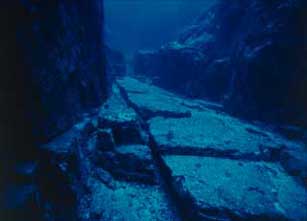
…
exclusive
…
June 2002
Morien Institute
illustrated interview with
Dr Paul Weinzweig
of Advanced Digital Communications,
Havana, Cuba, regarding
the discovery of:
“Megalithic urban ruins discovered off the coast of Cuba”
|
