|
|
|
|



text translation service for many worldwide languages
Morien Institute Research Projects
|
The Morien Institute is a non-profit research and education network striving to make ancient astronomy, astro-arch?ology, and research into the mysteries of the ancient world accessible to people with differing abilities. We run various projects that are designed to make our skywatching activities, our research into the celtic mysteries, and our enquiries into the sunken remains of Ice Age civilisations around the world, accessible and inclusive to everyone. This reflects the wide range of abilities of those people involved, and the many ways we focus on what can be achieved simply by trying.
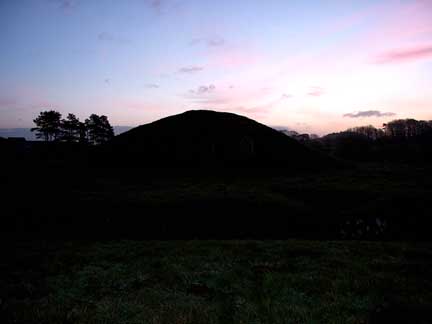
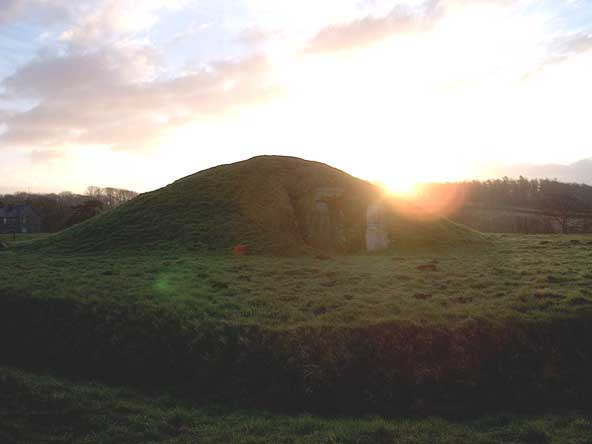
One of these projects concerns the compilation of an archive of all the ancient sacred sites in Wales and beyond, detailing their accessibility or otherwise. We will be publishing the details on these pages, with easy-to-follow directions on how to get there, and with many photographs of the sites that we visit. The picture below was taken at ‘first light’ on the Vernal Equinox (Alban Eilir to the ancient Britons) at Bryn Celli Ddu on Ynys M?n.
While the mound can just about be seen from the road the site is not at all accessible at present to wheelchair users, as the only access is via a stile, after which a good fifteen minute walk through muddy lanes finally gets you to one of the most mysterious sacred centres of the ancient inhabitants of Anglesey – the sacred druid island of Ynys M?n.
One recent theory about the possible original usage of this stone chamber is that at various times of the year, including both solstices and equinoxes, the layout of the chamber allows sunlight to be colimated into a narrow beam, which, over a period of several hours on those days, highlights ancient carvings on the interior of the chamber in a definite sequence. Was this a very early form of writing? Did the ancient skywatchers who built the chamber intend any significance in the order in which the various petroglyphs are illuminated by the light of the sun? Further observations at the site may one day tell.
These and similar ancient mysteries are the focal areas of the various Morien Institute projects. Emphasis is put on discovery in the landscape itself, especially the relationship between the ancient site, the horizon, and the ever-changing backdrop of celestial events which extend out into the cosmos. Most projects involve experiencing the ancient sacred places in the ways their builders may have intended – with skywatching as it was before the telescope, when ancient astronomers used stone chambers with entrance tunnels built to control the amount of sunlight that enters at given times of the year.
Ancient peoples spent much more time outside in the healthy fresh air than do modern peoples, and consequently regarded the greater universe, especially the immediate solar system, to be as much a part of their local environment as anywhere inside the circle of the horizon on the Earth itself. Wherever those ancient peoples were on the surface of our planet, the star-groups at the background to the apparent path of the sun and planets, (the zodiac, or ecliptic), were often regarded as defining the ‘adventures’ that the sun encountered on its annual ‘journey’ through the heavens.
Of course, this apparent path is really caused by the orbit of the Earth around the sun, and the background stars along this path were grouped together into different patterns, or constellations, by peoples of different cultures and given different names. They all occupy a plane some ten or twelve degrees either side of the ecliptic, and it is within this plane that most of the ‘wandering’ stars (the planets) also revolve around the sun.
In a more poetically expressed scientific language than modern societies use, the dynamics of the immediate cosmic environment were explained to successive generations in story form, where the celestial bodies and constellations were often portrayed as animals, birds, or even people. Over the passage of time these personifications became ‘the Gods’, stories about which have survived to this day as the myths and legends of various cultures around the world.
Interactions the accurate observations of ancient skywatchers – have been passed down to us over millennia in this story form we call ‘myths’. Regretably though, with a few notable exceptions, these ‘oral traditions’ are often dismissed out-of-hand by scientists trapped in their own narrow disciplines, who feel that the various mythologies of ancient peoples have nothing to contribute to our understanding of the past.
Unsurprisingly many of these ‘myths’ deal with the apparent annual journey of the sun through the heavens, and it was these ‘solar myths’ that Morien Morgan gathered from the remnants of the oral druidic traditions of the South Wales valleys, comparing them to similar solar myths of other ancient cultures in his studies of ancient Welsh druidism. But many of the world’s astro-myths also refer to ‘dragons’ and ‘winged-serpents’.
Did the red dragon, now on the flag of Wales, symbolically represent a comet, or which later disintegrated in the solar system sending fragments crashing to Earth? Fragments that burned up violently, appearing to ancient skywatchers to be dragon-like fireballs as they entered the Earth’s atmosphere?
Did cometary debris dust-load the upper atmosphere, blocking out the sun, and causing the abrupt climate changes in the 6th. century AD that are evident in the tree-ring record? And, did this in turn bring about the mysterious ‘Yellow Pestilence’, the ‘wastelands’ of the arthurian legends, and the beginning of the European Dark Age?
It should not be forgotten that the oceans cover around 71% of the surface of our planet. Asteroids and cometary debris from space impact in the sea more often than on dry land. These impacts produce huge tidal waves, tsunami, which cause devastating floods, and the folk memories of such deluges that have occurred in the past remain not just in the tales of Noah’s Ark and Atlantis, but in the legends of flooded kingdoms such as Lyonesse that are found in many ancient cultures around the world. These inundations are still spoken of today in the ‘living traditions’ of many non-industrialised peoples.
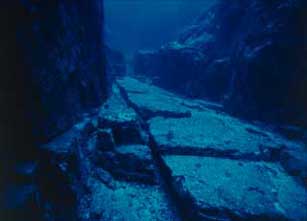
Now that the ruins of ancient civilisations are being discovered underwater on continental shelves all around the world, academics with a vested interest in the erroneous views of prehistory that are still being fed to unsuspecting students in schools and colleges today, seem desperate to downplay the significance of discoveries such as the enigmatic Yonaguni structure found off the coast of the southernmost Japanese island of Yonaguni-jima.
Other ruins lie underwater off the coast of other Japanese islands, and what they all have in common is that the vast underwater world which they occupy was last above sea-level some 10,000 to 12,000 years ago. This was at the precise time when Plato tells us that the lost continent/city of Atlantis sank beneath the waves in a cataclysm that inundated the whole civilisation ” … in one dreadful day and night … “.
On ancient high land, especially in what are now dry coastal areas, there is much evidence of the hurried abandonment of previously settled communities, mass migrations to higher ground, and new colonies showing the survivors of those catastrophes attempting to rebuild their lives elsewhere. In many of these discoveries there is increasing evidence of ‘astronomical’ considerations in the siting, layout, orientation and alignment of the newer structures, indicating an important desire on behalf of the builders to observe ‘live events’ in the ancient skies. What were they looking for? What celestial phenomena did they build these mysterious astronomically-oriented structures to predict? Were they looking for comets, or the erratic fragments of a giant comet, as many now believe?
Several Morien Institute projects are concerned with the ancient traditions that have been regarded as totally ‘mythological’ – the ‘lost continents’ and ‘Golden Ages’ of antiquity. Is there any substance to these ‘myths’, and if so, are we living amongst the remains of those civilisations inter-mingled with the remnants of a post-deluvian science of megalithic observatories built by the survivors to help predict the periodic returns of comets in order to forewarn the peoples of further sky-born destruction?
This seems to have been the greatest of fears amongst ancient peoples during the last twelve thousand years, and it is now believed by many scientists that even into historical times peoples around the world may well have witnessed cometary debris impacting the Moon as well as the Earth.
So great was the terror such events would have instilled in those who witnessed them, that it gave rise to the concept of a ‘vengeful sky god’ who had to be appeased. Many now believe that ‘blood sacrifice’ unfortunately developed out of these understandable fears, and that it was instigated astronomer-priests of numerous ancient cultures. These astronomer-priests abused their knowledge of the cyclical nature of temporary celestial events in order to maintain their power over the survivors of what seems to have been a series of cosmic catastrophes.
Ancient peoples who were arguably suffering from post-traumatic stress on a societal level, and so were easily manipulated by those who could predict future episodes of celestial bombardments using their megalithic observatories …
|
Below are links to just some of our Ancient Mysteries Projects
Leading Explorers
June 2002 Morien Institute illustrated interview with Dr Paul Weinzweig of Advanced Digital Communications, Havana, Cuba, regarding the discovery of:
“Megalithic urban ruins discovered off the coast of Cuba”
off the coast of Cuba
Structure at Yonaguni
October 2002 Morien Institute illustrated interview with Professor Masaaki Kimura of the University of the Ruykyus, Okinawa, Japan, regarding the discovery of:
“Megalithic structures found underwater off the coast of Yonaguni-jima, Japan”
& Ooparts
New Dating Debate
The Solar Year
Stanton Drew
, John Michael
by Cosmic Impacts?
Cataclysms
|

please take a look at our Ancient Mysteries Bookshoppe for a wide selection of books
that challenge orthodox views of prehistory on every continent
|
|
2019 Skywatching Calendar |
News & New Discoveries |
Marine Archaeology News 2019 |
Astro-Archaeology News 2019
The Morien Institute